Manga Maker AI: Create Professional Manga from Story to Page (March 2026)
2026-03-25
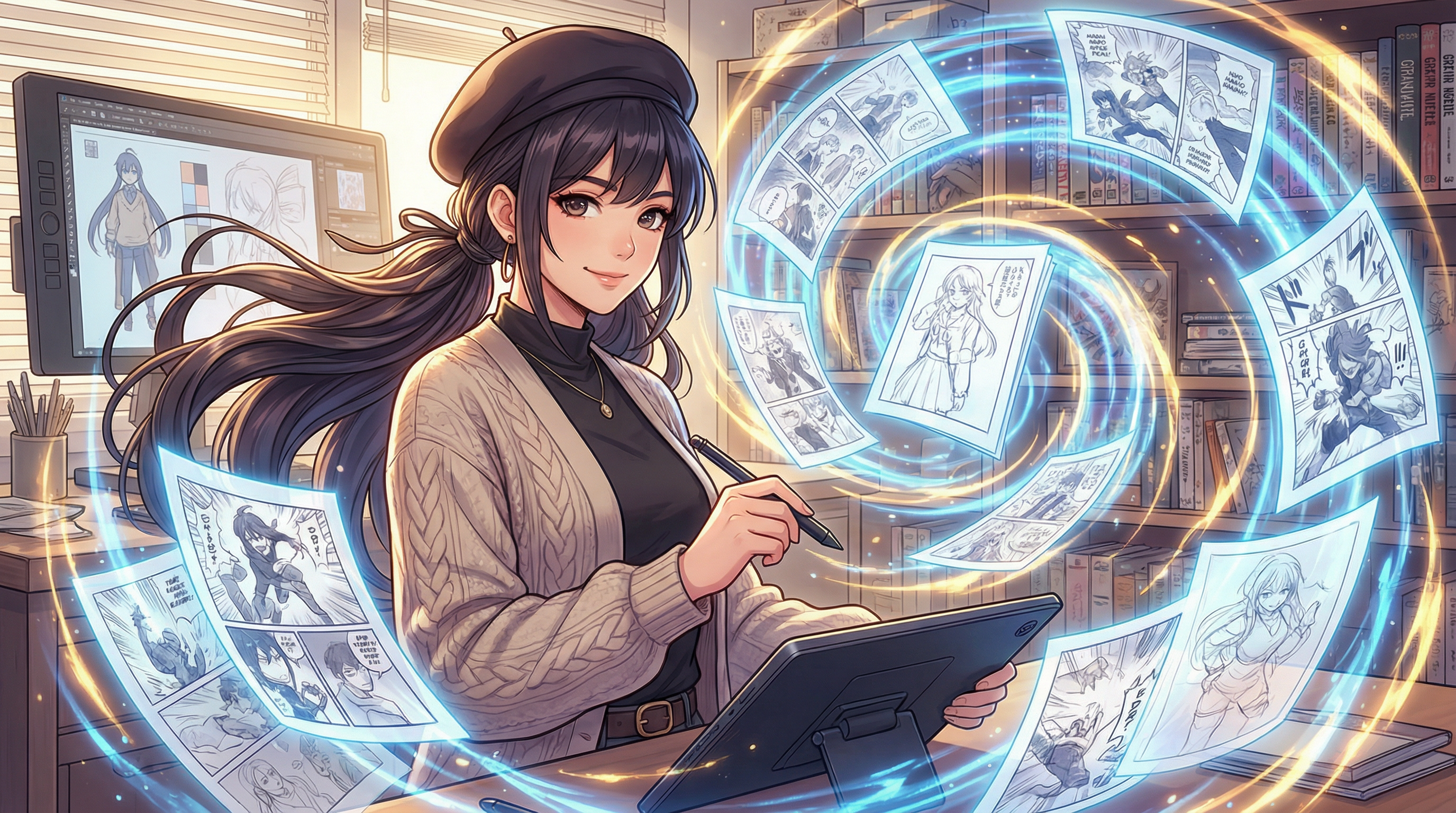
The manga maker AI has crossed from novelty into professional creative tool in 2026. The AI manga generator market was valued at USD 25.0 million in 2024 and is projected to reach USD 102.1 million by 2030, growing at a 27.50% CAGR (Research and Markets). Meanwhile, the broader manga market is expected to grow from USD 19.35 billion in 2025 to USD 56.38 billion by 2031 — a 19.52% CAGR (Mordor Intelligence). And international manga sales hit $1.92 billion in 2026, with non-Japanese markets now contributing 34% of total industry revenue — up from 22% in 2022 (Alibaba Product Insights).
The demand for manga content has never been higher. But the supply side remains brutally constrained — by artistic skill requirements, crushing production timelines, and costs that lock out independent creators. In January 2026, a fully AI-generated manga titled My Dear Wife, Will You Be My Lover? claimed the #1 spot on Japan's largest digital bookstore, Comic C'moA, outperforming established titles like Kingdom (CBR). The era of AI-assisted manga creation has arrived.
Jenova's Manga Creator is the manga maker AI built for this moment: a dedicated mangaka agent that handles the complete workflow from character design through 200+ page serialized epics — with five professional art style templates, a character reference sheet system for visual consistency, a plot memory engine for narrative continuity, and persistent project state tracking across sessions.
Quick Answer: What Is a Manga Maker AI?
A manga maker AI is specialized software that transforms text descriptions, scripts, or story concepts into professional manga pages — including character designs, panel layouts, screentone effects, dialogue placement, and authentic Japanese visual storytelling conventions — without requiring drawing skills.
- Character consistency across hundreds of pages using reference sheet architecture and identity embedding — Manga Creator handles this conversationally
- Five professional art style templates covering Shonen, Shoujo, Seinen, Slice-of-Life, and Chibi aesthetics
- Panel layout optimization with proper manga reading flow, page-turn reveals, and visual pacing
- Plot memory engine that maintains narrative continuity across long-form serialized projects
The Problem: Why Manga Creation Has Remained Out of Reach
Despite explosive global demand, aspiring manga creators face barriers that have historically excluded independent voices from the medium.
💰 The Prohibitive Cost of Professional Illustration
Hiring professional manga artists costs $50–$300 per page depending on complexity and detail level. A 200-page graphic novel could require $10,000–$60,000 in illustration costs alone — before considering editing, lettering, or printing (Jenova Research).
⏱️ The Crushing Time Investment
A single manga page can take a professional artist 4 to 10 hours — penciling, inking, toning, lettering, and composing panels. A 20-page chapter represents 80 to 200 hours of work. Many professional mangaka work alongside 2–7 assistants just to meet weekly serialization demands — resources unavailable to solo creators (Jenova Research). According to ScienceDirect research, manga work is "often demanding, involving challenging working hours, limited job security" and requires creators to function as "one-person studios."
🎨 The Multi-Skill Burden
Professional manga production demands simultaneous mastery of illustration fundamentals, sequential art, character design, background art, inking and toning, and lettering — a combination that takes years to develop. Meanwhile, Japan's domestic manga market contracted 1.7% in 2025 as publishers increased output by 6.5% to over 16,000 titles, squeezing per-title revenue and intensifying the pressure on creators (Jenova Research).
🔄 The Character Consistency Nightmare
Maintaining identical character appearances across hundreds of panels is one of manga's greatest technical challenges. As AI Magicx's 2026 guide noted: "The challenge is not generating a single good panel. It is generating dozens or hundreds of panels that look like they belong to the same comic — with consistent characters, consistent style, and appropriate compositions for the story being told."
This is exactly what the Manga Creator was built for.
Why Manga Creator Is the Manga Maker AI You Need
While general image generators like Midjourney produce stunning individual panels, they lack every feature necessary for manga production. According to Anifusion's 2026 comprehensive comparison, Midjourney has "no built-in character consistency (each panel generates different-looking characters), no panel layout tools, no speech bubbles or text integration, and a Discord-based interface not designed for comic workflows."
The Manga Creator takes a fundamentally different approach: it implements the same structured methodology used by professional mangaka, powered by AI execution.
| Feature | General Image Generator (e.g., Midjourney) | Manga Creator |
|---|---|---|
| Character consistency | ❌ Extremely difficult | ✅ Reference sheet system across 200+ pages |
| Panel layouts | ❌ Manual in external tools | ✅ Intelligent composition with reading flow |
| Speech bubbles & lettering | ❌ None | ✅ Integrated dialogue placement |
| Art style templates | ⚠️ Prompt-dependent | ✅ Five professional styles |
| Story continuity | ❌ None | ✅ Plot memory engine across sessions |
| Project state tracking | ❌ None | ✅ Persistent across sessions |
| Cost | $10–$60/month | Free to start |
How It Solves Each Pain Point
The Cost Barrier → Subscription Access. Instead of per-page artist fees, Jenova provides access to frontier AI models including GPT-5.4, Claude Opus 4.6, and Gemini 3.1 Pro Preview. Create as many iterations, variations, and complete pages as your project requires.
The Time Investment → Rapid Generation. What takes professional artists hours per panel, the manga maker AI generates in minutes. A full chapter (20–30 pages) typically takes a few hours to a day — enabling sustainable weekly production schedules that would otherwise require large teams.
The Multi-Skill Burden → Specialized AI Agents. The Manga Creator handles visual execution while you focus on storytelling. For narrative development, the Creative Fiction Writer helps craft compelling plots, character arcs, and dialogue before visual production begins.
The Character Consistency Problem → Reference Sheet Architecture. Before generating any story pages, you create character reference sheets showing each character in neutral poses with labeled features. These references load with every subsequent generation, ensuring visual consistency across your entire project. As Skywork's 2026 analysis noted, "A year or two ago, if you asked for the 'best AI character generator for consistent characters,' the honest answer would have been: 'None.' Now we have multiple excellent answers to that question."
Competitor Context
While tools like Dashtoon offer strong character consistency and a built-in publishing pipeline, they primarily lock free creators into publishing exclusively on their platform and are not optimized for traditional print manga (Anifusion). Midjourney produces the highest quality standalone illustrations but has zero manga-specific features — no panels, no speech bubbles, no story tracking, no character management (Skywork). Jenova's Manga Creator provides format specialization with multi-model access and no platform lock-in.
Related Agents You'll Also Like
Comic Creator — Western Comic Book Art
For creators blending manga influences with Western comic aesthetics:
- Bold Visual Style Templates: Superhero, Noir, Indie, Franco-Belgian, Cartoon, Realistic
- Character Reference Sheets for visual consistency across entire projects
- Dynamic panel layouts with authentic Western comic reading rhythm
Webtoon Creator — Mobile-First Vertical Storytelling
For creators publishing on LINE Webtoon, Tapas, or Lezhin:
- Vertical scroll rhythm optimization with strategic white space and "thumb stop" moments
- Platform-ready exports formatted for major webtoon platforms
- Full-color consistency across 100+ episodes
Creative Fiction Writer — Story Development Partner
Develop your narrative foundation before visual production begins:
- Research-backed worldbuilding and character development
- Polished dialogue that translates to manga scripts
- Editorial insight for pacing and narrative structure
Try the Manga Creator free — no credit card required.
How It Works: From Story Concept to Finished Manga
Step 1: Define Your Story and Characters
Start by describing your story concept, genre, and main characters to the Manga Creator. Choose from five professional art style templates — Shonen, Shoujo, Seinen, Slice-of-Life, or Chibi — each calibrated to match major manga traditions.
"I'm creating a shonen manga about a teenage girl who discovers she can manipulate gravity. The setting is a futuristic Tokyo. My main character, Yuki, has short black hair with a silver streak, wears a school uniform with a modified jacket, and has determined eyes. I want the art style to feel like a mix between My Hero Academia and Jujutsu Kaisen."
For complex narratives, use the Creative Fiction Writer to develop full character profiles, plot outlines, and scene breakdowns before visual production.
Step 2: Generate Character Reference Sheets
Before any story pages are created, the manga maker AI produces character reference sheets — front view, side view, 3/4 view, key expressions, and costume details. These references lock your characters' appearances for the entire project.
"Show Yuki in five expressions: determined, surprised, laughing, angry, and exhausted. Include her gravity manipulation visual effect — a purple glow around her hands."
The system uses identity embedding to create a mathematical "fingerprint" of each character, capturing facial structure, body proportions, distinctive characteristics, and clothing. This is the critical step that prevents the character inconsistency plaguing most AI art projects.
Step 3: Script Your Pages Panel by Panel
With characters established, provide your story direction for each page. The Manga Creator scripts the page based on your narrative, breaks content into panel-by-panel beats, writes dialogue matching each character's voice, and selects appropriate panel layouts based on narrative rhythm.
"Create a dramatic two-page spread: Yuki faces her rival across the rooftop of a futuristic skyscraper. Intense close-ups on both faces. Yuki's hands glow purple as debris begins to float around her. Her rival smirks. Final panel: wide shot showing the city below them as gravity warps the air between them."
Step 4: Generate, Iterate, and Refine
The AI generates each page with all character references loaded, then reviews output against quality criteria — character consistency, panel flow, and style adherence. Request adjustments to any element: composition, lighting, expression, dialogue placement, screentone density.
You can mix styles within a project — switching to chibi for comedic relief panels, then returning to seinen for dramatic sequences.
Step 5: Export and Publish
Export completed pages in formats optimized for your target platform — print-ready files for Amazon KDP, digital formats for online distribution, or platform-specific specifications for webtoon platforms.
Results & Use Cases
📚 Aspiring Mangaka Without Drawing Skills
Scenario: You've dreamed of creating manga but lack artistic training.
Traditional Approach: Years of art school or $10,000–$60,000 in professional artist commissions for a single graphic novel.
With the Manga Creator: Start with a one-shot to learn the workflow, then scale to serialized production. The AI handles visual execution while you focus on the story you've always wanted to tell. Character consistency is maintained automatically from page 1 to page 200.
📖 Novelists Visualizing Their Stories
Scenario: You've written a novel and want to create a manga adaptation.
Traditional Approach: Pitch to publishers, hope for adaptation rights, lose creative control.
With AI manga creation: Adapt your own work using the Creative Fiction Writer for script adaptation and the Manga Creator for visual production. Maintain complete creative ownership. The growing acceptance of AI manga — demonstrated by My Dear Wife, Will You Be My Lover? topping Japan's largest digital bookstore (CBR) — validates this path.
📱 Mobile-First Creators
Scenario: You want to publish on webtoon platforms like Tapas or LINE Webtoon.
Traditional Approach: Learn vertical scroll format conventions from scratch, produce weekly full-color episodes — a format that requires even more production time than traditional manga.
With Jenova: The Webtoon Creator specializes in mobile-optimized vertical storytelling with built-in episode hooks, scroll rhythm mapping, and platform-specific formatting for LINE Webtoon, Tapas, and Lezhin.
💼 Content Creators and Social Media
Scenario: You want manga-style content for social media, merchandise, or marketing.
Traditional Approach: Commission artists for each piece at $50–$300 per illustration, wait weeks for delivery.
With the manga maker AI: Generate consistent character art, reaction images, and short comic strips on-demand. The reference sheet system ensures your brand characters look identical across every piece of content.
🌍 International Creators Entering the Manga Market
Scenario: A non-Japanese creator wanting to participate in the global manga boom.
Non-Japanese markets now contribute 34% of total manga industry revenue — up from 22% in 2022 (Alibaba Product Insights). The broader anime manga industry exceeds $30 billion annually (Vitrina AI). With AI tools eliminating the traditional barriers of artistic training and production budgets, creators worldwide can participate in this explosive growth. Neon Genesis Evangelion creator Hideaki Anno stated that the industry has "no choice but to accept" AI technology, as it is too convenient to ignore (CBR).
FAQ
Do I need drawing skills to use a manga maker AI?
No. Manga maker AI tools are specifically designed for creators who have stories to tell but lack traditional artistic training. The Manga Creator is story-first — your creative vision and storytelling ability matter more than drawing skills. You direct the visual output through detailed text descriptions and iterative refinement; the AI handles all visual execution.
How does the AI maintain character consistency across hundreds of pages?
The Manga Creator uses a reference sheet architecture. Before generating story pages, you create character reference sheets showing each character in neutral poses with labeled features. These references load with every subsequent generation, ensuring visual consistency. Advanced systems use LoRA (Low-Rank Adaptation) training to create mathematical "fingerprints" of characters that persist across unlimited generations. As Anifusion's 2026 analysis confirmed, "specialized manga tools vastly outperform general AI art generators" on character consistency.
What manga styles can the AI generate?
The Manga Creator supports five professional art style templates: Shonen (bold lines, dynamic action, speed lines), Shoujo (soft lines, floral effects, emotional close-ups), Seinen (detailed anatomy, heavy shading, cinematic composition), Slice-of-Life (clean lines, warm expressions, cozy atmosphere), and Chibi/Comedy (super-deformed proportions, exaggerated reactions). You can mix styles within a project for different sequences.
Is AI-generated manga accepted by readers?
Growing evidence suggests increasing acceptance. In January 2026, an AI-generated manga titled My Dear Wife, Will You Be My Lover? topped Japan's largest digital bookstore rankings, outperforming established titles. Mob Psycho 100 manga editor Kazuaki Ishibashi observed that while creators are worried, "general readers seemed largely indifferent to the AI origins of the art as long as they are entertained."
Can I sell manga created with AI?
Jen](https://skywork.ai/skypage/en/ai-comic-generators/2031216161036009472): "A dedicated comic tool (like Jenova.ai) offers an end-to-end workflow. It includes features for story generation, panel layouts, character management, and dialogue integration. A general image generator like Midjourney only creates individual images." The Manga Creator handles the complete workflow — from character design sheets through publication-ready pages — with authentic manga conventions, persistent project memory, and five distinct style templates.
Conclusion
The manga market's trajectory — from USD 19.35 billion in 2025 to a projected USD 56.38 billion by 2031 (Mordor Intelligence) — represents one of the fastest-growing content markets in the world. International sales are surging, digital formats account for over 72% of consumption, and an AI-generated manga has already topped Japan's largest digital bookstore. The audience is massive, the distribution platforms are ready, and the only thing that was missing was an accessible creation tool.
What makes the Manga Creator different isn't just that it generates manga-style images — it's that it handles the complete workflow that professional mangaka follow: character reference sheets for visual consistency, five distinct art style templates, a plot memory engine for narrative continuity, and persistent project state tracking that remembers your characters, your story, and your creative direction across sessions.
The question is no longer "can I draw this?" It's "what story do I want to tell?"
Start with the Manga Creator for Japanese-style visual storytelling. Expand to the Comic Creator for Western formats or the Webtoon Creator for mobile-first vertical comics. Develop your narrative with the Creative Fiction Writer before visual production begins.
Explore the full agent library at Jenova.