AI Selfie Enhancer: Get Natural, Professional Results Without Losing Your Face (April 2026)
2026-04-07
In April 2026, the AI image enhancer market is valued at USD 2.83 billion and projected to reach USD 5.03 billion by 2030, growing at a 15.4% CAGR. Over 64% of social media users in Asia-Pacific actively use photo beautification apps, and 71% of social media images now involve AI tools in some form. AI selfie enhancement isn't a novelty — it's how the world presents itself online.
But the dominant approach to selfie enhancement — one-click filters that smooth, slim, and symmetrize every face toward the same algorithmic ideal — is breaking down. Audiences have developed sharp AI detection instincts, spotting synthetic skin textures and overly symmetrical compositions instantly. The 2026 trend is unmistakable: authenticity over perfection.
Jenova's Photo Editor takes a fundamentally different approach. Instead of applying a generic beautification filter, it enhances selfies through natural language conversation — you describe exactly what to improve and what to keep, with iterative refinement until the result looks like a better version of you, not a statistical average. Backed by the Beauty Consultant for personalized facial analysis and the Cosmetic Surgery Image Specialist for clinical-grade proportion evaluation, it's a complete selfie enhancement ecosystem.
Quick Answer: What Is an AI Selfie Enhancer?
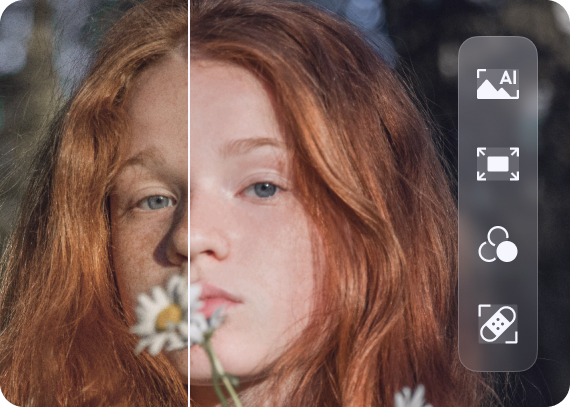
An AI selfie enhancer uses deep learning to improve portrait photos — smoothing skin, correcting lighting, removing blemishes, sharpening details, and refining facial features — while preserving the subject's natural identity. In 2026, the best AI selfie enhancers go beyond one-click filters to offer conversational, domain-aware enhancement.
- Professional selfie retouching — Photo Editor handles skin smoothing, blemish removal, lighting correction, and color grading while preserving natural texture
- Personalized beauty guidance — Beauty Consultant provides facial structure analysis and culturally fluent cosmetic direction
- Clinical facial evaluation — Cosmetic Surgery Image Specialist quantifies facial proportions with anatomical precision
- Multi-model flexibility — Access GPT-5.4, Claude Opus 4.6, Gemini 3.1 Pro Preview, and more — never locked into one model's aesthetic biases
The Problem With Generic AI Selfie Enhancers
The global photo editing software market is valued at USD 2.50 billion in 2026, with AI image editing recording 441% year-over-year growth in listings and traffic as the fastest-growing software category. But explosive growth has created a landscape where selfie enhancement tools optimize for engagement metrics rather than authentic results.
The Algorithmic Beauty Trap
Generic AI selfie enhancers don't enhance your face — they push every face toward the same statistical ideal. The adoption of AI-powered editing tools and AR filters has increased by 46%, enabling real-time visual enhancements at unprecedented scale. But as brand strategist Robin Albin warned in Beauty Independent: "AI beauty tools learn from engagement data... It's a runaway feedback loop with no human quarterback." The result is a homogenization of appearance that erases the features that make faces recognizable and human.
The Uncanny Valley Problem
"The Uncanny Valley is the sense of unease people feel when an image looks almost real but has 'off' proportions or lighting (typical of AI)." — Color Experts International, March 2026
Generic selfie enhancers smooth skin into a featureless, poreless surface — destroying the natural texture that makes faces look alive. The result reads as artificial rather than attractive. Meanwhile, approximately 32% of app developers are impacted by market saturation in the beautification space, and 29% of smartphone users express concerns over excessive storage and data usage by editing apps. Users cycle through selfie enhancement apps without finding one that consistently delivers natural-looking results.
The Authenticity Backlash
The defining consumer signal of 2026 is clear: in 2026, 78% of Americans reported using AI-powered tools, but they want AI that enhances rather than replaces their authentic appearance. As LTX Studio documented: "Images that look like authentic moments captured on a phone outperform pristine, artificial compositions across every engagement metric." Users don't want idealized reality — they want visuals that reflect genuine human experience.
This is exactly what Photo Editor was built for.
Why Photo Editor Is the Best AI Selfie Enhancer in 2026
While standalone selfie enhancement apps like Facetune, Remini, and BeautyPlus offer quick one-click filters, they approach enhancement as a single-purpose operation rather than a collaborative process. Jenova's Photo Editor treats selfie enhancement as a conversation — you describe what you want improved, what you want preserved, and how far to take each adjustment.
| Challenge | Generic Selfie Enhancers | Photo Editor Approach |
|---|---|---|
| Skin texture | Smooths everything into plastic porelessness | Preserves natural pores and texture while removing blemishes |
| Identity preservation | Pushes faces toward statistical averages | Maintains what makes each face unique |
| Creative control | One-click, take-it-or-leave-it | Conversational refinement — describe what you want |
| Consistency | Each edit is independent | Persistent cross-session memory retains your preferences |
| Model flexibility | Locked to one AI model | Multiple frontier models (GPT-5.4, Claude Opus 4.6, Gemini 3.1 Pro Preview) |
Conversational Enhancement, Not One-Click Filters
The core advantage of Photo Editor over every standalone selfie app is natural language control. Instead of sliding a "beauty" bar from 0 to 100, you describe exactly what you want:
"Smooth the skin on my forehead but keep my freckles. Brighten the under-eye area slightly. Don't change my jawline or nose shape at all."
"This is for my LinkedIn profile. Make the lighting more even, reduce the redness on my cheeks, and sharpen the eyes — but keep it looking natural, not retouched."
"Enhance this selfie for Instagram — I want the colors more vibrant and the background slightly blurred, but don't touch my facial features."
This level of granular control is impossible with one-click enhancers. You're not choosing between "enhanced" and "not enhanced" — you're directing a professional retoucher who understands the difference between a defining freckle and a distracting blemish.
Multi-Model Advantage for Selfie Enhancement
Because Jenova provides access to multiple frontier models — GPT-5.4, Claude Opus 4.6, Gemini 3.1 Pro Preview, plus models from xAI and DeepSeek — you're never locked into one model's aesthetic biases. This is critical for selfie enhancement: different models interpret "natural skin smoothing" differently, and having the ability to switch models means you can find the one that best matches your personal aesthetic.
Persistent Memory Across Sessions
Unlike standalone apps where every edit starts from scratch, the Photo Editor remembers your preferences across sessions. If you always want freckles preserved, under-eye circles reduced, and skin texture kept natural, those standards carry forward automatically. Your selfie enhancement becomes faster and more consistent over time.
Related Agents You'll Also Like
💄 Beauty Consultant
The Beauty Consultant provides personalized facial structure analysis and culturally fluent beauty guidance — the perfect complement to selfie enhancement. Upload a selfie and receive honest evaluation of your facial proportions, skin tone analysis, and recommendations for makeup, skincare, and cosmetic direction across global beauty traditions.
- Facial structure evaluation with proportion mapping
- Culturally fluent cosmetic direction (Parisian, Korean, Gulf, South Asian aesthetics)
- Skincare routine analysis and ingredient compatibility checks
🔬 Cosmetic Surgery Image Specialist
The Cosmetic Surgery Image Specialist provides clinical-grade facial proportion quantification — golden ratio, nasal projection, periorbital evaluation — plus procedure mock-ups. This addresses a real problem: patients bringing AI-beautified selfies to surgeons as reference, asking for results that aren't surgically possible because the AI composite doesn't follow actual anatomical constraints.
- Quantified facial proportion analysis (golden ratio, nasal projection)
- Procedure mock-ups for rhinoplasty, fillers, and other interventions
- Before/after layout formatting for clinical documentation
👗 Fashion Mockup Studio
For creators and brands who need selfie-quality portraits in commercial contexts, the Fashion Mockup Studio generates photorealistic on-model imagery for e-commerce, editorial, and campaign use — with studio-grade precision.
- Photorealistic fashion photography from garment descriptions
- Market-specific model archetypes for global audiences
- Studio-grade lighting and composition
How It Works: Enhancing a Selfie With Photo Editor
Step 1: Upload Your Selfie
Open a chat with Photo Editor and upload your selfie. The agent analyzes the image — identifying facial features, skin texture, lighting conditions, color balance, and any areas that could benefit from enhancement.
Step 2: Describe What You Want
Tell the agent exactly what to enhance and what to preserve. Be as specific or as general as you like:
"Make this look like a professional headshot. Even out the lighting, reduce the shine on my forehead, and sharpen my eyes. Keep everything else natural."
Step 3: Review and Refine
The Photo Editor returns your enhanced selfie. If you want adjustments — more smoothing, less smoothing, different color grading — describe the changes in natural language:
"The skin looks great, but can you bring back a bit more texture on my cheeks? And warm up the overall color temperature slightly."
Step 4: Download or Share
Once you're satisfied, download in your preferred format. Your enhancement preferences are saved automatically for future sessions — so next time, the agent already knows your standards.
Step 5: Get Deeper Analysis (Optional)
For users who want more than surface-level enhancement, bring in the Beauty Consultant using the @mention feature for personalized facial analysis, or the Cosmetic Surgery Image Specialist for clinical-grade proportion evaluation.
Results & Use Cases
📱 Social Media Selfie Enhancement
Scenario: You took a great selfie at golden hour, but the lighting is slightly uneven and there's a blemish on your chin.
Traditional Approach: Open Facetune, apply a generic "smooth" filter, hope it doesn't make your skin look plastic, manually adjust 6-8 sliders, export.
Jenova Solution: Upload to Photo Editor, say "even out the lighting, remove the blemish on my chin, keep my skin texture natural." Done in one message. The result looks like you on a good day — not like a different person.
💼 Professional Headshot Enhancement
Scenario: You need a polished LinkedIn headshot but can't afford a professional photographer and retoucher.
Traditional Approach: Use a generic AI enhancer that over-smooths your skin, makes your eyes unnaturally bright, and gives you the same "corporate AI headshot" look as everyone else.
Jenova Solution: Upload your best selfie to Photo Editor, describe "professional headshot style — even lighting, subtle skin smoothing, sharp eyes, neutral background blur." Follow up with the Beauty Consultant for guidance on which angles and expressions work best for your facial structure.
📊 Dating Profile Optimization
Scenario: You want your dating app photos to look their best without looking obviously filtered — because 82% of Americans support laws requiring disclosure of AI use, and authenticity builds trust.
Traditional Approach: Apply a beauty filter that makes you look 10 years younger and 20% more symmetrical. Match in person. Disappointment ensues.
Jenova Solution: Use Photo Editor for subtle, natural enhancement — "brighten the photo, reduce redness, sharpen slightly — but I want to look exactly like myself, just with better lighting." The Dating App Advisor can then evaluate which enhanced photos will perform best on specific platforms.
🛍️ Influencer & Content Creator Workflow
Scenario: You produce 20+ selfie-based posts per week and need consistent, on-brand enhancement across all of them.
Traditional Approach: Manually edit each photo in a standalone app, trying to remember your settings from last time, achieving inconsistent results.
Jenova Solution: The Photo Editor remembers your brand aesthetic across sessions — warm tones, natural skin, sharp eyes, soft background. Every selfie gets the same treatment automatically. Pair with the Social Media Content Generator for platform-native captions.
FAQ
How does an AI selfie enhancer work in 2026?
AI selfie enhancers use deep learning models trained on millions of professionally edited portraits to analyze skin texture, facial structure, lighting, and color balance — then apply targeted enhancements. Modern tools handle skin smoothing, blemish removal, eye enhancement, color correction, and facial feature refinement. Jenova's Photo Editor adds domain expertise and conversational control — you describe exactly what to enhance and what to preserve, with iterative refinement until the result matches your vision.
Can AI selfie enhancers make photos look worse?
Yes. As Color Experts International documented, AI beautification routinely creates the "uncanny valley" effect — images that look almost real but have "off" proportions or lighting. Generic enhancers smooth skin into a featureless surface, destroy natural texture, and push faces toward algorithmic ideals. The fix isn't avoiding AI — it's using a tool that lets you control the level of enhancement through conversation, which is why Jenova's Photo Editor outperforms one-click filters.
What's the difference between Jenova and Remini or Facetune?
Standalone apps like Remini and Facetune offer a single set of filters with limited context awareness — the same beautification logic applied to every face. Jenova provides specialized AI agents with domain expertise, multi-model access (GPT-5.4, Claude Opus 4.6, Gemini 3.1 Pro Preview), persistent memory across sessions, and conversational refinement. It's the difference between a filter that pushes every face toward the same ideal and a professional retoucher who understands your specific face and remembers your preferences.
How much does Jenova cost for selfie enhancement?
Jenova offers a free tier with all core features and limited usage. Paid plans start at $20/month (Plus) with 30× the usage of the free tier and custom model selection. Premium ($50/mo), Pro ($100/mo), and higher tiers scale usage further. Every visual agent — from the Photo Editor to the Beauty Consultant — is accessible on every plan. No credit card required to start.
Is AI selfie enhancement ethical?
The ethics depend on intent and degree. Subtle enhancement — evening out lighting, removing a temporary blemish, correcting color balance — is the digital equivalent of good lighting and flattering angles. The problem arises when enhancement fundamentally alters identity, creating unrealistic expectations. Jenova's conversational approach puts you in control of exactly how much enhancement to apply, and the Beauty Consultant provides honest, anatomically grounded evaluation rather than pushing toward algorithmic ideals.
How big is the AI selfie enhancement market?
The AI Image Enhancer Market is valued at USD 2.83 billion in 2026 and projected to reach USD 5.03 billion by 2030 at a 15.4% CAGR. The broader AI photo editors market reached $2.1 billion in 2024 and is expected to grow to $8.9 billion by 2034 at a 15.7% CAGR. The photo editing app market alone is estimated at USD 1.18 billion in 2026.
Conclusion
AI selfie enhancement in 2026 is a multi-billion-dollar market because everyone with a smartphone and a social media account wants to look their best in photos. But the industry's dominant approach — one-click filters that push every face toward the same algorithmic ideal — is failing. Audiences spot synthetic skin textures instantly. The 2026 trend is unmistakable: authenticity over perfection, human texture over synthetic smoothness, and AI working as a collaborator rather than a replacement for human judgment.
Jenova's Photo Editor eliminates the uncanny valley problem with conversational enhancement — you describe what to improve and what to keep, with iterative refinement until the result looks like a better version of you. The Beauty Consultant adds personalized facial analysis for users who want culturally fluent beauty guidance. And the Cosmetic Surgery Image Specialist provides clinical-grade proportion evaluation for anyone seeking anatomically honest assessment.
Try Photo Editor free — no credit card required. Explore more at Jenova.