AI Image Beautifier: Enhance Photos Naturally With AI (April 2026)
2026-04-06
In April 2026, AI image beautification has become one of the most widely used categories of mobile and cloud-based software on the planet. The global Picture Beautification App Market is valued at USD 1.66 billion in 2026 and is projected to reach USD 7.06 billion by 2035, expanding at a 14.8% CAGR — with over 64% of social media users in Asia-Pacific countries actively using photo-editing or beautification apps. Whether you're polishing a selfie for Instagram, enhancing a LinkedIn headshot, retouching product photos for your online store, or preparing marketing visuals for a campaign, AI image beautification is now embedded in how the world presents itself visually.
But here's the tension the industry is grappling with in 2026: the more AI beautifies, the less human the results look. As Beauty Independent documented in their survey of 13 beauty and AI executives, AI beautification tools are creating "a statistical amalgamation of features optimized to maximize dopamine hits" — composites of algorithmic perfection that aren't based on any real person's face. The result sits in the uncanny valley: technically flawless but emotionally hollow. Brand strategist Robin Albin warned that we're moving from "here's what beautiful looks like" to "here's what you could look like if you were beautiful according to algorithm X trained on dataset Y."
Jenova takes a fundamentally different approach to image beautification. Instead of one-click filters that push every face toward the same statistical average, it offers specialized AI agents that understand the difference between enhancement and erasure: Photo Editor for professional retouching that preserves natural texture, Beauty Consultant for personalized facial analysis and culturally fluent beauty guidance, Cosmetic Surgery Image Specialist for clinical-grade facial proportion evaluation, and Fashion Mockup Studio for photorealistic commercial imagery.
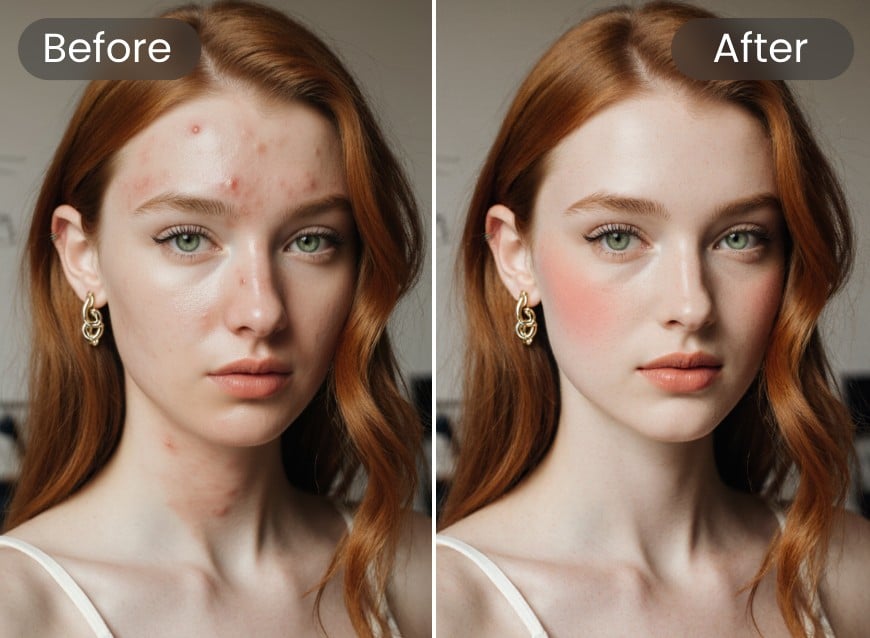
Quick Answer: What Is an AI Image Beautifier?
An AI image beautifier uses deep learning to enhance photographs — smoothing skin, removing blemishes, correcting lighting, improving color balance, and refining facial features — while ideally preserving the subject's natural appearance and identity. In 2026, the best AI image beautifiers go beyond one-click filters to offer domain-aware, iterative enhancement through natural language conversation.
- Professional photo beautification — Photo Editor handles skin smoothing, blemish removal, lighting correction, and color grading with natural texture preservation
- Personalized beauty analysis — Beauty Consultant provides facial structure evaluation and culturally fluent cosmetic direction
- Clinical facial evaluation — Cosmetic Surgery Image Specialist quantifies facial proportions and generates procedure mock-ups
- Commercial visual production — Fashion Mockup Studio creates photorealistic on-model imagery for e-commerce and editorial
The Problem With Generic AI Image Beautifiers
The picture beautification app market is growing at a 14.8% CAGR toward USD 7.06 billion by 2035, driven by selfie culture, influencer marketing, and the explosion of visual content across social platforms. The adoption of AI-powered editing tools and AR filters has increased by 46%, enabling real-time visual enhancements at unprecedented scale. But rapid growth has created a landscape where beautification tools optimize for engagement metrics rather than authentic enhancement — and the consequences are becoming impossible to ignore.
The Algorithmic Beauty Trap
"AI beauty tools learn from engagement data. The more people use filters that slim faces, enlarge eyes, smooth skin to porcelain, the more the algorithm decides 'this is what people want to look like,' and it generates more of it. Cosmetic procedures chase the AI aesthetic. Then AI trains on those procedures. The standards get more extreme. It's a runaway feedback loop with no human quarterback." — Robin Albin, Beauty Independent
Generic AI beautifiers don't enhance your face — they push every face toward the same statistical ideal. The result is a homogenization of appearance that erases the very features that make faces recognizable and human. As Dominica Baird, Department Chair at Savannah College of Art and Design, observed: "Younger consumers are far more skeptical of AI than many brands assume. In conversations with Gen Z, there is clear frustration with how brands are currently using AI, particularly in advertising."
The Uncanny Valley of Beautified Skin
As Color Experts International documented in March 2026, "The Uncanny Valley is the sense of unease people feel when an image looks almost real but has 'off' proportions or lighting (typical of AI)." Generic beautifiers smooth skin into a featureless, poreless surface — destroying the natural texture that makes faces look alive. The result reads as artificial rather than attractive: technically cleaner but emotionally disconnected.
The Authenticity Backlash
The defining trend of 2026 in AI imagery is the backlash against "too perfect" visuals. As LTX Studio documented: "Audiences have developed sharp AI detection instincts — spotting synthetic skin textures, impossible lighting, and overly symmetrical compositions instantly." The response across the creative industry is clear: "Images that look like authentic moments captured on a phone outperform pristine, artificial compositions across every engagement metric." Users don't want idealized reality — they want visuals that reflect genuine human experience.
Market Saturation and Tool Fatigue
Approximately 32% of app developers are impacted by market saturation in the beautification space, making it challenging for users to find tools that deliver genuine quality rather than recycled filters. Meanwhile, 29% of smartphone users express concerns over excessive storage and data usage by editing apps, reducing long-term engagement. The result: users cycle through beautification apps without finding one that consistently delivers natural-looking results.
The Jenova Solution: Domain-Expert AI Agents for Image Beautification
Instead of applying one generic beautification filter to every face, Jenova provides specialized AI agents — each with deep understanding of the visual conventions, quality standards, and common failure modes of their specific domain.
| Challenge | Generic AI Beautifiers | Jenova's Agent Approach |
|---|---|---|
| Skin texture | Smooths everything into plastic porelessness | Domain-aware agents preserve natural pores and texture |
| Identity preservation | Pushes faces toward statistical averages | Agents maintain what makes each face unique |
| Cultural awareness | One beauty standard for all users | Culturally fluent guidance across global aesthetics |
| Creative control | One-click, take-it-or-leave-it | Conversational refinement — describe what you want |
| Consistency at scale | Each edit is independent | Persistent cross-session memory retains your style |
| Model flexibility | Locked to one AI model | Multiple frontier models (GPT-5.4, Claude Opus 4.6, Gemini 3.1 Pro Preview) |
📸 Professional Photo Beautification
The Photo Editor provides professional retouching and beautification for portraits, products, and marketing visuals — understanding the critical difference between enhancement and erasure. Unlike one-click beautifiers that apply uniform smoothing, it understands skin texture preservation, lighting correction, blemish removal, and color grading at a professional level. Conversational refinement means you describe what you want — and what you want kept — in natural language.
💄 Personalized Beauty Analysis
The Beauty Consultant provides facial structure analysis, culturally fluent makeup direction, skincare routine ingredient checks, and cosmetic procedure candidacy based on aesthetic medicine methodology. For users who want to understand why certain enhancements work — not just apply a filter — this agent provides personalized guidance across Parisian, Korean, Gulf, and South Asian beauty traditions.
🔬 Clinical Facial Evaluation
The Cosmetic Surgery Image Specialist provides clinical-grade facial photo analysis with quantified facial proportions — golden ratio, nasal projection, periorbital evaluation, aging pattern mapping — plus procedure mock-ups and before/after layout formatting. For users who need precise facial measurement rather than subjective beautification, this agent understands facial anatomy, not just pixel patterns.
🎨 Marketing and Brand Visual Enhancement
The Graphic Designer handles branding, social media graphics, marketing materials, and print design — beautifying and enhancing visuals while maintaining brand consistency. The Marketing Visual Designer creates and enhances campaign-ready assets with understanding of visual hierarchy and platform-specific formatting.
This is exactly what Jenova was built for — specialized depth where generic tools fall short. Try any visual agent free — no credit card required.
Specialized AI Agents for Image Beautification
Photo Editor
Professional retouching and beautification for portraits, products, and landscapes — with domain-aware processing that preserves natural texture and authentic detail.
- Skin smoothing that maintains pores and natural imperfections instead of the "plastic skin" effect
- Blemish removal that distinguishes between a temporary pimple and a defining freckle
- Iterative refinement through natural language — describe what you want beautified, not which slider to move
Beauty Consultant
Personalized facial analysis and culturally fluent beauty guidance for portrait optimization — understanding why certain enhancements work before you apply them.
- Facial proportion evaluation with personalized enhancement recommendations
- Makeup direction, skincare analysis, and cosmetic procedure candidacy assessment
- Cultural fluency across global beauty standards — from Korean glass-skin aesthetics to Gulf modesty-forward styling
Cosmetic Surgery Image Specialist
Clinical-grade facial photo analysis built on aesthetic medicine methodology — for users who need precise measurement rather than subjective beautification.
- Quantified facial proportions: golden ratio analysis, nasal projection, periorbital evaluation, aging pattern mapping
- Procedure mock-ups for rhinoplasty, fillers, and other aesthetic interventions
- Before/after layout formatting and post-op healing tracking with complication flagging
Fashion Mockup Studio
Photorealistic on-model fashion photography for e-commerce, editorial, and campaign use — when image beautification extends into commercial visual production.
- Studio-grade imagery from garment photos with market-specific model archetypes
- Western, Korean, Japanese, Chinese, and Middle Eastern audience targeting
- Eliminates expensive photoshoots while maintaining catalog-quality output
Marketing Visual Designer
Campaign-ready visual creation and enhancement for logos, social media imagery, digital ads, and brand collateral.
- Platform-optimized visuals for Instagram, LinkedIn, Facebook, and display ads
- Brand guideline consistency across campaigns with persistent memory
- Multiple variations for A/B testing generated in minutes
How It Works: From Raw Photo to Naturally Beautiful Result
The key shift in AI image beautification in 2026 is that authenticity outperforms perfection. As LTX Studio documented, "AI is most powerful when it amplifies human vision, not when it tries to replicate perfection." Jenova's agents are built for exactly this — you provide the creative direction, the agent handles the technical execution while preserving what makes the image genuinely yours.
1. Choose the right specialist. Browse Jenova's agent gallery and select the agent that matches your task — portrait beautification, beauty analysis, marketing visual enhancement, or clinical facial evaluation.
2. Upload and describe your beautification goal. Use natural language to explain what you want. The agent understands context, not just pixels:
"Beautify this headshot for my LinkedIn profile. Smooth the skin slightly but keep it looking natural — I want to see pores and texture, not a filter face. Remove the blemish on my left cheek, brighten my eyes subtly, and correct the slightly warm color cast from the indoor lighting. Don't change my face shape or features."
3. Iterate conversationally. Unlike upload-download-reupload workflows, Jenova agents remember your full conversation. Refine with natural language:
"The skin smoothing is slightly too aggressive around the forehead — can you preserve more natural texture there? The eye brightening looks great but the teeth whitening went too far. Dial it back to look natural."
4. Apply domain-specific expertise. Each agent brings specialized knowledge. The Photo Editor understands the difference between a portrait that needs subtle skin texture preservation and a product photo that benefits from enhanced material clarity. The Beauty Consultant understands facial anatomy and cultural beauty standards. The Cosmetic Surgery Image Specialist quantifies proportions using aesthetic medicine methodology.
5. Build persistent preferences. Jenova's cross-session memory means your beautification standards, preferred enhancement levels, and visual preferences carry forward. The next time you need a photo beautified, the agent already knows your requirements — no re-explaining your style.
Results & Use Cases
📊 Social Media Content Enhancement
Scenario: A content creator needs to beautify and enhance 40 portrait photos per month for Instagram, LinkedIn, and TikTok — natural-looking enhancement that maintains their recognizable personal brand without the "filter face" look.
Traditional approach: Spend 45-90 minutes per image using Facetune, Lightroom, and Photoshop. Total: 30-60 hours per month.
Jenova solution: The Photo Editor handles portrait beautification with natural texture preservation — the defining difference between professional enhancement and the uncanny valley effect that plagues generic beautifiers. The Beauty Consultant provides facial structure analysis and culturally fluent enhancement guidance. Persistent memory ensures consistent style across all 40 images — no drift, no re-explaining your aesthetic.
💼 Professional Headshot Beautification
Scenario: A company needs to beautify headshots for 150 employees — consistent professional quality, subtle enhancement, but each person must still look unmistakably like themselves.
Traditional approach: Hire a retoucher at $5-$15 per image. Timeline: 1-2 weeks. Total: $750-$2,250.
Jenova solution: The Photo Editor beautifies real photographs — not fabricating new faces, but enhancing actual portraits. Skin smoothing that preserves natural texture. Blemish removal that keeps defining features. Consistent color grading and background treatment across all 150 images. The result looks polished without looking fabricated. As Beauty Independent reported, the industry is shifting toward "real people, real skin and real conditions front and center" — and Jenova's approach aligns with this standard.
📱 E-Commerce Product Image Beautification
Scenario: An online retailer needs to beautify 300 product images — correcting lighting inconsistencies, enhancing color accuracy, and ensuring professional presentation across the catalog.
Traditional approach: Hire a retouching team or outsource at $3-$10 per image. Timeline: 1-2 weeks. Cost: $900-$3,000.
Jenova solution: The Photo Editor beautifies each image with domain-aware processing that preserves material texture — exactly the failure mode that generic beautifiers get wrong on fabric, metallic finishes, and transparent objects. The Graphic Designer adapts beautified images for different marketplace specifications. Persistent memory maintains consistency across the entire catalog.
👗 Fashion and Beauty Campaign Imagery
Scenario: A fashion brand needs photorealistic on-model imagery for 100 new SKUs across three target markets — Western, Korean, and Middle Eastern audiences — with natural-looking beautification that avoids the uncanny valley.
Traditional approach: Hire photographers, book studios, coordinate models for each market. Timeline: 3-4 weeks. Cost: $15,000-$50,000+.
Jenova solution: The Fashion Mockup Studio generates studio-grade imagery from garment photos with market-specific model archetypes. The Photo Editor handles final beautification to ensure catalog-quality output. The Beauty Consultant provides culturally fluent guidance on enhancement standards for each target market — because what reads as "beautifully natural" in Seoul differs from Paris differs from Dubai.
🔬 Aesthetic Medicine Consultation
Scenario: A cosmetic dermatology practice needs to analyze patient photos with quantified facial proportions and generate procedure visualizations — going beyond subjective beautification into clinical measurement.
Traditional approach: Manual measurement using specialized software. Inconsistent across practitioners. Time-intensive.
Jenova solution: The Cosmetic Surgery Image Specialist provides clinical photo analysis with facial proportion quantification — golden ratio, nasal projection, periorbital evaluation, aging pattern mapping — plus procedure mock-ups for rhinoplasty, fillers, and other interventions. This addresses the problem Beauty Independent identified: patients bringing AI-beautified images to surgeons as reference, "asking for results that aren't surgically possible because the AI composite doesn't follow actual anatomical constraints." Clinical-grade analysis provides honest, anatomically grounded evaluation.
Competitor Comparison: Where Jenova Differs
While standalone beautification apps like Facetune, Remini, and BeautyPlus offer quick one-click enhancement, they approach beautification as a single-purpose filter rather than a collaborative process. As LTX Studio's March 2026 analysis documented, the defining trend of 2026 is that "AI is most powerful when it amplifies human vision, not when it tries to replicate perfection." Generic beautifiers do the opposite — they replace human judgment with algorithmic averages.
Jenova's advantage is specialization with unified access. Each visual agent carries deep domain knowledge — a photo editor that understands the difference between a defining freckle and a distracting blemish, a beauty consultant that knows culturally fluent cosmetic direction across global traditions, a cosmetic specialist that quantifies facial proportions rather than guessing. And because Jenova provides access to multiple frontier models (GPT-5.4, Claude Opus 4.6, Gemini 3.1 Pro Preview, plus models from xAI and DeepSeek), you're never locked into one model's aesthetic biases — a critical advantage when the goal is preserving what makes each face unique rather than normalizing toward a statistical average. Persistent cross-session memory means your beautification standards carry forward automatically — something no standalone beautification app offers.
FAQ
How does an AI image beautifier work in 2026?
AI image beautifiers use deep learning models trained on millions of professionally edited images to analyze skin texture, facial structure, lighting, and color balance — then apply targeted enhancements. Modern tools handle skin smoothing, blemish removal, eye enhancement, color correction, and facial feature refinement. Jenova's agents add domain expertise and conversational control on top of this — the Photo Editor understands which details to preserve versus enhance based on the image type and your specific instructions.
Can AI image beautifiers make photos look worse?
Yes. As Color Experts International documented, AI beautification routinely creates the "uncanny valley" effect — images that look almost real but have "off" proportions or lighting. Beauty Independent confirmed that AI beautifiers create "a runaway feedback loop" that pushes beauty standards toward impossible algorithmic ideals. The fix isn't avoiding AI — it's using a tool that lets you control the level of beautification, which is why Jenova's conversational agents outperform one-click beautification filters.
What's the best AI image beautifier for natural-looking results?
Natural results require understanding the difference between enhancement and erasure. Generic beautifiers normalize expressions, smooth away defining features, and create the uncanny valley effect. Jenova's Photo Editor handles beautification through natural language conversation — you describe exactly what to enhance and what to keep, with iterative refinement until the result looks like a better version of you, not a statistical average. The Beauty Consultant adds personalized facial analysis for users who want culturally fluent enhancement guidance.
How much does Jenova cost for image beautification?
Jenova offers a free tier with all core features and limited usage. Paid plans start at $20/month (Plus) with 30× the usage of the free tier and custom model selection. Premium ($50/mo), Pro ($100/mo), and higher tiers scale usage further. Every visual agent — from the Photo Editor to the Beauty Consultant — is accessible on every plan.
How big is the AI image beautification market?
The global Picture Beautification App Market is valued at USD 1.66 billion in 2026 and is projected to reach USD 7.06 billion by 2035 at a 14.8% CAGR. The broader AI in Beauty and Cosmetics market is projected to reach USD 16.4 billion by 2033 at a 19.8% CAGR. The adoption of AI-powered editing tools has increased by 46%, and over 64% of social media users in Asia-Pacific actively use photo beautification apps.
What's the difference between Jenova and standalone AI beautification apps?
Standalone beautification apps like Facetune or BeautyPlus offer a single set of filters with limited context awareness — the same beautification logic applied to every face. Jenova provides an ecosystem of specialized visual agents — each with domain expertise — plus multi-model access, persistent memory across sessions, tool integrations (Gmail, Drive, Notion), and conversational refinement. It's the difference between a filter that pushes every face toward the same ideal and a team of visual specialists who understand your specific face, your cultural context, and your personal aesthetic — and remember your preferences across sessions.
Conclusion
AI image beautification in 2026 is a $1.66 billion market growing at double-digit rates — because everyone with a camera, a social media account, or a professional profile wants to look their best in photos. But as the industry has matured, the limitations of generic, one-click beautification have become painfully clear. As Beauty Independent documented, AI beautifiers are creating "a runaway feedback loop" that pushes faces toward impossible algorithmic ideals — and the 2026 trend is unmistakable: authenticity over perfection, human texture over synthetic smoothness, and AI working as a collaborator rather than a replacement for human judgment.
Jenova eliminates these failure modes with specialized AI agents that understand their domains deeply. The Photo Editor for professional beautification that preserves natural texture and authentic identity. The Beauty Consultant for personalized facial analysis and culturally fluent beauty guidance. The Cosmetic Surgery Image Specialist for clinical-grade facial proportion evaluation. The Fashion Mockup Studio for photorealistic commercial imagery. Each agent brings the expertise of a specialist, accessible through natural conversation, with persistent memory that learns your standards over time.
Try any visual agent now — explore the full agent library at Jenova.