AI Comic Page Generator: Create Complete Pages with Consistent Characters (March 2026)
2026-03-26
In March 2026, the AI comic page generator has become the central production tool in a market experiencing explosive growth. The global AI comic generator market reached USD 33 billion in 2025 and is projected to hit USD 271.06 billion by 2035 at a 23.44% CAGR (Precedence Research). Meanwhile, 61% of digital artists now adopt AI tools in their workflows, and 57% of comic publishers integrate AI automation for production tasks like background rendering, coloring, and page layout (Business Research Insights).
Jenova's Comic Creator represents the page-first approach to AI comic production — a dedicated agent that generates complete, publication-ready comic pages with multi-panel layouts, consistent characters, integrated dialogue, and dynamic backgrounds in a single conversational workflow. It's backed by format-specialized agents for manga and webtoons, covering every major visual storytelling format.
Quick Answer: What Is an AI Comic Page Generator?
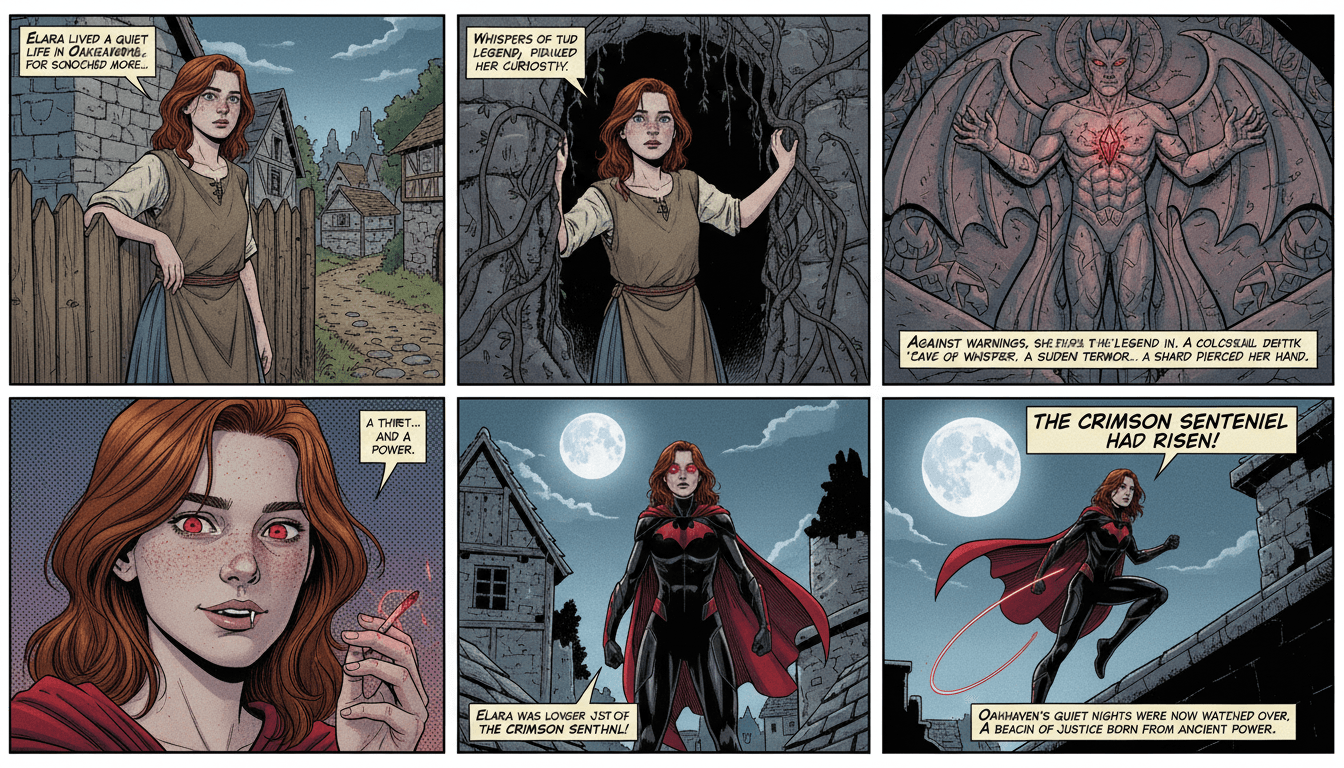
An AI comic page generator is a specialized tool that creates complete comic pages — including panel layouts, character art, backgrounds, dialogue placement, and visual pacing — from text descriptions, transforming story concepts into publication-ready pages without requiring drawing skills.
- Complete page composition with varied panel sizes, gutters, and visual flow — the Comic Creator handles this automatically
- Character consistency maintaining identical appearances across every panel on every page via reference sheet architecture
- Integrated dialogue with speech bubbles, thought bubbles, narration boxes, and sound effects placed within generated panels
- Dynamic panel layouts that adapt to narrative needs — splash pages for dramatic moments, tight grids for rapid action, wide panels for establishing shots
The Problem: Why Complete Comic Pages Have Been So Hard to Generate
Despite the explosion of AI image generators in 2026, creating a complete comic page — not just individual panels, but a fully composed page with layout, characters, backgrounds, dialogue, and visual flow — remains the central production challenge for independent creators.
📐 A Comic Page Is Not a Collection of Images
A comic page is a sophisticated visual instrument. It requires simultaneous mastery of panel layout and composition, character consistency across every frame, background integration with proper perspective, dialogue placement that guides reading flow, and visual pacing that controls narrative rhythm. As AI Magicx's 2026 guide documented:
"The challenge is not generating a single good panel. It is generating dozens or hundreds of panels that look like they belong to the same comic — with consistent characters, consistent style, and appropriate compositions for the story being told." — AI Magicx
💰 Prohibitive Cost of Professional Page Production
Professional comic illustration costs $50–$300 per page, with complex full-color pages at the top of that range. A standard 22-page comic issue runs $1,100–$6,600 for artwork alone (LlamaGen). A complete graphic novel can demand $5,000–$30,000 in illustration costs before editing, lettering, or printing. Average creator pay in the industry sits at approximately $200 per page (Gitnux).
⏱️ The Time Investment Per Page
A single manga page can take a professional artist 4 to 10 hours — penciling, inking, toning, lettering, and composing panels. A 20-page chapter represents 80 to 200 hours of work. — AI Magicx
For independent creators working part-time, completing a single 22-page issue — the standard page count for US comic periodicals (Gitnux) — can take months.
🔄 The Multi-Tool Fragmentation Problem
In 2026, creating a comic page with general-purpose AI tools typically requires cobbling together separate applications: one for generating individual panel images (Midjourney, Stable Diffusion), one for assembling panels into page layouts (Canva, Photoshop), one for adding speech bubbles and lettering (Clip Studio Paint), and one for managing character consistency across it all. As COMICPAD's March 2026 benchmark confirmed, Midjourney — the highest-rated tool for raw image quality — has "no panels, speech bubbles, lettering, or page assembly" (COMICPAD). Each tool has its own subscription, learning curve, and limitations — and none share character profiles or story state.
This is exactly what the Comic Creator was built for.
Why Comic Creator Is the Best AI Comic Page Generator
While general-purpose image generators produce individual images that you must manually assemble, the Comic Creator generates complete comic pages — panels, characters, backgrounds, dialogue, and layout — in a single conversational workflow. As Skywork's 2026 guide documented, the industry has shifted from general-purpose tools to specialized workflows where "a dedicated comic tool (like Dashtoon or Jenova.ai) offers an end-to-end workflow" including "story generation, panel layouts, character management, and dialogue integration" (Skywork).
While tools like Midjourney produce the highest raw image quality for individual panels, they require manual assembly in separate software — a process that takes 2–4 hours for a 10-page comic (COMICPAD). The Comic Creator compresses this entire pipeline into minutes.
| Page Production Challenge | Fragmented Tool Approach | Comic Creator Solution |
|---|---|---|
| Panel layout | Manual in Canva/Photoshop | Automatic, narrative-aware layouts |
| Character consistency | Manual tracking or LoRA training | Automated reference sheet system |
| Backgrounds | Generated separately, composited manually | Integrated with characters in each panel |
| Dialogue | Added manually in Clip Studio/Photoshop | Generated and placed within panels |
| Visual pacing | Creator must design manually | AI understands panel size and story beats |
| Project memory | No cross-session tracking | Persistent state across sessions |
| Cost | Multiple subscriptions ($30–$60+/month) | Single subscription |
How Complete Page Generation Actually Works
The Comic Creator uses a unified page generation architecture that treats each page as a complete narrative unit — not a collection of separate images stitched together:
1. Character Reference System: Before generating story pages, you create character reference sheets showing each character in neutral poses and key expressions. These references are loaded with every subsequent page generation, ensuring visual consistency across your entire project — even across 200+ pages.
2. Narrative-Aware Panel Layouts: The AI understands comic page grammar. It varies panel sizes based on narrative importance — large panels for dramatic reveals, tight panels for rapid dialogue, full-page splashes for climactic moments. Panel flow follows proper reading direction with appropriate gutters and framing.
3. Integrated Scene Composition: Characters and backgrounds are generated together within each panel — not composited separately. This ensures natural integration where characters cast appropriate shadows, interact with scene elements, and maintain proper scale and perspective.
4. Dialogue Integration: Speech bubbles, thought bubbles, narration boxes, and sound effects are generated as part of the page — positioned to guide reading flow without obscuring critical art.
Six Professional Style Templates
| Template | Best For | Page Signature |
|---|---|---|
| Superhero | Action-heavy, dynamic pages | Bold colors, dramatic panel breaks, power effects |
| Noir | Mystery, crime, atmospheric drama | Heavy shadows, limited palette, cinematic compositions |
| Indie | Character-driven, literary stories | Expressive linework, muted tones, intimate layouts |
| Franco-Belgian | Adventure, historical, detailed worlds | Rich environments, clear-line art, architectural detail |
| Cartoon | Comedy, all-ages, educational | Bright colors, exaggerated expressions, clean layouts |
| Realistic | Grounded drama, biographical | Detailed anatomy, photographic lighting, textured pages |
Example Page Prompts
Here's what working with the Comic Creator for page generation actually looks like:
"Generate a 6-panel page in Noir style: Panel 1 (wide establishing shot) — Rain-drenched waterfront at night, a lone figure walking toward a warehouse. Panel 2 (medium shot) — Detective Vasquez pushes open the warehouse door, gun drawn. Panel 3 (close-up) — Her eyes adjusting to the darkness, expression shifting from caution to recognition. Panel 4 (wide interior) — The warehouse is empty except for a single chair under a hanging bulb. Panel 5 (medium shot) — Vasquez approaches the chair, notices something on the seat. Panel 6 (extreme close-up) — A photograph face-down on the chair. Vasquez's hand reaching for it. Dialogue in Panel 2: 'NYPD. Don't move.' Narration box in Panel 1: 'The tip said midnight. It was 12:03.'"
"Create a full-page splash in Superhero style: The hero stands atop a crumbling skyscraper, cape billowing, city burning below. Lightning splits the sky behind them. The villain hovers in the distance, silhouetted against the storm. Title text at the top: 'ISSUE #7: THE FALL.' No dialogue — let the image carry the weight."
"Generate a 5-panel page in Indie style: A quiet morning routine. Panel 1 — Alarm clock showing 6:47 AM. Panel 2 — Maya's hand reaching to turn it off, face half-buried in pillow. Panel 3 — Standing at the kitchen counter, coffee brewing, staring out the window at rain. Panel 4 — Sitting at the table, coffee cup in both hands, expression contemplative. Panel 5 — Her phone buzzes on the table. She looks at it but doesn't pick it up. No dialogue. Narration box in Panel 5: 'Some mornings, silence is the only honest thing.'"
Multi-Model Advantage
The Comic Creator runs on Jenova's unified AI infrastructure — access to GPT-5.4 (OpenAI), Claude Opus 4.6 (Anthropic), Gemini 3.1 Pro Preview (Google), plus models from xAI and DeepSeek. Different models excel at different aspects of page generation: some produce more atmospherically nuanced compositions, others handle multi-panel layouts with more precision, and others iterate faster on dialogue placement. No vendor lock-in means you can switch based on what your current page demands.
Related Agents You'll Also Like
Manga Creator
For creators working in Japanese manga styles with different page conventions. The Manga Creator applies the same complete page generation to right-to-left reading flow, screentone atmospheric effects, and the distinctive pacing that separates manga from Western comics.
- Five professional style templates: Shonen, Shoujo, Seinen, Slice-of-Life, Chibi
- Right-to-left panel flow with proper manga reading rhythm
- Screentone and halftone pattern integration
- Serialized story tracking across 200+ page epics
Webtoon Creator
Built for mobile-first vertical scroll storytelling where "pages" follow entirely different rules. The Webtoon Creator generates continuous vertical episodes optimized for scroll rhythm — where panel transitions serve as breathing room and cliffhanger panels drive readers to the next episode.
- Vertical scroll rhythm optimization for mobile reading
- Episode-based structure with built-in cliffhanger pacing
- Full-color consistency across entire seasons
- Platform-specific presets for LINE Webtoon, Tapas, and Lezhin
Creative Fiction Writer
The ideal pre-production partner for developing the narrative foundation that drives your page descriptions. Before you generate a single page, use the Creative Fiction Writer to build your story outline, develop character arcs, write dialogue, and create page-by-page breakdowns that translate directly into structured visual prompts.
- Deep story research with genre conventions and cultural references
- Page-by-page breakdowns optimized for visual adaptation
- Character arc development and dialogue writing
- Persistent story state tracking across sessions
How It Works: From Story Concept to Finished Pages
Step 1: Define Your Story and Page Count
Start by outlining your narrative and target format. The Comic Creator helps you map your story into a page plan — determining how many pages you need, where key story beats fall, and which pages deserve splash treatment. For deeper narrative development, work with the Creative Fiction Writer first.
"I'm creating a 22-page noir detective comic for self-publishing on Amazon KDP. The story follows Detective Vasquez investigating a cold case that connects to her own past. I need an establishing sequence (pages 1-3), investigation scenes (pages 4-12), a confrontation (pages 13-18), and a twist ending (pages 19-22). Noir style, heavy shadows, limited color palette."
Step 2: Generate Character Reference Sheets
Before creating any story pages, establish your visual anchors. Generate reference sheets for each major character showing multiple angles, expressions, and outfit details. These sheets become the AI's "character bible" — referenced automatically in every subsequent page generation.
"Create a character reference sheet for Detective Elena Vasquez: Latina, early 40s, sharp features, silver-streaked black hair pulled back tight, rumpled charcoal overcoat, small scar on her left temple. Show front view, three-quarter view, profile, and expressions: controlled intensity, weary skepticism, rare vulnerability, cold fury."
Step 3: Generate Pages with Narrative Direction
Script your pages with panel-by-panel descriptions. Specify the number of panels, shot types, character actions, dialogue, and emotional tone. The AI generates each complete page — layout, art, and text — based on your descriptions.
"Generate page 1: 5 panels. Panel 1 (wide, top third of page) — Aerial view of a rain-soaked waterfront district at night. Caption: 'Pier 17. Three weeks after the third disappearance.' Panel 2 (medium) — Vasquez exits her car, umbrella in hand. Panel 3 (close-up) — Her hand on the car door, wedding ring visible. Panel 4 (medium) — She walks toward the pier, passing a 'NO TRESPASSING' sign. Panel 5 (wide, bottom third) — The pier stretches into fog, a single light visible at the far end. Caption: 'The anonymous tip said midnight. I don't trust anonymous tips. But I trust patterns less.'"
Step 4: Review, Iterate, and Refine
Review each page for narrative pacing and visual clarity. Request targeted edits — adjust a panel's camera angle, change lighting, modify a character's expression, reposition a speech bubble — without regenerating the entire page. The AI's speed enables experimentation that would be prohibitively expensive with traditional artists.
Step 5: Scale Across Your Full Project
With characters established and your visual style locked in, scale from individual pages to complete issues. The persistent project memory tracks your narrative position, character states, visual continuity, and plot threads — ensuring that page 22 maintains consistency with page 1.
Results & Use Cases
📚 Self-Publishing a 22-Page Comic Issue
Scenario: Creating a standard single-issue comic for Amazon KDP
Traditional Approach: Write a script (1–2 weeks), commission an artist ($1,100–$6,600), wait 2–4 months for delivery, manage revision cycles, hire a separate letterer ($2–$5 per page).
With the Comic Creator: Generate character reference sheets in your first session, produce all 22 pages with consistent characters, dynamic layouts, and integrated dialogue. Iterate in real-time when a page doesn't match your vision. The personal/hobbyist segment already dominates the AI comic generator market with approximately 42.5% share (Precedence Research).
📱 Weekly Webtoon Serialization
Scenario: Launching a weekly series on LINE Webtoon or Tapas requiring consistent episode production
Traditional Approach: Hire a dedicated artist ($200–$500 per episode), maintain a grueling weekly schedule, risk burnout and visual inconsistency across episodes.
With the Webtoon Creator: Generate mobile-optimized vertical episodes with built-in hooks and consistent full-color art across entire seasons. Maintain a sustainable weekly publishing cadence without the production bottleneck. Webtoons reach 100 million monthly active users globally (Gitnux).
🎓 Educational Comics
Scenario: Transforming complex lesson plans into visual narratives for classroom use
Traditional Approach: Hire an illustrator for custom educational comics ($3,000–$10,000 per project), wait weeks for delivery.
With AI comic page generation: Educators convert dense material into visually engaging comic pages that improve student engagement and information retention. Generate multiple page variations for different learning levels. The education segment is a key growth driver in the AI comic generator market (Business Research Insights).
💼 Crowdfunding and Pitch Materials
Scenario: Building a Kickstarter campaign for an original comic series
Traditional Approach: Commission sample pages ($500–$1,500) just for the pitch, with no guarantee of funding. Kickstarter comics projects numbered 5,000 in 2023 with a 60% success rate (Gitnux).
With the Comic Creator: Generate polished sample chapters, character turnarounds, variant covers, and promotional art — all before your campaign launches. Iterate based on backer feedback without additional illustration costs.
FAQ
What is the best AI comic page generator in 2026?
For creators who want complete pages — not individual panels that need manual assembly — Jenova's Comic Creator generates full pages with panel layouts, consistent characters, integrated dialogue, and backgrounds in a single workflow. It supports six professional art style templates and maintains character consistency across 200+ page projects. For manga-specific pages, the Manga Creator handles right-to-left flow and screentone integration. For mobile-first vertical formats, the Webtoon Creator optimizes scroll rhythm and episode pacing.
How does AI maintain character consistency across multiple pages?
The system uses a reference image architecture. Before generating story pages, you create character reference sheets — turnaround views, expression sheets, costume references — and these are loaded with every subsequent page generation. Modern AI models create mathematical "fingerprints" (identity embeddings) of each character, capturing facial structure, body proportions, and distinctive features. As COMICPAD's March 2026 benchmark confirmed, character consistency is "the make-or-break criterion" for comic creation (COMICPAD).
Do I need drawing skills to use an AI comic page generator?
No drawing skills are required. AI comic page generators are specifically designed for writers, storytellers, educators, and creators who have compelling narratives but lack traditional artistic training. You direct the visual output through detailed text descriptions — specifying panel layouts, character actions, dialogue, and atmosphere — and the AI handles all visual execution. As Skywork's 2026 guide confirmed, "AI comic generators are specifically designed for writers, marketers, educators, and storytellers who have ideas but lack traditional artistic training" (Skywork).
Is an AI comic page generator free to use?
The Comic Creator is available through Jenova with free access to core features and limited usage — sufficient for testing workflows and creating sample pages. For extended creation sessions and higher usage limits, paid plans start at $20/month. Free platforms represent 62% of global AI comic generator software usage, while paid solutions account for 38% (Business Research Insights).
What's the difference between an AI comic page generator and Midjourney?
A dedicated AI comic page generator like the Comic Creator generates complete pages — panel layouts, character art, backgrounds, dialogue placement, and visual pacing — in a single workflow. Midjourney produces individual images. While Midjourney may produce higher raw image quality for individual panels, it has "no panels, speech bubbles, lettering, or page assembly" (COMICPAD). Manual workflows using Midjourney plus Canva take 2–4 hours for a 10-page comic, while dedicated page generators produce comparable results in minutes.
Can I create print-ready comic pages with AI?
Yes. The Comic Creator generates pages suitable for digital publishing and print preparation. For Amazon KDP, the standard format is PDF at 300 DPI with standard trim sizes (6.625 × 10.25 inches for US comics, 6 × 9 inches for graphic novels). AI-generated pages can be exported and assembled for print in layout software. The AI-generated comic book market is expanding at a 32.1% CAGR, reaching $1.52 billion in 2025 (Jenova Research).
Conclusion
The comic page — not the individual panel — is the fundamental unit of visual storytelling. A page controls pacing, guides the reader's eye, balances dialogue with visual narrative, and creates the rhythm that makes comics a unique medium. Yet page-level production has remained the most complex, expensive, and time-consuming aspect of comic creation: $50–$300 per page, 4–10 hours per page, and mastery of multiple disciplines from layout to lettering (AI Magicx).
The AI comic generator market's growth from USD 33 billion in 2025 to a projected USD 271.06 billion by 2035 (Precedence Research) reflects a fundamental shift: the barriers of cost, skill, and time have been eroded. Character consistency across pages is solved through reference sheet systems and identity embedding. Panel layouts adapt to narrative needs automatically. Dialogue integrates directly into generated pages. The only remaining challenge is the creative one: What story do your pages need to tell?
Try the Comic Creator for complete Western comic page generation with six professional style templates. For manga-specific pages, the Manga Creator handles Japanese visual conventions. For mobile-first vertical formats, the Webtoon Creator optimizes scroll rhythm and episode pacing. Develop your narrative with the Creative Fiction Writer before visual production begins.
Explore the full agent library at Jenova.