AI YouTube Search MCP Server: Structured Video Intelligence
2025-08-10
The AI YouTube Search MCP Server provides AI systems with structured access to YouTube's vast video library through standardized search tools. While YouTube hosts over 500 hours of video uploaded every minute, finding specific content programmatically remains technically complex for developers building AI applications.
Key capabilities:
- Targeted video search by keyword, topic, or exact title
- Playlist discovery for curated content collections
- Channel search for creator-specific content libraries
- Structured data output for seamless AI integration
Quick Answer: What Is AI YouTube Search MCP Server?
The AI YouTube Search MCP Server is a standardized integration tool that enables AI systems to perform structured searches across YouTube's video, playlist, and channel databases. Built on the Model Context Protocol (MCP), it provides three specialized search tools that return formatted data for AI processing.
Key capabilities:
- Video search with keyword and topic filtering
- Playlist discovery for structured content collections
- Channel search for creator-focused queries
- Standardized data format compatible with MCP-enabled AI clients
The Challenge of Programmatic Video Search
YouTube represents the world's largest video repository, containing academic lectures, technical tutorials, breaking news coverage, and cultural documentation. However, accessing this content programmatically presents specific technical barriers:
Core integration challenges:
- API Complexity – Building custom YouTube API wrappers requires handling authentication, rate limits, and quota management
- Data Parsing – Video metadata arrives in inconsistent formats requiring normalization
- Search Precision – Generic search interfaces lack the granularity needed for specific content types
- Maintenance Overhead – API changes require ongoing wrapper updates and testing
API Integration Complexity
Developers building AI applications face substantial overhead when integrating YouTube search functionality. The YouTube Data API v3 requires OAuth 2.0 authentication, quota management (with a default limit of 10,000 units per day), and careful handling of multiple endpoint types for videos, playlists, and channels.
10,000 units/day – Default YouTube API quota limit Source: Google Developers Documentation
Each search operation consumes quota units, and exceeding limits halts functionality until the next reset period. This creates reliability concerns for production AI systems.
Data Structure Inconsistencies
YouTube's API returns video metadata in nested JSON structures with optional fields that vary by content type. Developers must write extensive parsing logic to extract relevant information like video duration, view counts, publication dates, and channel details. This parsing layer adds complexity and potential failure points.
Limited Search Granularity
Standard YouTube search interfaces don't distinguish between content types in query construction. Finding a specific playlist versus individual videos requires different API endpoints and query parameters. AI systems need structured tools that match their task requirements—whether discovering curated learning sequences or locating specific creator content.
How AI YouTube Search MCP Server Solves These Problems
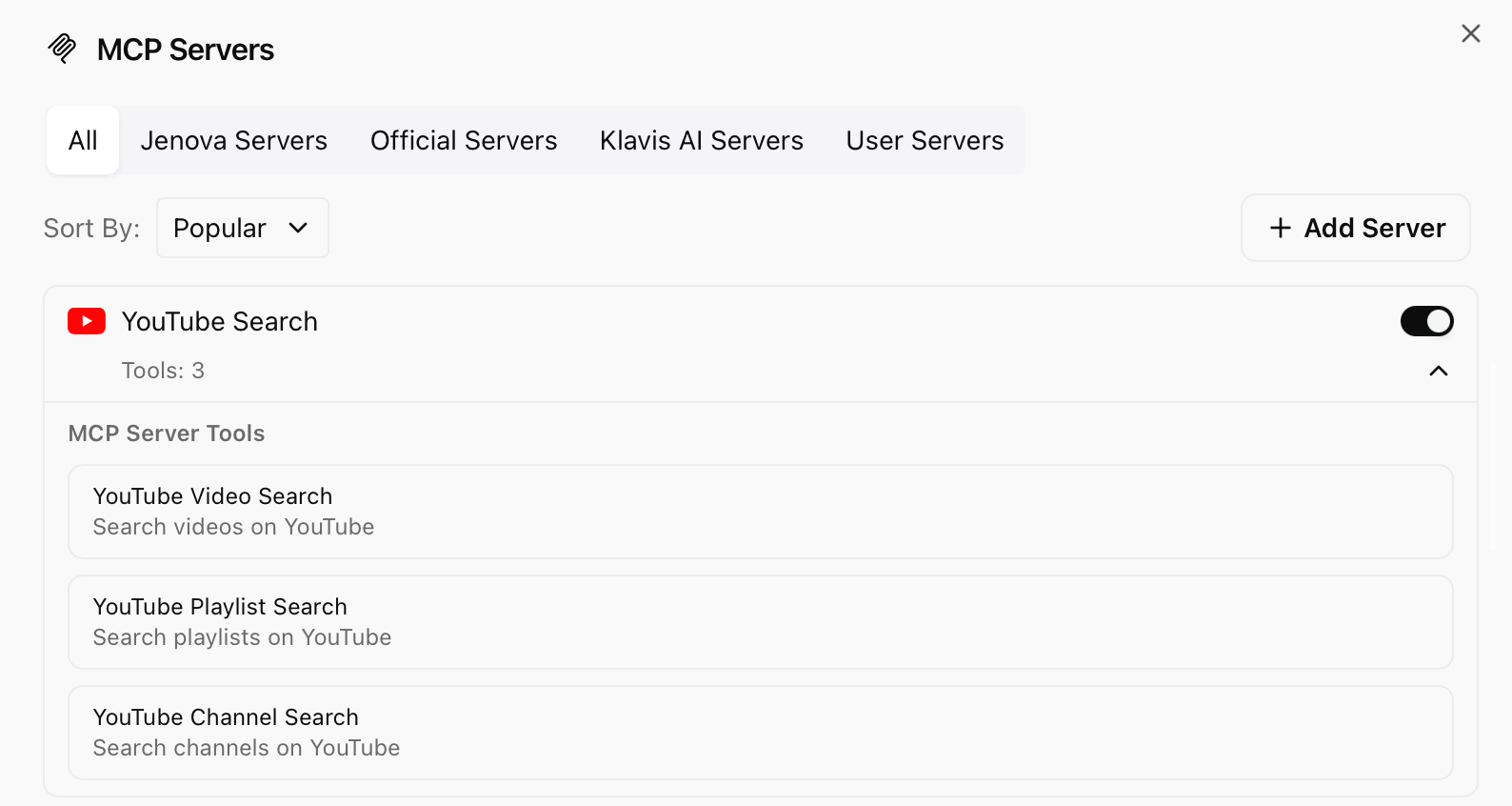
The AI YouTube Search MCP Server abstracts YouTube's API complexity into three specialized, standardized tools that AI systems can invoke directly:
| Traditional Approach | AI YouTube Search MCP Server |
|---|---|
| Custom API wrapper development | Pre-built standardized integration |
| Manual quota management | Server-side quota handling |
| Complex authentication setup | Transparent authentication |
| Inconsistent data parsing | Structured, normalized output |
| Generic search interface | Task-specific search tools |
YouTube Video Search Tool
This tool enables precise video discovery through keyword, topic, or title queries. It returns structured metadata including:
- Video title and description
- Channel information
- Publication date and duration
- View count and engagement metrics
- Direct video URL
The structured output format allows AI systems to immediately process results without additional parsing logic.
YouTube Playlist Search Tool
Playlist search addresses a specific use case: discovering curated content collections. This proves valuable for:
- Educational Content – Finding complete course sequences or lecture series
- Music Discovery – Locating genre-specific or mood-based compilations
- Documentary Series – Identifying multi-part investigative content
- Tutorial Sequences – Discovering structured learning paths
The tool returns playlist metadata including title, creator, video count, and playlist URL, enabling AI systems to recommend comprehensive content collections rather than isolated videos.
YouTube Channel Search Tool
Channel search provides direct access to creator-specific content libraries. This supports workflows requiring:
- Source Verification – Confirming content comes from official channels
- Creator Analysis – Examining a channel's complete video catalog
- Brand Monitoring – Tracking organizational content output
- Expert Discovery – Locating subject matter authorities
The tool returns channel metadata including subscriber count, video count, and channel description, giving AI systems context about content authority and reach.
How It Works: Step-by-Step Integration
Step 1: Enable the Server in Your MCP Client
MCP-compatible AI clients like Jenova provide built-in server libraries. Users enable the YouTube Search MCP Server through the client interface without manual configuration or API key management.
Step 2: Issue Natural Language Queries
Users interact with the AI using natural language. The AI determines which YouTube search tool matches the query intent:
- "Find videos about quantum computing" → Video Search tool
- "Locate a Python programming course playlist" → Playlist Search tool
- "Show me the MIT OpenCourseWare channel" → Channel Search tool
Step 3: Server Processes the Request
The MCP server receives the tool invocation, constructs the appropriate YouTube API query, handles authentication and quota management, and retrieves results.
Step 4: AI Receives Structured Data
The server returns normalized, structured data to the AI client. This data includes all relevant metadata in a consistent format, eliminating the need for custom parsing logic.
Step 5: AI Presents Results to User
The AI processes the structured data and presents results in a user-friendly format, often with additional context, summaries, or recommendations based on the original query intent.
Real-World Applications and Use Cases
📚 Academic Research and Learning
Query: "Find the complete Stanford CS229 Machine Learning course lectures and supplementary materials."
Traditional Approach: Manual YouTube search, browsing multiple channels, verifying content authenticity, compiling video links—approximately 30-45 minutes.
AI YouTube Search MCP Server: The AI uses the Playlist Search tool to locate the official course playlist, then employs Channel Search to verify it's from Stanford's official channel. Results delivered in under 10 seconds.
Key benefits:
- Verification of official academic sources
- Complete course sequence discovery
- Supplementary material identification
- Time savings of 95%+
💼 Market Intelligence and Trend Analysis
Query: "What are the most-viewed product reviews for the iPhone 15 Pro from tech channels with over 1 million subscribers?"
Traditional Approach: Multiple searches, manual subscriber verification, view count comparison, credibility assessment—approximately 20-30 minutes.
AI YouTube Search MCP Server: The AI combines Video Search (for product reviews) with Channel Search (for subscriber verification), filtering and ranking results by view count. Delivers curated list in seconds.
Key benefits:
- Automated credibility filtering
- View count-based ranking
- Multi-criteria search execution
- Competitive intelligence gathering
📱 Cultural Trend Monitoring
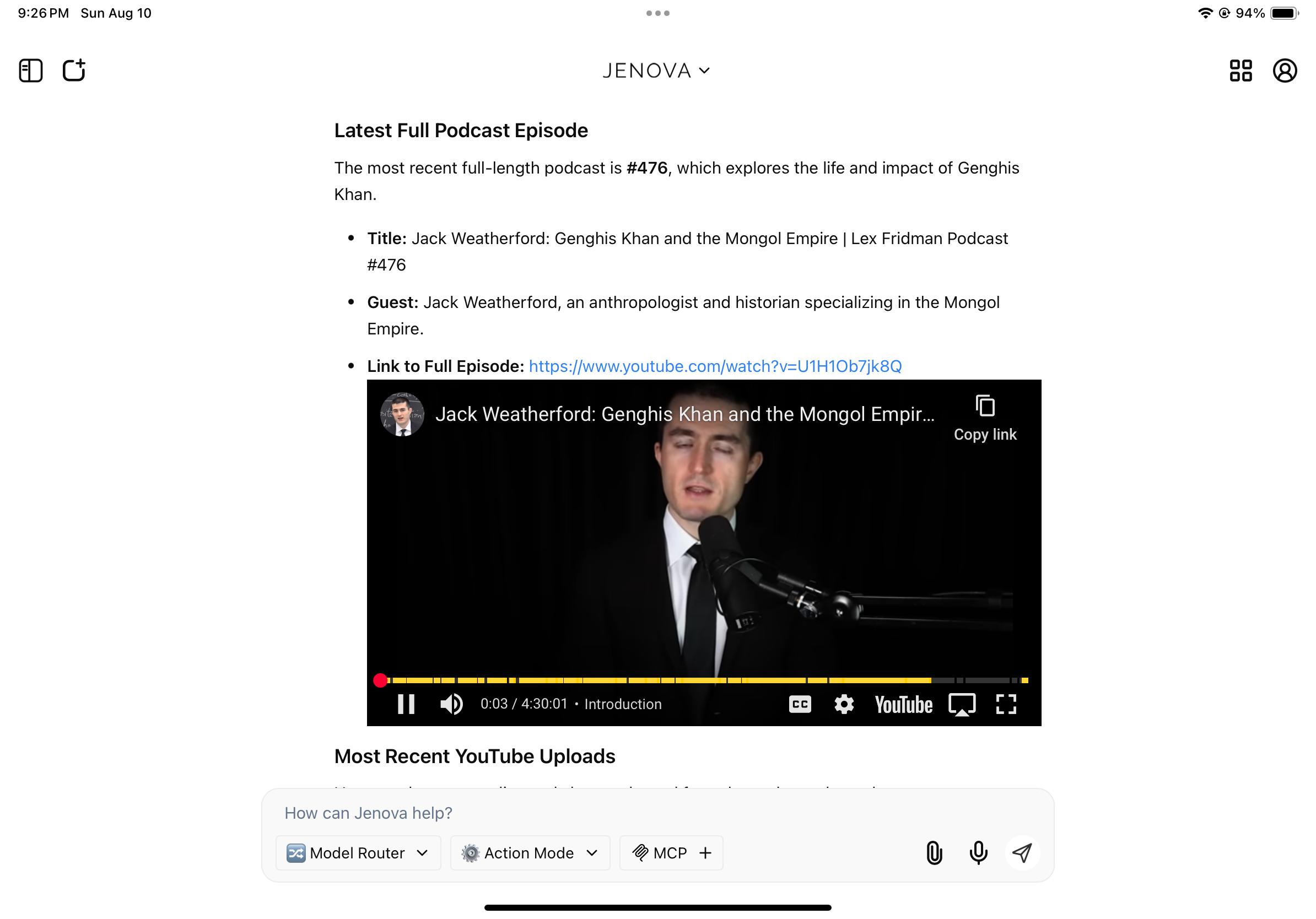
Query: "Identify trending K-Pop music videos in South Korea this week and compile related playlists."
Traditional Approach: Navigating regional charts, identifying trending content, locating curated playlists, verifying recency—approximately 15-25 minutes.
AI YouTube Search MCP Server: The AI uses Playlist Search to locate official YouTube charts ("Top 100 Songs South Korea") and user-curated trending playlists, then employs Video Search for individual trending videos. Results compiled instantly.
Key benefits:
- Regional trend identification
- Official chart access
- User-curated content discovery
- Real-time trend monitoring
🎯 Multi-Modal Knowledge Synthesis
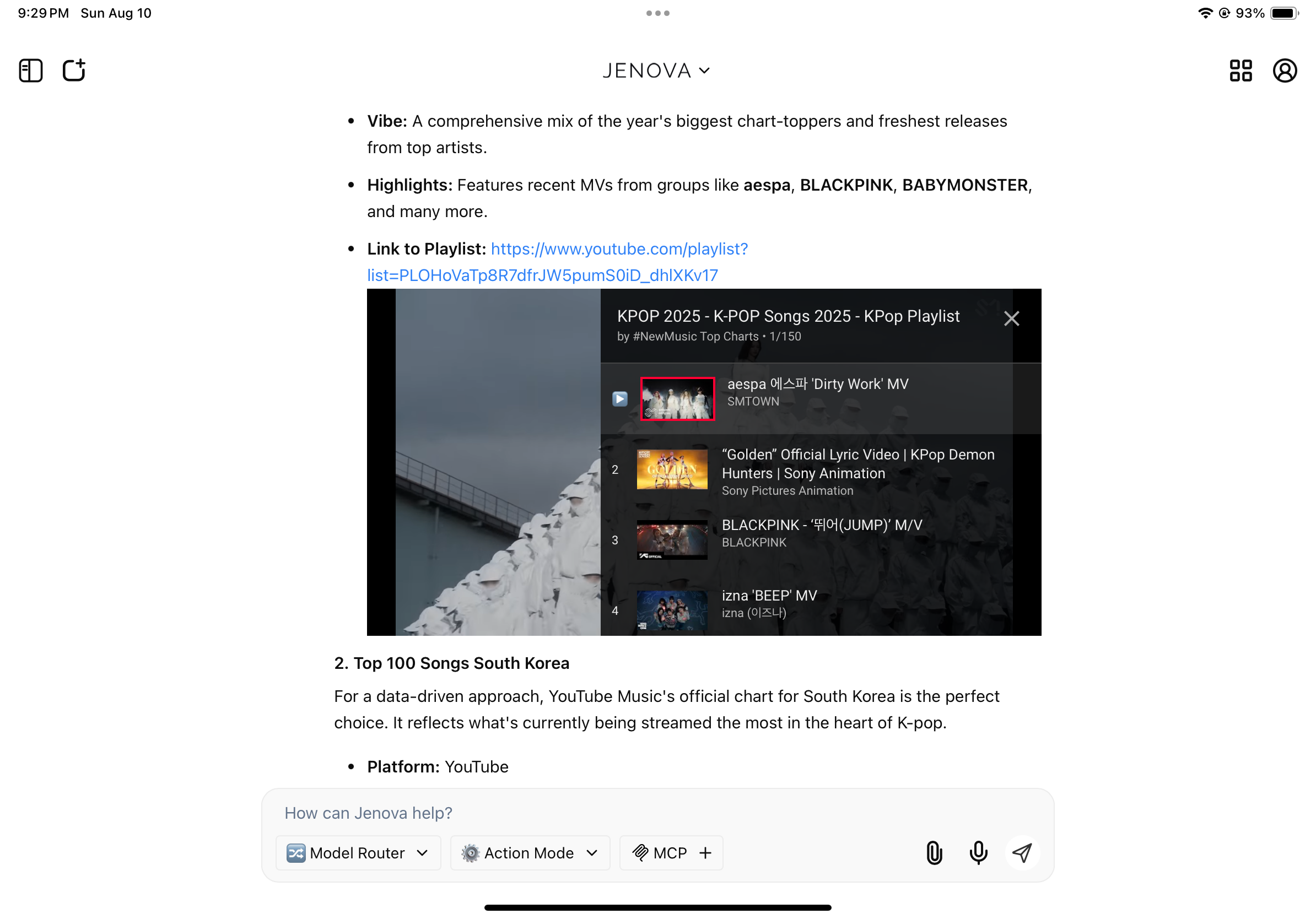
Query: "Find the Lex Fridman podcast episode with Jack Weatherford on Genghis Khan, and create a list of the most-viewed reinforcement learning talks from major tech conferences in the last six months."
Traditional Approach: Separate searches for podcast episode and conference talks, manual date filtering, view count sorting, credibility verification—approximately 25-40 minutes.
AI YouTube Search MCP Server: The AI executes parallel queries using Video Search for the specific podcast episode and a combination of Video Search and Channel Search for conference talks (targeting channels like "Google TechTalks" or "Microsoft Research"). Results synthesized in under 15 seconds.
Key benefits:
- Parallel query execution
- Specific content pinpointing
- Conference channel targeting
- Comprehensive result synthesis
Frequently Asked Questions
How does AI YouTube Search MCP Server differ from regular YouTube search?
The AI YouTube Search MCP Server provides structured, programmatic access designed for AI systems rather than human users. It offers three specialized tools (video, playlist, channel search) that return normalized data in consistent formats, enabling AI systems to process results without custom parsing logic. Regular YouTube search is optimized for human browsing with visual interfaces and recommendation algorithms.
Is the YouTube Search MCP Server free to use?
Access to the YouTube Search MCP Server depends on your MCP-compatible AI client. Jenova offers free tier access to all MCP servers, including YouTube Search, with daily usage limits. Paid subscribers receive significantly higher usage limits. The server itself handles YouTube API quota management transparently.
Can I use the YouTube Search MCP Server on mobile devices?
Yes, when accessed through Jenova—the only MCP client with full iOS and Android support. Mobile access enables on-the-go video discovery, research, and content curation with the same capabilities as desktop usage.
How accurate is the YouTube Search MCP Server?
The server's accuracy depends on YouTube's underlying search algorithms and data quality. It returns results directly from YouTube's API without modification. When used through Jenova, which maintains a 97.3% tool call reliability rate, users benefit from robust infrastructure that ensures search requests execute successfully and consistently.
Does the YouTube Search MCP Server work with other MCP servers?
Yes, the standardized MCP architecture enables seamless integration with other MCP servers. For example, you could combine YouTube Search with a web search MCP server to cross-reference video content with written articles, or integrate with a data analysis server to process video metadata. Jenova's vector-based tool selection handles hundreds of simultaneous MCP servers without performance degradation.
Can the YouTube Search MCP Server access private or unlisted videos?
No, the server only accesses publicly available YouTube content. It respects YouTube's privacy settings and content restrictions. Private videos, unlisted videos (unless you have the direct URL), and age-restricted content follow YouTube's standard access rules.
Conclusion: Transforming Video Discovery for AI Systems
The AI YouTube Search MCP Server transforms YouTube from a passive content platform into a structured, queryable knowledge resource for AI systems. By providing specialized search tools with normalized data output, it eliminates the technical complexity of YouTube API integration while enabling precise, task-specific video discovery.
For researchers, analysts, and knowledge workers, this means AI assistants can now locate specific academic lectures, verify source credibility, discover curated learning sequences, and monitor cultural trends—all through natural language queries. The server's standardized architecture ensures these capabilities work consistently across any MCP-compatible AI client.
As the MCP ecosystem expands, tools like the YouTube Search MCP Server establish the foundation for truly intelligent video discovery, making the world's largest video library accessible to AI systems in structured, meaningful ways. Get started with the YouTube Search MCP Server to unlock structured video intelligence for your AI workflows.
References
- Model Context Protocol. "MCP Official Documentation." Accessed August 10, 2025.
- Wang, Boris. "Jenova: The First AI Agent Built for MCP." LinkedIn, 2025.
- yPredict. "Jenova AI Unlocks the Next Chapter in MCP Innovation." yPredict.ai, August 2, 2025.
- Google Developers. "YouTube Data API Overview." Google Developers Documentation.
- YouTube Official Blog. "YouTube Press Statistics." YouTube Press Resources.