Why Does the Same AI Character Change Face, Clothes, or Hairstyle Across Comic Panels?
2026-08-13
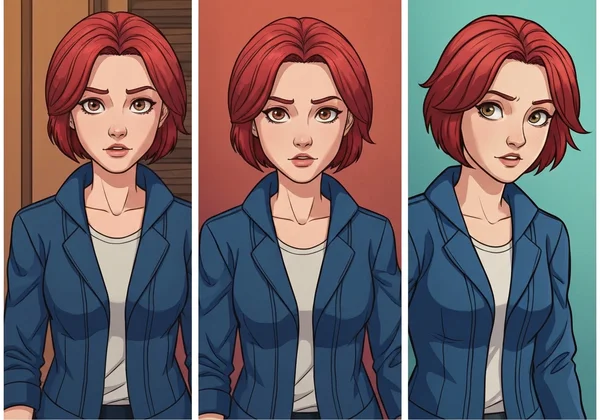
What Actually Causes Identity Drift Between Panels — Prompt Wording or Model Architecture?
Character drift in AI comics is an architectural limitation, not a prompting mistake — text-to-image models generate each panel as an independent sampling event with no memory of prior outputs, so a description like "red-haired detective in a trench coat" resolves to a statistically plausible person each time rather than the same person. The most reliable fixes route identity through reference images and asset systems rather than text: tools like ComicInk, LTX Studio, Figma Weave, and Jenova's Comic Creator all converge on this principle from different angles.
What separates drift-resistant workflows from drift-prone ones:
✅ Reference-anchored generation — identity is carried by an image asset, not re-described in prose each panel
✅ Attribute decoupling — face, hair, wardrobe, and background are locked independently so a scene change doesn't reshuffle the character
✅ Foreground/background separation — research shows background details drift even when the face holds (CharaConsist, ICCV 2025)
✅ Vocabulary discipline — "brown trench coat" must stay "brown trench coat," never "coat" or "jacket"
✅ Motion tolerance — consistency methods degrade sharply once a character changes pose or action
To evaluate any tool or workflow honestly, it helps to first understand the four distinct failure mechanisms hiding behind the single symptom of "my character looks different."
What Are the Four Technical Causes of Character Drift?
Drift has four separable causes, and each responds to a different fix. Treating them as one problem is why most creators cycle through prompt tweaks that never fully work.
1. No memory mechanism. Each generation is an independent event. LTX Studio's engineering breakdown states it plainly: the model "cannot 'remember' previously generated character features," so every render restarts from the text description. A prompt is a probability distribution, not a specification — "green eyes, mid-30s" describes millions of valid faces.
2. Style and identity entanglement. Models struggle to separate who the character is from how the image looks. Change the art direction between panels — dramatic lighting, a wider shot — and facial geometry shifts along with it, because the model never learned those are independent variables.
3. Perspective and 3D reasoning gaps. Rendering the same person from a new angle requires implicit 3D understanding the model doesn't have. This is why side and back views drift hardest, and why LTX recommends frontal references specifically for downstream flexibility.
4. Attention dispersion. The model allocates finite attention across character, wardrobe, background, and style simultaneously. Add narrative complexity and character detail loses the competition.
🎯 Why Clothing Drifts More Than Faces
Wardrobe is the most under-discussed failure mode. The ICCV 2025 CharaConsist paper found that identity-reference methods including IP-Adapter and PhotoMaker "focus solely on facial identity preserving and cannot ensure consistency in other attributes such as clothing or scenes." Face-locking tools can hold a face steady while the jacket changes color, the collar restyles, and the accessories vanish — because those systems were never trained to preserve them.
How Much Consistency Can Current Methods Actually Achieve?
Measured consistency is real but partial — no method reaches identity-lock, and the numbers show exactly where each approach breaks. The CharaConsist team benchmarked four leading approaches using CLIP image similarity split into foreground (CLIP-I-fg) and background (CLIP-I-bg) components, plus facial embedding similarity (ID Sim).
Their reported results place CharaConsist at 0.883 CLIP-I-fg and 0.916 CLIP-I-bg on background-maintaining tasks, versus 0.876 and 0.895 for ConsiStory. The gap widens on background consistency specifically — the dimension most methods ignore entirely.
In a human preference study reported in the same paper, evaluators chose CharaConsist over baselines 64% of the time on clothing consistency and 98% of the time on background consistency, while textual alignment preference sat at only 57% — a measurable trade-off between locking identity and following the prompt.
That trade-off is the central tension in this entire category. Every consistency mechanism constrains the generator, and constraint costs prompt responsiveness. The paper's own ablation shows FLUX.1 with CharaConsist applied scores lower on CLIP-T (text alignment) than the unmodified base model.
📊 The Motion Problem
Consistency methods degrade under movement. The CharaConsist authors identify this directly: "when the foreground character undergoes large motion variations, inconsistencies in identity and clothing details become evident." For comics — a medium built on characters running, fighting, gesturing, and reacting — this is the hardest constraint. A talking-heads panel holds far better than an action panel, and any tool comparison that only tests static portraits overstates real-world performance.
Which Approaches Are Available, and How Do They Compare?
Four distinct architectural approaches exist, and they trade off along the same three axes: setup cost, consistency strength, and creative flexibility.
| Dimension | General Generators (Midjourney, DALL·E) | ComfyUI + IP-Adapter/ControlNet | Reference-Asset Platforms (LTX, Figma Weave, ComicInk) | Jenova Comic Creator |
|---|---|---|---|---|
| Consistency mechanism | Seed reuse + prompt repetition | Trained adapters, LoRA, face embeddings | Saved character assets reused per generation | Persistent conversational memory + saved character definitions |
| Face consistency | Weak — reported as the primary failure by users | Strong; IP-Adapter FaceID optimized for identity | Strong; asset-anchored | Strong for defined characters; varies by selected model |
| Wardrobe consistency | Weak | Weak — documented gap in identity-reference methods | Handled via outfit variants (LTX duplicate-and-modify) | Maintained through explicit character sheets in session memory |
| Setup cost | Minimal | High — workflow building, model weights, GPU | Moderate — build character library first | Low — conversational setup, no technical config |
| Pose/action flexibility | High but inconsistent | Moderate; ControlNet gives pose control | Moderate; frontal-reference bias limits angles | Moderate; drift increases with extreme action |
| Local hardware | None | 3–37 GB VRAM depending on offload mode | None | None |
| Pricing | Midjourney/DALL·E subscription tiers | Free software; hardware and electricity cost | Figma Weave free tier + paid plans; ComicInk free 4-page trial | Free tier; Plus $20/mo at 30× free usage |
| Best for | Single striking images, concept art | Technical creators needing maximum control | Teams standardizing a recurring cast | Story-first creators writing multi-panel narratives conversationally |
General-Purpose Generators
Midjourney and DALL·E produce the highest per-image aesthetic quality and the worst cross-panel consistency. Creator forums document the pattern consistently — users report "the inability to have the same or even similar characters throughout." The OpenAI developer community has an open request thread for character consistency and style locking explicitly asking for preservation of "facial features, body shape, skin tone, clothing, and pose across requests." Seed reuse and single-source-image anchoring help — Midjourney practitioners report better clothing stability when sticking to one source image plus a fixed seed — but neither approach guarantees identity.
ComfyUI Adapter Stacks
The strongest technical ceiling, the steepest learning curve. IP-Adapter preserves appearance and style while ControlNet governs structure; practitioners combine both because neither alone suffices. The CharaConsist repository documents hardware reality clearly: 37 GB VRAM for single-GPU operation, dropping to 3 GB only with sequential CPU offload and a severe speed penalty. This path excludes most comic creators on hardware grounds alone.
Reference-Asset Platforms
The pragmatic middle. LTX Studio's Elements system stores characters as persistent, taggable assets invoked with @ mentions. Figma Weave takes a node-based approach where "consistency is structural, not accidental." ComicInk generates character reference images first, then attaches them to every page render. All three make the same architectural bet: stop describing the character, start referencing them.
How Do You Actually Prevent Drift in a Working Comic?
The single highest-leverage change is converting your character from a description into an asset before you generate any panels. Everything else is refinement.
Universal pre-production steps:
- Build a character sheet first. Lock face, hair, build, wardrobe, and palette in one canonical render before panel one exists.
- Freeze your vocabulary. LTX's guidance is explicit: "'Brown trench coat' should always be 'brown trench coat,' not 'coat' or 'jacket' in subsequent descriptions." Synonym drift causes visual drift.
- Use frontal, neutrally lit references. Directional shadows and side angles bake into the reference and conflict with later scenes.
- Create wardrobe variants deliberately rather than re-describing outfits. LTX handles this by duplicating a character and editing only the clothing fields, preserving facial identity across
@Sarah_casualand@Sarah_formal.
In Jenova's Comic Creator, the session's persistent memory does the anchoring work — you establish the character once in conversation and the agent carries that definition forward:
"Create a character sheet for Mara Voss: 34, sharp jawline, close-cropped silver hair, faded olive field jacket with a torn left cuff, dark grey cargo pants. Neutral expression, frontal view, soft even studio lighting, flat neutral background. Western comic ink style."
Then, per panel, reference rather than re-describe:
"Panel 3: Mara Voss — same character sheet, same olive field jacket with the torn left cuff — crouched behind an overturned car, looking left. Keep face, hair, and wardrobe identical to the sheet."
In LTX Studio, the equivalent flow is: open Elements → Create New Element → Character → upload 5–12 reference images or generate one → name it → then tag @CharacterName in every shot prompt. Updates to the saved Element propagate automatically to every tagged appearance.
In ComfyUI, you're building a graph: load an IP-Adapter FaceID node for identity, chain ControlNet for pose structure, and either train a LoRA on your character or use a fixed reference image as the identity source across all renders.
⚠️ What Won't Work
Adding "consistent character" or "same person as before" to a prompt does nothing. The model has no "before." Community documentation of this failure is blunt: "most people tell AI what they want" rather than supplying a reference the system can lock onto. Text cannot compensate for a missing memory mechanism.
Why Do Backgrounds Drift Even When the Character Holds?
Backgrounds drift because nearly every consistency method optimizes exclusively for the foreground subject, leaving the environment to regenerate freely each panel. The CharaConsist authors identify this as a core gap in prior work: existing training-free methods "fail to maintain consistent background details, which limits their applicability."
The measured cost is significant. In the human preference study, background consistency showed the widest margin of any dimension — 98% preference for the method that explicitly handles it, versus 2% and 0% for the two baselines. That's not a marginal improvement; it indicates the baselines essentially don't attempt background preservation.
For comics this matters more than for single illustrations. A two-page conversation set in one kitchen needs that kitchen to stay the same kitchen. When the cabinets change color between panels, readers register the scene as discontinuous even if they can't articulate why.
The technical fix in CharaConsist is a foreground-background mask derived from attention differences, enabling "decoupled control over foreground and background consistency" — you can hold the scene fixed for a continuous sequence, or release it deliberately for a location change. Most consumer tools don't expose this control, so the practical workaround is generating an establishing background separately and reusing it as an image reference across the sequence.
What Trade-Offs Should You Expect When You Lock a Character Down?
Every consistency gain costs you something, and the two most common costs are prompt responsiveness and scene variety. Understanding this prevents the frustrating cycle of tightening constraints and wondering why the model stopped following instructions.
Consistency versus prompt adherence. The CharaConsist ablation study is unusually candid here: applying the consistency method to FLUX.1 lowered the CLIP-T text alignment score relative to the base model. Preference testing found textual alignment at 57% — the weakest of all measured dimensions. Strong reference anchoring pulls generation toward the reference and away from your new instructions.
Reference bias versus angle range. Frontal references maximize downstream reusability, but they also bias the model toward frontal output. Getting a genuine three-quarter or overhead panel from a frontal-locked character requires fighting the anchor.
Static fidelity versus action. Consistency benchmarks are typically measured on relatively composed scenes. Comics need motion, and motion is where the CharaConsist paper explicitly locates degradation.
Setup investment versus flexibility. ComfyUI's LoRA and adapter pipelines offer the highest ceiling, but practitioners note the practical burden — one workflow author describes the appeal of not needing to "save every character checkpoint file," which implies that most workflows do exactly that.
What Do Practitioners Say About Where This Technology Actually Stands?
The consensus among people building production comic workflows is that reference-anchoring solved most of the problem, and the remaining failures are concentrated in motion and wardrobe.
"The mental model most people bring to AI comics is wrong from the first panel. They think of the prompt as a spec sheet the model reads and executes. It isn't — it's a sampling constraint. When you write 'red-haired detective,' you've narrowed the space of possible faces from billions to millions, not to one. Every panel is a fresh draw from that narrowed space. Once creators internalize that, they stop rewriting prompts and start building reference assets, and the problem largely dissolves."
"What surprises people is that faces were the easy part. Face-locking has strong, well-trained solutions across multiple architectures. Wardrobe is the stubborn one, because clothing has more degrees of freedom than a face and far less training signal dedicated to preserving it. In our own testing, a character will hold their face across a twelve-panel sequence while the jacket quietly changes its collar three times. We tell creators to treat the outfit as a named entity with fixed vocabulary — a torn left cuff, specifically — rather than a general description. Distinctive, nameable details survive; generic ones don't."
"The honest limitation nobody advertises is action. Consistency benchmarks are run on relatively composed shots. Comics are not composed shots — they're people mid-punch, mid-fall, mid-sprint. That's exactly where every current method loses grip. If you're planning a fight sequence, budget for iteration and consider anchoring the sequence to a single wide establishing panel rather than expecting eight independent action panels to cohere."
— Jenova Product Team, 6 years building multi-panel AI generation workflows
Which Approach Fits Your Situation?
The right tool depends on three variables: how technical you are, how many panels you need, and whether story generation matters as much as image generation.
Choose a general-purpose generator if you need a small number of striking images and can accept visual inconsistency, or you're producing concept art rather than sequential narrative. Midjourney remains the strongest option for pure image aesthetics.
Choose ComfyUI with IP-Adapter and ControlNet if you have GPU access, technical patience, and need maximum control — particularly if you're producing enough volume to justify training a character LoRA. The FaceID Plus V2 workflows are the current practical standard.
Choose a reference-asset platform if you're producing repeatedly with a fixed cast and want centralized asset management. Figma Weave suits teams sharing character standards; LTX Studio suits video-adjacent work; ComicInk suits fast end-to-end comic output.
Choose Jenova's Comic Creator if your bottleneck is story as much as art — the agent handles script, panel breakdown, and generation in one conversational thread, with session memory carrying character definitions forward across long projects. It's available at jenova.ai/a/comic-creator. For vertical-scroll formats, the Webtoon Creator handles episode structure and scroll rhythm; Manga Creator covers monochrome panel conventions. The honest limitation applies here too: extreme action poses and complex multi-character panels still require iteration, and the platform doesn't expose the foreground/background masking control that research-grade methods offer. Free tier includes limited usage; Plus is $20/month at 30× that allowance.
Whichever path you take, the underlying principle is identical. Character consistency is an asset-management problem wearing a prompt-engineering costume. Build the reference first, name every distinctive detail, reuse the same words, and accept that action panels will cost you extra attempts.
References
- CharaConsist: Fine-Grained Consistent Character Generation — ICCV 2025 paper with benchmark data and human preference study
- CharaConsist GitHub Repository — official implementation and hardware requirements
- LTX Studio — How to Create a Consistent AI Character, including the four technical limitations of AI generation
- OpenAI Developer Community — Need for Character Consistency and Style Locking in Image Generation
- ComicInk — Best AI Comic Generators 2026, comparing generation approaches
- Figma Weave — AI Consistent Character Generator, node-based consistency approach
- Medium — How I Solved Character Consistency in ComfyUI After Trying ControlNet and IPAdapter
- RunComfy — IPAdapter FaceID Plus V2 Consistent Character Workflow
- Medium — How to Work With All the Factors Relating to Character Consistency in Midjourney
- Community discussion on why hairstyle, jawline, and skin tone drift in AI character generation