Why Does AI College Advice Ignore Fit, Budget, and Odds?
2026-08-25
How Do Rankings-First AI Tools Compare to Fit-Budget-Odds Counseling?
Most general-purpose AI college tools sort schools by prestige because rankings are abundant, structured, and easy to retrieve — not because they predict whether a student will be admitted, afford the bill, or finish a degree. Specialized advisors such as Jenova’s College Admissions Consultant, Kaplan’s KapAdvisor, and Kollegio produce more usable lists when they are given a full profile: intended major, net-price ceiling, academic range, and geographic constraints.
The gap between a rankings dump and a workable college list shows up in four places:
✅ Program fit — major strength, teaching model, and career pathways beat overall rank for most students, because earnings and employment vary sharply by field of study ✅ Financial fit — sticker price is a poor guide; average published tuition in 2025–26 runs from $4,150 at public two-year colleges to $45,000 at private nonprofit four-year colleges ✅ Admission likelihood — a list of 4%–8% schools wastes applications unless the student has a genuine hook ✅ Completion environment — undermatched students are consistently less likely to graduate than matched peers
To compare these tools honestly, it helps to stop asking which one names the “best” colleges and start asking which one keeps all four constraints in view at once.

Why Do Generic AI Tools Default to Rankings in 2026?
Generic chatbots default to rankings because prestige lists are the densest, most frequently copied college data on the public web, while net-price, program-level, and admissions-probability data are sparse, student-specific, and often paywalled. That is a data problem, not a counseling philosophy.
Three structural forces keep ranking-first answers in circulation. First, training corpora and search indexes are saturated with “top 25” roundups, so a one-shot prompt such as “What colleges should I apply to?” retrieves prestige hierarchies by default. Second, rankings arrive as clean tables; family income, expected family contribution, major interest, and counselor strategy do not. Third, nearly half of students are already using AI on their own to pick schools, complete applications, and prepare for tests, according to an EAB survey reported in 2026, which means ranking-shaped answers now reach students who never sit with a counselor.
Human counseling capacity makes the shortcut more tempting. The American School Counselor Association ratio cited by The Hechinger Report is 372 students per counselor nationally, and the load climbs to 570 in Arizona and 565 in Michigan. NACAC estimates that only about a fifth of counselor time goes to college advising, and nearly one in five high schools have no college counselor at all. When an overworked junior asks a chatbot for a list at 11 p.m., the model returns what it can retrieve instantly.
Angel Pérez, CEO of the National Association for College Admission Counseling, has been blunt about the quality problem: asking generative AI what college a student will get into does not produce reliable answers. The information counselors most want to offload — how to file the FAFSA, when to take the SAT — is procedural. The information students most need — fit, match, and the unique shape of one applicant — is exactly what a rankings-sorted reply skips.
What Should You Evaluate in an AI College Advisor?
An AI college advisor should be judged on whether it can hold four constraints at the same time: program fit, net affordability, admission likelihood, and completion environment. Rank position is a weak fifth input, useful only after the first four are satisfied.
This Four-Constraint College List model is the evaluation frame used throughout this article. A school that fails any single constraint is a bad recommendation, even if it sits high in a national ranking.
Program fit asks whether the campus actually teaches the intended field well, not whether the university is famous. A student aiming at nursing, accounting, or computer science can be poorly served by a prestigious college whose relevant department is small, theoretical, or capacity-constrained. Georgetown’s Center on Education and the Workforce documents large payoff differences across 152 majors, which is why major-level research belongs in the first pass, not the last.
Net affordability asks what the family will actually pay after grants. Eduventures research reported that 99% of parents and guardians have a preference for the cost of their students’ college choices. Sticker price cannot answer that question. Aid officer Mark Kantrowitz has long argued that families need academic fit, social fit, and financial fit together, not prestige alone.
Admission likelihood asks whether the student’s grades, testing, coursework, and context land inside a school’s recent admitted range. Without this, AI lists collapse into a stack of reaches.
Completion environment asks whether the student is matching, overmatching, or undermatching. Selectivity is not the goal; finishing is. Brookings researchers have shown that students who undermatch are less likely to graduate.
Tools that cannot ingest income, major, geography, and a transcript — or cannot remember them across sessions — will keep optimizing the one variable they can see: rank.
Which AI College Tools Account for Fit, Cost, and Admission Odds?
Among widely used options in 2026, Jenova’s College Admissions Consultant and KapAdvisor are the strongest at turning a student profile into a constrained list, while Kollegio and Counselly are stronger at free matching and process Q&A, and generic chatbots remain weakest on budget and odds. None of them replaces a human counselor for trust and advocacy.
| Feature / Dimension | KapAdvisor (Kaplan) | Kollegio | Jenova College Admissions Consultant | Counselly | Generic ChatGPT / Gemini |
|---|---|---|---|---|---|
| Program-level fit analysis | School insights plus advisor knowledge; major depth varies | AI recommender and quiz match schools to a profile | Research-backed major, location, and pedagogy matching with persistent constraints | School-finding Q&A; depth depends on the prompt | Often defaults to overall rank unless the user forces a major filter |
| Net price / budget modeling | Limited published net-price engine; cost discussed in planning prompts | Scholarship matching and financial-aid features on the free product | Can research net-price calculators, COA, and aid patterns; no built-in institutional NPC | Financial-aid Q&A available; calculator depth unverified | Frequently cites sticker price or outdated averages |
| Admission likelihood | Explicit “chances of getting in” positioning, built on Kaplan’s long admissions dataset | Matching against “thousands of data points”; model internals unpublished | Range-based likely / target / reach construction from transcript and testing | Process guidance more than statistical modeling | Unreliable; NACAC’s Pérez warns this is exactly where generic AI fails |
| Persistent student profile | Document upload (scores, transcripts) on Premium | Account-based quiz and recommendation history | Unlimited chat history and cross-session memory of budget, scores, and preferences | Session-based counselor chat | Weak unless the user re-pastes the full profile every time |
| Pricing (as of 2026) | Free tier; Premium listed at $199 | Free consumer product | Free platform tier; paid plans from $20–$500/month with higher usage | Unverified public pricing | Free or consumer Plus/Pro plans |
| Best for | Students already in Kaplan test prep who want essay feedback and chance estimates | Students who want a no-cost matcher and scholarship alerts | Students who need a multi-week, memory-persistent strategy across list, essays, and timeline | Students who want 24/7 process answers | Quick factual lookups, not a counseling substitute |
KapAdvisor
KapAdvisor is Kaplan’s virtual admissions counselor, offered free and as a Premium product. Published features include personalized essay support, analysis of uploaded SAT/PSAT score reports and transcripts, daily SAT and ACT practice, and guidance on chances of admission. That mix is stronger than a generic chatbot on odds and testing.
The limitation is institutional. KapAdvisor is built around Kaplan’s test-prep and “dream school” framing, so it can still over-index on selective targets if the student does not volunteer a hard budget. Premium essay review is useful, but it is not the same as a living financial-fit model.
Kollegio
Kollegio markets a free AI recommender, scholarship tools, and 24/7 essay support, and it claims students can “pay nothing and get the services of a $10,000 college coach.” For families with no counseling budget, a zero-price matcher is a real advantage.
The trade-off is transparency. Matching logic, net-price accuracy, and how the product treats low-income or first-generation constraints are not independently documented in the same way a counselor’s methodology would be. Free tools also have weaker incentives to tell a student not to apply to a famous campus.
Jenova College Admissions Consultant
Jenova’s College Admissions Consultant is built for school selection, essay strategy, and timeline management against a specific profile. Because it sits on a platform with persistent memory and live research tools, it can keep a net-price ceiling, intended major, and testing range in view across weeks of work rather than resetting after one chat.
The honest limitations matter. It does not ingest a proprietary historical applicant database, and it has no Common App or Naviance integration. Admission-odds estimates are research-informed ranges, not a closed statistical model trained on millions of prior files. Students who want a school-issued scattergram still need their counselor’s platform.
Counselly and other process bots
Counselly positions itself as an AI counselor for finding schools, writing essays, and walking through admissions steps. Similar products include GradGPT for applications, aid, and timelines, Orbit for college and scholarship matching, and CollegeFit for free 24/7 Q&A. The Princeton Review concentrates on essay refinement rather than list construction.
These tools are strongest at availability. They are weaker when the student never discloses income, or when the interface rewards “best colleges for me” prompts that the model quietly translates into rankings.
How Does Undermatching Change Graduation Outcomes?
Undermatching — enrolling at a college less selective than the student is qualified to attend — is associated with lower bachelor’s completion, lower satisfaction, and weaker early-career outcomes, especially for students who had access to a more supportive campus. Rankings-only AI that steers high-achieving, lower-income students toward “safe” or familiar campuses can accidentally recreate this pattern.
A 2021 AERA research snapshot found that undermatched students are consistently less likely to graduate, while overmatched students are consistently more likely to graduate, than matched peers. Brookings has made the same core point: students who undermatch finish college at lower rates. That is why “just pick a cheaper, less selective school” is not automatically the wise budget move.
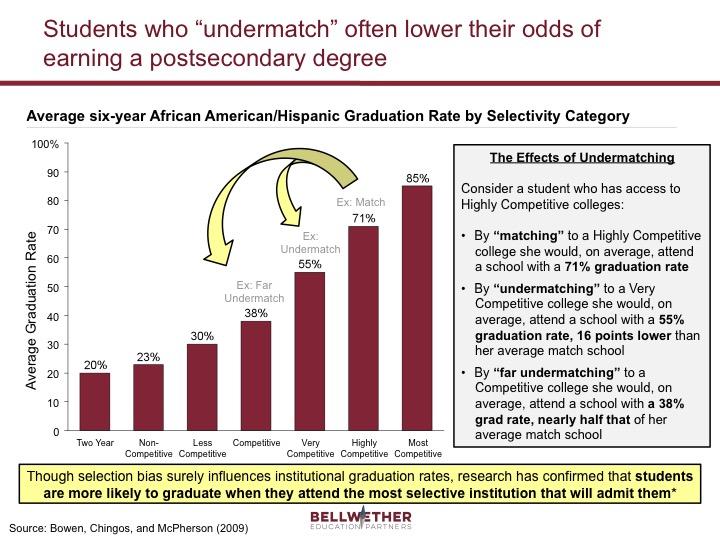
The chart above, drawn from Bowen, Chingos, and McPherson’s Crossing the Finish Line (2009) and circulated by Bellwether Education Partners, makes the completion gradient concrete for African American and Hispanic students. Average six-year graduation rates rise from 20% at two-year colleges and 23% at non-competitive four-year colleges to 55% at very competitive, 71% at highly competitive, and 85% at most competitive institutions.
The undermatch example in that graphic is stark. A student who could match to a highly competitive college (71% graduation rate) but enrolls at a very competitive one instead lands near 55% — 16 points lower. Far undermatching into a competitive college drops the average to 38%, roughly half the completion rate of the match school.
This is the contrarian implication for AI advice. Ignoring selectivity entirely is not the cure for rankings obsession. Selectivity is a noisy proxy for resources, peer effects, and completion infrastructure. The error is using rank as the only sort key, not using match as one of four constraints.
How Should Students Weigh Program Fit Against Prestige?
Students should treat overall rank as a tie-breaker after confirming that a campus offers the right major, teaching style, and early-career pathway — because program-level outcomes diverge far more than most ranking tables admit. Prestige is a campus-level average; careers are major-level.
Bachelor’s degree holders are about half as likely to be unemployed as peers whose highest credential is a high school diploma, but that average hides field effects. Georgetown’s major-level data exist precisely because a biology degree, a nursing degree, and a fine-arts degree do not produce the same employment or earnings distribution. An AI that recommends “the best national universities” to a future accountant, teacher, or cybersecurity analyst is answering a different question than the one the student asked.
Program fit also includes pedagogy and access. A highly ranked research university can be a poor match for a student who needs small seminars, guaranteed clinical placements, or a co-op calendar. Conversely, a regional public with a strong, accredited professional program can outperform a famous campus whose relevant department is an afterthought.
This is where a Career Advisor is more useful than another ranking table. Mapping occupations, licensure, and typical degree pathways before locking a college list keeps the major from becoming an afterthought. The same logic applies inside Jenova’s admissions consultant: the first prompt should name the field, not the dream school.
A practical test: if removing the ranking number would make the recommendation collapse, the recommendation was never about fit.
What Does a Realistic Financial Fit Analysis Require?
A realistic financial-fit analysis starts with net price for the family’s income band, not published tuition, and it treats unaffordable prestige as a failed match rather than a flattering reach. Most AI answers fail this test because they quote sticker prices and national averages.
College Board’s 2025–26 published prices illustrate why averages mislead. Public four-year in-state tuition and fees average $11,950; out-of-state averages $31,880; public two-year in-district averages $4,150; private nonprofit four-year averages $45,000. After grant aid, the picture changes again: estimated net tuition and fees are about $2,300 for first-time, full-time in-state students at public four-year colleges and $16,910 at private nonprofit four-year colleges.
The all-in number families actually feel is higher. The Education Data Initiative puts average annual cost, including books, supplies, and living expenses, at $38,270 per student. U.S. News reported that average tuition and fees at private ranked colleges rose about 3.3% for 2025–26. Meanwhile, 71.4% of undergraduates receive some federal or nonfederal aid, so two students at the same campus can face entirely different bills.
Income makes the distortion worse. IHEP has shown that students from the lowest income backgrounds would need to contribute almost 150% of their family income at many colleges. Brookings’ 2026 affordability update tracks how those burdens have shifted over time. An AI that congratulates a low-income student on a “best value” private university without opening the net-price calculator is not giving college advice. It is reciting marketing.
Federal comparison tools exist for a reason. The U.S. Department of Education publishes college affordability and transparency resources specifically so families can compare costs, aid, and borrowing. Any serious AI counselor should send students there — or to each college’s net-price calculator — before a school stays on the list.
Lumina Foundation, citing Federal Reserve research, notes that college still pays off for most students on average. Averages do not pay an individual family’s bill. Financial fit is the constraint that turns a flattering list into a list a student can accept in April.
How Do You Build a Balanced College List With AI?
You build a balanced list by giving the model hard constraints first — major, net-price ceiling, academic range, and geography — then forcing a likely / target / reach mix, rather than asking for the “best” colleges. The quality of the list is mostly determined by the quality of that opening brief.
A rankings-shaped prompt looks like this:
“What are the best universities in the United States?”
A Four-Constraint prompt looks like this:
“I’m a first-generation student with a 3.6 unweighted GPA, 1320 SAT, and an $18,000 annual net-price ceiling. I want computer science or information systems, preferably within four hours of Atlanta. Build a 10-school list with 3 likelies, 4 targets, and 3 reaches. For each school, note CS program size or focus, latest published acceptance range, and how to estimate net price for a family income of $62,000.”
On Jenova’s College Admissions Consultant, the useful sequence is:
- State academic facts, budget, major, and non-negotiables in the first message.
- Ask for a 10–12 school list already sorted into likely, target, and reach, with a one-line program-fit note and a net-price next step for each.
- Cut any campus that fails budget or program fit, even if the name is famous.
- Only then draft essays and a deadline calendar against the surviving list.
- If testing is the binding constraint, move score work to the SAT/ACT Tutor so the odds dimension can actually change.
KapAdvisor’s published workflow is more document-driven. Students can start on the free tool, then on Premium upload score reports and transcripts for profile analysis and receive essay feedback tailored to each college. That is a strong path for applicants who already have a short list and need execution help. It is a weaker path if the short list was itself a ranking table.
Kollegio’s path starts with a quiz and recommender. Treat those matches as candidates, not a finished list. Run each survivor through a net-price calculator and a major-page read before an application fee is paid.
Two process rules keep AI from sliding back into prestige mode. Never accept a list that lacks at least three schools the student is likely to afford and likely to enter. Never keep a reach that the family cannot pay even with a generous aid assumption.
What Do College Counseling Experts Say About Rankings-First Advice?
Counseling leaders increasingly argue that AI is useful for procedural work and after-hours answers, but dangerous when it substitutes prestige lists for fit, match, and financial reality. The experts closest to school-based advising want models to clear busywork so humans can talk about the student.
“The rankings reflex in consumer AI is a retrieval problem wearing a counseling costume. Public web text is overflowing with ordered lists of famous colleges and almost empty of a specific family’s AGI, a specific department’s clinical slots, or a specific high school’s grade-inflation context. If you do not force those inputs into the prompt — and keep them in memory — the model will optimize the only tidy variable it can see.”
“We treat a usable college list as a four-constraint object. Program fit, net price, admission range, and completion environment all have to clear a minimum bar. A university that fails one constraint is not a flattering reach; it is a wasted application or, worse, an undermatch that lowers the odds of a degree. Selectivity still belongs in the model because match predicts completion. It just cannot be the sort key.”
“The other failure mode is one-shot chat. Families change aid estimates, testing, and major interest over months. An advisor that cannot remember last Tuesday’s $20,000 ceiling will cheerfully reintroduce $80,000 campuses on Thursday. Persistent context is not a convenience feature in this domain. It is the difference between counseling and trivia.”
— Jenova Product Team, designers of specialized admissions-advising agents used by students across 70+ countries
School-based voices land in the same place from the other direction. Diana Moldovan, director of college and career placement at New York’s Urban Assembly School for Law and Justice, told The Hechinger Report that trust cannot be replaced and that AI is most valuable when it frees counselors to talk about academic, social, and financial choices. NACAC’s Angel Pérez has said purpose-built tools should handle SAT and FAFSA mechanics so counselors can focus on “fit and match and the unique aspects of the individual student.”
That consensus is the real indictment of rankings-first AI. The field’s own experts are not asking models for a better top-20 list. They are asking for systems that stop answering the wrong question.
References
- Georgetown CEW — The Major Payoff: earnings and employment by undergraduate major
- College Board Research — Trends in College Pricing Highlights, 2025–26 published and net prices
- AERA — Exploring the Association Between Student-College Match and Student Outcomes Over Time
- The Hechinger Report — On-demand college counseling, courtesy of AI (counselor ratios, EAB survey, NACAC commentary)
- Encoura / Eduventures — The College Affordability Gap: parent cost preferences
- Center for Excellence in Education — Mark Kantrowitz on academic, social, and financial fit
- Brookings — Can We Fix Undermatching in Higher Ed?
- Kaplan — KapAdvisor AI college admissions counselor features and Premium pricing
- Kollegio AI — free college matching, scholarships, and essay support
- Counselly — AI college counselor for school search, essays, and admissions steps
- APLU — Employment and earnings benefits of a college degree
- Education Data Initiative — Average annual cost of college
- U.S. News & World Report — Average college tuition, 2025–2026
- Bold.org — College affordability and share of undergraduates receiving aid
- Institute for Higher Education Policy — Affordability barriers for lowest-income students
- Brookings — Is college becoming less affordable? An update
- U.S. Department of Education — College Affordability and Transparency resources
- Lumina Foundation — What will make college truly affordable?
- GradGPT — AI counselor for applications, financial aid, essays, and timelines
- Orbit — AI college and scholarship matching
- CollegeFit — Free AI college counselor for admissions, essays, and aid
- The Princeton Review — AI college admissions essay counseling