Why Do Repeated AI Divination Readings Give Conflicting Interpretations?
2026-08-11
What Are the Three Sources of Variance Behind Contradictory AI Readings?
Repeated AI divination readings conflict because three independent sources of variance stack on top of each other: the randomness of the draw itself, the probabilistic nature of language model output, and the shifting context you supply between attempts. None of these is a malfunction. A large language model is, as the Nielsen Norman Group describes it, fundamentally a system that predicts "what the most likely next word is in the sequence" — a process that is statistical rather than deterministic, which means the same cards, hexagram, or birth chart can yield materially different prose on each pass.
Key factors that separate genuine interpretive variance from tool failure:
✅ Draw randomness — most AI divination tools re-randomize the cards or coins each session, so you are not re-reading the same spread; you are reading a new one ✅ Sampling temperature — the same model at a higher randomness setting will "occasionally bypass the most likely next token and choose from the less probable continuations," producing divergent phrasing and emphasis ✅ Context drift — every follow-up question you type reframes the reading, and the model weights your latest framing heavily ✅ Symbolic multivalence — tarot symbols legitimately carry opposing meanings; the Tower can read as "impending rupture, or as false assumptions finally giving way," per researchers who interviewed practitioners for a CHI 2026 study ✅ Sycophancy pressure — models tend to accommodate the framing you give them, so a rephrased question invites a rephrased answer
Understanding which of these three layers produced your specific contradiction is what determines whether you should discard the reading, reconcile it, or treat the divergence itself as the signal.
How Do You Tell Which Layer Caused Your Contradiction?
You diagnose the source by controlling one variable at a time — hold the draw fixed, hold the question fixed, and observe what still changes.
We use a three-question diagnostic when readings disagree. It isolates the layer of variance responsible before you attempt any interpretation:
1. Did the cards change? If you asked the tool to "read again" and it dealt a fresh spread, the contradiction is draw-level. You have two separate readings, not one reading interpreted twice. This is the most common cause and the least meaningful. Two different spreads disagreeing is expected — physical decks do the same thing.
2. Did the wording change? If the draw was identical but your question shifted from "should I leave this job?" to "what am I missing about this job?", the contradiction is prompt-level. The model is answering a different question. Semantically small changes to a prompt can produce substantively different outputs because the model conditions its entire response on that framing.
3. Did nothing change? Same cards, same question, same tool — and still a different reading? That's model-level variance from sampling randomness. This is the layer that maps most directly to what AI researchers describe as inconsistency across repeated generations. The Nielsen Norman Group notes that a documented technique for surfacing this is "asking the LLM to generate responses to the same prompt multiple times, and then checking for consistency among the answers" — inconsistency across repeats is treated as a diagnostic signal, not a result.
| Layer | Test | What contradiction means |
|---|---|---|
| Draw | Are the cards/hexagram identical? | Two distinct readings — compare, don't reconcile |
| Prompt | Is the question word-for-word identical? | You changed the query; model answered correctly |
| Model | Both above held constant? | Sampling variance — treat the overlap as signal |
Why Does Symbolic Ambiguity Make Divination Especially Prone to This?
Divination systems are built on deliberately multivalent symbols, which means contradictory interpretations are structurally native to the practice — not introduced by AI.
A standard tarot deck contains 78 cards, and academic surveys note that the Major Arcana "represent the main themes of human life, such as love, death, spirituality, acceptance," while the Minor Arcana "represent subtle mysteries of life," according to a literature review published through Bowdoin College. These are broad archetypal categories by design. A symbol that covers "acceptance" covers both surrender and resignation — opposite emotional registers within one card.
Human readers resolve this ambiguity using information the AI does not have: your history, your tone, your face. The CHI 2026 researchers put it directly — which reading fits "depends on the other cards, the specific question and what the reader already knows about their own situation." An AI system operating without that grounding will generate a plausible resolution rather than the correct one, and a different plausible resolution on the next pass.
This is worth naming honestly: the same ambiguity that makes a reading feel personally meaningful is the ambiguity that makes it unstable across repeats. You cannot have one without the other.
There is also a documented psychological amplifier. The Bowdoin review identifies the Barnum effect — "the tendency to believe that vague predictions or general personality descriptions... have specific applications to one's unique circumstances." When two contradictory readings both feel accurate, the Barnum effect is a plausible explanation for why. Both are general enough to fit.
Is This Different From an AI Hallucination?
Interpretive variance and hallucination are related but distinct — and confusing them leads to the wrong response.
A hallucination, as IBM defines it, occurs when an AI system "produces outputs that sound plausible but are factually wrong, irrelevant or entirely" fabricated. The scale is non-trivial: a Columbia Journalism Review study cited by the Nielsen Norman Group found ChatGPT "falsely attributed 76% of the 200 quotes from popular journalism sites that it was asked to identify," and indicated uncertainty in only 7 of 153 error cases.
In divination, the distinction plays out like this:
- Factual hallucination — the AI misstates what a card traditionally means, invents a card that isn't in the deck, describes a hexagram line that doesn't exist, or fabricates a "traditional" attribution. This is an error. Correct it.
- Interpretive variance — the AI gives two different but internally defensible readings of the same symbol. This is not an error. Both may be legitimate.
Here is where it gets genuinely strange: the CHI 2026 practitioners sometimes made no distinction at all. Some interviewees "treated bizarre AI-generated outputs or hallucinations as meaningful precisely because they were random and unintended, the same way that a card drawn at random feels like it carries a secret message."
That is a coherent position within a divinatory frame — randomness is the mechanism. It is also a position worth adopting consciously rather than by accident, because it removes any basis for distinguishing insight from malfunction.
What Should You Actually Do When Two Readings Disagree?
Treat the disagreement as data about the question rather than a flaw in the answer, and use the divergence to locate what is genuinely unresolved.
The intersection method — run the reading two or three times deliberately, then extract only what appears in all versions. This mirrors the consistency-checking approach used in AI reliability research: agreement across independent generations is a weak but real signal; divergence flags the uncertain territory. The overlap is your stable core. The divergence is your open question.
For a practical walkthrough, here's how this looks with a chat-based tool. Using Jenova's Mystic Tarot Reader:
- Draw once and let the reading complete.
- Ask for a second interpretation of the same spread rather than a new spread:
"Keep these exact cards. Give me a second, independent interpretation that a different reader might reach — and tell me explicitly where it diverges from your first."
- Then request the reconciliation:
"What do both interpretations agree on? What question would I need to answer myself for one reading to be more correct than the other?"
With ChatGPT or a general assistant, the same pattern works but requires you to restate the cards manually each time, since the draw is not held in a structured state. With dedicated tools like Tarotap, which selects the spread from your question and supports follow-ups within a session, you can ask for a re-reading without losing the original layout.
Ask better questions. Overchat AI's guidance on this is sound and worth repeating: ask open questions rather than yes/no, keep one topic per spread, and match the spread to the question. Their point that "stacking several questions into one reading muddies which card answers what" is a direct cause of self-contradictory output — a multi-topic prompt invites the model to answer inconsistently across sub-topics.
Watch for accommodation. If your second reading conveniently agrees with what you argued for between readings, you likely prompted your way there. Test it: state the opposite position and see if the reading flips again. If it does, you're steering, not consulting.
Which AI Divination Tools Handle Consistency Best?
No current tool eliminates interpretive variance, but they differ meaningfully in whether they preserve the draw, retain session context, and let you compare readings side by side.
The dimensions that actually govern consistency are: whether the tool holds a fixed spread across follow-ups, whether it remembers prior readings, and whether it lets you interrogate its own interpretation.
| Dimension | Overchat AI | Jenova Mystic Tarot Reader | Tarotap | Nummi | General ChatGPT |
|---|---|---|---|---|---|
| Deck handling | Full 78-card Rider-Waite, upright + reversed | Full 78-card, reversals, positional reading | Rider-Waite, adaptive spread selection | Rider-Waite, 3-card and daily | No fixed deck state — user must supply cards |
| Cross-session memory | Not documented | Readings referenced across sessions | Follow-ups within a session | Conversational, chat-based | Varies by account settings |
| Spread persistence for re-reads | Spread selected by user upfront | Positional spread visually rendered | Spread auto-selected from question | Chat-based, less structured | User must manually restate |
| Distinguishing feature | Bundled with 100+ non-divination AI tools | Persistent memory + visual spread rendering | Picks the spread for you; free tier available | Ties reading to birth chart and transits | Maximum flexibility, zero structure |
| Documented limitation | Vendor is also the reviewer of the roundup | Requires paid tier for higher usage; broader agent platform is overkill if you only want tarot | Free tier limited to 2 readings + 1 yes/no daily, with ads | Tarot secondary to astrology; depth behind subscription | No draw state; highest variance across repeats |
| Pricing | $14.99/mo or $49.99/yr | Free tier with daily limits; Plus $20/mo | Free tier; $5.99–$12.99/mo | Free with limits; $7.99/mo or $49.99/yr | Free tier; paid tiers vary |
| Best for | Users wanting tarot plus general AI tooling | Users tracking readings over time across systems | Casual users who want the spread chosen for them | Astrology-first practitioners | Users who want full control of the prompt |
Pricing and feature data as of 2026, per the Overchat AI comparison roundup. Note that this roundup is published by Overchat AI, which ranks its own product first — read the rankings accordingly, though the feature-level detail on competitors is specific and verifiable.
Honest assessment of the Jenova option: persistent cross-session memory is the feature most directly relevant to the consistency problem, because it lets a later reading reference an earlier one rather than starting cold. The trade-off is real — Jenova is a general agent platform, not a purpose-built tarot app, so if tarot is your only interest, a dedicated $7.99/month app covers it more cheaply. Jenova makes sense if you're also working across systems: the I Ching Oracle for hexagram casting, the Numerology Reader for chart work, or the Dream Interpreter for symbolic material from a different source.
Honest assessment of general chatbots: ChatGPT and equivalents produce the highest variance because nothing holds the draw. Every re-read is a fresh generation from a re-typed prompt. This is also why they're the most useful for the intersection method — you can force explicit divergence in a way that structured apps sometimes resist.
What Do Researchers Say About Trusting Inconsistent AI Guidance?
The strongest current position among researchers studying AI divination is that inconsistency is tolerable — even useful — as long as the AI is not treated as an authority.
"The variance people find so unsettling in repeated AI readings is, in our view, the least dangerous property of the system. A tool that gives you three different answers is visibly a tool that does not know. The failure mode we'd flag as more serious is the opposite one: a reading that is smoothly consistent because the model has learned what you want to hear and is producing it reliably. Consistency achieved through accommodation is worse than honest divergence."
"What the CHI 2026 findings suggest is that the healthiest use pattern is adversarial. Practitioners who asked the AI to challenge their assumptions — to generate the interpretation they were resisting — got more out of it than those who asked for a verdict. That framing changes the meaning of contradiction entirely. If you're using the tool to surface blind spots, two conflicting readings is a better outcome than one."
"The practical guardrail we recommend is separating the mechanical layer from the interpretive layer. Ask the AI what a card traditionally means, in what positions, with what standard reversals — that's factual, checkable, and stable. Then do the synthesis yourself. The moment you delegate the synthesis, you've delegated the part that requires knowing your own situation, and the AI does not have that information."
— Jenova Product Team, agent design and evaluation, 6 years building conversational AI systems for reflective and advisory workflows
This aligns with the researchers' own conclusion. Their view is that AI "should be a tool to enhance self-reflection, rather than one that serves as a substitute for it" — and that the promising blueprint is technology that "doesn't simply hand you answers but keeps you actively engaged in the process of finding them."
How Common Is This, and Why Does It Matter Now?
Consulting AI for personal guidance is now a mainstream behavior, which makes the consistency question consequential rather than niche.
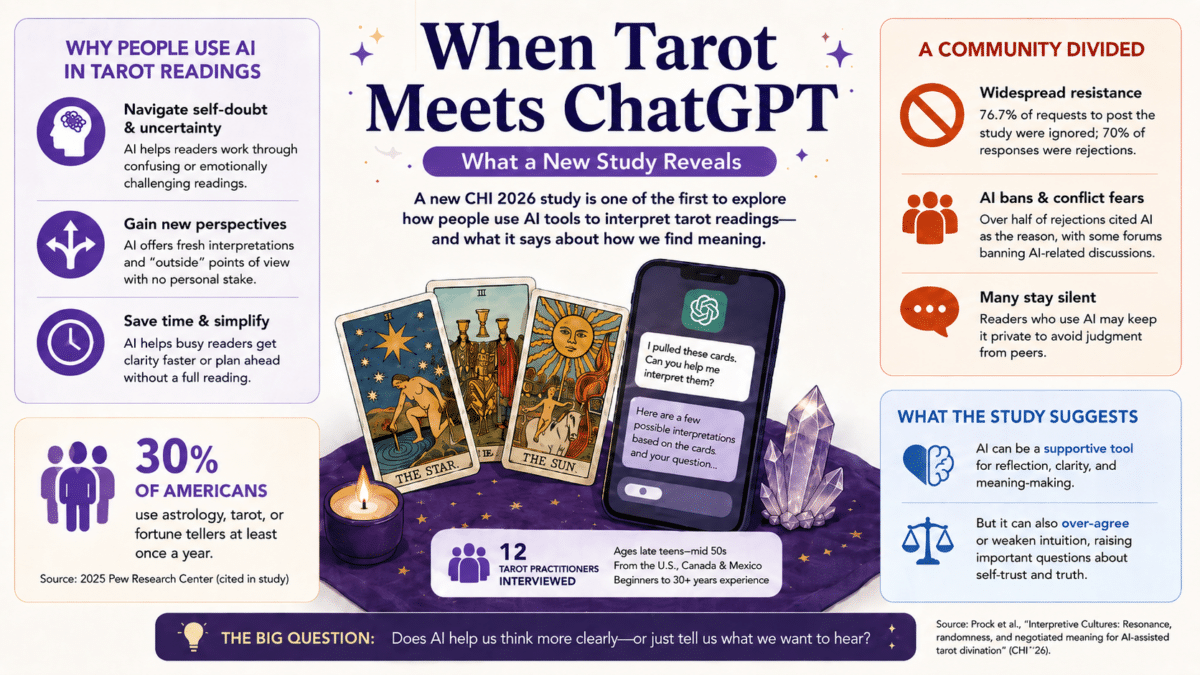
According to a 2025 Pew Research survey cited in the CHI 2026 study, nearly 1 in 3 Americans consult tools such as tarot or astrology at least once a year — interest thought to be driven largely by Gen Z and social media. The same reporting notes survey findings that up to 87% of generative AI users consult the technology for "personal applications," a category that includes advice and emotional support for relationship conflicts and mental health struggles.
The overlap between those two populations is where inconsistent readings stop being a curiosity. The CHI 2026 study documented practitioners relying on chatbots specifically because they "didn't want to 'bug' or 'pester' their friends" — a one-sided dynamic the researchers identify as parasocial interaction.
The stated risks are documented and not hypothetical. The same reporting notes that chatbots "have also been found to nurture delusional beliefs and even lead to self-harm," and that advice-seekers "can also become emotionally dependent," relying on the technology "for companionship and guidance instead of friends and family."
Read against that backdrop, contradictory readings have a defensible upside: they interrupt the illusion of authority. A system that visibly disagrees with itself is harder to mistake for an oracle.
When Should You Stop Re-Rolling a Reading?
Stop when you notice you are re-reading to change the answer rather than to understand it — that shift usually happens by the third attempt.
Practical stopping rules:
- After three passes, you have enough to run the intersection method. Additional draws mostly add noise.
- When you're editing the question toward a preferred answer, stop. You've moved from consulting to steering.
- When the readings converge but you keep going, stop. Convergence was the signal.
- When the question is one AI can't hold — anything requiring knowledge of your history, relationships, or medical or financial specifics — stop and bring it to someone who has that context.
The CHI 2026 practitioners who reported the most value used AI to "generate alternative perspectives so they could compare the different interpretations and see which resonated more." That is a bounded, three-pass workflow with a human doing the final synthesis. It is not an infinite re-roll in search of the reading you already wanted.
Contradictory readings are, in the end, an accurate representation of the underlying situation. If a question had one clean answer, you probably wouldn't be asking a deck of cards.