Why Do Preset AI Roleplay Stories Fail to Give Players Real Control Over the Plot?
2026-08-06

Why Do Preset AI Roleplay Stories Fail to Give Players Meaningful Control Over the Plot?
Preset AI roleplay stories fail to deliver real plot control because the story's destination is authored before you arrive — your choices adjust flavor, pacing, and dialogue, but the beats, the antagonists, and the ending were fixed at design time. Even when an AI generates the prose on the fly, a preset scenario constrains the model to a predetermined arc, so decisions that feel consequential often route back into the same corridor. Genuine agency requires three things a preset story rarely provides: an open world state that your actions can permanently alter, persistent memory that carries those alterations forward, and a system with no authored destination to protect.
The problem is structural, not stylistic. Interactive narrative researchers have long argued that a player's sense of control depends less on the number of options and more on whether those options appear relevant — the key to agency "lies in managing the perceived relevance of the decisions that players make while they play" (Player Agency and the Relevance of Decisions, Springer). Preset scenarios routinely break that relevance by absorbing every decision into the same next scene.
Key reasons preset AI stories flatten player agency:
✅ Pre-authored beats — the arc's turning points exist before play begins, so choices reroute rather than redirect ✅ Combinatorial explosion — genuinely branching content grows exponentially, so designers collapse branches back together ✅ Cosmetic consequence — outcomes change tone and dialogue while the world state stays identical ✅ No durable world state — without persistent tracking, an "irreversible" choice quietly evaporates ✅ Narrative gravity — the model steers back toward the scenario's intended trajectory, overriding your improvisation
Understanding where in the pipeline agency gets lost is what separates "this story ignored me" from a setup that actually responds.
What Does "Meaningful Plot Control" Actually Mean in an AI Roleplay Game?
Meaningful plot control means your decisions change the state of the world in ways that persist and constrain what happens next — not merely which paragraph you read. A choice is meaningful when a later scene is impossible, different, or newly available because of it. If the same scene arrives regardless of what you did, you experienced a menu, not agency.
Interactive narrative research distinguishes between the freedom to act and the freedom to matter. Analysis of agency in interactive narrative design notes that agency "is often narrowly understood as a user's freedom to either perform virtually embodied actions or alter the mechanics" — a definition the authors argue is too thin to capture what players actually want (Dimensions of Agency for Interactive Narrative Design, AAAI). Acting freely is not the same as authoring outcomes.
A practical way to test whether a story gives real control — apply these four checks to any decision you make:
| Test | Question to Ask | Failing Signal |
|---|---|---|
| Persistence | Is this still true in twenty scenes? | The NPC you killed reappears |
| Exclusivity | Did this close off another path? | Every option leads to the same next scene |
| Propagation | Do unrelated characters know? | Only the NPC present acknowledges it |
| Structural impact | Could the ending change? | The finale is identical either way |
Most preset AI stories pass the first test intermittently and fail the other three consistently. That gap — between acknowledged and consequential — is the precise experience players describe as "my choices didn't matter."
Why Do Preset Story Structures Collapse Player Choices Back Together?
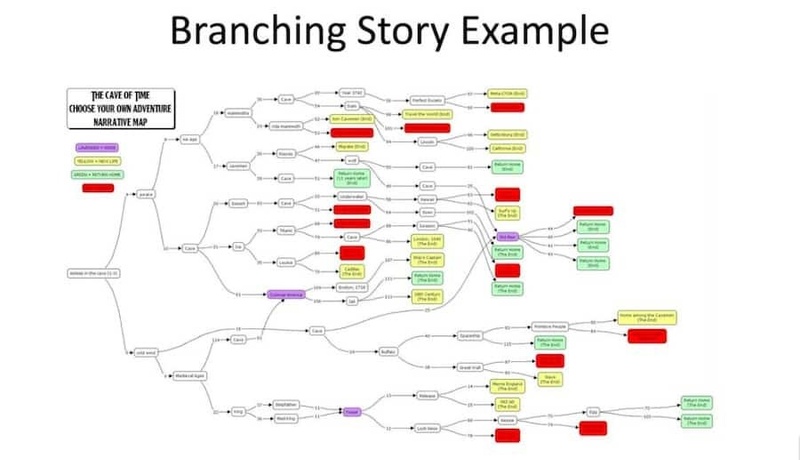
Preset structures collapse choices because fully branching narratives grow exponentially, and no author — human or AI-assisted — can write or maintain that volume of content. Two binary choices produce four paths; ten produce over a thousand. The standard mitigation is convergence: let branches diverge briefly, then funnel them back into a shared scene.
This constraint is well known among players themselves. Discussion of games with genuine branching notes plainly that "branching story lines grow exponentially in complexity, making it unmanageable for larger games. Mostly you have to settle with being given the illusion" of choice (
).AI-generated prose was supposed to break this ceiling — and partly does. As one analysis puts it: "Every choice in an RPG creates a branch. In old systems, branches were finite and pre-written. In an AI RPG, branches are infinite" (The Power of Choice: How Branching Narratives Work in AI RPGs, EchoQuest). But infinite prose is not infinite structure. A preset scenario still specifies who the antagonist is, what the stakes are, and roughly where the story lands. The AI can generate unlimited text inside that container — it cannot dissolve the container.
Three convergence patterns produce most of the disappointment:
- 🔀 The false fork. Two visibly different options produce two different paragraphs, then rejoin. Common in scenario-driven AI games where scene order is scripted.
- 🎭 The reskin. The same event occurs regardless, but the framing shifts to acknowledge your earlier choice — the ally becomes a rival, the outcome doesn't move.
- ⏳ The deferred payoff that never arrives. A choice is flagged as important, then never referenced again because nothing tracks it. This is where memory failure and structural failure become indistinguishable.
Doesn't Generative AI Solve the Branching Problem?
Generative AI removes the content bottleneck but not the state bottleneck — and state is what makes choices matter. A model can improvise a scene no author wrote, but if the system doesn't record that the scene happened and enforce its consequences, the improvisation is disposable.
The distinction shows up clearly across platform reviews. Comparisons of AI RPGs note that "traditional RPGs use branching dialogue trees with a finite number of paths. AI RPGs generate story content on the fly, meaning every" session diverges (Best AI RPG Games in 2026, howworks.ai). Yet the same review landscape repeatedly flags where that promise breaks. AI Dungeon, the format's originator, is described as "totally open-ended with no genre or setting limits" while simultaneously suffering because "longer sessions can lose narrative coherence" and offering "minimal game mechanics (no stats, dice, or structured rules)" (Best AI Story Games in 2026, aiga.io).
That combination — unlimited generation plus weak state tracking — produces a specific failure mode: the story accepts every choice and honors none of them. You can do anything, and nothing sticks.
A useful frame: treat plot control as a function of three independent layers, each of which can fail on its own.
| Layer | What It Governs | Failure Symptom |
|---|---|---|
| Generation | Whether the AI can write your unscripted action | "That's not an option" / refusal to deviate |
| State | Whether the world records what changed | Consequences never materialize |
| Structure | Whether the arc's destination can move | Same ending regardless of play |
Preset scenarios are typically strong on generation, weak on state, and locked at the structure layer. Open-ended sandboxes are strong on generation and structure but often weak on state — which is why they feel free but incoherent. The platforms that deliver actual agency are the ones that hold all three.
What Should You Look for in an AI Roleplay Game if You Want Real Plot Control?
The strongest predictor of real plot control is whether the platform maintains a persistent world state independent of the chat transcript — everything else follows from that. Prose quality, character variety, and visual polish are secondary; a beautiful story that forgets your rebellion is still a story you're not steering.
When evaluating any AI roleplay tool for agency specifically, weigh these dimensions:
- 🗺️ Open scenario vs. authored arc. Can you invent the premise, or must you play inside a pre-written one? Open-premise systems have no destination to defend.
- 🧠 Persistent memory across sessions. Consequences that survive only within one chat window aren't consequences. Cross-session persistence is the minimum bar for a long arc.
- 📜 World-state grounding. Can you attach documents, lore, or a running record that the system treats as canon and enforces?
- ⚙️ Mechanical enforcement. Do stats, resources, relationships, or rules exist that your choices consume and alter? Tools with "minimal game mechanics" have less to change (aiga.io).
- 🎚️ Model quality and switchability. Coherence over long arcs varies significantly by model, and locked single-model platforms give you no recourse when improvisation degrades.
- 🚪 Deviation tolerance. Does the system follow you off-script, or steer you back? This is the most direct test of whether a preset arc is quietly in charge.
An evaluation framework worth applying: score each candidate on Premise Freedom, State Persistence, Consequence Propagation, and Deviation Tolerance. A tool that scores high on premise freedom but low on persistence gives you a blank page that forgets — fun for an hour, hollow by hour three. A tool that scores high on persistence but low on premise freedom gives you a well-remembered rail. You need both.
Which AI Roleplay Platforms Give Players the Most Control Over the Plot?
The platforms offering the most genuine plot control are those combining open premises with durable state — but they trade off sharply against setup effort, structure, and how much authored content you get for free. Below is a balanced comparison of leading options as of 2026.
-
Jenova Roleplay Game Master — A managed roleplay agent on the Jenova platform built around unlimited memory, character consistency, and complete creative freedom to explore any scenario you imagine. Its specific strength for plot control is that there is no preset arc to protect: you define the premise, and because story state persists across sessions and attached documents ground the world as canon, decisions accumulate rather than evaporate. Access to multiple frontier models from OpenAI, Anthropic, Google, and others matters here too, since long-arc coherence varies by model. Honest limitations: it is prose-driven with no illustrated scenes or dice-based mechanical enforcement, it offers less low-level prompt surgery than a self-hosted stack, and Jenova's authored game-category scenarios — such as The Mansion or Love Island — are themselves preset premises, which suits players who want a starting frame rather than a blank page.
-
AI Dungeon — The original open-ended sandbox, still the benchmark for premise freedom: "totally open-ended with no genre or setting limits," with Story Cards and "large context windows for long continuity" (aiga.io; Dunia). The trade-off is coherence and structure — "longer sessions can lose narrative coherence" and it offers "minimal game mechanics (no stats, dice, or structured rules)" (aiga.io). Maximum freedom, weakest enforcement.
-
Dunia — Built explicitly around interactive fiction rather than chatbot behavior, with world definition, an editor, branching play, and publishable worlds. Its own positioning emphasizes control: "You can move fast with the platform's one-click world generation, or stay hands-on in the editor and shape the setting yourself," aimed at creators who care about "long-form consistency, recurring NPC behavior, and world rules that don't wobble halfway through an arc" (Dunia). Its stated limitation: "If you want an AI companion app, this isn't really that."
-
Friends & Fables — The strongest mechanical enforcement on this list. It offers "a proper TTRPG experience with real game rules" and "an AI game master that enforces D&D 5e mechanics," tracking combat and character progression (aiga.io). Real rules mean real consequences — but it is "strictly TTRPG. Not great for freeform storytelling or non-RPG genres" and is "locked to D&D 5e rules, which limits flexibility."
-
Character.AI — The easiest entry point and the weakest fit for plot control specifically. It is "dialogue only. No game mechanics, world-building, or scene progression," and while it leads on immediate character chemistry, "long-form continuity takes work" and "content guidelines can feel restrictive for creative work" (aiga.io; Dunia). Excellent for conversation, poor for authoring outcomes.
| Feature / Dimension | Jenova Roleplay Game Master | AI Dungeon | Dunia | Friends & Fables | Character.AI |
|---|---|---|---|---|---|
| Premise freedom | Any scenario you imagine | Fully open-ended | Define or generate your world | Locked to D&D 5e framing | Character-chat framing |
| State persistence | Unlimited, cross-session | Story Cards + large context | World rules + editor | Campaign + character progression | Limited; perks on paid tier |
| Mechanical enforcement | Narrative only | Minimal (no stats/dice) | Branching play, world rules | Full D&D 5e rules enforced | None |
| Deviation tolerance | High — no authored arc | High | Medium (world-bounded) | Low (rules-bounded) | Low |
| Model choice | Multiple frontier models | Multiple models by tier | Platform models | Platform model | Proprietary only |
| Pricing | Free tier; Plus from $20/mo | Free base; paid tiers unlock best models/context | Free to start; subscription for heavy use | Paid tiers | Free + c.ai+ |
| Best For | Long arcs where your choices define the plot | Chaotic open sandboxing | Authored worlds others can replay | Rules-driven consequence | Fast character conversation |
Pricing and features reflect the state of these products in 2026 and may change; verify current details on each provider's site.
How Does Persistent Memory Turn a Choice Into a Consequence?
Persistent memory converts a choice into a consequence by making the changed world state retrievable at the moment it becomes relevant — potentially hundreds of turns later. Without it, "irreversible" decisions are only irreversible until they scroll out of the model's context window.
The mechanism is worth being precise about. A language model reconstructs your story from whatever text sits in its working context on each turn. When you burn a bridge in scene four, that event exists as a few sentences buried in transcript. By scene sixty, those sentences may be gone — and the model, generating fluently regardless, will happily narrate you crossing the bridge. Nothing "overruled" your choice. The system simply never encoded it as state.
Platform reviews consistently identify this as the dividing line. Analysis of roleplay tools with memory notes that "most AI roleplay apps reset every session — characters drift, plotlines collapse, canon breaks at session three" (AI Roleplay With Real Memory, Fostera). The failure is described as canon breaking, not as forgetting — which is the correct framing. A forgotten consequence and a contradicted consequence are the same event from the player's seat.
Three architectural properties separate systems where choices stick from systems where they don't:
- Cross-session persistence. State survives closing the app. Without this, every long campaign restarts from partial amnesia.
- Retrieval on relevance. The right fact reaches the model at the right turn, rather than everything competing for one finite prompt.
- Canon grounding. Attached documents or lore records that the system treats as authoritative, overriding the model's improvised guesses.
In practice, this is why the same choice can feel weightless on one platform and load-bearing on another — even when both generated equally good prose in the moment.
How Do You Set Up an AI Roleplay Session Where Your Choices Actually Drive the Plot?
You get real plot control by refusing to inherit a destination — define an open premise, establish the stakes and factions yourself, then record consequences as canon as they happen. The specifics differ by platform; the sequence does not.
With Jenova's Roleplay Game Master (open-premise approach):
- Open the Roleplay Game Master agent.
- Define a situation rather than a plot — set the world, the pressures, and the unresolved tensions, but no intended ending:
"Run an open political intrigue campaign in the port city of Halverin. Three factions compete for the harbor: the Merchant Assembly, the Ashcloak smugglers, and a decaying noble house. I play an unaffiliated dockworker. There is no predetermined outcome — the city's fate follows from my actions. Never steer me toward a planned storyline; let consequences emerge."
- Attach a lore document with your factions, map, and key figures so the world is grounded canon rather than improvised each turn.
- Add an explicit consequence rule up front:
"Track a running world state: who holds the harbor, who is dead, who owes whom. Enforce it. If my actions make an outcome impossible, it stays impossible."
- Play. Story state and character consistency persist across sessions, and you can switch the underlying model if long-arc coherence starts slipping. The agent is available on a free tier, with paid plans starting at $20/month for higher usage.
- Periodically promote major turning points into your attached lore document so early choices become permanent canon rather than perishable transcript.
With AI Dungeon (sandbox approach):
- Start a custom scenario rather than a published one, so no authored arc is loaded.
- Write your premise into the opening prompt with explicit "no predetermined ending" framing.
- Create Story Cards for factions, locations, and status flags — these are your manual state layer.
- Update Story Cards after major decisions; the system will not do this for you.
- Trim or edit AI output that quietly reverses a consequence, before it becomes the new baseline.
With Friends & Fables (rules-driven approach):
- Start a campaign and accept that the D&D 5e framework will bound your options.
- Lean into mechanical consequence — resources spent, HP lost, and relationships shifted are enforced rather than narrated.
- Use homebrew world-building tools to author the setting even though the rules are fixed.
Both open-premise and rules-driven routes deliver genuine consequence; they differ in what enforces it. Narrative systems enforce through persistent state and canon; TTRPG systems enforce through mechanics. Preset story scenarios enforce through neither — which is precisely why they feel hollow.
What Do Interactive Narrative Researchers Say About Player Agency?
Researchers consistently find that agency is a matter of perceived relevance and decision impact rather than option count — which explains why preset AI stories can offer endless dialogue choices and still feel controlling.
"While many forms of storytelling are well-suited to the domain of entertainment, interactive storytelling remains unique in its ability to also afford its audiences a sense of having influence over what will happen next. We propose that the key to encouraging such feelings of agency in interactive stories lies in managing the perceived relevance of the decisions that players make while they play."
"By actively choosing among several potential consequences of a given player decision, the proposed system highlights the relevance of each decision while accommodating for its players' preferences over potential story content."
— Thue, Bulitko, Spetch & Romanuik, Player Agency and the Relevance of Decisions, ICIDS (Springer)
The broader literature converges on the same conclusion from a different angle. Work on agency in interactive narrative design argues that treating agency as mere freedom of action is insufficient — agency "is often narrowly understood as a user's freedom to either perform virtually embodied actions or alter the mechanics of" the system, a framing the authors extend toward richer, meaning-oriented dimensions (AAAI). Separately, research classifying agency in interactive narrative proposes distinguishing the player's roles as audience, actor, and author — a useful lens here, since preset AI stories reliably deliver the first two and withhold the third (Player Agency in Interactive Narrative: Audience, Actor & Author, Edinburgh Research Explorer). More recent HCI work reinforces that "interactive structure and narrative depth often have a more profound influence" on player experience than surface presentation (Action Before Empathy: How Player Agency Shapes Experience, ACM Digital Library).
Practitioner analysis lands identically. Reviewers testing 2026 platforms warn that "some platforms are still basically chatbot wrappers, and some are trying to become real creative systems," and that "if a tool misses even one" of memory, character consistency, or tonal control, "long arcs usually get mushy fast" (Dunia). Both camps arrive at the same place: agency is engineered through structure and state, not granted through a longer menu.
What Are the Most Common Mistakes That Kill Player Agency?
The most common mistake is starting from a published preset scenario and then expecting to redirect it — followed closely by never converting decisions into recorded canon. Each has a direct fix.
| Mistake | Why It Kills Agency | The Fix |
|---|---|---|
| Starting from an authored scenario | The arc has a destination it will steer toward | Begin with an open premise you define |
| Choosing from offered options only | Menu selection is the narrowest form of agency | Write unlisted actions; test deviation tolerance early |
| Never recording consequences as canon | Choices live only in transcript and get evicted | Promote turning points into an attached lore document |
| Assuming acknowledgment equals consequence | The AI naming your choice isn't the same as enforcing it | Demand a tracked world state and check it periodically |
| Letting a quiet reversal pass | The contradicted state becomes the new baseline | Correct or regenerate immediately when canon breaks |
| Expecting mechanics where none exist | Narrative-only tools have no stats to change | Either add explicit tracked variables or use a rules-enforcing platform |
| Playing one long unbroken session | Late-context coherence degrades before the window fills | Periodically re-ground the world state in a fresh summary |
Are Preset AI Stories Ever the Better Choice?
Yes — preset scenarios are the better choice when you want a strong opening hook, a defined genre frame, and immediate momentum without doing setup work. The failure mode described throughout this article only becomes a problem when you expect authorial control from a format designed to deliver a curated experience.
Preset stories excel at three things open sandboxes struggle with:
- ⚡ Zero-friction starts. A blank premise is intimidating; an established situation with stakes already loaded gets you playing in one message.
- 🎯 Tonal coherence. Authored scenarios maintain a consistent atmosphere because someone designed for it. Open sandboxes drift tonally as they improvise.
- 📖 Craft in the setup. A well-constructed hook — an amnesiac waking somewhere hostile, a countdown already running — does narrative work that ad-hoc premises rarely match.
Jenova's own game-category agents illustrate the trade honestly. The Mansion drops you into a memory-wiped survival mystery; Love Island places you among eight strangers with emergent social dynamics; Civilization hands you a nation with rivals pursuing their own ambitions. These are preset premises by design — and that's the point. The distinction that matters is preset premise versus preset plot: a fixed starting situation with an open outcome preserves agency, while a fixed sequence of beats does not.
The practical rule: choose preset when you want a strong situation handed to you and are happy to explore within it. Choose open-premise when the story's destination is the thing you came to author. The mistake is not picking preset — it's picking preset and then being surprised the ending was already waiting.
The throughline across every point in this guide is that plot control is a property of architecture, not prose. AI roleplay stories give players real agency when there is no authored destination to defend, when the world records what you changed, and when that record reaches the model at the exact turn your decision should bite. Anything less produces beautiful, responsive, memorable text about a story you were never actually driving.