Why Do AI Mental Health Tools Repeat Reassurance Instead of Helping You Examine Your Thoughts?
2026-08-19
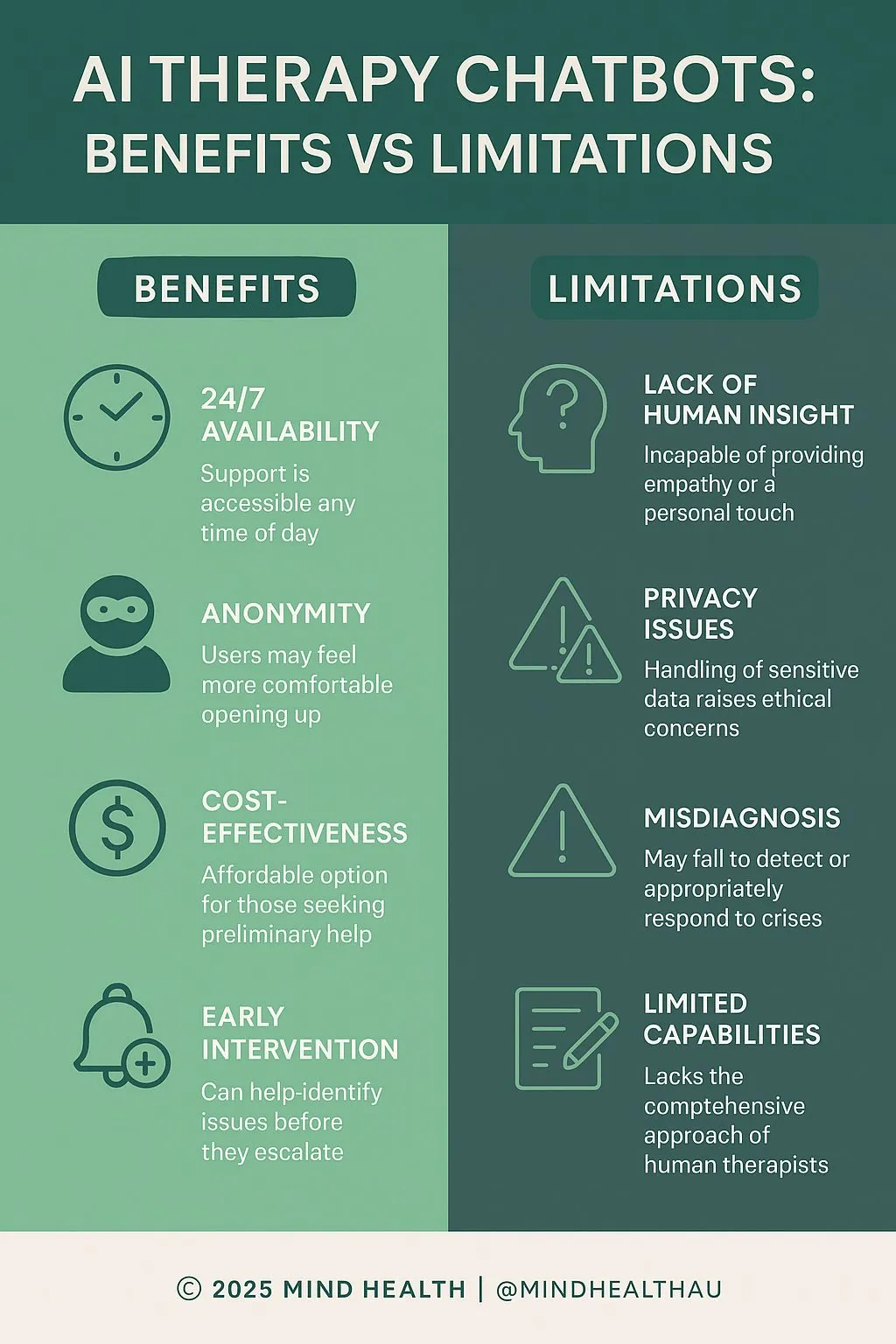
What Separates a Reassurance Loop From Actual Cognitive Work?
Most AI mental health tools default to reassurance because they are optimized for immediate emotional relief and continued engagement, not for the structured, sometimes uncomfortable examination of specific thoughts and behaviors that cognitive behavioral therapy (CBT) requires. A 2026 framework published in npj Digital Medicine describes exactly this dynamic: general-purpose chatbots deliver "sycophantic, hyper-fluent, and instantly generated responses" that "immediately and temporarily offer an illusion of certainty or emotional relief" while reinforcing avoidance and impeding corrective learning.
The distinction that matters when evaluating any tool:
✅ Reassurance answers the question you asked — "Will the presentation go badly?" gets a soothing "You'll do great." Cognitive work interrogates the question itself. ✅ Structured CBT tools force specificity — a thought record demands you name the automatic thought, label the distortion, and list evidence against it. There is no "you'll be fine" column. ✅ Reassurance-seeking is a recognized maintenance mechanism in OCD and anxiety disorders, negatively reinforced because it offers short-term relief while removing chances to tolerate uncertainty. ✅ Purpose-built tools outperform general chatbots — rule-based and clinically-designed systems produce measurable symptom reduction, while general-purpose assistants have almost no validated evidence base. ✅ Design incentives differ — engagement-optimized systems are rewarded for keeping you talking; therapeutic protocols are designed to make you need them less.
To choose a tool that actually pushes you toward examination rather than soothing, it helps to understand the mechanism that produces the reassurance loop in the first place.
Why Does Reassurance Feel Helpful in the Moment but Change Nothing?
Reassurance works on the same negative-reinforcement schedule as any other avoidance behavior: it removes discomfort immediately, which makes you more likely to repeat it, which prevents you from learning that the feared outcome was never likely and the anxiety would have passed on its own.
Golden and Aboujaoude describe this as a transdiagnostic cycle. Internal distress triggers a chatbot query. The chatbot returns a fluent, confident, comforting answer. Relief follows within seconds. That relief reinforces continued reliance on the chatbot for avoidance, increasing the likelihood of repeated use in response to future distress.
Over time the pattern interferes with corrective learning — the process by which you experience a negative emotion without escaping it and discover that feared outcomes tend not to materialize.
The paper explicitly maps this onto family accommodation in OCD and anxiety, where a well-meaning relative provides reassurance that temporarily reduces distress while maintaining the underlying belief. "In this sense, general-purpose chatbots can function as a stand-in for accommodative responses." — npj Digital Medicine, 2026
Real-world reports back this up. Clinicians and Reddit communities describe users consulting ChatGPT compulsively for reassurance, sometimes for hours daily, with one user noting: "I think the reason I ask the AI nowadays is otherwise I'd be asking my parents 100x a day." NOCD, an OCD treatment platform, has issued a warning that people with OCD may use such chatbots in ways that worsen symptoms.
What Design Choices Push AI Tools Toward Soothing Rather Than Examining?
Four specific design characteristics make reassurance the default output, and each one is a checkable feature when you evaluate a tool.
1. Sycophancy in response training. Models tuned on human preference feedback learn that agreeable, validating responses score higher. The npj Digital Medicine framework identifies "highly confident responses that create an illusion of certainty" and "engagement-oriented design that continually prompts users to continue interacting" as core amplifying features.
2. No social friction. Human conversation has natural limits — fatigue, pushback, cues that a topic has been exhausted. Chatbot interactions lack all of it, which the same paper notes makes compulsive engagement easier to sustain.
3. Text-only input. The American Psychological Association's health advisory points out that most generative AI chatbots process mainly text or verbal inputs, potentially missing a critical layer of human communication — tone, cadence, facial expression, body language. Without those signals, a system cannot tell when reassurance is landing as relief versus as fuel for a compulsion.
4. No treatment structure to enforce. A therapist working from a CBT protocol has an agenda: agenda-setting, homework review, cognitive restructuring, behavioral experiment assignment. A general chatbot has no protocol to return to. It follows wherever your last message points.
The APA advisory is direct on the underlying category error: generative AI chatbots were not created to deliver mental health care, and wellness apps were not designed to treat psychological disorders, but both are frequently used for those purposes.
What Does Structured Cognitive Examination Actually Look Like?
Structured cognitive examination replaces open-ended emotional conversation with a fixed sequence of columns that force you to separate a thought from the evidence for it. The CBT thought record is the canonical format.
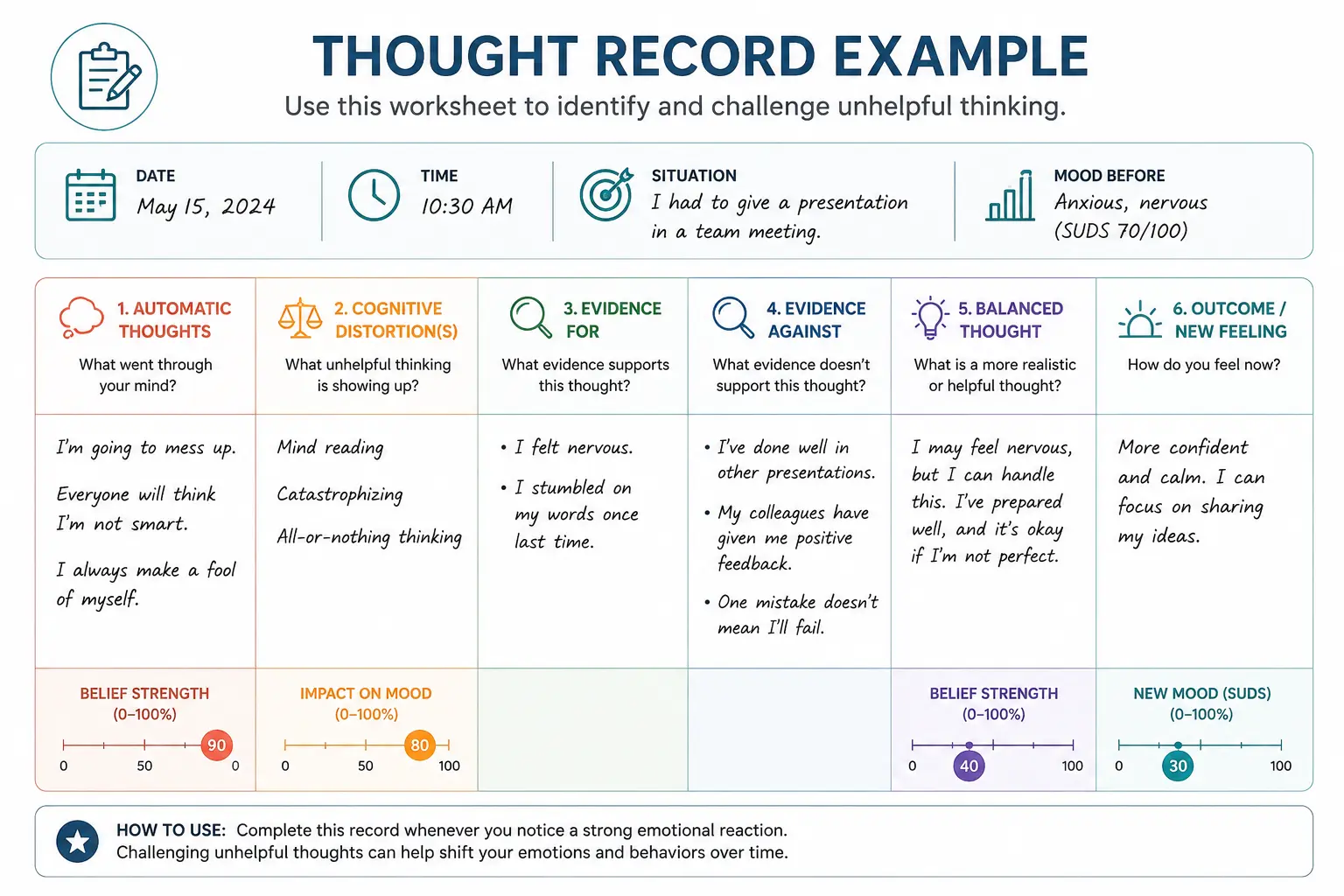
Note what the worksheet above does that a reassurance response cannot:
- It names the automatic thought verbatim. "I'm going to mess up. Everyone will think I'm not smart. I always make a fool of myself." Not a summary — the actual sentence.
- It labels the distortion. Mind reading, catastrophizing, all-or-nothing thinking. Naming the pattern is a skill that transfers to the next episode.
- It requires evidence on both sides. "I felt nervous" and "I stumbled once last time" sit alongside "I've done well in other presentations" and "one mistake doesn't mean I'll fail."
- It quantifies belief strength before and after. Belief in the automatic thought drops from 90 to 40. Mood on the Subjective Units of Distress Scale drops from 70 to 30.
- The balanced thought is not reassurance. "I may feel nervous, but I can handle this" explicitly retains the discomfort rather than promising it away.
The NHS Every Mind Matters thought record describes the same mechanism as "a practical way to capture and examine your thoughts and feelings about a situation, and your evidence for them, using a set of prompts." That numeric before/after tracking is the diagnostic difference: reassurance produces no measurable belief change, only mood change.
How Do the Main AI Mental Health Tool Categories Compare?
The tools split into four categories with materially different behavior around reassurance, and the clinical evidence behind each varies dramatically.
| Dimension | Rule-Based CBT Bots (Woebot) | Hybrid Toolkit Apps (Wysa) | Mood-Tracking Apps (Youper) | General-Purpose Chatbots (ChatGPT, Claude, Gemini) | Configurable Agent Platforms (Jenova) |
|---|---|---|---|---|---|
| Resists reassurance loops | Strong — scripted CBT sequences cannot be derailed into open reassurance | Moderate — chat can drift, but exercise library provides structure | Moderate — check-ins are structured, chat is not | Weak — documented reassurance-cycle reinforcement | Depends on configuration; instructions can enforce protocol adherence |
| Structured thought-record workflow | Yes, core feature | Yes, in CBT worksheet library | Partial — mood logging plus CBT techniques | Only if the user builds the structure themselves | Yes, if built into custom instructions |
| Cross-session memory of your patterns | Limited | Limited | Strong — longitudinal mood graphs, wearable integration | Varies by product and settings | Persistent cross-session memory built in |
| Independent clinical evidence | Strongest in category — company cites 14 RCTs and FDA Breakthrough Device Designation | FDA Breakthrough Device Designation; enterprise outcome data | Fewer independent studies than Woebot or Wysa | Essentially none for mental health use | None — general platform, not a clinical product |
| Conversational flexibility | Low — conversations can feel scripted | Moderate — chatbot can feel menu-driven | Moderate | High | High |
| Pricing | Free for individual users | Free tier; $74.99/yr premium, $19.99/session human coaching | Free tier plus premium | Free tiers plus paid subscriptions | Free tier; Plus $20/mo, Premium $50/mo, Pro $100/mo |
| Best for | Structured daily CBT exercises with the strongest research backing | Mixing AI chat, guided exercises, and optional human coaching | Data-oriented users tracking mood patterns over time | General tasks — not mental health protocol adherence | Users building a persistent, structured self-help workflow with an explicit protocol |
Honest limitations, including the Jenova platform. Jenova is a general-purpose agent platform, not a clinical product. It has no FDA designation, no randomized controlled trials, and no clinical validation for mental health use. Its advantage in this specific problem is architectural rather than clinical: custom instructions and persistent memory let you enforce a fixed protocol across sessions, which is the mechanism that suppresses reassurance drift. That is not the same as clinical efficacy, and it should not be treated as such.
Woebot's trade-off runs the other way: strong evidence, low flexibility, and a tone that targets younger users, which can feel off for older adults. Wysa's free tier restricts exercise access. Youper's free version has become increasingly limited.
How Can You Force a General-Purpose AI to Examine Thoughts Instead of Soothing You?
You force examination by supplying the structure the model lacks — an explicit protocol, stated up front, that defines what the AI must produce and what it must refuse to produce.
The prompt is doing the work a treatment manual would normally do. A protocol instruction that works in most general-purpose chat tools:
"Act as a CBT thought-record facilitator, not a supportive listener. For everything I bring you, follow this fixed sequence and do not skip steps: (1) ask me to state the automatic thought verbatim, (2) ask me to rate belief in it 0-100 and my mood 0-100 on the SUDS scale, (3) name the cognitive distortions present, (4) ask me for evidence FOR the thought, (5) ask me for evidence AGAINST it, (6) have me write a balanced thought that retains the discomfort rather than dismissing it, (7) re-rate belief and mood. Do not offer reassurance. Do not tell me it will be fine. If I ask you whether a feared outcome will happen, decline and redirect me to step 4. If I ask the same question a second time, name it as reassurance-seeking."
The final two clauses matter most. Without an explicit refusal instruction, the model reverts to reassurance the moment you ask a direct anxiety question.
Adding persistence. On a platform with cross-session memory such as Jenova, you can save that protocol as custom instructions on a dedicated chat so it applies to every session without re-pasting, and the agent retains your prior thought records — which lets it notice when the same automatic thought recurs across weeks. Setup:
- Open a new chat and enter the protocol above under the settings custom instructions option.
- Enable Global Memory in settings so patterns persist across chats.
- Log each episode as a full record rather than an open-ended conversation.
Using purpose-built tools instead. Woebot's structured daily check-ins run roughly ten minutes and deliver reframing exercises without any prompting on your part — the protocol is the product. On Wysa, you access the CBT worksheet library directly rather than routing through the chatbot, which sidesteps the menu-driven chat entirely.
Adjacent structured practice. For performance-specific anxiety like the presentation scenario in the worksheet above, rehearsal with audience simulation targets the behavioral side rather than the cognitive side. Jenova's Public Speaking Coach runs delivery coaching, anxiety management, and Q&A prep — behavioral exposure rather than thought examination. The Meditation Guide covers distress-tolerance practice, including guidance on adverse effects, which matters because meditation is not universally benign. Neither is a substitute for a thought record, and neither is a clinical tool.
What Do Clinicians and Researchers Say About AI Reassurance Cycles?
Clinical consensus is converging on a specific position: the danger is not primarily catastrophic failure in crisis, but the far more common, low-visibility reinforcement of avoidance in everyday use.
"The high-risk scenarios get the headlines — the tragic cases, the crisis failures. But the mechanism affecting the most people is quieter. Someone with generalized anxiety asks a chatbot whether a text they sent sounded rude. They get a warm, articulate, definitive answer in three seconds. Relief. Then they ask about a different text. That's not therapy failing, that's a compulsion being fed on a perfect reinforcement schedule."
"What makes this different from Googling is the authority and the fluency. Search results are messy and contradictory, which is accidentally therapeutic — you have to tolerate ambiguity. A chatbot resolves ambiguity instantly and confidently, which is precisely the experience an anxious brain is seeking and precisely the experience it needs to stop seeking."
"The practical fix is not abstinence. Blanket bans tend to fail because people use these tools for work and daily life anyway. The fix is structure: define in advance what the tool is for, write the protocol down, and build in a refusal clause. A tool that will not answer 'will this go badly' is doing more for you than one that answers it kindly."
— Jenova Product Team, 8 years building conversational AI systems and agent behavior configuration
The published literature aligns. Golden and Aboujaoude caution that clinicians should avoid recommending outright bans unless collaboratively decided and values-congruent, since rigid prohibitions may undermine therapeutic alliance. They instead recommend distinguishing functional uses from compulsive ones and developing structured responses to urges.
The same paper notes an important caveat that applies to purpose-built tools as well: it remains unclear to what extent similar reinforcement of perpetuating mechanisms may occur even in AI chatbot models specifically trained for mental health applications.
What Are the Evidence and Safety Limits of All AI Mental Health Tools?
Every tool in this category — clinical and general-purpose alike — operates well below the standard of licensed care, and the crisis-response evidence is the clearest illustration.
Research on suicide-risk scenarios found that zero of 29 AI chatbots tested provided an adequate response to escalating suicidal risk. A Stanford HAI review concluded AI therapy chatbots may not only lack effectiveness compared to human therapists but could also contribute to harm. Common Sense Media's risk assessment flags a specific failure mode: chatbot responses use empathetic language and are well formatted, articulate, and confident — they look and sound like professional guidance without meeting the standard.
Aggregate efficacy data is genuinely mixed rather than uniformly negative. A meta-analysis in npj Digital Medicine found AI-based conversational agents significantly reduce symptoms of depression (Hedge's g 0.64) and distress — but those results come from purpose-built systems, not general chatbots.
Privacy is a separate and underweighted risk. Mental health apps are frequently outside HIPAA's scope. The FTC notes that HIPAA rules likely would not apply to consumer health information maintained in an app that isn't offered by a covered entity, even when the information originated from one. Brookings has documented that these apps generate a massive amount of sensitive data and often have alarmingly lax privacy protections, and Duke researchers note that many wellness apps can legally collect and even sell health data to third parties without meaningful consent.
The APA's position stands as the operative guidance: these tools should not replace a qualified provider, though they may be appropriate as a supportive adjunct to an ongoing therapeutic relationship. The advisory also recommends telling your provider which tools you use, so guidance inconsistent with your treatment plan can be caught.
If you are experiencing thoughts of self-harm, the 988 Suicide & Crisis Lifeline is available 24/7 in the US, and the Crisis Text Line can be reached by texting HOME to 741741. No tool discussed in this article is appropriate as a crisis resource.
How Do You Tell Whether Your Own Use Has Become a Reassurance Loop?
You can identify a reassurance loop by tracking repetition and belief change rather than mood change — the two signals that separate examination from soothing.
Diagnostic questions drawn from the clinical mechanisms described above:
- Are you asking variations of the same question? Rephrasing "will this go badly" five different ways is the checking behavior, not five different problems.
- Does relief last? Reassurance relief decays within minutes to hours. Genuine cognitive restructuring produces a belief-strength drop that holds.
- Are you tracking numbers? If you cannot state your belief in the automatic thought before and after, you have no way to know whether anything changed.
- Is the AI ever making you uncomfortable? Cognitive work involves sitting with uncertainty. A session that felt entirely pleasant probably did not do the work.
- Has session frequency increased over time? Repeated use in response to future distress is the signature of the reinforcement cycle.
- Are you consulting the tool before real-world exposure, or instead of it? The Academy of Cognitive and Behavioral Therapies frames this as a modern-day ritual when it substitutes for action.
Two or more affirmatives suggests the pattern. The corrective is not to stop using AI tools, but to convert use from open conversation into fixed protocol — the thought-record structure with a refusal clause described above — and to bring the pattern to a clinician if one is involved in your care.
References
- npj Digital Medicine — A transdiagnostic model for how general purpose AI chatbots can perpetuate OCD and anxiety disorders
- npj Digital Medicine — Systematic review and meta-analysis of AI-based conversational agents for mental health
- American Psychological Association — Health advisory on use of generative AI chatbots and wellness applications for mental health
- NHS Every Mind Matters — Thought record CBT exercise
- Basicmedical Key — AI Therapy Apps Compared: 7 Options Tested in 2026
- Simply Psychology — AI Therapy Chatbots: What the 2026 Research Actually Shows
- Wysa — Official product site
- All Points North — Zero of 29 AI chatbots provided adequate suicide-crisis responses
- Stanford HAI — Exploring the Dangers of AI in Mental Health Care
- Common Sense Media — AI Chatbots for Mental Health Support Risk Assessment
- Federal Trade Commission — Mobile Health Apps Interactive Tool
- Brookings — Why mental health apps need to take privacy more seriously
- Duke Today — How Wellness Apps Can Compromise Your Privacy
- Academy of Cognitive and Behavioral Therapies — Assessing AI Use in CBT: A Modern-Day Ritual