Which Type of AI Tool Is Most Recommended for Structured Self-Help Exercises During Work Stress and Mild Anxiety?
2026-08-19
Which Design Features Separate Structured AI Self-Help Tools From General-Purpose Chatbots?
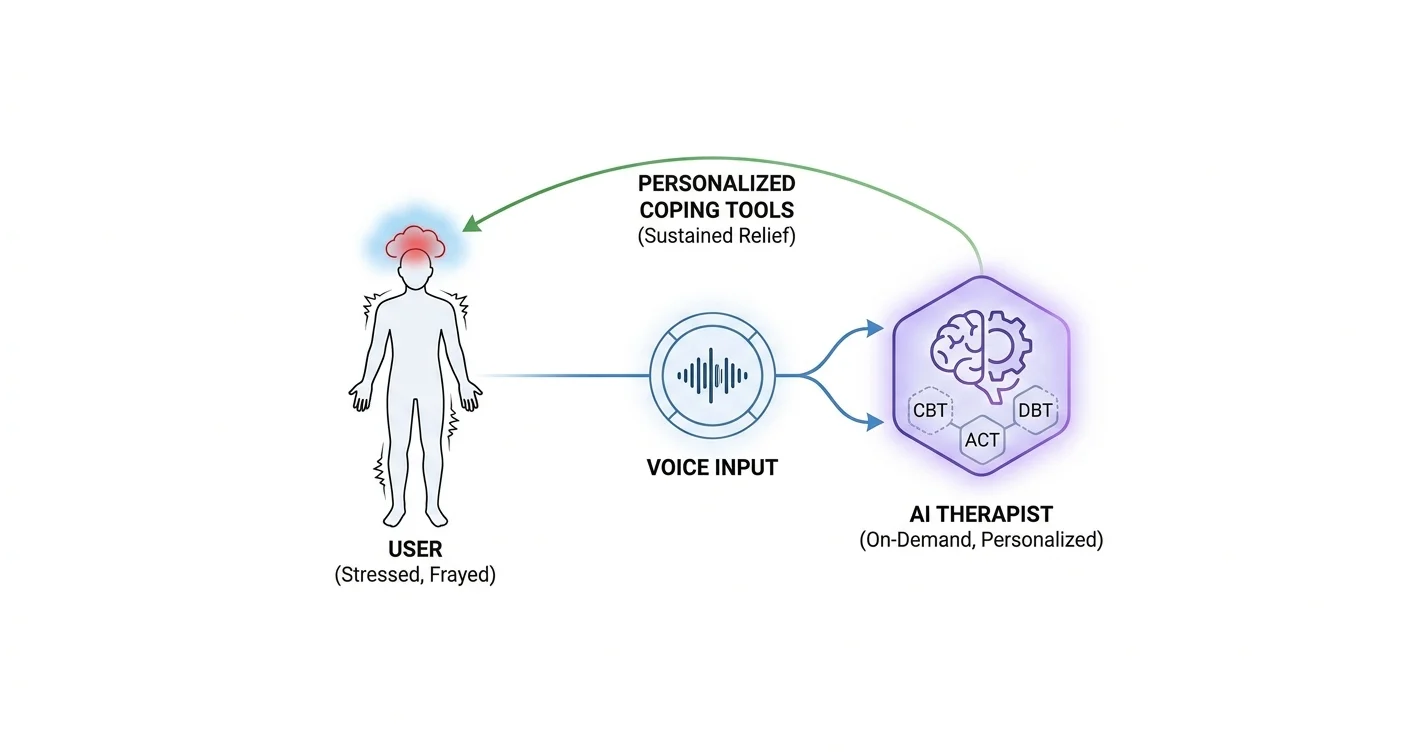
For structured self-help exercises during work stress and mild anxiety, the most recommended category is a protocol-driven AI tool built on CBT frameworks — one that walks you through a defined exercise sequence rather than free-form conversation. In practice, this means clinically-designed chatbots like Wysa, structured CBT programs like Woebot, or a specialized AI agent configured with explicit therapeutic protocols. General-purpose chatbots can help you organize thoughts, but the American Psychological Association warns that they are designed to agree with you rather than challenge distorted thinking — the exact opposite of what a CBT exercise requires.
The design features that actually matter:
✅ Protocol adherence — the tool follows a fixed exercise structure (thought record, worry time, behavioral activation) instead of drifting into open chat ✅ Cognitive challenge, not validation — it asks "what evidence contradicts this thought?" rather than affirming your interpretation ✅ Session persistence — it tracks which exercises you completed and what patterns recurred across weeks ✅ Crisis routing — it explicitly escalates to human resources when distress exceeds the mild range ✅ Transparent limitations — it states what it cannot do, per APA advisory guidance
Choosing between these categories requires a clear framework — the differences are less about interface polish and more about whether the tool imposes structure or waits for you to supply it.
Why Does Work Stress Specifically Call for Structured Exercises Rather Than Open-Ended Venting?
Work stress responds well to structured exercises because it is typically maintained by identifiable thought-behavior loops that structured protocols are designed to interrupt. Venting relieves pressure in the moment but leaves the maintaining cycle intact.
Cognitive Behavioural Therapy rests on the principle that thoughts, feelings, and actions are connected, and that unhelpful thought cycles produce behaviors that reinforce the original thought. The NHS illustrates this with a simple example: the thought "no one wants to spend time with me" leads to withdrawal, which produces isolation, which confirms the thought.
Workplace stress follows the same architecture. A missed deadline generates "I'm not competent enough," which drives over-preparation and avoidance of visible tasks, which reduces opportunities to disconfirm the belief.
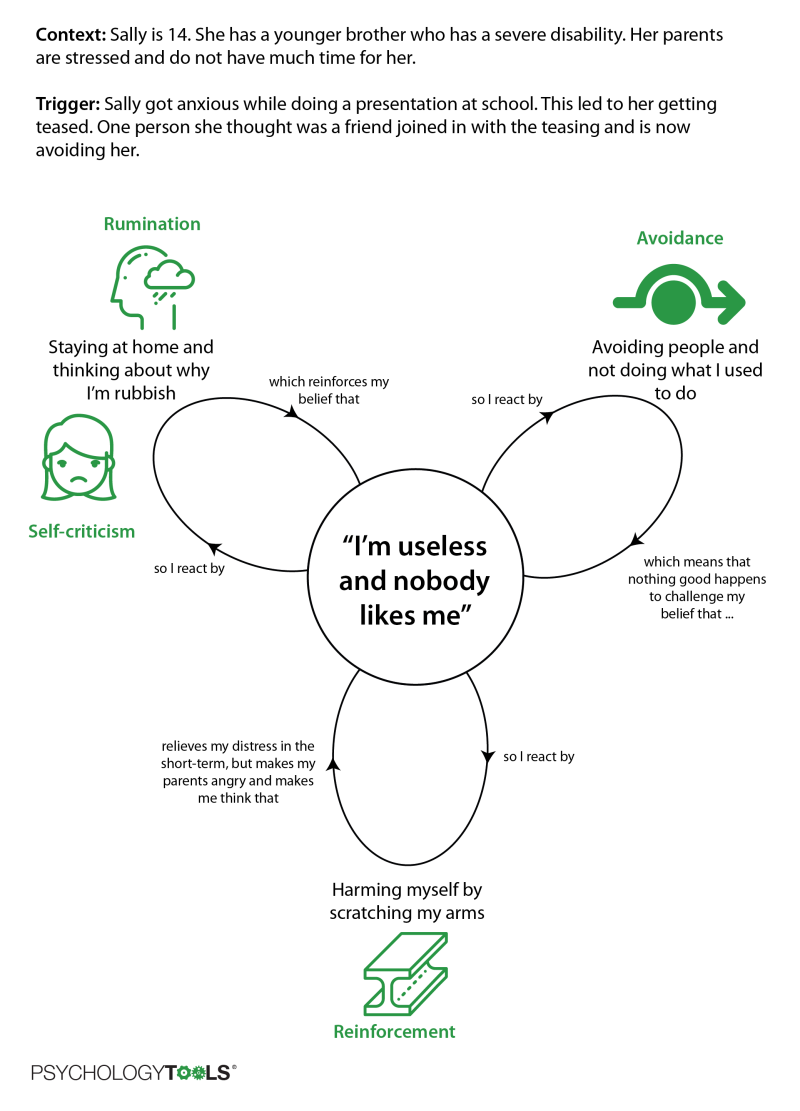
The diagram above maps a clinical case, but the structure generalizes directly to workplace patterns. Rumination becomes replaying a meeting all evening. Avoidance becomes declining the presentation. Self-criticism becomes the internal performance review that never ends. Each loop feeds the central belief.
The scale of the problem is documented. Maudsley Learning reports that 12.7% of all sickness absence days in the UK are attributable to mental health conditions, and that one in four people in the UK will experience a mental health problem. This is why CBT-based workplace interventions target specific mechanisms — stress management, emotional regulation, burnout prevention — rather than general reassurance.
What Should You Look for in an AI Tool for Structured Self-Help?
You should evaluate AI self-help tools across six dimensions: protocol structure, cognitive challenge capability, session memory, safety design, evidence base, and cost. Most tools perform well on two or three and poorly on the rest — the trade-offs are the whole decision.
Here is the evaluation framework used throughout this guide:
1. Protocol Structure (heaviest weight for this use case) Does the tool run a defined exercise from start to finish? A thought record has seven steps. A worry-time protocol has a fixed schedule. Tools that abandon the sequence when you go off-topic are not delivering structured self-help.
2. Cognitive Challenge Capability The APA is explicit that AI tends to agree with you and is designed to reinforce your perspective rather than challenge it. A tool that only validates cannot perform cognitive restructuring — the core mechanism of CBT.
3. Session Memory and Pattern Recognition Work stress recurs. A tool that recognizes "this is the third time this month a specific colleague triggered this thought" delivers something a single-session tool cannot.
4. Safety Design and Crisis Boundaries Every credible tool must route users toward human help beyond mild-to-moderate distress. Wysa states plainly that it is not designed to assist with crises including severe mental health conditions or suicidal ideation.
5. Evidence Base Independent, peer-reviewed evidence for the specific product — not just for CBT in general.
6. Cost and Access Friction Free tiers, subscription cost, and whether the tool is available at the moment stress spikes.
How Do the Main Categories of AI Self-Help Tools Compare?
The four main categories are clinical CBT chatbots, general-purpose AI assistants, specialized AI agents on multi-model platforms, and static digital CBT workbooks. Each optimizes for a different constraint.
| Dimension | Wysa | Woebot | General-Purpose Chatbot | Jenova Specialized Agents | Static CBT Workbook |
|---|---|---|---|---|---|
| Protocol structure | Strong — fixed CBT exercise library | Strong — chat-based structured programs | Weak — drifts unless user enforces structure | Configurable — depends on agent design and instructions | Strongest — fully fixed, no deviation |
| Cognitive challenge | Moderate — scripted challenge prompts | Moderate — scripted CBT reframing | Weak by default; improves with explicit prompting | Moderate — depends on agent instructions and prompting | Moderate — user must self-administer |
| Session memory | Yes, within app account | Yes, within app account | Varies by product and settings | Persistent cross-session memory on the platform | None |
| Human oversight | Yes — all care pathways include human oversight | Available through employer/health-system deployments | None | None | None |
| Independent evidence | 45+ peer-reviewed publications claimed; JMIR study of 1,213 users on coaching completion | Founded 2017 by clinical research psychologist Dr. Alison Darcy; ORCHA-certified, not FDA-approved | Not evaluated as a mental health intervention | Not clinically evaluated as a therapeutic intervention | Extensive evidence for CBT method; varies by workbook |
| Crisis handling | Explicit exclusion + escalation | Explicit clinical boundaries | Inconsistent | Not designed for crisis use | None |
| Pricing | Freemium; free tier available | Primarily employer/health-system distribution | Free to ~$20/mo | Free tier; $20/mo Plus tier | Free (NHS, Think CBT) |
| Best for | Anonymous, protocol-faithful daily CBT practice | Employer-provided structured wellness programs | Organizing thoughts before a therapy appointment | Adjacent skill work — presentation anxiety, meditation practice | Provider-assigned homework between sessions |
Reading the table: No single category wins outright. Wysa and Woebot lead on protocol fidelity and clinical grounding. Static workbooks lead on structure and cost but require self-discipline. General-purpose chatbots are the most available and the least reliable for this specific task. Specialized agents occupy a distinct position — they are strongest for the workplace skills that drive stress, not for the therapeutic exercise itself.
Which Specific Tools Are Strongest for CBT-Based Exercises?
Wysa is the strongest general recommendation for anonymous, protocol-faithful CBT practice, with Woebot as the leading option when your employer or health system provides it.
🧠 Wysa
Wysa positions itself as an anonymous, clinically-backed alternative to general AI. The company reports 6 million people helped, coverage across 105 countries, and 45+ peer-reviewed publications. A peer-reviewed JMIR study of 1,213 users found that access to AI support between coaching sessions made users nearly three times more likely to complete their coaching programme — 6.57 average sessions versus 0.55 for coaching alone.
Strengths: Anonymity removes stigma friction. Human oversight is built into care pathways. Wysa powers mindline.sg, a Singapore government digital mental health platform, providing 24/7 CBT-based support.
Limitations: Wysa states it is not designed for crises, cannot offer medical or clinical advice, and requires users to be 18 or older. The freemium model gates some content.
💬 Woebot
Woebot was founded in 2017 by clinical research psychologist Dr. Alison Darcy and was included in Newsweek's inaugural list of the World's Best Digital Health Companies. Its stated mission is chat-based AI wellness tools that address therapist shortages and scheduling friction.
Strengths: Explicit clinical research lineage. Structured, conversational CBT delivery.
Limitations: Woebot's own site notes that ORCHA certification does not denote FDA clearance or approval. Distribution is oriented toward organizations rather than direct consumers, so individual access may depend on your employer.
📋 Free Structured Workbooks
Before paying for anything, the NHS Every Mind Matters CBT guides cover reframing unhelpful thoughts, worry time, facing fears, and problem-solving at no cost. Think CBT publishes free downloadable worksheets used in NHS therapy contexts.
A contrarian note: a free NHS worry-time protocol executed consistently for three weeks will likely outperform an expensive AI subscription used sporadically. The technology is not the active ingredient — the repeated exercise is.
How Do You Actually Run a Structured Exercise With an AI Tool?
Running a structured exercise requires you to specify the protocol upfront rather than describing your feelings and hoping the tool responds usefully. This single behavioral change separates useful sessions from circular ones.
With a clinical CBT chatbot (Wysa or Woebot):
- Open the app and select a specific exercise rather than starting free chat — look for "reframe a thought," "worry time," or "thought record."
- Complete the full sequence even when it feels mechanical. The mechanical quality is the point.
- Log the outcome so the tool can surface patterns later.
With a general-purpose AI assistant, prompt for protocol explicitly:
"Walk me through a standard CBT thought record, one step at a time. Do not skip steps and do not offer reassurance. Start with the situation, then the automatic thought, then the emotion and intensity rating."
Then, critically, request challenge rather than agreement — the APA specifically recommends asking AI to challenge your thinking or provide alternative perspectives, since a request for a single perspective will usually produce agreement:
"What evidence contradicts this thought? Give me three alternative interpretations, including one that is less favorable to me."
Where specialized agents fit — the adjacent-skill approach:
Work stress often has a concrete trigger. If yours is presentations, Public Speaking Coach handles anxiety management alongside delivery coaching and audience simulation. If yours is difficult conversations with a manager, Negotiation Coach runs role-play simulations for salary talks and conflict scenarios. If you are building a downregulation practice, Meditation Guide covers technique matching and practice programs across traditions.
These agents run on the Jenova platform, which provides persistent cross-session memory — useful because the same trigger tends to recur monthly. They are not therapeutic tools and are not clinically evaluated as mental health interventions. Their value is upstream: reducing the frequency of the situations that generate the stress in the first place.
Example prompt for the adjacent-skill approach:
"I get intense anxiety before status meetings with my director. Help me build a five-minute pre-meeting routine and run three simulated versions of the meeting where you play a skeptical director."
What Do Psychologists Say About Using AI for Mental Health Support?
Psychologists broadly endorse AI as a supplement for skill practice and thought organization while warning firmly against treating it as a replacement for professional care. The APA's 2025 health advisory represents the clearest consensus position available.
The APA's guidance names four specific failure modes: AI tends to agree with users, AI is designed to maximize engagement rather than set therapeutic limits, AI sounds confident when wrong, and AI can simulate the feeling of being known without any actual clinical understanding. The advisory adds a line worth memorizing: feeling better does not always mean getting better.
"The most common mistake we see with AI self-help isn't overuse — it's unstructured use. Someone opens a chat during a stressful afternoon, describes what happened, receives sympathetic validation, and closes the app feeling temporarily lighter. Nothing in that interaction resembles a CBT exercise. No thought was identified, no evidence was examined, no behavioral experiment was designed. The relief is real but it evaporates by the next trigger."
"Our recommendation is to treat the AI as a protocol executor rather than a conversation partner. Name the exercise, demand the full sequence, and explicitly instruct the model to challenge rather than affirm. Users who do this report qualitatively different sessions — harder, less pleasant, and considerably more useful."
"The boundary also has to be stated plainly. These tools are appropriate for work stress and mild anxiety. They are not appropriate for crisis, for diagnosis, or for anything involving thoughts of self-harm. That is not a legal disclaimer, it is an operating limit."
— Jenova Product Team, 6 years building specialized AI agents across health, learning, and workplace domains
When Should You Stop Using AI Self-Help and Contact a Professional?
You should stop and contact a human professional whenever distress exceeds the mild-to-moderate range — and the threshold is lower than most people assume. The APA states without qualification: do not rely on AI in a crisis.
Seek immediate human help if you or anyone else:
- Has thoughts of harming yourself or another person
- Has urges to self-harm
- Is hearing or seeing things others do not
- Is holding strong distressing beliefs others do not share
In the US, call 911, or text or call 988 (the Suicide and Crisis Lifeline), or go to the nearest emergency department.
Beyond crisis, several softer signals warrant professional consultation. The APA advises watching for whether AI chat sessions interfere with sleep, hobbies, school, work, or social interaction, and being highly skeptical if an AI suggests pulling away from real-world relationships. Research cited in the advisory documents emotional dependence harms from social chatbots and sycophantic AI decreasing prosocial intentions.
One more practical point: the APA recommends being honest with your mental health professional if you are using AI for support, so they can check that what you are learning aligns with your treatment goals. Also note that information shared with AI is not private — chatbots are owned by corporations and data may be used for model training or marketing.
Which Tool Should You Choose Based on Your Situation?
The right choice depends on three variables: whether your employer provides a tool, whether you are already in therapy, and whether your stress has an identifiable trigger.
| Your situation | Recommended primary tool | Why |
|---|---|---|
| Mild work stress, no therapy, want anonymity | Wysa | Anonymous, protocol-faithful, free tier, human oversight in care pathways |
| Employer offers a mental health app | Woebot or the provided tool | Clinical grounding plus organizational safety infrastructure |
| Already working with a therapist | Free NHS or Think CBT worksheets | Homework between sessions, no conflicting guidance |
| Budget is zero and discipline is high | NHS Every Mind Matters guides | Structured, evidence-backed, no cost |
| Stress traces to a specific work skill | Specialized AI agent for that skill | Addresses the trigger rather than the aftermath |
| Any crisis-range distress | Human professional, 988, or emergency services | AI is explicitly out of scope |
The honest summary: clinical CBT chatbots are the most recommended category for structured self-help exercises during work stress and mild anxiety, because they combine protocol fidelity, clinical design lineage, and explicit safety boundaries. Specialized AI agents are a strong complement for upstream skill work but are not therapeutic tools. General-purpose chatbots are the weakest option for this specific job despite being the most convenient — their default agreeableness undermines the mechanism that makes CBT work.
References
- American Psychological Association — Guide to Navigating AI-Generated Advice Thoughtfully
- American Psychological Association — Artificial Intelligence, Wellness Apps Alone Cannot Solve Mental Health Crisis
- NHS Every Mind Matters — Online Self-Help CBT Techniques
- Maudsley Learning — CBT for Workplace Wellbeing, Work-Related Stress and Anxiety
- Wysa — Everyday Mental Health: Clinical Evidence, Scale, and Safety Disclaimers
- Woebot Health — Philosophy of Care, Founding, and Certification Notes
- Think CBT — Cognitive Behavioural Therapy Worksheets and Exercises
- Cheng, M., et al. (2026) — Sycophantic AI Decreases Prosocial Intentions and Promotes Dependence, Science
- Laestadius, L., et al. (2024) — Mental Health Harms from Emotional Dependence on Social Chatbots, New Media & Society
- Dohnány, S., et al. (2026) — Feedback Loops Between AI Chatbots and Mental Health, Nature Mental Health
- Wang, L., et al. (2025) — Evaluating Generative AI in Mental Health: Systematic Review of Capabilities and Limitations, JMIR Mental Health
- Rahsepar Meadi, M., et al. (2025) — Ethical Challenges of Conversational AI in Mental Health Care: Scoping Review, JMIR Mental Health