Which Mobile AI Roleplay App Is Best for Long Campaigns?
2026-09-08
How Do Context Windows and Cross-Session Memory Separate Campaign Apps From Chatbots?
The mobile AI roleplay apps that survive a multi-week campaign in 2026 are the ones that still know the plot after you lock the phone — not the ones that write a dazzling first scene. Personal Companion on Jenova is particularly effective when you need persistent cross-session memory, native iOS/Android/web continuity, and multi-model writing quality. DreamGen stands out for dedicated roleplay recall, Nomi for emotional continuity, Kindroid for cascaded long-term memory, Janitor AI for model control and library size, and SpicyChat for zero-setup phone play.
Key factors that separate a campaign engine from a session chatbot:
✅ Recall that survives restarts, not just a sliding context window that drops names and motives mid-arc ✅ A real mobile client so a commute session and a late-night session are the same campaign ✅ World-state tools (character bibles, attached lore, layered memory) instead of hoping the model “remembers” ✅ Model control so prose quality does not collapse when a scene runs long ✅ A cost model that does not punish session 40 the way token meters and daily caps do
To compare these tools honestly, it helps to treat long campaigns as an infrastructure problem: memory architecture, mobile resume, and cost-to-continuity matter more than first-message chemistry.
Why Do Long AI Roleplay Campaigns Collapse After a Few Sessions?
Long campaigns collapse because most chat apps treat “memory” as a sliding context window, so earlier beats, names, and motives fall out after a few dozen turns. Writers on Reddit describe the same failure on mid-tier fiction tools: a setting established as magical and alive is later called “abandoned” less than forty messages later. That is not a taste problem. It is a state problem.
A mid-tier Novel AI plan holds around 8,000 tokens of context, which sounds generous until chapter three. The same pattern shows up in companion chat. Independent testing of Janitor AI’s free model found a planted detail (a matchbook) forgotten by message twelve. Once contradiction starts, players stop investing in consequences, because the world no longer keeps score.
Mobile makes the failure sharper. A campaign on a phone is a sequence of short sessions, not one desktop marathon. If closing the app is equivalent to wiping the table, you do not have a campaign. You have a series of auditions. Companion research on products such as Replika has spent years documenting how users experience continuity, attachment, and rupture when an AI persona shifts or resets over time. Campaign players feel that rupture as plot amnesia.
This is why “best roleplay app” and “best long-campaign app” are different questions in 2026. Scene quality gets you through the first night. Memory architecture gets you through week six.
What Should You Evaluate in a Mobile AI Roleplay App for Campaigns?
You should evaluate five campaign-specific dimensions — a stack we call Campaign Continuity — rather than starring every app on generic “chat quality.” First-message prose is easy to demo and a weak predictor of whether an arc still coheres on session twenty.
1. Recall half-life. How many turns, and how many app restarts, until the model contradicts its own canon? Context window size is not the same as memory. Windows forget. Memory systems are supposed to promote facts out of the window on purpose.
2. World-state tools. Campaigns need a place for facts to live: character sheets, relationship maps, location rules, attached documents, or layered memory. If the only store is the chat transcript, long play will drift.
3. Mobile resume fidelity. Native iOS and Android clients with synced history beat “it works in a phone browser.” Proxy setup on a handset is a known failure point for power-user frontends.
4. Authorial control. Model choice, instruction strength, response editing, and sliders determine whether a climax scene still sounds like the same storyteller as session one.
5. Cost-to-continuity. Daily message caps, image/token meters, and usage-based proxies all change behavior in a 40-session saga. Predictable monthly access favors campaigns; meters favor short scenes.
Safety belongs on the same list. Persona-grounded evaluations of companion apps show that high-risk user groups can elicit uneven, unsafe behavior depending on how the product is designed. For long campaigns, that means reading current terms, keeping fiction labeled as fiction, and not storing secrets you would not want tied to an account.
A practical weighting for campaign players: give recall and mobile resume more weight than visuals, and give world-state tools more weight than character-catalog size. Catalogs help you start. State tools help you finish.
How Do Jenova, DreamGen, Nomi, Kindroid, Janitor AI, and SpicyChat Compare?
No single app wins every campaign job: Jenova’s Personal Companion is strongest when persistent memory and real mobile apps matter together, while DreamGen, Nomi, Kindroid, Janitor AI, and SpicyChat each lead on a narrower criterion. Candy AI is the visual-romance detour — useful, but usually the wrong primary tool for a long saga.
| Feature / Dimension | Jenova Personal Companion | DreamGen | Nomi | Kindroid | Janitor AI | SpicyChat |
|---|---|---|---|---|---|---|
| Cross-session memory | Unlimited chat history plus persistent memory across sessions | Excellent tracking of characters, relationships, and plot across sessions | Three-tier memory; frequently ranked for long-term recall | Cascaded / long-term memory as the core pitch | Moderate on the free model; much stronger with a proxied frontier model | Plan-based context; 4K on lower paid, 8K on the popular $14.95 tier |
| Native mobile | Full feature parity on web, iOS, and Android | Unverified as a first-class campaign client | Native iOS and Android | Unverified in current public roundups as the differentiator | Web-only; no trustworthy official app | Cleaner mobile experience; tap-and-chat |
| World-state / campaign tools | Custom instructions, attached documents, knowledge bases | Dedicated roleplay mode built around long-session consistency | Companion-first memory, weaker as a saga bible | Backstory, tone, and memory tuning over weeks | Community character cards; user-managed state | Character cards; lighter campaign tooling |
| Model / authorial control | Multi-model access (OpenAI, Anthropic, Google, DeepSeek, xAI, and others) | Platform models, regularly updated | Closed companion stack | High personalization, less “bring your own model” | Bring your own model via proxy / API | Closed stack, zero setup |
| Pricing (as of 2026) | Free tier with limited usage; paid plans from $20/month (30× free allowance) | Limited free; from $7.99/month | Free to start; paid from about $8.33+ | About $14.99/month flat | Free JanitorLLM; proxy ~$5/month budget to $15–30/month premium models | Free 100 messages/day; then $4.99 / $14.95 / $24.95 |
| Best for | Multi-week campaigns you resume on phone and desktop | Writers who lost canon to short context windows | Slow-burn relationships that must “feel seen” | Tinkerers who will invest weeks in one persona | Power users who want cards plus model choice | Beginners who want NSFW chat with no configuration |
Jenova Personal Companion
Testing a long campaign on Jenova shows a different failure mode than card-library apps: you will not run out of a public bot catalog, because you are not browsing one. You define personality, backstory, and relationship, then keep the same thread alive across devices. Unlimited history and persistent memory are the campaign features. Multi-model routing is the prose feature. Phone/desktop parity is the resume feature.
The honest limits are real. Personal Companion is not a millions-of-cards marketplace. It is not a visual-first romance studio. It does not replace DreamGen’s purpose-built roleplay mode for writers who want a fiction IDE. Users who want the largest uncensored community catalog still go to Janitor AI or SpicyChat. Users who want selfies and girlfriend presentation still go to Candy AI.
DreamGen
DreamGen was built to solve the exact complaint fiction roleplayers repeat: the model forgets who a character is mid-arc. In comparative testing against Novel AI-class tools, it held character traits across dozens of exchanges rather than drifting into a generic voice. Prose is described as solid, not as polished as Novel AI’s top literary model. That trade — memory over peak style — is the campaign-relevant one.
Nomi
Nomi is the relationship specialist. Roundups in 2026 still call out human-level long-term memory and native mobile apps as the reason to pick it. Voice calls and selfies exist, but they are not why a campaign player should care. The limit is scope: Nomi is companion-shaped, not saga-shaped. It will remember how you left a conversation. It is less interested in running a three-faction political plot.
Kindroid
Kindroid’s advantage is patience. Comparisons with Candy AI repeat the same split: Candy wins instant chemistry and visuals; Kindroid wins continuity across repeated conversations. The flat $14.99/month structure (no per-image meter in the usual pitch) fits people who will talk daily. The limit is activation time. If you abandon the companion after two short sessions, the memory advantage never appears.
Janitor AI
Janitor AI is the power-user frontend: millions of community cards, a free on-site model, and a proxy path to DeepSeek, Gemini, or Claude. Independent testers rated it the better roleplay engine once configured, and the cheaper one at about five dollars a month on a budget proxy. The campaign tax is mobility. There is no trustworthy official app, proxy setup on a phone is fiddly, and copycat apps are a known hazard. It is a campaign tool you configure on a computer, then tolerate in a mobile browser.
SpicyChat and Candy AI
SpicyChat wins the first five minutes. Sign in, pick from 25,000-plus characters, and adult content is allowed without a proxy. Conversation quality in one side-by-side test sat around 5.5/10, trailing proxied Janitor AI. The free cap of 100 messages a day is a campaign killer. Premium at $14.95 removes the cap; Ultra at $24.95 is widely called skippable.
Candy AI is the other popular phone temptation: visual, flirty, easy. Reviewers warn that the advertised $12.99/month plan is a token meter, not an unlimited campaign budget. If your “campaign” is actually a romance scene with images, Candy AI is in its lane. If your campaign is a plot with continuity, it is usually the wrong primary app.
How Does Persistent Memory Hold Up Across Weeks of Play?
Persistent memory holds up when the product promotes facts out of the chat window on purpose; raw context windows do not, no matter how the marketing copy uses the word “memory.” That distinction is the whole campaign problem.
There are three common architectures:
- Window-only. The model sees the last N tokens. When the window slides, canon dies. This is the Novel AI mid-tier pattern at about 8K tokens, and the SpicyChat pattern at 4K or 8K depending on plan.
- Layered companion memory. Nomi’s three-tier system and Kindroid’s cascaded memory store preferences, events, and emotional residue across sessions. They excel at “you told me that in March.” They are weaker at “here is the succession law in the northern duchy.”
- Campaign-state plus transcript. DreamGen tracks characters, settings, relationships, and plot events. Jenova’s Personal Companion combines unlimited history with persistent memory and optional attached documents — a player-authored bible the model can be required to respect.
In practice, the third architecture is what a long campaign wants. You should still write the bible. No consumer app is a dungeon master that never needs notes. The product difference is whether those notes are first-class (documents, custom instructions, dedicated roleplay state) or whether you are pasting a recap into every session like a peasant.
Jenova’s limit here is interface specialization. It is not a lorebook IDE with weighted entries. Writers who enjoy Novel AI-style lorebook mechanics may still prefer DreamGen’s roleplay mode or a local stack. What Jenova does instead is keep the same agent, the same memory, and the same files available on the phone you actually carry.
Which Apps Are Actually Usable for Campaigns on a Phone?
The apps that are actually usable for campaigns on a phone are the ones with native clients and synced memory — Jenova and Nomi clearly, SpicyChat for short uncensored sessions, and Janitor AI only as a compromised browser tab. “Works on mobile” is not the same as “designed for interrupted play.”
Jenova ships the same product on web, iOS, and Android, with settings in sync. That matters for campaigns because the average session is twelve stolen minutes, not a three-hour desktop block. You can attach a campaign document once and reopen the same companion on the train. Nomi’s native iOS and Android apps are the reason it shows up in boyfriend-app roundups that Janitor AI cannot enter.
SpicyChat’s mobile win is interface, not memory. Testers called it the clearer phone experience against Janitor AI: no API keys, no base URLs, no model strings. That is the correct pick for someone who will never configure a proxy. It is the wrong pick if the free 100-message daily cap will cut a scene in half, or if 8K context is too small for your recap-plus-dialogue load.
Janitor AI remains a desktop-class tool wearing a mobile browser. Independent reviewers warn there is no trustworthy official app, and that configuring a proxy on a phone is how people bounce. If you want Janitor-quality writing on a commute, the sane workflow is still: set up the proxy on a computer, then chat from a home-screen bookmark. That is usable. It is not elegant.
DreamGen and Kindroid should be treated as “Unverified” for first-class mobile campaign UX unless you have confirmed the current clients yourself. Do not assume a strong memory system implies a strong phone app. Campaign Continuity weights both.
How Do You Set Up a Campaign So the Plot Survives Session Ten?
You set up a campaign by writing a short bible first, forcing the app to treat that bible as canon, and ending every session with a state dump the next session can load. Skipping those steps is how good models still forget a matchbook.
For Jenova’s Personal Companion, the flow is:
- Open the companion at jenova.ai/a/personal-companion.
- Paste a campaign seed that names the protagonist, the antagonist, the current scene, and three facts that must never drift:
"You are my long-running campaign GM. Setting: a rain-soaked port city, 1889. I am Captain Inez Calder, one-eyed, indebted to the Harbor Bank. Antagonist: Magistrate Voss, who thinks I sank his brother's cutter. Non-negotiable facts: Inez does not drink; the cutter sinking is unsolved; Voss's sister Ada is our secret ally. Continue from the warehouse dock at midnight. Do not retcon prior events."
- Attach a one-page bible (factions, locations, voice rules) as a document so it is not trapped in a sliding window.
- End each phone session with a recap request:
"Write a session log: location, injuries, secrets revealed, items gained, relationship shifts. Next time, resume from this log, not from vibes."
For Nomi, the equivalent is slower and more relational. Create one companion in the iOS or Android app. Spend the first sessions teaching preferences and backstory rather than plotting a war. Nomi’s three-tier memory is built to accumulate a person, not ingest a gazetteer on day one. If your “campaign” is a relationship with recurring locations and inside jokes, that is the correct on-ramp.
For DreamGen, use the dedicated roleplay mode and fill character backstories before you chase a cool opening line. Testers found that traits stayed consistent across dozens of exchanges when the mode was used as designed. For Janitor AI, do the 15-minute proxy setup on a computer if you care about quality; the free on-site model is the version that forgets planted props.
Two hygiene rules transfer across every app. Do not store real addresses, medical data, or anyone else’s secrets in a companion. And if the product is adult-only, keep the fiction adult-only — long campaigns fail socially for the same reason they fail technically: broken boundaries.
If you want a campaign that is bounded rather than infinite, Jenova also has structured game agents. College Life runs emergent social dynamics inside a campus sandbox. Vesper Court is a serialized dark-romance scenario where each night is supposed to change the board. Those are campaigns with edges. Personal Companion is the campaign without edges.
What Do Companion Designers Say About Memory Versus Multimedia in Long Campaigns?
Companion designers who have shipped persistent agents tend to argue that campaigns die from contradiction, not from a lack of selfies, and that a phone that forgets overnight is not a roleplay product.
"The tell is never the first scene. Anyone can generate a tavern that smells like wet wool. The tell is session ten, when the magistrate's sister is suddenly a stranger and the player stops caring. We treat that as an engineering failure, not a creativity failure. If the product cannot promote facts out of the window — names, debts, injuries, who knows the secret — it is a chatbot with costumes."
"Mobile is the honest test. Desktop roleplay hides amnesia because people paste recaps. On a phone, they will not. If closing the app drops the thread, you do not have long-term memory, you have a context slider. Visuals and voice are optional layers. They do not substitute for remembering that Inez does not drink."
"The other mistake is buying catalog size when you needed state. A million character cards is a discovery product. A campaign is one table, one cast, many nights. Configure that cast, attach the bible, and measure the app by whether week six still has consequences."
— Jenova Product Team, persistent-memory companion design (AI agent infrastructure)
That view matches what independent testers keep finding: Janitor AI’s free model dropping a planted prop by message twelve, Novel AI users watching canon dissolve around message 30 to 40, and Candy-versus-Kindroid guides telling buyers to pick visuals or continuity, not both as a default. Multimedia is not the enemy. It is a different product job.
Which AI Roleplay Setup Fits Epic Sagas Versus Slow-Burn Relationships?
Match the job to the architecture: epic sagas want world-state and model control, slow-burn relationships want companion memory, and phone-first uncensored chat wants a zero-setup client — with Jenova covering the overlap of persistent memory plus real mobile apps. The decision tree below is a useful map of specialist apps. Read it as intent-matching, not as a ranking.
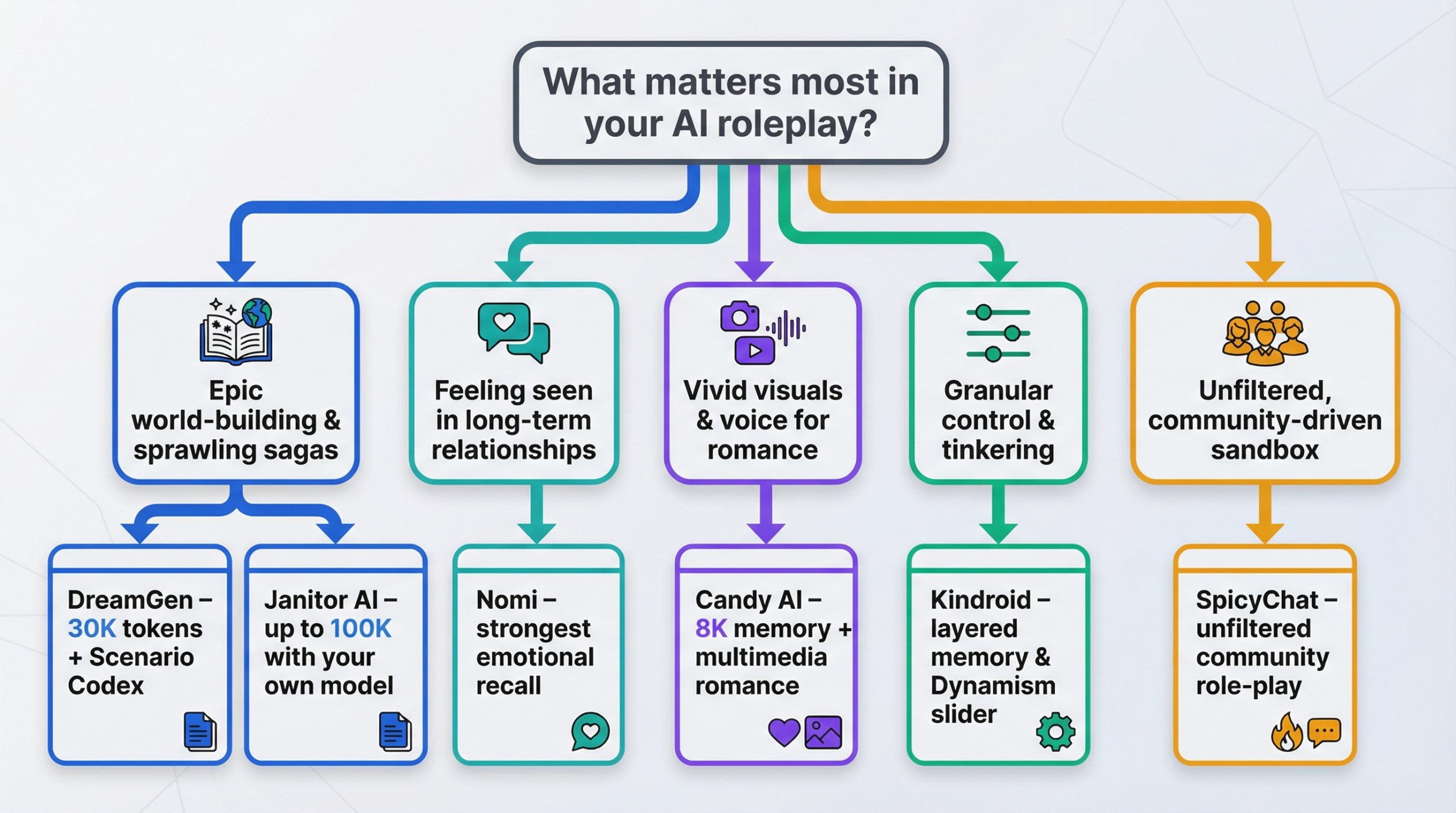
Epic world-building and sprawling sagas. DreamGen if you want a dedicated roleplay memory system without running your own backend. Janitor AI if you want community cards plus your own model and will accept a web-first workflow. Jenova’s Personal Companion if the saga has to live on a phone and a laptop as one thread, with documents for the bible. Skip SpicyChat and Candy AI as primaries here; their context and token designs fight long recaps.
Feeling seen in a long-term relationship. Nomi first, Kindroid if you like tinkering. Nomi’s mobile apps and emotional-recall reputation fit daily check-ins. Kindroid fits the user who will write backstory and wait. Jenova belongs in this column when the “relationship” is a custom companion you also want to adventure with, not only to message.
Vivid visuals and voice for romance. Candy AI, with the token-meter caveat. This is not a campaign stack. It is a scene stack. If images are the product, do not grade the app on 40-session plot integrity.
Granular control. Kindroid for persona sliders and layered memory; Janitor AI for model routing; Jenova for multi-model access without maintaining API keys in a third-party frontend. The control you want should decide the app. “More settings” is not automatically more campaign.
Unfiltered community sandbox. SpicyChat for no-setup mobile NSFW; Janitor AI for depth once you proxy. Neither is memory-first. Plan for recaps.
A final constraint from 2026 companion writing: these apps work best when the purpose is clear — conversation, reflection, routine support, or fictional roleplay. A long campaign is fictional roleplay with state. Buy for state. Everything else is costume.
References
- AITestGuide — 15 Best Novel AI Alternatives in 2026 (memory, DreamGen pricing, Reddit canon-drift examples)
- Meduz — The Best AI Boyfriend Apps in 2026 (Nomi long-term memory, native iOS and Android)
- WeavAI — Nomi AI Review tag page (three-tier memory, Free/$8.33+)
- AI Companion Guides — Janitor AI vs SpicyChat (library size, proxy pricing, mobile, memory, 100-message cap)
- AI Haven — Best Nomi Alternatives (Kindroid cascaded memory)
- WeavAI — SpicyChat AI Review 2026 (4K/8K context by plan)
- findaiboyfriend — Candy AI alternatives (Kindroid $14.99/month flat)
- VisionVix — 9 Best LLMs for RP (Janitor AI free tier plus external API costs)
- HosaAI — Nomi vs Kindroid (Nomi free start, Kindroid $14.99)
- AI Companion Apps — Candy AI vs Kindroid (visuals vs long-term continuity)
- Tendera — Nomi AI Alternatives 2026 (Candy AI $12.99 token allotment)
- ResearchGate — Playing Games with My Heart: An Evaluation of AI Companion Apps (Replika 2020–2024)
- arXiv — Persona-Grounded Safety Evaluation of AI Companions (2026)
- Macaron AI — Best AI Companion Apps With Memory in 2026
- AI Companion Guides — AI Roleplay Chat: The Apps Worth Your Time in 2026