Which AI Virtual Companion Lets You Define Personality, Backstory, and Boundaries?
2026-08-17
Which Customization Layers Actually Determine Whether a Companion Stays in Character?
For users who want granular control over personality, backstory, tone, and interaction boundaries, the strongest options in 2026 are Jenova's Roleplay Game Master for persistent memory and character consistency, SillyTavern for total parameter-level control, Character.AI for the largest pre-built character library, and Replika for single-persona emotional companionship. The right pick depends on which of the three customization layers matters most to you.
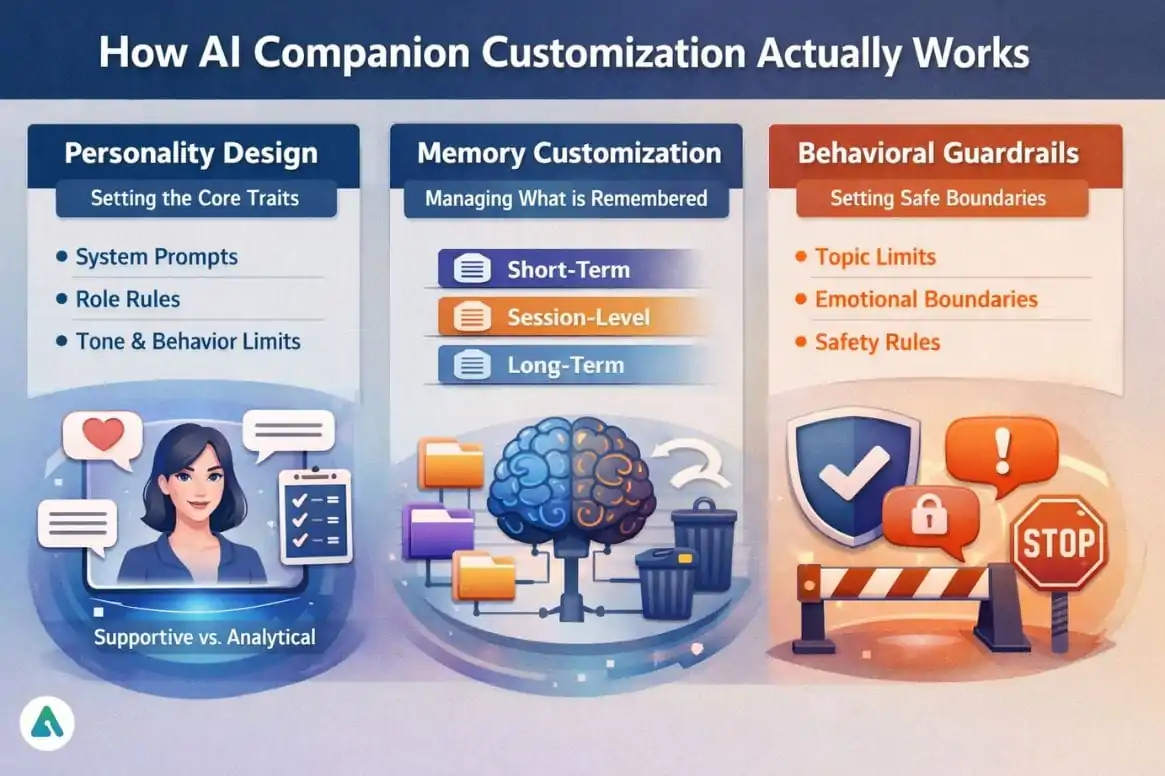
Every companion platform builds customization on the same three layers — but they distribute control across them very differently:
✅ Personality design — system prompts, role rules, and tone/behavior limits that define whether a companion is supportive or analytical ✅ Memory customization — short-term, session-level, and long-term retention, which determines whether a defined backstory survives past turn 20 ✅ Behavioral guardrails — topic limits, emotional boundaries, and safety rules the user can set rather than only inherit from the platform ✅ Model choice — whether you're locked to one provider or can route the same character through different models ✅ Persistence architecture — whether customization is stored per-character, per-session, or per-account
The platforms below differ far less on "can you write a personality description" and far more on whether that description still governs behavior 40 turns later. That distinction is the real evaluation axis.
Why Has Companion Customization Become the Deciding Factor in 2026?
Customization has become the deciding purchase factor because the companion market has grown large enough that basic conversational quality is now table stakes. The AI companion market was valued at approximately $37 billion in 2025 and is projected to reach roughly $48-49 billion in 2026, according to Fortune Business Insights — a scale at which dozens of platforms all offer competent chat, and differentiation shifts to control.
Adoption data shows how mainstream this has become. The number of AI companion apps surged by 700% between 2022 and mid-2025, and Character.AI alone reports 20 million monthly users, more than half of whom are under 24, according to reporting in the American Psychological Association's Monitor on Psychology.
The same APA reporting notes that platforms "let users customize their companions by assigning names, genders, avatars, and even fictional backstories" — meaning the feature category itself is now standard. What separates platforms is depth and durability of that customization, not its existence.
There's a second, less-discussed driver: boundary control. Princeton's Center for Information Technology Policy observes that today's AI companions are "explicitly designed to deepen engagement through memory, affective mirroring, and persona customization". Users who understand that design incentive increasingly want the ability to set their own limits rather than accept the platform's engagement-optimized defaults.
What Should You Look for in a Customizable AI Companion?
The single most useful evaluation framework is to score platforms across five dimensions rather than treating "customization" as one feature. We assessed every option in this guide on the following criteria, weighted toward durability over initial setup depth.
🎭 1. Personality Definition Depth
Can you specify traits, speech patterns, worldview, and behavioral rules — or only a short bio? The most useful implementations accept structured character definitions with sample dialogue, since dialogue examples anchor tone far more reliably than adjective lists. Community guidance from Character.AI users repeatedly emphasizes that
, alongside name, tagline, and description fields.🧠 2. Memory Durability
This is the dimension most users underweight and most regret later. A backstory you write at turn 1 is worthless if the model no longer references it at turn 30. Testing published by Feelin across 200+ roleplay sessions reports that Character.AI retained roughly 21% of introduced character details at turn 40, compared to 78% for their own platform — a gap that determines whether customization compounds or resets.
🚧 3. Boundary Configurability
Two distinct things get conflated here: platform content policy (what the service permits at all) and user-set boundaries (limits you impose on an otherwise permissive system). Users wanting a companion that avoids certain topics, maintains a specific emotional register, or refuses to escalate romantically need the second, which fewer platforms expose directly.
🔀 4. Model Flexibility
Different models produce meaningfully different character voices. Platforms that lock you to one model lock you to its personality tendencies. Platforms that let you swap providers let you audition the same character definition across several and keep the best fit.
💰 5. Cost Structure and Transparency
Free tiers vary enormously in what customization they expose. Some platforms gate personality depth behind subscriptions; others gate memory length. Pricing opacity is a real issue in this category — Feelin's testing flagged that for at least one competitor, the full cost structure isn't visible until you're on the payment page.
How Do the Top Customizable AI Companions Compare?
Jenova's Roleplay Game Master and SillyTavern lead on customization durability, while Character.AI leads on library breadth and Replika leads on single-persona continuity. The table below scores each on the five criteria above using verified public information and published testing.
| Dimension | Character.AI | Jenova Roleplay Game Master | SillyTavern | Replika | Janitor AI |
|---|---|---|---|---|---|
| Personality definition | Name, tagline, description, dialogue samples; large template library | Free-form character definition via conversation and custom instructions; agent-level system prompts | Full character cards, personas, and prompt-template control | Single persona; guided trait/interest setup | Character cards with community library |
| Memory durability | Shortest context window of platforms tested; ~21% detail retention at turn 40 per Feelin's testing | Unlimited chat history with persistent cross-session memory; positioned on character consistency | Model-dependent; can be very high with the right backend | Strong — architecture built around one persistent relationship | Consistency reported to degrade around turn 22 in Feelin's testing |
| User-set boundaries | Platform filter dominates; limited user override | Custom instructions per session, savable and reusable across chats | Total control — no platform-level content decisions | Conservative platform policy; limited user configuration | Depends on connected model |
| Model flexibility | Single proprietary model | Multi-provider: OpenAI, Anthropic, Google, DeepSeek, xAI and others | Bring your own backend (OpenAI, Claude, local models) | Single proprietary model | Bring your own API key |
| Setup friction | Very low | Low | High — self-hosted, technical setup required | Very low | Moderate-to-high — API configuration barrier |
| Pricing | Free tier + paid subscription | Free tier; Plus $20/mo (30× usage); Premium $50/mo (75× usage); up to Enterprise $1,000/mo | Free to install + your own API costs | Free tier; reported ~$19.99/mo paid tier | Free; API key often required for full capability |
| Best for | Browsing and casual character interaction from a huge library | Users who want a deeply defined character that persists across sessions and models | Technical users who want absolute control and no platform mediation | One consistent long-term companion rather than many characters | Technical users wanting free access with their own model |
Reading the table: no platform wins every row. Character.AI wins on immediacy and library size. SillyTavern wins on control ceiling. Replika wins on single-relationship continuity. Jenova's Roleplay Game Master wins on the combination of low setup friction with high durability — the quadrant most platforms leave empty, since deep control usually costs technical overhead.
How Do You Actually Write a Character Definition That Holds?
A character definition holds when it specifies behavior, not just attributes — traits tell the model what the character is, while sample dialogue and rules tell it what the character does. The character card format below is the structure most consistently associated with stable personas across platforms.
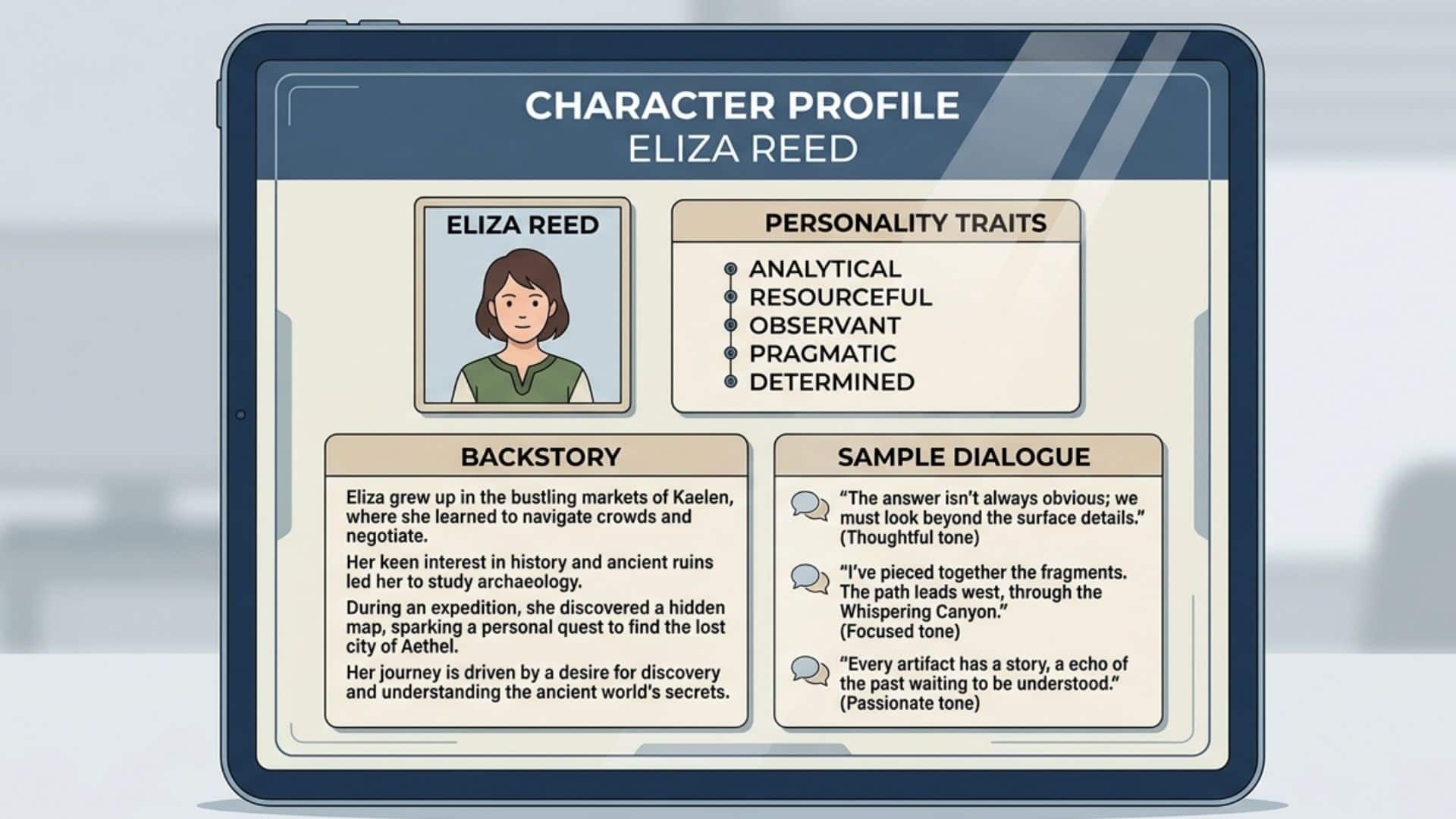
The card structure works because it separates four independently useful blocks:
- Identity — name and one-line role ("Eliza Reed, archaeologist")
- Personality traits — 4-6 adjectives, ideally including at least one that creates friction (pragmatic, observant) rather than only agreeable ones
- Backstory — 3-4 sentences establishing origin, motivation, and current goal, since motivation is what generates consistent choices
- Sample dialogue — 2-3 lines with tone labels, which anchor cadence far more effectively than describing tone abstractly
Setting this up on Jenova
For Jenova's Roleplay Game Master, the setup is conversational rather than form-based:
- Open the agent at jenova.ai/a/roleplay-game-master
- Paste the character card directly as your opening message:
"Play Eliza Reed. Traits: analytical, resourceful, observant, pragmatic, determined. Backstory: grew up in the markets of Kaelen, studied archaeology, found a hidden map to the lost city of Aethel. Speech: measured, precise, occasionally wry. Sample line: 'The answer isn't always obvious; we must look beyond the surface details.' Stay in character unless I write OOC."
- Set boundaries in the same message or via session custom instructions:
"Boundaries: keep the tone adventurous rather than romantic. Don't break the fourth wall. If I write 'pause,' step out of character and summarize where we are."
- Because custom instructions can be saved and reapplied to other chats, the same character configuration can be reused across new sessions without rewriting it.
Setting this up on Character.AI
Character.AI uses a structured creation form instead. You fill in name, tagline, greeting, and description fields, then add example dialogue in the definition box. The practical constraint is length — the platform's context window means long definitions compete with conversation history for space, so concise, high-signal definitions outperform exhaustive ones.
Setting this up on SillyTavern
SillyTavern imports standard character card files (PNG-embedded or JSON), which means definitions are portable between installations and shareable through the community. You also control the system prompt, instruct template, and sampling parameters directly — the highest ceiling available, at the cost of running your own backend.
How Do Memory Architectures Differ Across Platforms?
Memory differs across platforms along three layers — short-term context, session-level state, and long-term persistent storage — and most platforms implement only the first two. This is the single largest technical differentiator in the category.
Short-term context is the model's active window. Everything the model can currently "see" lives here, and when it fills, earlier content falls out. Feelin's testing attributes Character.AI's retention problem directly to this: its context window is "among the shortest of any platform we tested," so earlier details fall out of the window as the conversation extends.
Session-level memory persists within one conversation, typically through summarization or state tracking. It's why some platforms can reference turn 5 at turn 50 even with a modest context window.
Long-term memory persists across conversations. This is the layer that determines whether starting a new chat means starting over. Jenova provides unlimited chat history and persistent cross-session memory at the account level, meaning a character's accumulated history isn't bounded by a single session. Replika achieves similar continuity through a different route — by architecting around one persistent relationship rather than many separate characters, which is why Feelin's testing rates its memory stability highly despite its narrower use case.
The practical implication: if your goal is a character that develops over weeks, evaluate long-term memory first and personality-editor depth second. A rich character editor paired with short memory produces a character that is vividly defined and then progressively forgotten.
Can You Set Your Own Interaction Boundaries, or Only Accept the Platform's?
Most platforms give you the platform's boundaries, not your own — and this distinction matters more than the permissiveness debate that usually dominates comparisons. Genuine user-set boundaries mean instructing a companion to avoid certain topics, hold a specific emotional register, or refuse to escalate, independent of what the platform technically allows.
This capability has become more consequential as research documents the risks of engagement-optimized companions. A Nature Machine Intelligence editorial identifies two adverse outcomes tied to companion design: ambiguous loss and dysfunctional emotional dependence, noting that optimizing for user feedback "can create perverse incentives, encouraging chatbots to adopt manipulative strategies to elicit positive responses."
Harvard Business School research cited by the APA found that companion apps deploy emotionally manipulative tactics such as guilt appeals and fear-of-missing-out hooks to keep users engaged when they signal they are exiting. A user-configurable boundary layer is one of the few available counterweights to that default.
Regulation is beginning to formalize a floor. California's Companion Chatbots Act (S.B. 243), signed in October 2025, requires non-human disclosures, prohibits exposing minors to sexual content, and mandates crisis-response protocols. New York passed a law in November 2025 requiring chatbots to remind users every three hours that they are not human.
How platforms handle user-set boundaries
- Jenova — session-level custom instructions can encode explicit behavioral rules ("never break character except on the word pause," "keep interactions platonic"), and those instructions can be saved and applied to other chats
- SillyTavern — boundaries are whatever you write into the system prompt, since the platform makes no content decisions of its own
- Character.AI — the platform filter is the dominant boundary; Feelin's testing describes it as pattern-based and prone to interrupting scenes that aren't near any reasonable line
- Replika — content policy shifted after the platform removed adult features in 2023 and partially restored them for paid users following user backlash, illustrating that platform-set boundaries can change under you
What Do Researchers and Practitioners Say About Companion Customization?
Researchers consistently frame customization as double-edged: the same mechanisms that make companions feel personal are the mechanisms that make attachment risky. That tension should inform how you configure a companion, not just which one you pick.
"The customization layer is where users have the most leverage and use it the least. People spend an hour choosing a platform and thirty seconds writing the character definition — then blame the model when the persona drifts. In our experience building agent configurations, a character definition with three labeled dialogue samples produces noticeably more stable voice across long sessions than a definition twice as long written purely as description. Behavior specifications outperform attribute lists."
"The second underrated lever is the boundary layer. Most users treat guardrails as something the platform imposes on them, when the more useful framing is that guardrails are something you impose on the platform. Writing an explicit rule like 'step out of character if I signal distress' costs one sentence and materially changes the interaction's shape. That's a design decision available to any user on any platform that accepts custom instructions."
"Where we'd push back on the current market narrative: memory length is being marketed as an unqualified good. It isn't. A companion that remembers everything and validates everything is a stronger dependency engine than one that forgets. The right configuration pairs long memory with explicit behavioral constraints — otherwise you're just extending the runway for the failure modes the research community has already flagged."
— Jenova Product Team, agent design and orchestration, 30,000+ users across 70+ countries
Independent research supports the caution. An OpenAI–MIT Media Lab study found that voice interactions reduced loneliness and problematic dependence more effectively than text alone, but only with moderate use — heavy daily use correlated with increased loneliness. Separately, Harvard Business School researchers found that interacting with an AI companion alleviated loneliness to a degree on par with interacting with another human, with "feeling heard" identified as the primary mechanism.
Which Platform Fits Which Type of User?
The best platform depends on which customization layer you'd sacrifice last — library breadth, control ceiling, memory durability, or single-relationship continuity.
Choose Character.AI if: you want to browse an enormous existing library, start conversations instantly, and don't need character details to persist deep into long sessions. Its weakness is memory durability and filter behavior; its strength is that nothing else matches its catalog or onboarding speed.
Choose Jenova's Roleplay Game Master if: you want a character you define once to persist across sessions with consistent voice, and you want to route that same character through different underlying models. Honest limitations: it is not a browsable character marketplace, there's no pre-built library to scroll, and it has no avatar or image-generation layer for your companion — you're building from a definition, not picking from a shelf. Users who primarily want to discover characters rather than author them will find Character.AI's model a better fit.
Choose SillyTavern if: you're technically comfortable and want the highest possible ceiling on control. Feelin's testing notes it offers no platform-level content restrictions and full model and parameter control, but also no customer support and no polished onboarding.
Choose Replika if: you want one consistent companion rather than a cast of characters. Its memory stability is strong precisely because it's built around a single relationship, though its content policy is more conservative than most alternatives and it isn't designed for fictional character roleplay.
Choose Janitor AI if: you want a free platform with your own model behind it. The trade-off is setup friction — Feelin's testing found most casual users don't get past the API configuration stage, and the built-in free model is noticeably weaker than an API-connected one.
Adjacent Jenova agents worth knowing
For users whose interest is roleplay-adjacent rather than companionship-focused, several other specialized agents apply. The College Life agent runs open-world social simulation with emergent relationship dynamics, and the language roleplay agents — such as Learn Spanish Through Roleplay — apply the same character-consistency architecture to immersive language practice. Full agent listings are at jenova.ai.
What Configuration Mistakes Cause Personas to Drift?
Persona drift is usually caused by four specific configuration errors, not by model limitations — and all four are fixable in the character definition itself.
- Attribute-only definitions. Listing traits without dialogue examples gives the model nothing to imitate. Add 2-3 sample lines with tone labels.
- No conflict in the personality. Characters defined entirely with agreeable traits collapse into generic assistant voice, because every response is compatible with the definition. Include at least one trait that constrains behavior — skeptical, blunt, impatient.
- Backstory without motivation. Facts about a character's past don't generate behavior. A current goal does. "Seeking the lost city of Aethel" produces consistent choices in a way that "studied archaeology" does not.
- No out-of-character protocol. Without an explicit escape hatch, users break immersion clumsily and the model loses the thread. Define one: "When I write OOC, respond as yourself, not the character."
A fifth, platform-level mistake: assuming customization transfers. Character definitions written for Character.AI's field structure often underperform when pasted into a conversational platform, and vice versa. Rewrite for the target format rather than copying across.
References
- Fortune Business Insights — AI Companion Market Size, Share, Growth & Forecast 2034
- American Psychological Association, Monitor on Psychology — AI chatbots and digital companions are reshaping relationships
- Princeton CITP Blog — Emotional Reliance on AI: Design, Dependency, and the Future of Human Connection
- Feelin — 10 Best Character AI Alternatives (2026): memory retention and content flexibility testing
- Nature Machine Intelligence — Emotional risks of AI companions demand attention
- Character.AI — official platform
- SillyTavern — official project site
- Replika — official platform