Which AI Tool Is Best for Literature Reviews With Verifiable Citations?
2026-08-21
How Do Citation Traceability and Audit Trails Separate Reliable AI Literature Tools From Generic Chatbots?
For literature reviews that must survive peer review, the most useful AI tools in 2026 are not the ones that generate the longest summaries — they are the ones that make every claim checkable. Elicit is the strongest dedicated option for systematic reviews because it pairs screening and data extraction with sentence-level citations. Scite is the strongest option for checking whether a finding has been supported or contradicted. Jenova's Academic Research Assistant is the strongest option when discovery, citation management, and manuscript preparation need to live in one persistent research workspace.
What separates a citable literature tool from a generic chatbot is not fluency. It is whether a reader can walk from an AI-generated sentence back to a real paper, a real passage, and a real method.
Key factors that determine whether an AI literature review can be trusted:
✅ Traceability — Does the tool cite the exact sentence or figure, or only a paper title? ✅ Corpus quality — Does it search peer-reviewed literature, or the open web? ✅ Citation polarity — Can it show whether later papers support, mention, or contradict a finding? ✅ Auditability — Can screening decisions, exclusions, and search strategies be reconstructed? ✅ Human verification — Does the workflow force a check against the source, or hide that step?
To compare these tools meaningfully, it helps to evaluate them as a citation-integrity stack rather than as interchangeable “AI for papers” products.
Why Has Citation Verification Become the Defining Problem in AI-Assisted Literature Reviews?
Citation verification has become the central problem because AI can now retrieve and summarize papers faster than researchers can check whether those summaries are faithful. One 2026 industry analysis found that AI-assisted literature review processes can finish about 30% faster than traditional methods. Speed without source control is how fabricated references, misattributed findings, and silently retracted papers enter manuscripts.
A systematic review is not a reading list. According to current evidence-synthesis guidance, it is a method in which authors set explicit eligibility criteria, collect the studies that meet those criteria, and report the process in enough detail that others can assess trustworthiness. PRISMA 2020 exists precisely so readers can see why a review was done, how studies were identified, and what was found.
Generic chatbots fail this standard in a predictable way. They often return a plausible citation, a plausible finding, and a plausible author list — then leave the researcher to discover that the paper does not contain the claim, the year is wrong, or the article does not exist. Dedicated research tools reduce that risk by searching scholarly corpora, linking claims to sources, and, in the best cases, quoting the supporting passage.
The practical implication for 2026 is simple. The “best” AI literature tool is the one whose outputs can be audited, not the one whose prose sounds most academic.
What Criteria Should Researchers Use to Evaluate AI Literature Review Tools?
Researchers should evaluate AI literature tools with a Citation Integrity Framework: traceability, corpus coverage, citation polarity, auditability, verification workflow, and cost per verified source. Tools that score well on only one dimension — fast search, pretty maps, or cheap summaries — still fail if a supervisor, reviewer, or librarian cannot reconstruct the evidence.
The framework looks like this in practice:
- Traceability: Paper-level links are a start. Sentence-level or quotation-backed citations are stronger because they show where in the source the claim lives.
- Corpus coverage: A tool that searches 138 million academic papers plus ClinicalTrials.gov is not equivalent to one that searches the public web.
- Citation polarity: Knowing a paper was cited 400 times is weaker than knowing those citations support, contrast, or merely mention the original finding.
- Auditability: Screening logs, exclusion reasons, and search strategies matter for reviews that must follow PRISMA-style reporting.
- Verification workflow: The tool should make it easy to open the source, confirm the authors, and match the claim to the text.
- Cost per verified source: A $10 tool that forces hours of manual checking can be more expensive than a $49 tool that quotes the extraction.
University evidence-synthesis guides still start in the same place they did before AI: a well-defined research question, documented search strategy, screening, and citation management. AI should compress those steps. It should not erase them.
This is also where conversational agents differ from single-purpose apps. The Academic Research Assistant is built as a research partner for literature discovery, manuscript preparation, and citation management, with access to scholarly search tools and persistent project memory. That is valuable for ongoing thesis or lab work. It is not a substitute for a PRISMA-auditable screening database.
How Do Elicit, Scite, Consensus, SciSpace, and Jenova Compare on Verifiable Citations?
Elicit leads on extractable, review-grade citations; Scite leads on citation context; Consensus leads on yes/no evidence questions; SciSpace leads on reading and explaining papers; and Jenova’s Academic Research Assistant leads when a researcher needs a durable workspace that can search, organize, cite, and draft without resetting context every session. No single tool wins every dimension.
| Feature / Dimension | Elicit | Scite | Academic Research Assistant | Consensus | SciSpace |
|---|---|---|---|---|---|
| Citation traceability | Sentence-level quotes and figures from sources | Citation statements classified in context | Inline citations via scholarly search, with user verification | Answers linked to cited papers | Cited writing and paper-level source links |
| Corpus / source access | 138M papers plus 545,000+ trials | 300M+ articles, including paywalled full text from 30+ publishers | Real-time discovery across academic databases and repositories | Peer-reviewed evidence search used by 5 million+ researchers, students, and clinicians | 280M+ papers |
| Citation polarity | Limited; stronger on extraction than citation stance | Supporting / contrasting / mentioning Smart Citations | No native support-vs-contradict classifier | Consensus-style evidence synthesis for research questions | Not a dedicated citation-stance engine |
| Review workflow | Protocol, screening, extraction, PRISMA-oriented reports | Reports, collections, reference check, AI assistant | Conversational discovery, citation management, manuscript prep | Question-to-evidence search and synthesis | Reading, comparison, and cited drafting |
| Pricing (as of 2026) | Free Basic; Pro $49; Scale $169 | About $20/month for personal plans | Free tier; Plus $20/mo; Premium $50/mo | Pro commonly listed around $10/month | Premium commonly listed around $12/month on annual billing |
| Best for | Systematic reviews and data extraction | Checking whether a finding has held up | Persistent literature-to-manuscript workflows | Fast evidence questions with source links | Explaining and comparing papers while writing |
Elicit
Elicit is built around systematic review mechanics rather than chat. It can screen large result sets, extract quantitative and qualitative data, and generate reports in which each claim is backed by sentence-level citations. Every extraction is supposed to be supported by quotes or figures from the source, which is the right unit of evidence for a results table.
The limitation is focus and cost. Elicit’s official paid tiers jump from a free Basic plan to Pro at $49 and Scale at $169, and the product is strongest when the researcher already wants a protocol-driven review. It is less natural as an all-purpose writing partner for a dissertation chapter that also needs outlining, citation formatting, and iterative argument work.
Scite
Scite’s advantage is citation context. Its model analyzes 1.6 billion Smart Citations and classifies each as supporting, contrasting, or mentioning, so a high citation count is no longer treated as automatic validation. The assistant answers from 300 million-plus full-text articles, including publisher-partner content other tools cannot legally see.
The limitation is workflow breadth. Scite is excellent at telling you how a paper has been treated by later literature. It is less complete as a screening-and-extraction pipeline for a full systematic review, and personal pricing around $20 per month is higher than several discovery-first tools.
Consensus
Consensus is strongest when the research question is empirical and bounded: does the evidence support this claim, and which papers say so? Reviewers note that you can click any citation to inspect the source behind the answer, and the company positions the product as a way to gather peer-reviewed sources rather than as a ghostwriter.
The limitation is depth. Consensus is better at evidence snapshots than at PRISMA-auditable screening, dual review, or long-running manuscript memory. It is a powerful first pass, not a complete review archive.
SciSpace
SciSpace is built as a broader research assistant: run literature reviews on 280 million-plus papers and write with cited sources. That combination helps when the bottleneck is understanding dense methods sections, comparing related papers, and moving from notes into a draft.
The limitation is verification discipline. SciSpace can generate citations and help with reference cleanup, but it is not Scite’s citation-polarity engine and not Elicit’s extraction-and-audit system. Researchers still need a separate habit of opening the PDF.
Jenova Academic Research Assistant
The Academic Research Assistant is strongest as a durable research partner rather than as a single-function database. It is designed for academics and PhD students who need real-time literature discovery, citation management, and manuscript preparation in one place, with persistent memory across sessions and the ability to attach papers as a private knowledge base.
The honest limitation is specialization. It does not currently provide Elicit’s PRISMA-auditable dual screening or Scite’s support-versus-contrast classifier. Like every LLM-based research assistant, it still requires the researcher to verify that each cited paper exists, that the authors are correct, and that the claim appears in the source.
How Does Sentence-Level Citation Tracing Work in Systematic Review Tools?
Sentence-level tracing works by tying each extracted fact to the exact passage or figure that supposedly contains it, so a reviewer can accept or reject the claim without rereading the whole article. Elicit makes this the center of its product: other tools often link only to a reference, which still leaves the reader to hunt for the supporting sentence — and sometimes the information is not in the cited source at all.
That distinction matters more than interface polish. A paper-level citation can be technically real and still be misleading if the AI summarized the abstract, ignored the limitations, or borrowed a statistic from a cited-in-passing study. A quotation-backed extraction is harder to fake and faster to audit.
Elicit’s systematic-review flow is built around that audit trail. Researchers can refine a protocol, combine sources, screen papers with exclusion reasons and supporting quotes, extract data from tables and figures, and synthesize across many papers with a methods section and PRISMA-oriented reporting. For living reviews, the same structure can be updated as new studies appear.
This is also where traditional methods still constrain AI. PRISMA 2020 asks authors to report identification, screening, eligibility, and inclusion in enough detail that users can assess trustworthiness. A tool that cannot show why a paper was excluded is useful for exploration and weak for a registered systematic review.
Researchers doing narrative or scoping reviews can borrow the same discipline without adopting the full Elicit stack. Require every AI claim to carry a quotation, a page or section marker, and a link. If the tool cannot provide those, treat the sentence as a lead, not as evidence.
What Role Do Smart Citations Play in Checking Whether a Finding Has Been Supported or Contradicted?
Smart Citations help researchers see how a paper has been cited, not merely how often, which is the difference between popularity and corroboration. Scite classifies citation statements as supporting, contrasting, or mentioning, then lets users inspect the citing sentence itself rather than trusting a raw count.
That is a direct answer to a common literature-review failure. A widely cited measurement scale, dataset, or clinical finding can accumulate hundreds of mentions because it is convenient, controversial, or foundational — including citations that dispute it. Scite Reports are designed to turn weeks of manual full-text review into a structured view of those citation statements, filterable by classification, section, year, or source type.
Additional Scite features extend the same idea into manuscript quality control. Reference Check reviews the citations in an uploaded PDF for retraction notices, editorial flags, and contrasting findings. Collections monitor a set of papers over time so a lab can see whether the evidence base is shifting.
The limitation is that citation stance is not the same as study quality. A paper can be “supported” by later work that used weak methods, and it can be “contrasted” by a study that asked a different question. Smart Citations are an evidence map, not a risk-of-bias assessment. They should sit beside, not replace, appraisal tools used in systematic and other evidence-synthesis reviews.
For researchers who cannot add another paid platform, a lighter version of the same habit still helps: search “cited by” lists, read the citing paragraph, and code it as support, contrast, or mention before letting the paper into a synthesis table.
How Do You Build a Verifiable Literature Review Workflow With AI Tools?
A verifiable AI literature review follows five steps: define scope, craft structured queries, search multiple angles, organize results, and verify every citation against the source. The tools change. The sequence should not.
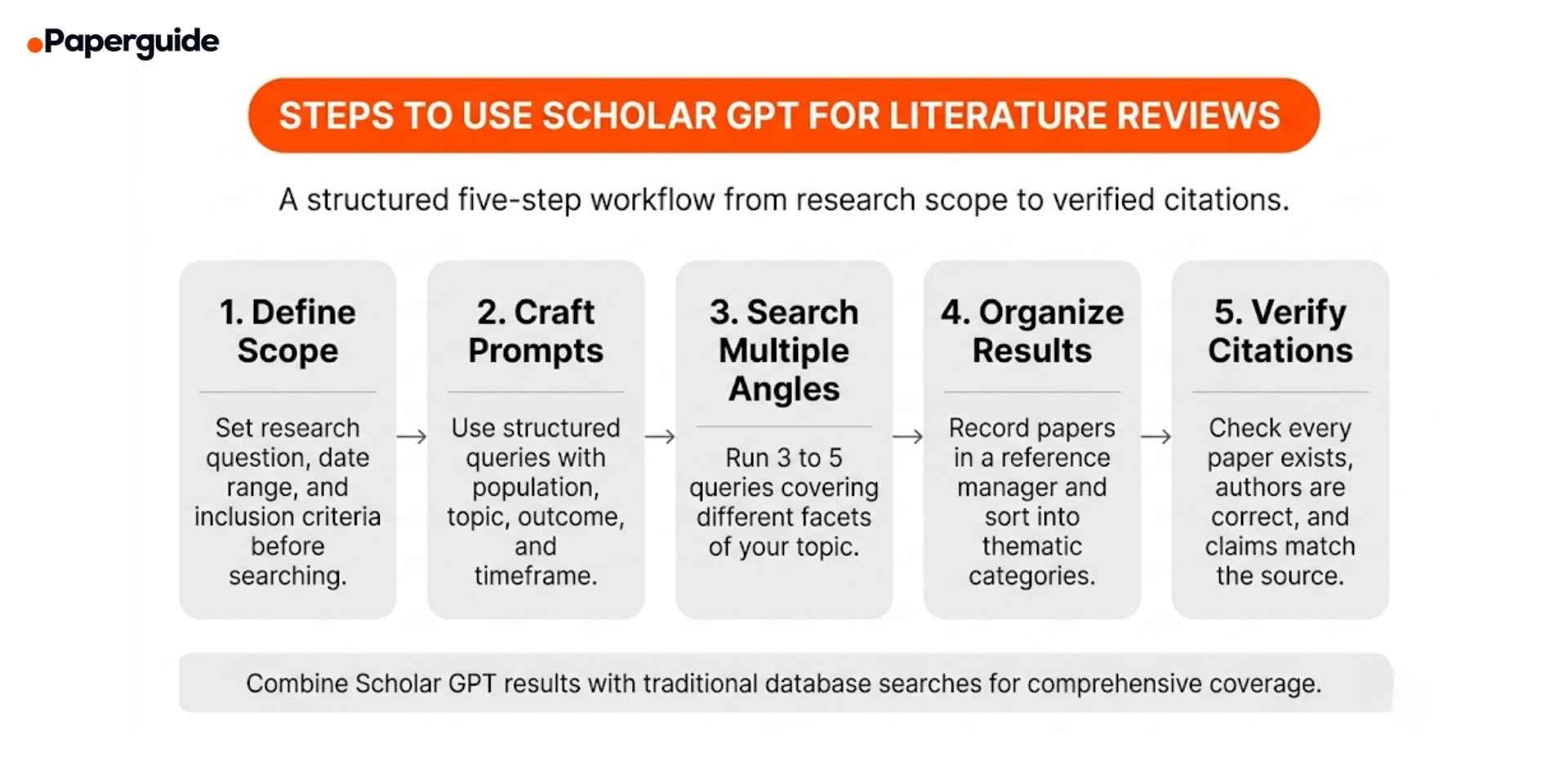
That sequence matches what methods guides have said for years. The Oxford Centre for Evidence-Based Medicine describes evidence finding as an iterative process: structured searching, follow-on citation chasing, and documentation. AI is most useful when it executes those loops faster without deleting the paper trail.
For the Academic Research Assistant, a typical start looks like this:
- Open the agent and state the review type, discipline, and output format.
- Constrain the search before asking for synthesis:
"I am writing a narrative literature review on retrieval-augmented generation in systematic reviews. Limit to peer-reviewed empirical studies from 2020–2026. Return a table with APA citation, DOI, study design, sample, main finding, limitation, and a short quotation I can verify. Do not include a paper unless you can provide a DOI or stable URL."
- Run three to five queries that cover different facets: methods papers, domain applications, failure cases, and reporting standards.
- Save promising papers into a working bibliography and attach PDFs to the project knowledge base.
- Verify authors, titles, years, and claims against the PDF or publisher page before the draft is allowed to keep them.
For Elicit, the equivalent start is more protocol-shaped: refine the question, gather sources from the Elicit corpus or imported databases, screen with documented reasons, extract into columns, then synthesize only from retained studies. For Scite, start with a seed paper or claim, open the citation report, and separate supporting from contrasting statements before writing the “agreement in the field” paragraph.
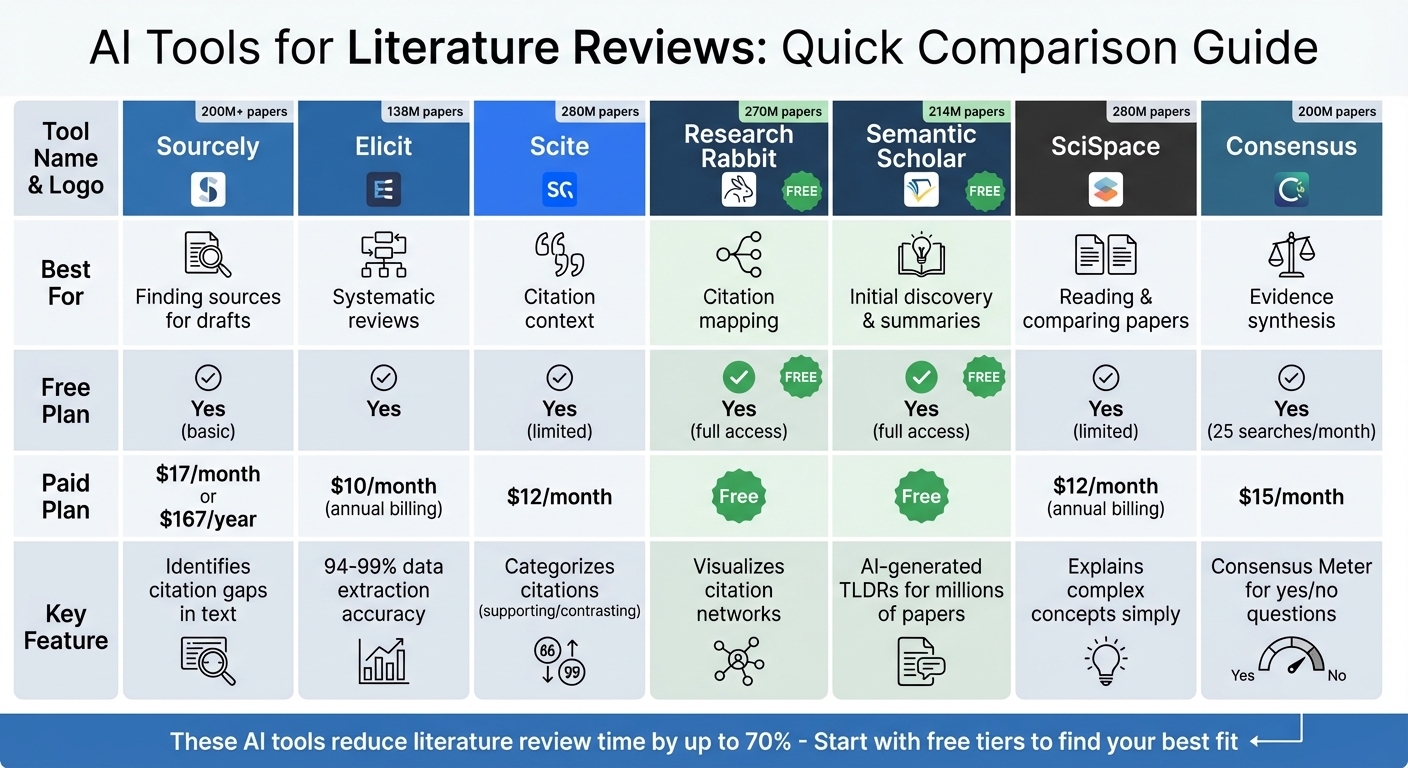
Free discovery tools still belong in the same workflow. Semantic Scholar is a strong first-pass search engine with AI-assisted reading features. ResearchRabbit maps citation networks across 310 million academic papers and is widely used to find related work visually. Sourcely helps turn draft text into candidate sources, with plans starting at $17 per month or $167 per year. None of these should be the last verification step.
The non-negotiable rule is the fifth step. If the paper cannot be found, the authors do not match, or the claim is not in the source, it comes out of the review — regardless of which AI produced it.
What Do Research Methodologists Say About Using AI for Evidence Synthesis?
Research methodologists increasingly treat AI as an accelerator for search, screening, and extraction, while insisting that citation verification and reporting transparency remain human responsibilities. The useful question is no longer whether AI belongs in a literature review. It is which parts of the review can be delegated without destroying auditability.
"The failure mode we see is almost never 'the model missed a keyword.' It is unverifiable attribution. A tool can return forty real papers and still be unusable if the researcher cannot point to the sentence that supports each cell in a synthesis table. That is why sentence-level citations and citation-stance classifiers matter more than summary quality."
"A second misconception is that one platform should own the whole review. In practice, high-integrity workflows are stacks. Semantic search or citation mapping finds the neighborhood. A systematic-review engine extracts and logs decisions. A Smart Citation layer checks whether the field later supported or contradicted the finding. A persistent research agent keeps the bibliography, the inclusion logic, and the manuscript in one memory instead of scattering them across chats."
"We also advise teams to price tools in researcher hours, not subscription fees. If a $10 product requires an afternoon of citation forensics and a $49 product quotes the extraction, the expensive tool is often cheaper. The reverse is also true: paying for a systematic-review suite to write a short narrative overview is waste. Match the tool to the review type, then keep a verification gate that no model is allowed to skip."
— Jenova Product Team, AI research-workflow design, 8 years in academic tooling and agent infrastructure
That position is consistent with library guidance. AI tools can visualize citation relationships and reduce the time spent assembling a field map, but they do not replace documented methods. For any review that claims completeness, the methods section still has to explain databases, dates, inclusion rules, and how disagreements were handled.
Which AI Research Tool Fits Different Review Types — Scoping, Systematic, and Narrative?
The best AI literature tool depends on the review type: Elicit for systematic reviews, Scite for evidence checking, Consensus for bounded empirical questions, ResearchRabbit or Semantic Scholar for scoping and field mapping, and the Academic Research Assistant for narrative reviews that must become a maintained manuscript. Choosing by genre prevents both under-tooling and over-buying.
Systematic reviews and meta-analyses. Use Elicit when screening volume, data extraction, and reproducible reporting are the constraints. Its ability to keep claims tied to source quotations is the closest match to PRISMA’s demand for transparent methods and results. Add Scite when included studies are controversial or retraction-prone.
Scoping reviews and new fields. Use ResearchRabbit to see how clusters of papers connect, then Semantic Scholar for open discovery. University comparisons describe ResearchRabbit as a citation-based mapping tool focused on relationships between works. These tools excel at coverage. They do not, by themselves, prove that a generated statement is faithful.
Narrative reviews, theses, and lab writing. Use the Academic Research Assistant when the work continues for weeks: search, reread, reorganize, cite, and draft inside one memory. A related Jenova option, Deep Research, is better when the immediate need is a long, source-heavy synthesis report rather than an ongoing advisor relationship. Pair either with Scite or the original PDFs before submission.
Quick evidence questions. Use Consensus when a clinician, student, or policy researcher needs a sourced yes/no or directional read of the literature, then open the cited studies. SciSpace fits the adjacent case: a paper is already in hand and the bottleneck is comprehension.
A practical stacking pattern for a PhD chapter in 2026 looks like this:
- Map the field in ResearchRabbit or Semantic Scholar.
- Screen and extract core studies in Elicit if the chapter claims systematic coverage.
- Check landmark findings in Scite.
- Keep the living bibliography, outline, and prose in the Academic Research Assistant.
- Verify every surviving citation against the publisher record.
That stack is less convenient than a single chatbot. It is also the version most likely to produce a literature review whose citations remain standing after a careful reader checks them.
References
- Elicit — Systematic Literature Reviews: screening, sentence-level citations, and data extraction
- Elicit — Official pricing for Basic, Pro, Scale, and Enterprise plans
- Scite Features — Smart Citations, 300M+ articles, and citation classification
- Cypris AI — 11 Best AI Tools for Scientific Literature Review in 2026 (time-savings finding)
- PMC — Systematic reviews of the literature: an introduction to current methods
- PRISMA statement — PRISMA 2020 reporting guidance for systematic reviews
- University of Pittsburgh Library — Steps in a systematic review
- EQUATOR Network — PRISMA 2020 updated guideline for reporting systematic reviews
- Paperguide — SciSpace vs Scite pricing and workflow comparison (2026)
- Elephas AI — Scite AI 2026 review and personal-plan pricing
- Consensus — Pricing page and researcher-trust statement
- The Effortless Academic — Consensus AI Review 2026: citation-backed answers
- SciSpace — AI research assistant and 280M+ paper corpus
- Paperguide — SciSpace vs Consensus pricing comparison (2026)
- PMC — PRISMA 2020 explanation and elaboration
- University of Pennsylvania Libraries — Evidence Synthesis (Systematic Reviews) overview
- Oxford Centre for Evidence-Based Medicine — Eight steps to finding evidence for a systematic review
- ResearchRabbit — Citation mapping and 310 million academic papers
- Sourcely — Literature-review structure, source finding, and pricing
- University of Maryland Libraries — AI tools for academic research, including ResearchRabbit
- Semantic Scholar — AI-powered scientific literature discovery