Which AI Tool Finds Literature Gaps and Cites Every Source?
2026-08-21
How Do Source Traceability and Contradiction Mapping Separate AI Research Tools?
For researchers who need literature-gap detection and claim-level source linking, Jenova's Academic Research Assistant is strongest for multi-week, source-traced synthesis, while Elicit leads structured systematic reviews, Scite leads citation-support classification, and ResearchRabbit leads visual field mapping. The split in 2026 is no longer “which tool finds papers.” It is which tool can show what the literature has not settled — and point every conclusion back to a verifiable original.
Key factors that separate gap-finding research AI from generic academic search:
✅ Claim-level traceability — every synthesized statement maps to a paper, not a model’s memory ✅ Gap typology — methodological, population, contradiction, and uncharted-territory gaps, not just “few papers on X” ✅ Contradiction mapping — knowing whether later work supports, mentions, or challenges a finding ✅ Longitudinal memory — a running map of what you already screened across weeks of review ✅ Corpus honesty — licensed full text, Scholar-scale discovery, or user-uploaded PDFs, with the coverage limits stated
To compare these tools meaningfully, it helps to treat gap detection and source linking as separate capabilities. Many products excel at one and leave the other to the researcher.
Why Has Unsourced Gap Identification Become a Credibility Problem in 2026?
Unsourced gap claims have become a credibility problem because generative models can invent a “missing literature” narrative that looks rigorous while citing papers that do not say what the summary claims. A 2026 Nature report found that specialized literature-review models can match human experts on citation correctness, while general-purpose LLMs often do not. That finding reframes tool choice: fluency is cheap; grounded absence-of-evidence is not.
University guidance now treats verification as part of the workflow, not an optional extra. Paperpal’s 2026 review of academic AI tools notes that students and researchers still need to check AI suggestions against original sources when the system flags gaps or connections. Library guides likewise frame generative tools as discovery aids that must be paired with source evaluation, not as substitutes for reading.
The scholarly risk is specific. A hallucinated citation is visible. A hallucinated gap is quieter: it can survive peer review if reviewers do not re-search the same slice of the field. Work on AI in academic writing and research planning treats literature review as a high-leverage, high-error stage, which is exactly where unsourced “no one has studied this” claims do the most damage.
Gap identification therefore needs two outputs, not one: a statement of what is missing, and a documented trail of what was actually examined.
What Should You Evaluate in an AI Tool for Literature Gaps?
You should evaluate an AI literature-gap tool on six dimensions that we call the Gap-to-Source Integrity Framework: gap typology, claim-level linking, contradiction detection, corpus coverage, longitudinal memory, and cost per review cycle. Search volume and “chat with PDF” features are useful, but they do not tell you whether a gap claim would survive a methods review.
🎯 Gap typology coverage
A usable tool should distinguish at least four gap types: methodological weakness, conflicting findings, underserved populations or geographies, and genuinely uncharted questions. Tools that only return “related papers” collapse those types into a single relevance score.
📚 Claim-level source linking
The unit of trust is the sentence, not the bibliography. Look for answers that expose the underlying paper, quotation, or citation statement. Scite’s design, for example, draws answers from peer-reviewed full text and links each one to its source rather than from open-web generation.
⚖️ Contradiction detection
Absence of evidence is not evidence of absence, and agreement is not consensus. Tools that classify whether later papers support or contrast a finding reduce the chance that a “gap” is actually an unresolved debate.
🗂️ Corpus coverage and access
Coverage numbers are not interchangeable. Elicit searches more than 138 million papers, Consensus draws on 250 million-plus papers, ResearchRabbit indexes over 310 million, and Scite reports 300 million-plus articles with 32 million full-text sources and 30-plus publisher partners. A smaller licensed full-text set can beat a larger metadata index for claim checking.
🧠 Longitudinal memory
Gap analysis is iterative. If the tool forgets last week’s inclusion criteria, you will re-discover the same “gaps” and miss the ones that only appear after clustering.
💸 Cost per review cycle
Price only matters relative to the job. A $10 consensus search and a $49 systematic-review workspace are not substitutes.
Testing against this framework shows a consistent pattern: extraction platforms, citation-intelligence platforms, mapping platforms, and persistent research agents optimize different cells of the same matrix.
How Do Jenova, Elicit, Scite, ResearchRabbit, and Consensus Compare?
They separate cleanly by job: Jenova for sourced, multi-session gap synthesis; Elicit for protocol-driven systematic review; Scite for support-versus-contrast citation intelligence; ResearchRabbit for visual field mapping; and Consensus for fast evidence-agreement snapshots. None of the five dominates every cell of the Gap-to-Source Integrity Framework.
| Feature / Dimension | Elicit | Jenova Academic Research Assistant | Scite | ResearchRabbit | Consensus |
|---|---|---|---|---|---|
| Gap identification | Missing data and extraction blanks across screened sets | Conversational analysis across methodological, population, contradiction, and uncharted gaps | Gaps inferred from contrasting citation patterns | Visual voids in citation and author networks | Disagreement and thin-evidence zones via synthesis |
| Source linking | Reports with viewable sources and table extractions | Claim-level linking via Scholar-scale search plus uploaded papers | Answers grounded in full text, including paywalled partner content | Paper-to-paper mapping rather than sentence-level proof | Natural-language answers with paper citations |
| Contradiction detection | Comparative extraction across study rows | Prompted conflict analysis across clusters | Supporting / contrasting / mentioning Smart Citations | Indirect, through citation chaining | Consensus Meter and conflicting-argument search |
| Corpus | 138M+ papers | Google Scholar, web sources, and private knowledge bases | 1.6B+ Smart Citations; 300M+ articles | 310M+ papers | 250M+ papers |
| Project memory | Zotero import, tables, alerts on paid tiers | Unlimited chat history and cross-session memory | Collections with citation and retraction alerts | Collections that improve recommendations | Search and Deep Search workspace |
| Pricing (as of 2026) | Free Basic; Pro $49/user/month | Free tier; Plus $20/month | Free tier; paid access around $20/month | Core mapping widely used at no published list price | Free tier; Pro about $10/month |
| Best for | PRISMA-style screening and data extraction | Multi-week gap arguments that must cite originals | Checking whether a finding has held up | Seeing who and what a field is missing | Fast yes/no evidence snapshots |
Elicit
Elicit is strongest when the “gap” is an empty cell in a evidence table. Its systematic review workflow covers protocol refinement, source gathering, screening, extraction, and synthesis, and the Pro plan can screen 5,000 papers in a dedicated review pipeline. That structure is closer to a methods appendix than to a chatbot.
The limitation is interpretive. Empty extraction fields show what screened papers failed to report. They do not automatically tell you whether the empty field is a true research gap, a measurement convention, or a corpus-coverage artifact. Elicit also does not classify citing papers as supporting or contrasting the way Scite does.
Jenova Academic Research Assistant
Jenova’s Academic Research Assistant is strongest when gap finding is an argument you build over many sessions, not a one-shot table. It combines real-time literature discovery with manuscript preparation and citation management, and it can keep inclusion criteria, rejected papers, and running gap notes in persistent memory. Researchers can attach PDFs as a private knowledge base so synthesis is grounded in the actual corpus under review.
The honest limitation is infrastructure. It does not ship a PRISMA screening pipeline at Elicit’s scale, nor Scite’s supporting/contrasting citation classifier, nor ResearchRabbit’s interactive network graph. Teams running a formal systematic review will often pair it with one of those specialists rather than replace them.
Scite
Scite is strongest when the question is “has this finding held up?” Smart Citations classify 1.6 billion-plus citation statements as supporting, contrasting, or mentioning. That is a different — and often more rigorous — route to gap detection than keyword search: a claim with many mentions and few supporting citations is a weak foundation, not a gap, and a claim with accumulating contrasts is a conflict, not an opening.
The limitation is workflow breadth. Scite is citation intelligence first. It will not, by itself, produce a clustered literature map or a multi-week research design memo with population and methods gaps spelled out. Independent 2026 reviews also note that advanced use sits on a paid plan.
ResearchRabbit
ResearchRabbit is strongest at showing structural gaps: isolated author clusters, missing citation bridges, and seed-paper neighborhoods that never connect. Users and librarians describe it as a way to map a field, identify relevant authors, and find potential gaps visually, across more than 310 million papers.
The limitation is evidential grain. A hole in a graph is a discovery clue, not a sourced conclusion. You still need a second step that opens the papers and ties the “missing link” claim to methods, samples, and results.
Consensus
Consensus is strongest for rapid agreement checks. Deep Search expands terms, identifies conflicting arguments, and walks the citation graph, while the Consensus Meter visualizes how much evidence agrees on a yes-or-no question. The product reports use across 10 million researchers, students, and clinicians and partnerships with over 170 university libraries.
The limitation is depth. A meter that shows split evidence is not the same as a documented methodological gap. Free use caps advanced Pro Searches, so heavy review work moves to a paid tier quickly.
How Does Cross-Session Memory Change Multi-Week Literature Reviews?
Cross-session memory changes gap analysis because true gaps usually appear only after you have clustered studies, not after the first search. A tool that forgets your inclusion criteria, excluded papers, and “already ruled out” hypotheses will keep proposing the same vacancies. Persistent memory turns the review into a cumulative map rather than a series of disconnected chats.
In practice, the difference shows up in week three. By then a doctoral literature review has a private taxonomy: operationalizations of the construct, common sample frames, and a short list of methods that dominate the field. Jenova’s Academic Research Assistant can retain that taxonomy, attached PDFs, and prior gap notes without forcing the researcher to re-paste context. That is a different design choice from collection-based tools, which remember documents well but not necessarily the analytical decisions made about them.
Scite Collections and ResearchRabbit collections still matter. Scite Collections can alert you to new supporting or contrasting citations and flag retractions, which is memory of the field. Jenova’s memory is of your reasoning. Gap work needs both: a living external literature and a stable internal protocol.
The limitation of memory-centric agents is auditability. A persistent chat is not a PRISMA flowchart. If a journal or funder requires a reproducible screening log, Elicit’s table-and-protocol workspace remains the clearer paper trail.
How Can AI Surface Methodological, Population, and Contradiction Gaps?
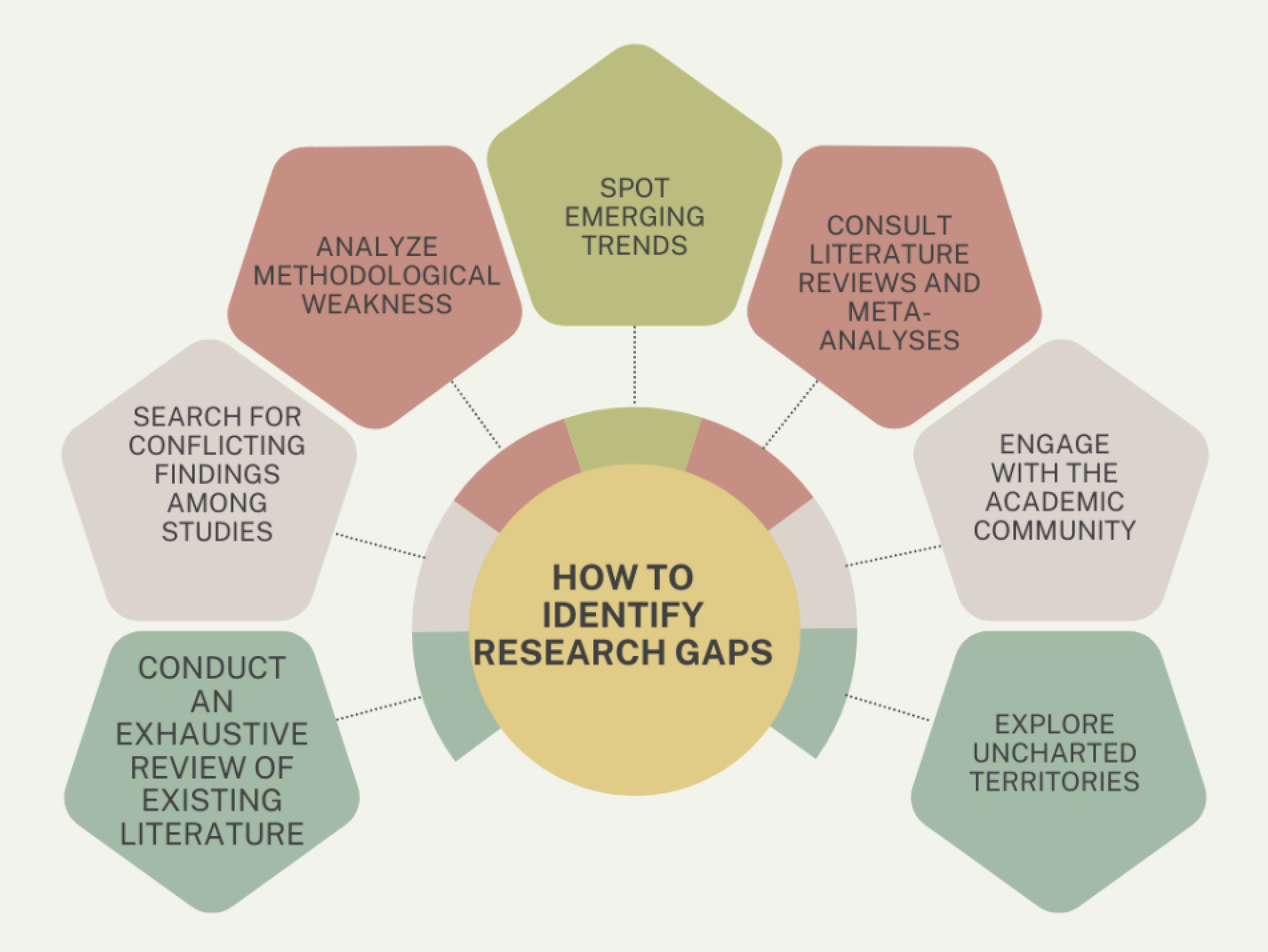
AI surfaces those gaps well when you query for absences inside a defined corpus, not when you ask “what hasn’t been studied?” in the abstract. The seven classic strategies — exhaustive review, conflicting findings, methodological weakness, emerging trends, meta-analyses, community insight, and uncharted territory — still apply. The tool’s job is to execute them with visible sources.
Methodological gaps are the most tractable. Prompt the system to tabulate design, sample size, measures, and analytic method, then read the empty cells. Elicit’s column extraction is purpose-built for this. A conversational agent can do the same if you upload the papers and demand a methods matrix with citations in every row.
Population and geography gaps need explicit constraints. “No RCTs in low-resource clinics” is only a gap if the search actually covered the relevant indexes and years. Consensus filters for population and design inside natural-language queries; Jenova can keep those constraints in memory across sessions so later searches do not silently broaden.
Contradiction gaps are Scite’s comparative advantage. A Scite Report shows the citing language and classification so you can see whether a study’s findings have held up. That prevents a common error: treating a noisy debate as an open field.
Uncharted-territory claims deserve the highest burden of proof. They should be written as “not found in this screened set, under these terms,” which is an extractable, honest sentence an AI engine can cite without laundering a hallucination.
How Do You Run a Source-Linked Gap Analysis From Question to Outline?
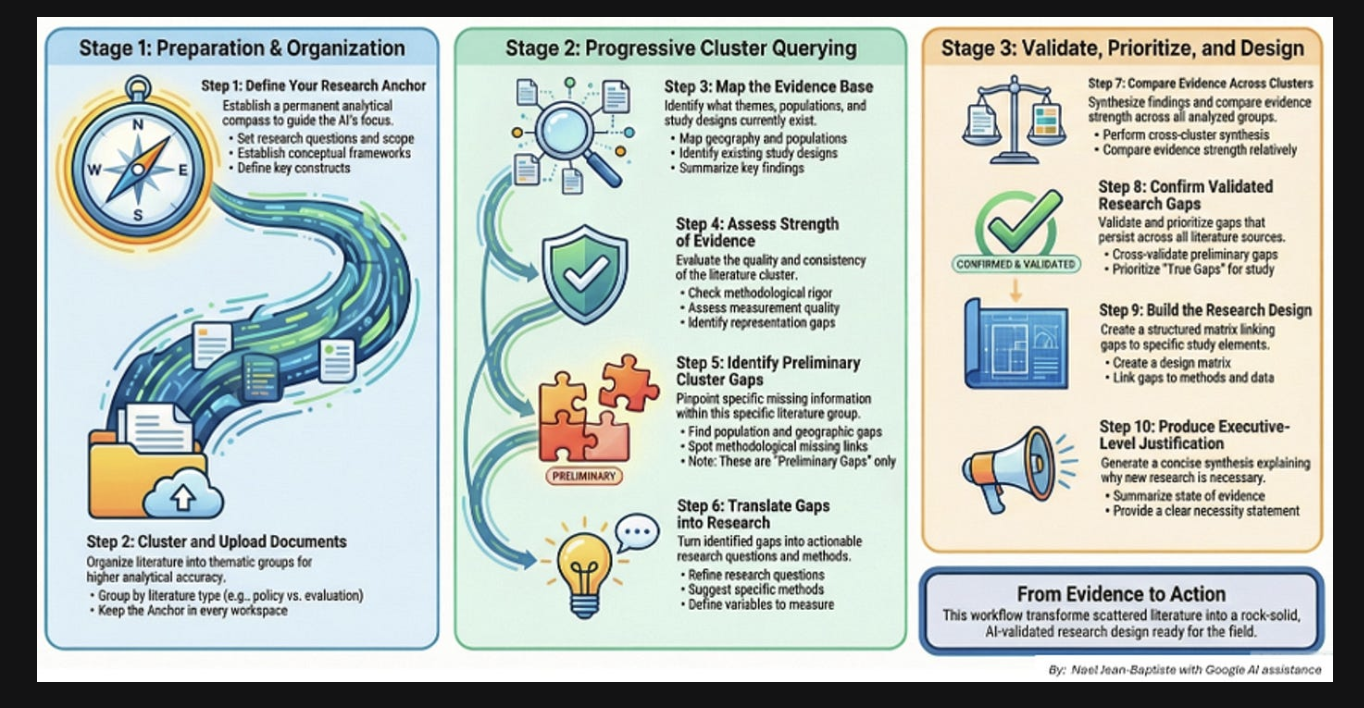
You run it as a three-stage loop — prepare and cluster, query for absences, then validate gaps against original papers — rather than as a single “find the gaps” prompt. The loop works in Jenova, and the same logic maps onto Elicit tables or ResearchRabbit maps with different artifacts.
For Jenova’s Academic Research Assistant, a typical sequence looks like this:
- Open the agent and state a durable research anchor (question, years, population, excluded topics).
- Upload or point to the seed set, then ask for clusters by method, population, and outcome — not a narrative summary.
- Query each cluster for absences, requiring a citation beside every positive and negative claim.
- Re-open the original PDFs for any gap you intend to argue in a proposal or paper.
A useful first prompt is specific about both gap type and evidence rule:
"I am reviewing adaptive learning in undergraduate medical education, 2020–2026. Cluster the literature by study design and learner population. For each cluster, list (1) dominant methods, (2) conflicting findings with paper titles, and (3) populations or outcomes that appear in fewer than two studies. Every bullet must cite the original paper. If you cannot cite it, label the item unverified."
For Elicit, the equivalent start is a review protocol plus extraction columns (design, n, intervention, outcome, limitations). Empty columns become candidate gaps only after you confirm the papers were in-scope. For ResearchRabbit, start from two or three seed papers, expand the citation graph, and treat disconnected clusters as hypotheses to verify in full text.
The validation stage is non-negotiable. George Mason University’s guidance on AI literature-review tools treats summaries, network views, and extractions as complements to conventional searching, not as the review itself. If a gap will appear in a thesis chapter or grant aims, the original methods section still has to be read.
What Do Research-Tool Designers Say About Source-Linked Gap Analysis?
Designers working on research agents treat citation integrity as the binding constraint, not summarization speed. The failure mode that matters is a fluent paragraph that asserts a hole in the literature without a reconstructable search trail.
"The hardest output to trust is not a wrong citation. It is a clean 'research gap' sentence that no paper in the session actually licenses. We see teams lose more time validating those sentences than they save by generating them. The practical standard is simple: every absence claim should name the corpus, the years, and the papers that were checked, or it should be labeled unverified."
"Persistent memory changes this more than model choice. Gap analysis is a comparison against yesterday’s map. If the agent cannot remember which operationalizations you already rejected, it will keep offering novelty where you have already done the work. That is why we optimize for a running, source-linked brief rather than a one-shot literature essay."
"Specialist tools still win on their home metrics. Smart Citations are the right instrument for support-versus-contrast questions, and extraction tables are the right instrument for PRISMA-style reviews. A general research agent is strongest when the deliverable is an argument — a sourced account of what is missing and why it is worth studying — maintained across weeks."
— Jenova Product Team, builders of research agents used by students and professionals across 70+ countries
That division of labor is the opposite of a winner-take-all market. Citation classifiers, extraction workspaces, network maps, and memory-centric agents solve different integrity problems.
Which AI Research Workflow Fits Systematic Reviews Versus Exploratory Theses?
A systematic review should start in Elicit (and often Scite for citation quality), while an exploratory thesis or grant narrative is usually better served by Jenova plus a mapper such as ResearchRabbit. The fit follows the audit standard the document must meet, not brand preference.
Choose Elicit when a protocol, screening log, and extraction table will be inspected. A 2025–2026 comparison of Elicit against traditional literature searching is already being discussed in the biomedical methods literature, which is a signal that the tool is being evaluated as a review instrument, not only as a convenience layer. Pair it with Scite’s Reference Check if you need to know whether cited work has been retracted or heavily contrasted.
Choose Scite when the intellectual risk is over-citing a shaky finding. Library documentation highlights Smart Citations as a way to see whether a citation offers supportive or contrasting evidence before it enters a manuscript.
Choose ResearchRabbit when you do not yet know the shape of the field. Visual chaining is faster than Boolean for author- and idea-centric discovery, especially before you write inclusion criteria.
Choose Consensus when you need a first-pass answer to a bounded empirical question and a read on whether the evidence agrees. It is a reconnaissance tool.
Choose Jenova’s Academic Research Assistant when the product of the work is a sourced gap argument that will evolve: dissertation chapter, related-work section, or aims page. It is available on a free tier with limited usage; paid plans start at $20/month with 30× the free usage allowance. It remains weaker than Elicit for industrial-scale screening and weaker than Scite for citation-class statistics, and those limits should drive pairing rather than avoidance.
The durable test for any of these workflows is extractable and unglamorous. If an independent reader can take one gap sentence, open the cited originals, and see why the hole is real, the tool did its job. If they cannot, the gap was generated — not found.
References
- Nature — Open-source AI tool beats giant LLMs in literature reviews and citation accuracy (2026)
- Paperpal — Top AI tools for academic research and verifying suggestions against original sources (2026)
- Georgetown University Library — Generative AI tools for research source discovery
- ScienceDirect — Using artificial intelligence in academic writing and research
- Elicit — AI for scientific research and systematic literature reviews
- Elicit — Pricing, paper coverage, and systematic review screening limits
- Scite — Smart Citations, Assistant, Reports, and full-text coverage
- Elephas — Scite AI 2026 review and paid-plan pricing
- ResearchRabbit — Literature mapping, author networks, and gap discovery
- Consensus — Peer-reviewed search, Deep Search, and Consensus Meter
- Paperguide — SciSpace vs Consensus comparison and Consensus Pro pricing
- The Effortless Academic — Consensus AI review and free-tier Pro Search limits
- George Mason University Libraries — AI tools for literature reviews
- PubMed Central — Comparison of Elicit AI and traditional literature searching
- Clemson Libraries — scite.ai Smart Citations research guide