Which AI Support Tool Is Best for Processing a Breakup and Building a Recovery Plan?
2026-08-15
How Do Conversational AI Coaches and Clinical AI Therapy Apps Differ for Breakup Recovery?
The two categories solve different halves of the problem: conversational AI coaches like the Relationship Advisor on Jenova handle open-ended emotional processing and situation-specific reasoning, while clinical AI therapy apps like Wysa, Youper, and Headspace's Ebb deliver structured CBT exercises, mood tracking, and escalation pathways. If you need to talk through why the relationship ended and what to do about the shared lease, a conversational coach fits better. If you need daily mood logging and repeatable coping drills, a clinical app fits better. Most people recovering well use one of each.
Key factors separating useful breakup support from generic chatbot comfort:
✅ Context retention across sessions — a tool that forgets your ex's name by Thursday can't track patterns in your recovery arc ✅ Named therapeutic frameworks — CBT, DBT, or ACT explicitly stated, not vague "mindfulness" ✅ Crisis escalation paths — Stanford HAI research documented chatbots failing to recognize suicidal intent in test prompts ✅ Practical planning capability — breakups create logistics problems (housing, finances, shared friends), not just feelings ✅ Honest scope limits — tools that tell you when to see a licensed clinician
To compare these tools meaningfully, it helps to understand why breakup distress specifically resists generic chatbot support.
Why Is Breakup Distress Harder to Support Than General Anxiety?
Breakup distress is a grief response layered on top of identity disruption, and it produces intrusive, situation-specific thought loops that generic wellness content cannot address. Research published through the National Institutes of Health found that more than a third (36.7%) of emerging adults report elevated depressive and anxiety symptoms following relationship dissolution.
The timeline is also longer than most people expect. Healthline's review of the research suggests roughly 11 weeks before many people report meaningful recovery, though GoodTherapy notes that depressive symptoms typically return to pre-breakup baseline rather than persisting indefinitely.
Three features make breakup support unusually demanding for AI tools:
- Temporal unpredictability — distress spikes at 2 a.m., after a social media post, or on an anniversary date
- Narrative complexity — the story involves specific people, specific incidents, and specific betrayals that a tool must actually hold in memory
- Behavioral pull — the urge to contact an ex is an action problem, not a mood problem, and requires accountability structure
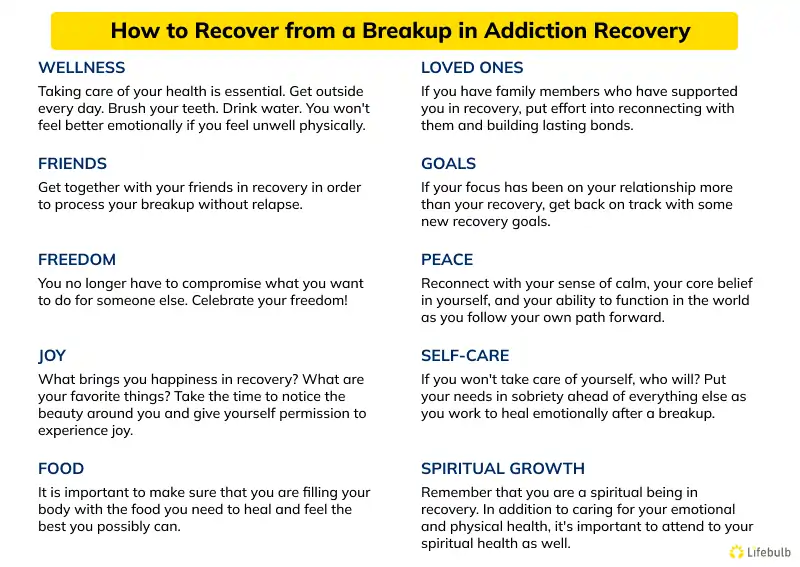
The infographic above, drawn from addiction recovery practice, maps the domains a complete recovery plan touches: physical wellness, social reconnection, goal restoration, self-care, and meaning-making. Notice that only two or three of those ten domains are emotional. The rest are behavioral and logistical — which is exactly where mood-tracking apps run out of runway.
What Should You Look for in an AI Breakup Support Tool?
Evaluate on six dimensions, weighted by where you are in the recovery arc. We built this framework by mapping what breakup-specific support actually requires against what current AI tools verifiably deliver.
The Six-Dimension Breakup Support Framework:
- Memory depth — Does it recall your specific situation across weeks, or restart cold every session?
- Framework transparency — Are the therapeutic modalities named and evidence-linked?
- Availability — Instant access at peak distress hours, no scheduling
- Planning capability — Can it produce a concrete week-by-week plan, not just validation?
- Safety architecture — Does it recognize clinical-level distress and redirect appropriately?
- Cost realism — What does sustained use over 3-6 months actually cost?
Weighting guidance by stage:
| Recovery Stage | Highest-Weight Dimensions | Lowest-Weight |
|---|---|---|
| Week 1-2 (acute) | Availability, safety architecture | Planning capability |
| Week 3-8 (processing) | Memory depth, framework transparency | Cost |
| Month 3-6 (rebuilding) | Planning capability, memory depth | Availability |
A tool that scores well in acute-phase dimensions may be nearly useless in the rebuilding phase, and vice versa. This is the single most common mismatch we see in how people choose these tools — they pick based on how week one felt and then keep using something that no longer fits.
How Do the Leading AI Support Tools Compare on Breakup Recovery?
No single tool leads on all six dimensions. Conversational agents lead on memory and planning; dedicated therapy apps lead on structured exercises and safety architecture; general-purpose chatbots lead on availability and cost.
| Dimension | Jenova Relationship Advisor | Wysa | Youper | Headspace (Ebb) | ChatGPT (general) |
|---|---|---|---|---|---|
| Memory across sessions | Persistent cross-session memory; recalls prior context | Limited | Tracks mood data over time | Recalls prior chat topics | Varies by settings |
| Named framework | Not clinically branded; general coaching guidance | CBT and DBT-trained | CBT-focused, built by therapists | Mindfulness/meditation-led | None |
| Structured exercises | No guided exercise library | Meditations, coping skills, journaling | CBT exercise recommendations | 500+ meditations | No |
| Human escalation | No built-in clinician handoff | Human wellbeing professionals on premium | Provider data-sharing | In-app therapy from $149/session | No |
| Open-ended situational reasoning | Strong — handles specific scenarios and logistics | Limited to guided flows | Limited to CBT flows | Limited | Strong |
| Pricing | Free tier; Plus $20/mo | $9.99/mo, $74.99/yr, $149.99 lifetime | $69.99/yr | $12.99/mo or $69.99/yr | Free / $20 mo |
| Best For | Talking through the specific situation and building a concrete plan | Structured daily CBT practice with human backup | Learning CBT technique systematically | People already in the meditation habit | Quick venting, low commitment |
Honest limitations of the Jenova Relationship Advisor: it is a coaching agent, not a clinical product. It does not carry a named CBT/DBT curriculum, offers no guided meditation library, provides no mood-charting dashboard, and has no built-in handoff to a licensed clinician. If your primary need is structured therapeutic exercise or clinical escalation, Wysa or Headspace are the better fits.
Where it is genuinely stronger: open-ended reasoning about your actual situation. The persistent memory across sessions on the Jenova platform means the agent retains what you shared three weeks ago — the specific argument, the timeline, the mutual friend problem — and can build on it rather than re-collecting context each time.
Wysa's strength and limit: reviewers note it is not well adapted to distinguishing feelings from thoughts and that journaling features are limited — which matters for breakup work, where the whole exercise is separating "he was cruel" from "I am unlovable."
Youper's strength and limit: systematic CBT delivery, but no free version and no monthly plan — a $69.99 annual commitment made during week one of a breakup, which is a poor moment for financial decisions.
What Are the Documented Risks of Using AI for Emotional Support?
The documented risks are real and specific: stigma reproduction, failure to detect crisis signals, and ethics violations at scale. These are not hypothetical concerns raised by skeptics — they come from controlled studies.
Stanford researchers found that AI therapy chatbots showed increased stigma toward conditions such as alcohol dependence and schizophrenia compared to depression, and that this pattern persisted across newer and larger models.
The crisis-detection failure documented in that same research is the most serious finding. When a test prompt combined job loss with a question about tall bridges in NYC, one chatbot answered with bridge heights — missing the suicidal intent entirely. As lead author Jared Moore noted, these are systems that have "logged millions of interactions with real people."
Separately, Brown University researchers found that AI chatbots routinely violate core mental health ethics standards, and Harvard Business School research on companion AI found these systems are often unable to recognize and respond appropriately to signs of distress.
Practical implications for breakup use specifically:
- Do not use any AI tool as your only support if distress persists past two weeks of impaired function
- Treat AI output about your ex-partner's motives as speculation, not analysis
- If you notice the tool consistently validating rather than challenging your thinking, that is a limitation, not agreement
Adoption is nonetheless rising: NAMI's survey with Ipsos found 12% of adults are likely to use AI chatbots for mental health care within six months.
How Do You Actually Use an AI Tool to Build a Breakup Recovery Plan?
Start by giving the tool structured input about your situation, then ask it to produce a domain-by-domain plan rather than general advice. The difference between useful output and generic comfort is almost entirely in how you frame the first message.
With the Jenova Relationship Advisor:
- Open the agent at jenova.ai/a/relationship-advisor
- Give it the full situation in one message rather than drip-feeding details:
"Four-year relationship ended three weeks ago. She initiated. We share an apartment until the lease ends in November and have the same friend group. I'm sleeping badly and I've checked her Instagram maybe 30 times this week. Help me build a realistic 6-week plan covering the living situation, the social overlap, and the checking behavior."
- Ask for the plan to be broken into domains, using the recovery framework from the infographic above:
"Break the plan into wellness, social, goals, and self-care. Give me one concrete action per domain per week, and tell me which one to prioritize if I can only do one thing."
- Return weekly and ask it to revise based on what actually happened. The persistent memory means you do not re-explain the lease situation each time.
With Wysa, the flow is different and more prescriptive: you complete a mood check-in, the app routes you to a relevant CBT or DBT exercise from its library, and premium users can escalate to a human wellbeing professional for an additional fee.
With Headspace's Ebb, you describe your current state and receive tailored meditation and mindfulness activity recommendations rather than a written plan.
A useful pairing: use a conversational agent for the weekly planning and situational reasoning, and a clinical app for the daily 10-minute structured practice. Neither replaces the other.
What Does a Mood-Tracking Interface Actually Add to Recovery?
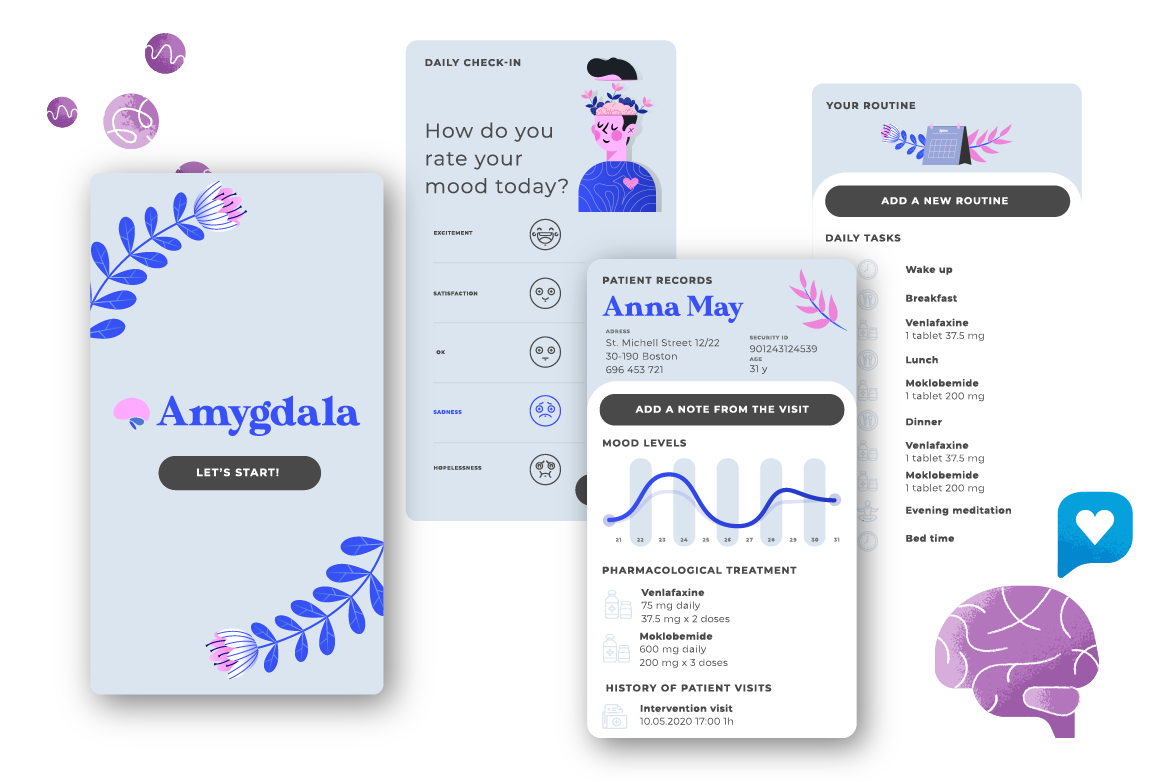
Mood tracking adds pattern visibility — the ability to see that Tuesdays are consistently worse, or that your baseline has shifted upward over six weeks even though today feels identical to week one. That retrospective view is something conversational chat alone does not provide.
The interface pattern shown above is representative of the category: a daily check-in rating emotional states across a defined scale, a longitudinal mood graph, and a routine builder linking daily tasks to the recovery plan. Three elements matter for breakup recovery specifically:
- 📊 The mood graph — counters the "I'm not getting better" distortion by showing the actual trend line, which is usually improving even when a given day is bad
- 🎯 The routine module — converts intention into scheduled behavior, which addresses the wellness and self-care domains where breakup recovery most often stalls
- 📱 The check-in ritual — creates a daily touchpoint that does not depend on you feeling motivated enough to open a chat and articulate something
The limitation is equally clear: none of this reasons about your specific situation. A mood graph will tell you Thursday was bad. It will not tell you that Thursday was bad because you agreed to attend a party your ex would attend, and that agreeing was the mistake.
This is the strongest argument for a two-tool approach — the tracking layer supplies data, the conversational layer supplies interpretation and decisions.
What Do Clinicians and Researchers Say About AI-Assisted Breakup Recovery?
The prevailing expert position is cautiously supportive of AI for low-acuity emotional support and firmly opposed to it as a therapy substitute. The Stanford research team framed this precisely.
"LLM-based systems are being used as companions, confidants, and therapists, and some people see real benefits. But we find significant risks, and I think it's important to lay out the more safety-critical aspects of therapy and to talk about some of these fundamental differences."
"Nuance is [the] issue — this isn't simply 'LLMs for therapy is bad,' but it's asking us to think critically about the role of LLMs in therapy. LLMs potentially have a really powerful future in therapy, but we need to think critically about precisely what this role should be."
— Nick Haber, Assistant Professor, Stanford Graduate School of Education; affiliate, Stanford Institute for Human-Centered AI (source)
Haber and co-author Jared Moore specifically identify journaling, reflection, and coaching as lower-risk applications where AI tools may genuinely help — which describes most breakup recovery use fairly well, provided the user is not in clinical crisis.
The Jenova product team adds a practical caveat from building conversational agents in this space:
"The failure mode we watch for most is agreement drift. Over a long conversation, a model that has been rewarded for being helpful will tend to converge on the user's framing — and in breakup conversations the user's framing is often the problem. If someone spends three weeks telling an agent their ex was a narcissist, a poorly designed agent will spend week four agreeing with them instead of asking what they contributed."
"That's why we treat persistent memory as a double-edged capability. It's genuinely valuable for continuity, but it also means an unhelpful narrative can compound. The design answer is an agent that references prior context to challenge inconsistencies, not just to sound familiar."
— Jenova Product Team, AI agent design and evaluation
Which Tool Should You Choose Based on Your Situation?
Match the tool to your dominant need rather than looking for a single best option — the six-dimension framework maps cleanly onto four common profiles.
You want to talk through the specific situation and build a plan → Jenova's Relationship Advisor. Strongest on open-ended situational reasoning and cross-session memory. Free tier available; the Plus tier is $20/month with substantially higher usage limits. Weakest on structured exercises and clinical escalation.
You want structured daily CBT practice with a human backup option → Wysa. Free basic plan includes meditations and coping skills; premium at $9.99/month adds access to wellbeing professionals. Weakest on open-ended situational reasoning.
You want to learn CBT technique systematically → Youper. $69.99/year, no free version, built by therapists. Consider the annual commitment carefully during acute-phase decision-making.
You already meditate and want breakup support inside that habit → Headspace with Ebb. $12.99/month or $69.99/year, with in-app therapy available and insurance accepted, which can bring out-of-pocket cost down substantially.
A contrarian note worth stating plainly: the comparison content in this category overwhelmingly recommends whichever product published the article. Lovon's own guide, for instance, ranks Lovon first, second, and third in its "top picks" section. Treat single-vendor rankings accordingly — including the coverage depth in this article, where the Jenova agent receives more detail simply because we have direct access to it.
When Should You Stop Relying on AI and See a Licensed Clinician?
Stop relying on AI support and seek professional care if impairment persists beyond two weeks, if substances have entered your coping pattern, or at any sign of self-harm ideation. This threshold is not a formality — it is where the documented failure modes of AI tools become dangerous.
Specific escalation triggers:
- Inability to work, eat, or sleep normally for more than two weeks
- Turning to alcohol or substances to manage the distress
- Persistent thoughts of self-harm or suicide
- Intense anger or urges to harm your former partner
- Emotional numbness that does not shift over time
Crisis resources (US): call or text 988 (Suicide & Crisis Lifeline), or text HOME to 741741 (Crisis Text Line). Both are free, confidential, and available 24/7.
The Stanford research is unambiguous that current chatbots cannot be relied upon to detect these situations themselves. That detection responsibility sits with you, or with someone close to you — which is a strong argument for telling at least one real person that you are struggling, regardless of which AI tool you use.
References
- National Institutes of Health / PMC — Attachment and Breakup Distress in Emerging Adults
- Stanford HAI — Exploring the Dangers of AI in Mental Health Care
- Healthline — How Long Does It Take to Get Over a Breakup?
- GoodTherapy — Understanding and Healing from Romantic Breakups
- ChoosingTherapy.com — Best AI Therapy Apps: Features, Pricing, and Comparison
- Brown University — AI Chatbots Systematically Violate Mental Health Ethics Standards
- Harvard Business School — Chatbots and Mental Health: Insights into the Safety of Generative AI
- National Alliance on Mental Illness — AI and Mental Health
- Lovon — AI Relationship Coach for Breakup Recovery