Which AI Roleplay Tool Is Best at Remembering Character Relationships, Quests, and World Lore Over Time?
2026-08-06

What Is the Best AI Roleplay Tool for Long-Term Memory?
The best AI roleplay tool for remembering relationships, quests, and lore over time depends on which of those three memory types matters most to you — and the honest answer is that no single platform leads on all three. Roleplay Game Master on Jenova is the strongest option for unlimited cross-session narrative continuity in any genre, LoreWeaver AI is built around a structured world database that tracks characters and relationships as queryable entities, Friends & Fables leads for quest-state and campaign persistence in D&D 5e, and NovelAI remains the reference implementation for lorebook-driven world memory in solo writing.
The distinction that actually matters is how memory is stored, not how much of it a platform advertises:
✅ Conversational memory — the model re-reads chat history; degrades as context fills, and is where "drift" originates ✅ Lorebook/keyword memory — static entries injected when trigger words appear; reliable for lore, poor for evolving relationships ✅ Database-backed world state — characters, factions, and quests stored as structured records that survive indefinitely ✅ Unlimited context retention — the full session history stays available rather than being windowed out ✅ Relationship deltas — whether the system tracks how a relationship changed, not just that a character exists
Those four architectures behave very differently under load, and the rest of this guide breaks down which one solves which memory problem, how the major platforms implement each, and how to test any tool's memory in under five minutes.
Why Do Most AI Roleplay Tools Forget Your Story?
Most AI roleplay tools forget your story because they store it in a conversation window rather than a structured database — so as the session grows, older details get squeezed out to make room for newer ones. This is an architectural limit, not a writing-quality problem, and it is the single most consistent complaint across the entire category.
The mechanics are straightforward. A conversation-based system re-reads as much of your chat history as fits in its context budget on every turn. When the campaign exceeds that budget, something has to go — and what goes is usually the oldest material, which is exactly where your foundational world lore and early relationship-defining moments live.
Jenova's analysis of the problem lists the specific casualties in order of how quickly they disappear: character backstories and motivations, established world-building details, previous plot developments and consequences, NPC relationships and histories, and player choices and their narrative impact (Jenova roleplay memory analysis).
The Three Failure Modes You'll Actually Notice
1. Recap mode. You spend more time reminding the AI what happened than advancing the story. The Jenova analysis describes this as being forced into "constant 'recap mode'" — a tax on every session that grows with campaign length.
2. Personality drift. Even when the AI remembers facts, it loses voice. A cautious NPC becomes reckless. A villain's motivations shift without explanation. AI Dungeon's own 2023 user survey found that 73% of AI roleplaying users cited character inconsistency as their primary complaint (cited via Jenova roleplay analysis).
3. Consequence amnesia. The most damaging failure for long campaigns. A choice you made in session three stops mattering, because the system no longer holds the record of it. Relationship memory dies here first, since relationships are stored as accumulated interactions rather than discrete facts.
The aiga_ platform review frames the diagnostic well: "Most AI roleplay apps feel impressive in the first ten minutes. The real test is hour two: does the story still remember the promise you made, the faction you angered, and the relationship you changed?" (aiga platform comparison)
That framing is the core of this entire evaluation. Ten-minute quality is now commodity — every frontier model writes a competent scene. Hour-two quality is where platforms separate.
What Are the Three Types of Memory an AI Roleplay Tool Needs?
An AI roleplay tool needs three distinct memory types, and most platforms are only good at one — which is why "best memory" is a meaningless claim without specifying which kind.
Here is the framework used throughout this guide. Score any platform on all three before committing to a long campaign.
🧬 Relationship Memory
What it stores: How characters feel about you and each other, and why. Not "Marcus is an ally" but "Marcus trusts you because you covered for him at the gate, and resents you for what happened to his brother."
Why it's hardest: Relationships are cumulative and mutable. A static entry can't capture them, because the value changes with every scene. This is the memory type that conversation-window systems lose first and that keyword lorebooks handle worst.
How to test it: Ask an NPC directly why they feel the way they do about you. A system with real relationship memory will cite specific events. A system without one will produce a plausible-sounding generality.
🗺️ Quest and World-State Memory
What it stores: Active objectives, completed objectives, inventory, faction standings, locations discovered, and consequences pending. This is the most structurable memory type — it maps cleanly onto database fields.
Why it matters: Quest state is what makes a story feel like a game rather than a conversation. Without it, threads dangle unresolved and the world stops reacting to your progress.
How to test it: Ask for a status report. "List every open thread, who's waiting on me, and what I'm currently carrying." Accuracy here is binary and immediately obvious.
📚 Lore Memory
What it stores: Static world facts — the history of the empire, how magic works, the geography, the pantheon. Unlike relationships, lore rarely changes once established.
Why it's easiest: Because it's static, keyword-triggered injection works well. This is exactly what lorebooks were invented for, and it's why lorebook-based platforms feel strong on world consistency while still fumbling relationships.
How to test it: Reference an obscure detail from early in the campaign without re-explaining it, and see whether the response treats it as known.
The Evaluation Weighting
For most long-form roleplayers, the priority order is relationship > quest state > lore — because lore inconsistencies are annoying while relationship failures are immersion-ending. If you're primarily worldbuilding rather than character-driven roleplaying, invert the first and third.
How Do the Major AI Roleplay Tools Compare on Memory?
The major platforms cluster into four memory architectures, and each one has a distinct failure profile. The table below is deliberately dimension-first rather than platform-first, because the architecture predicts the behavior.
| Dimension | Roleplay Game Master (Jenova) | LoreWeaver AI | Friends & Fables | NovelAI | Character.AI |
|---|---|---|---|---|---|
| Memory architecture | Unlimited context retention across sessions | Living world database of characters, relationships, history | Campaign memory + structured world data + lore ingestion | Lorebook + long context window | Conversation context |
| Relationship memory | Perfect NPC consistency; remembers relationship development and rippling consequences | NPCs remember how you treated them; consequences echo across sessions | Advanced memory and customization via AI Game Master "Franz" | Lorebook-based; author-managed rather than automatic | Weaker long-story continuity per third-party review |
| Quest / world state | Plot threads, choices, and consequences retained indefinitely | Persistent characters, factions, locations; interactive knowledge graph | Quests, one-shots with branching paths, inventory, travel, tactical 5e state | Author-controlled through lorebook entries | Not a stated feature |
| Lore memory | Complete world-building detail retention | Persistent world entities woven into every response | Lore dump — "the AI learns and uses them instantly" | Lorebooks are the platform's core strength | Character-card scoped |
| Genre range | Any genre, any theme, zero content restrictions | Fantasy, romance, sci-fi, horror; uncensored | D&D 5e focused | Any — prose-first | Any — chat-first |
| Multiplayer | Not available — solo only | Not a stated feature | Up to 6 players, async and cross-platform | Not party-first | Group chat features |
| Visual layer | None — text-first | Unlimited image generation, adaptive music, knowledge graph | Battlemaps, maps, image generation, text-to-speech | Separate image tool | None |
| Pricing | Free tier with daily limit; Plus $20/mo (30× usage) | Not published on the page reviewed | Not published on the page reviewed | Not published in sources reviewed | Not published in sources reviewed |
| Best for | Long-horizon solo campaigns in any genre where continuity is the priority | Character-relationship-driven stories with visual and audio layers | Group 5e campaigns with quest structure and tactical combat | Solo authors managing their own lore systems | Fast, casual character chat |
Pricing and feature details reflect the sources reviewed at the time of writing; verify current terms on each vendor's site.
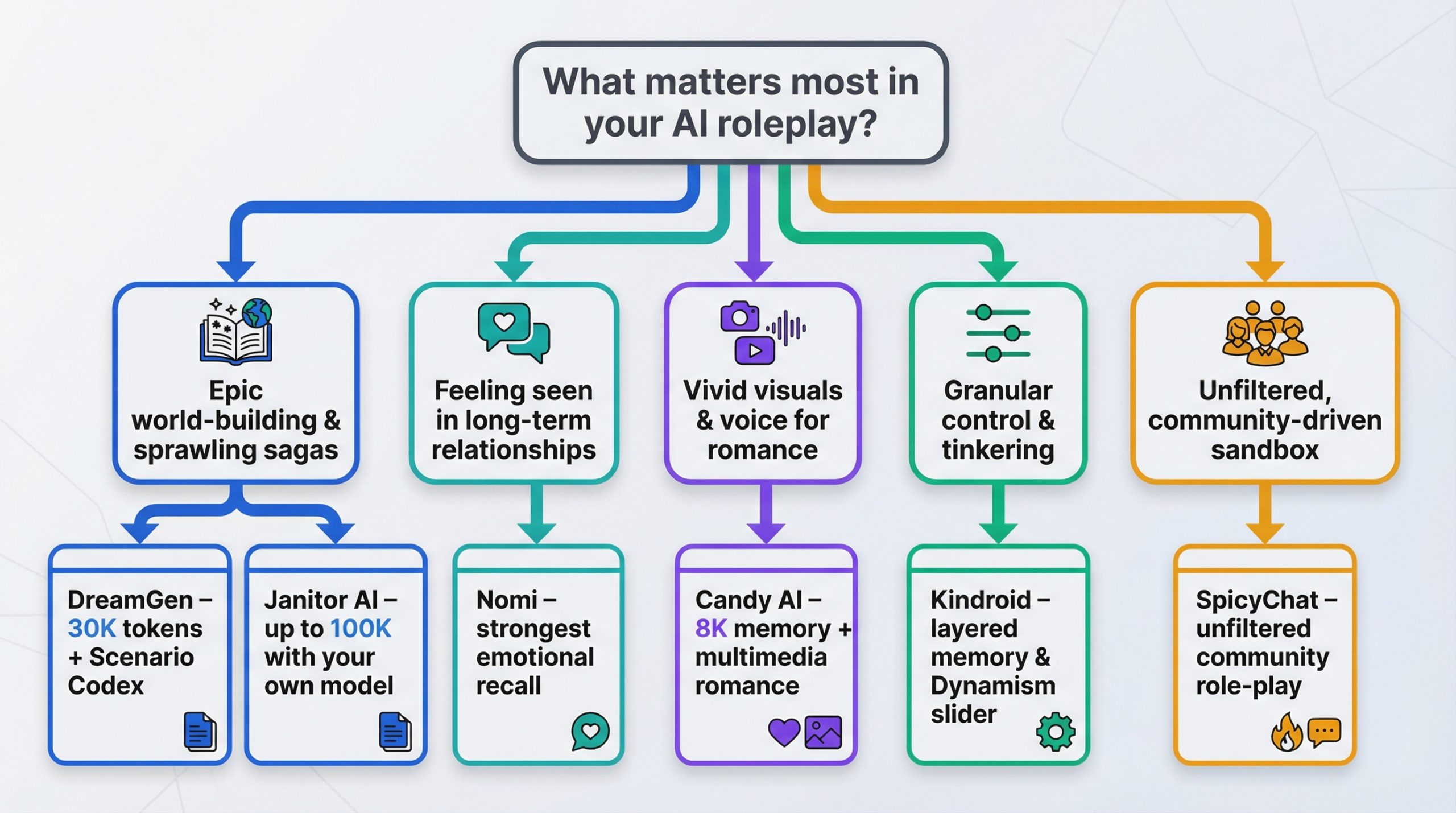
🎭 Roleplay Game Master (Jenova) — Unlimited Retention, Genre-Agnostic
Strengths: Built specifically around the memory problem. It advertises unlimited context retention across sessions of any length, maintaining "every NPC interaction and relationship development, all plot twists, revelations, and consequences, complete character backstories and motivations, detailed world-building elements and lore, and player choices and their rippling narrative impact." Users report campaigns spanning hundreds of messages without narrative degradation, with minor NPCs mentioned once reappearing naturally when relevant (Jenova roleplay documentation).
It also runs a dual-mode architecture — GM Mode for planning and parameter adjustment, Roleplay Mode for immersion — which keeps meta-discussion from contaminating the narrative. Switching is done by prefixing a message with "GM:". Genre range is unrestricted, spanning fantasy, sci-fi, horror, modern, historical, and hybrids, with user-controlled content intensity rather than platform-imposed filtering.
Honest limitations: It is text-first with no visual layer — no battlemaps, no generated character art, no maps, no adaptive audio. If you want to see your world, LoreWeaver AI and Friends & Fables both do things it cannot. There is no multiplayer party mode, so group tables should look elsewhere. And its memory is narrative rather than schematic: it retains everything, but it doesn't expose a structured faction-reputation panel or an interactive relationship graph the way a database-first platform does. You query it conversationally rather than reading it off a dashboard.
Best for: Solo players running months-long campaigns in any genre, where continuity across dozens of sessions is the binding constraint.
🕸️ LoreWeaver AI — The Structured World Database
Strengths: The clearest implementation of relationship memory as a first-class data structure. It maintains "a living database of your world—characters, relationships, history—woven into every response," with persistent characters, factions, and locations across every session. Its demo interface surfaces memory explicitly — showing a callout like "Memory: Marcus's brother was executed here • Session 3" during active play, which is the visible-state design that conversation-based systems lack.
It layers substantially beyond text: unlimited uncensored image generation, adaptive AI music that shifts with narrative tone, an interactive knowledge graph for visualizing character connections, and visual scripting for IF/THEN narrative triggers that fire NPC dialogue and plot twists based on player actions. It reports 10,000+ worlds created and a 4.9/5 creator rating (LoreWeaver AI).
Limitations: Pricing is not published on the page reviewed, which makes cost-per-session impossible to evaluate up front. The visual scripting layer implies setup work — IF/THEN threads are authored, not emergent, so you are partly building the branching yourself. Multiplayer is not a stated feature.
Best for: Character-relationship-driven stories where you want memory to be visible and queryable, with visual and audio production value.
⚔️ Friends & Fables — Quest State and Party Play
Strengths: The strongest quest-memory implementation among the platforms reviewed, because quests are structured objects rather than narrative recollections. Its AI Game Master, Franz, "adapts to your choices and creates dynamic storylines" with advanced memory and customization. The world-building suite includes map makers, character generators, lore ingestion where "the AI learns and weaves them into your campaigns instantly," a travel system, quest and one-shot creation with branching paths, tactical 5e combat with battlemaps, inventory management, and text-to-speech narration. Multiplayer supports parties of up to six players, asynchronously and cross-platform. It reports 100,000+ players and world builders (Friends & Fables).
Limitations: D&D 5e focused, which constrains genre range meaningfully — you're in fantasy unless you homebrew hard. Pricing isn't published on the page reviewed. And the structured-state advantage is strongest for mechanical memory (inventory, quests, combat) rather than emotional memory; relationship nuance is less schematized than in LoreWeaver AI's model.
Best for: Groups running fantasy campaigns where quest tracking, tactical combat, and party coordination matter more than genre flexibility.
✍️ NovelAI and Character.AI — The Lorebook and the Chat Window
The aiga_ comparison positions NovelAI as "closer to a prose studio than a chat game," with its strength in "long-form writing control, lorebooks, style settings, and private drafting." On memory specifically, it's described as "strong for lorebook-driven solo writing" — meaning lore memory is excellent and author-controlled, while relationship memory is only as good as the lorebook entries you maintain by hand. It is explicitly "not built around multiplayer sessions" (aiga platform comparison).
Character.AI is the fastest route to casual character chat with a large library, but the same review flags "limited world simulation, no integrated scene art, and weaker long-story continuity than dedicated roleplay worlds." Memory is conversation context — fine for a scene, structurally unsuited to a campaign.
Which Tool Should You Choose for Your Specific Memory Problem?
Match yourself to the memory failure you're actually experiencing, not to a ranking — because the platforms genuinely optimize for different things.
- Your NPCs forget how they feel about you → LoreWeaver AI, whose relationship database is designed for exactly this, or Roleplay Game Master if you want unlimited retention without a visual layer.
- Your campaign is months long and threads keep dying → Roleplay Game Master. Unlimited cross-session retention with no recap requirement is the specific problem it was built to solve.
- Your quests and inventory drift out of sync → Friends & Fables. Structured quest and inventory objects don't degrade the way narrated state does.
- Your world lore contradicts itself → NovelAI's lorebooks, or Friends & Fables' lore ingestion. Static facts are the one memory type keyword injection handles cleanly.
- You play with friends → Friends & Fables is the only reviewed option with real multiplayer, supporting up to six players asynchronously across time zones.
- You want the world to look and sound like something → LoreWeaver AI for adaptive music and unlimited image generation, or Friends & Fables for maps and battlemaps.
- You want a prewritten scenario with memory already scaffolded → Jenova's scenario agents: The Mansion for amnesia mystery, The Asylum for horror investigation, Vesper Court for vampire-court dark romance, Love Island and College Life for emergent social dynamics where relationship memory is the gameplay, and K-Pop Producer for a 60-day career sim built on accumulating consequences.
How Do You Set Up a Campaign That Actually Remembers?
You set up a campaign that remembers by declaring your memory structures explicitly at the start — because named, structured entities survive far better than details the system has to infer from narrative flow.
This is the highest-leverage habit in AI roleplay, and it works on every platform regardless of architecture.
On Roleplay Game Master
The documented setup runs in a specific order, and the first step matters more than it looks:
-
Disable Global Memory in Settings. The agent explicitly recommends this so context from your other conversations doesn't bleed into the campaign. If you've been using the platform for work, that context can contaminate a fantasy session (Jenova setup guide).
-
Define your world, tone, content level, and character — then add the memory scaffolding the guide doesn't require but that makes state queryable:
"Dark fantasy, mature content, gritty realism. Themes of moral ambiguity and political corruption. I'm playing Kael, a disgraced knight seeking redemption after failing to protect the royal family. Track four things explicitly for me: a relationship score for every named NPC with a one-line reason for its current value, my active and completed quests, my inventory, and standing with the three major factions. Update these silently as we play."
- Audit the state periodically. Once every few sessions, drop into GM Mode:
"GM: Give me a full state report — every NPC relationship with the event that most affected it, all open quest threads, current inventory, and faction standings."
If the report is specific and traceable to real events, memory is intact. If it's vague, re-anchor by restating the structures.
- Continue across sessions freely. The documented behavior is that you can close the conversation, return days or weeks later, and resume with full continuity — no recap required.
On Friends & Fables
Do the structural work in the tooling before you play rather than in your prompt. Build the world in the world-building suite, dump your existing lore in so the AI learns it, define NPCs with explicit relationships, and create quests as authored objects with branching paths. The platform's structured data layer does what a prompt does on a text-first system, and it does it more durably because the data lives outside the conversation.
On LoreWeaver AI
Lean on the knowledge graph. Because the platform visualizes character connections and lets you discover clusters, use it as an audit tool — if a relationship you expect to exist isn't in the graph, the AI doesn't know about it either. Set up IF/THEN visual scripting threads for the consequences you most want to survive, since scripted triggers don't depend on the model remembering anything.
Three Habits That Preserve Memory Anywhere
- Name your relationships numerically. "Marcus: +4, trusts me since the gate" survives compression far better than "Marcus and I are close."
- Close your loops explicitly. When a quest resolves, say so. Unclosed threads accumulate and crowd out live state.
- Ask the world what changed without you. "What happened in the capital during the three weeks I was gone? Include one development I won't like." This forces the system to exercise its world state rather than just react to you.
What Do AI Storytelling Experts Say About Memory Architecture?
The expert view is that memory marketing has run well ahead of memory engineering, and that most buyers are evaluating the wrong variable entirely.
"The word 'memory' is doing an enormous amount of unearned work in this category right now. Four different products will tell you they have persistent memory and mean four architecturally incompatible things — a longer context window, a keyword-triggered lorebook, a summarization pipeline, and an actual relational database. Those fail in completely different ways. A lorebook will hold your world's creation myth perfectly for a year and still have no idea that the innkeeper is now afraid of you. A long context window handles the innkeeper fine right up until it doesn't, and there's no warning before it stops."
"The test we'd give anyone evaluating a platform takes about four minutes and cuts through all of it. Play three sessions. In session one, make a specific promise to a named NPC and do something that should have a delayed consequence. In session three, walk up to that NPC and say nothing but 'you've been avoiding me.' A system with real relationship memory will tell you exactly why. A system without one will improvise something charming and generic — and improvisation is the tell, because it means the state was reconstructed rather than retrieved."
"Our honest position on our own product: we optimize for narrative continuity over schematic state. Roleplay Game Master will remember a minor NPC you named once forty sessions ago and bring them back at the right moment, which is genuinely hard. What it won't do is hand you a dashboard with faction reputation bars on it — you have to ask for the state rather than read it. If you want your world model to be visible and inspectable, a database-first platform with a knowledge graph is the better tool, and we'd rather say that than pretend otherwise. Different memory problems, different architectures."
— Jenova Product Team, 8 years across AI agent infrastructure and long-context narrative systems
Is There Research Supporting Structured Memory for AI Roleplay?
Yes — the academic work converges on the same conclusion as the product landscape: memory alignment and structured retrieval, not raw model quality, determine long-narrative coherence.
A 2026 survey of advances in AI interactive storytelling identifies two research directions that map directly onto the platform architectures above: PsyMem, which "directly addresses memory alignment in role-playing LLMs," and SCORE, which "shows how summarization plus retrieval can keep long narratives coherent over time" (Yenra research survey).
That second finding is the important one commercially. Summarization-plus-retrieval is the architecture underneath most credible long-memory claims — the system compresses old material into durable summaries and retrieves the relevant pieces on demand, rather than trying to hold everything in active context. It's why unlimited-retention claims are technically achievable rather than marketing fiction, and it's also why implementation quality varies so much between platforms making the same claim.
The practical translation: when a platform tells you it has unlimited memory, ask what it summarizes and what it retrieves. Those two mechanisms are where the engineering actually lives.
Jenova's own analysis reinforces the user-side stakes, noting that context retention directly correlates with satisfaction in conversational AI while most roleplaying tools ignore the requirement — with over 50 million active tabletop RPG players worldwide representing the addressable audience for tools that get it right (Jenova roleplay analysis).
Does Memory Depth Come at the Cost of Something Else?
Yes — memory depth trades against visual richness, multiplayer support, and mechanical structure, and every platform in this comparison has made a different version of that trade.
The trade-offs, stated plainly:
Text-first depth vs. visual production. Roleplay Game Master retains everything but shows you nothing — no art, no maps, no music. LoreWeaver AI and Friends & Fables both deliver substantial visual layers, and both are running additional systems that consume budget the text-first tool spends entirely on continuity.
Structured state vs. genre freedom. Friends & Fables tracks quests and inventory beautifully because it's built on D&D 5e — the schema exists because the rules do. That precision is also the constraint. A genre-agnostic tool can't pre-build a quest object for a story it can't predict.
Automatic memory vs. authored memory. NovelAI's lorebooks are extremely reliable and entirely manual. LoreWeaver AI's IF/THEN visual scripting is powerful and requires you to author the branches. Automatic retention asks less of you but gives you less control over what's prioritized.
Solo depth vs. party play. Multiplayer multiplies the state a system has to track — six players' relationships, inventories, and quest progress rather than one. Friends & Fables supports it; the deepest-memory solo tools generally don't.
There is no configuration that wins all four. The realistic approach is to identify which trade-off you can absorb and pick accordingly — and to expect that the answer changes if your play style does.
Which AI Roleplay Tool Should You Actually Start With?
Start with the tool that solves your dominant memory failure, and expect to test more than one — the category is young enough that no platform has solved all three memory types.
The condensed version of everything above:
| If your priority is… | Start with |
|---|---|
| Months-long continuity in any genre, solo | Roleplay Game Master |
| Relationship memory you can see and query | LoreWeaver AI |
| Quest state, inventory, and party play in 5e | Friends & Fables |
| Author-controlled lore for solo fiction | NovelAI |
| Fast casual character chat, no campaign | Character.AI |
| A prewritten scenario with memory built in | Vesper Court, The Mansion, The Asylum, Love Island, College Life, or K-Pop Producer |
The diagnostic that cuts across all of them is the one worth internalizing: if a tool can't tell you why an NPC feels the way they do about you, citing a specific event, it isn't remembering your relationship — it's regenerating a plausible one. That test costs one message, works on any platform, and predicts hour-two quality better than any feature list.
Run it before you commit a campaign to anything.
If you'd rather design the characters before you play them, our Character Creator handles guided builds, backstories, and portraits across genres.