Which AI Roleplay Platform Is Best for Voice-Based Adventures?
2026-09-08
What Separates Live Voice Companions From Adventure-Native AI Platforms?
The strongest choice for voice-based AI roleplay in 2026 depends on whether you need a live two-way voice call or a long-running adventure that remembers plot, inventory, and character state. Jenova is strongest when the adventure itself is the product — persistent memory, specialized scenario agents, and speech-to-text input across sessions. Character.AI remains the most accessible live-call option, while Kindroid and Nomi AI compete on call latency and companion memory, and Replika remains a polished single-companion voice product.
That split is the evaluation frame most roundups skip. “Voice roleplay” is not one feature. It is three stacked layers, and platforms that win on one layer often lose on another.
Key factors that separate a phone-call companion from a voice-ready adventure platform:
✅ Audio channel — live duplex calling versus one-way character TTS versus user speech-to-text with text or playback replies ✅ Turn latency — whether replies land near human conversational pace or force an unnatural pause ✅ Cross-session memory — whether the paladin still owes you a debt three nights later ✅ World structure — open character chat versus scenario-native agents with a beginning, middle, and stakes ✅ Cost of sustained play — monthly fees, call limits, and whether usage is capped daily
To compare these tools honestly, it helps to score the full stack rather than asking which app has a microphone button.
Why Has Voice Roleplay Become a Distinct Category in 2026?
Voice has become a distinct AI roleplay category because companion apps now compete on call quality, while a second group of platforms compete on story continuity — and those are no longer the same race. Industry coverage of AI companion apps in 2026 now treats memory, pricing, and platform access as first-order comparison axes, not extras.
The commercial signal is large enough to matter. One 2025 market recap put AI companion revenue at $82 million in the first half of 2025, across 337 revenue-generating apps. That scale explains why voice is being productized: audio raises session time, and session time is the monetizable unit.
Researchers are treating the category as more than entertainment. A 2026 consumer-research paper on AI companions and well-being examines how people form vulnerable relationships with these systems. Trinity College Dublin’s AI Accountability Lab secured a UK grant in late 2025 to study companion risks. Voice intensifies that research problem because spoken intimacy feels closer to a real call than a text thread.
For adventure players, the practical consequence is a crowded shelf. Some products optimize for hearing a character answer like a phone call. Others optimize for finishing a campaign. Confusing those jobs is how people end up with a great voice and a forgotten quest log.
What Should You Evaluate in a Voice-Capable AI Roleplay Platform?
You should evaluate a voice-capable roleplay platform on six dimensions: voice modality, latency, memory, character consistency, adventure structure, and cost of a full session — not on whether a voice button exists. A platform can ship TTS and still be a weak adventure tool if it cannot hold a plot across days.
The original framework used here is the Voice Adventure Stack. Layer 1 is the audio channel. Layer 2 is character fidelity — voice timbre, emotional range, and persona stability. Layer 3 is campaign state: locations, NPCs, consequences, and unfinished threads.
Most companion apps invest heavily in Layers 1 and 2. That is rational for a product whose job is “talk to one person.” It is incomplete for dungeon crawls, mystery houses, court intrigue, or multi-hour anime scenarios where yesterday’s choice should still be binding.
Use this checklist before paying for a month of play:
- Modality fit: Do you need interruption-style calling, or is speaking your turn and hearing the reply enough?
- Silence handling: Does the system wait for you to finish, or does it clip the last word?
- Memory write path: Are facts stored as editable notes, embeddings, or only in the current context window?
- Multi-entity support: Can you keep a party, a villain, and a setting distinct?
- Session resume: Can you continue Tuesday’s raid without re-explaining the map?
- Constraint honesty: Are NSFW, violence, or horror limits stated up front, especially on voice?
As of 2026, pricing is a poor proxy for stack depth. Character.AI Plus is $9.99 per month or $94.99 per year, while Replika Pro is $19.99 monthly or $69.99 annually. Kindroid is cited at $13.99 per month in a 2026 companion comparison. Lower call prices do not automatically mean better adventures.
How Does Jenova Compare to Character.AI, Kindroid, Nomi, and Replika?
Jenova compares most strongly on adventure structure and cross-session memory, while Character.AI, Kindroid, Nomi AI, and Replika compare more strongly on live voice calling. No single platform wins every row if you score audio channel and campaign continuity as separate jobs.
Jenova’s relevant strengths are persistent chat history, speech-to-text input, text-to-speech playback of agent replies, multi-model access, and scenario agents built as complete adventures rather than blank character cards. Its honest limitation is equally important: it does not currently offer Character Calls-style two-way voice conversations. You can speak turns in and hear replies read back; you do not get a full-duplex phone call with barge-in.
Character.AI’s strength is distribution and live calling. Character Calls were introduced as two-way conversations that work like a phone call, with call transcripts stored as text. The limitation is that unlimited voice calls sit on c.ai+ as of 2026, and the product remains character-chat first rather than campaign-native.
Kindroid is frequently picked when users want designed characters and comparatively strong voice calls. Nomi AI is typically framed around a three-tier memory system with a dedicated notes layer. Replika still leads some reviewers on cross-platform polish and emotional calibration, with the constraints of one companion per account and voice gated behind Pro.
| Feature / Dimension | Character.AI | Jenova | Kindroid | Nomi AI | Replika |
|---|---|---|---|---|---|
| Voice modality | Live two-way Character Calls; character voices | Speech-to-text in; message TTS playback | Live voice calls | Live voice calls | Live voice calls (Pro) |
| Typical call latency | Not independently timed in this review | Not a duplex-call product | About 1.7 seconds average in one 2026 test | About 2.1 seconds average in the same test | Reviewers cite comparatively strong call quality; exact latency unverified here |
| Cross-session memory | Better memory on Plus; free chat is more limited | Unlimited chat history and persistent memory | Strong character-design memory controls | Notes plus longer-term memory layers | In-session context is strong; free-tier persistence is weaker |
| Adventure structure | User-created characters and scenes | Scenario-native game agents plus custom agents | Companion/character focused | Companion focused | Single companion relationship arc |
| Multi-character play | Large public character catalog | Multiple specialized agents; custom agents | Multiple companions depending on plan | Multiple companions (reviewers cite up to 10) | One companion per account |
| Pricing (as of 2026) | Free; Plus $9.99/mo or $94.99/yr | Free limited usage; Plus $20/mo for 30× usage, higher tiers above that | About $13.99/mo | About $16.99/mo in 2026 comparisons | Free text; Pro $19.99/mo or $69.99/yr |
| Best for | Fast character calls and huge catalogs | Multi-session adventures, mysteries, and custom campaigns | Designed personas with snappy voice | Memory-forward companion calls | One polished companion with avatar/AR extras |
Jenova’s paid usage is cumulative rather than daily-capped: Plus is $20/month, Premium $50, Pro $100, Max $200, Ultra $500, and Enterprise $1,000, with monthly usage resetting on the billing date. That model fits long adventure sessions better than products that throttle voice minutes. It still does not close the live-call gap.
Which Platforms Deliver the Most Natural Two-Way Voice Calls?
Kindroid currently has the edge on raw reply speed, Nomi AI has the edge on not interrupting you, Character.AI has the edge on availability and language coverage, and Replika has the edge on a polished single-companion call. Jenova is not the right comparison set if a phone-call feel is the only requirement.
A 2026 side-by-side of work-conversation calls found that neither Nomi nor Kindroid consistently stayed under a 1.5-second turnaround — the threshold where most people stop noticing delay. Kindroid averaged about 1.7 seconds and sometimes clipped the end of a sentence. Nomi averaged about 2.1 seconds, waited for a clearer pause, and used more filler acknowledgments.
That trade-off maps directly onto adventures. Fast fantasy banter wants Kindroid’s shorter silence threshold. A horror interrogation or a bargaining scene with a goblin merchant wants Nomi’s patience, because players pause mid-sentence to think. Character.AI’s Character Calls FAQ documents two-way voice, multilingual support including Spanish, Portuguese, Russian, Korean, Japanese, and Mandarin, and transcripts saved as text.
Replika’s voice is a Pro feature, not a free-tier one. Reviewers who still recommend it for calls usually pair that praise with the annual plan at $69.99/year, or about $5.83 a month, because the $19.99 monthly rate is harder to defend. Replika also does not support multiple companions, which limits party-based adventures even when the call quality is good.
If your definition of “voice adventure” is literally talking out loud while walking, start with Character.AI or Kindroid. If your definition is finishing a story that still makes sense next week, score memory and scenario design before you score milliseconds.
How Does Cross-Session Memory Affect Voice Adventure Quality?
Cross-session memory determines whether a voice adventure is a campaign or a series of impressive one-night stands. Voice without memory produces immersion in the moment and amnesia at the next login, which is fatal for mysteries, romances with consequences, and any plot that depends on an unpaid debt.
Nomi AI’s documented approach is a three-tier memory system, including a dedicated notes section for key facts. That is useful when you need the model to retain that your ranger is missing an eye, allergic to wyvern venom, or already married to the NPC the tavern keeps trying to ship you with. Kindroid is repeatedly contrasted as a system where users can control exactly what the companion remembers.
Character.AI advertises better memory on Plus, alongside unlimited voice calls and newer models, on its subscription page. Independent comparisons still describe more limited free-tier notes, including a roughly 400-character note per chat in one 2026 write-up. Replika holds emotional context well inside a session, but reviewers report that memory does not persist meaningfully between sessions on the free tier.
Jenova’s design bet is different: unlimited conversation history and persistent memory across sessions, plus the option to attach documents as a knowledge base. In practice, that means a custom campaign bible — maps, NPC lists, house rules — can sit underneath the adventure instead of being restated every night. The limitation is that memory quality still depends on how cleanly you write the world; a messy lore dump will be remembered messily.
Voice makes forgetting more jarring than text does. Reading “Who are you again?” is annoying. Hearing it in character, in the paladin’s voice, breaks the scene.
When Do Specialized Adventure Agents Outperform Generic Character Chat?
Specialized adventure agents outperform generic character chat when the user wants a complete scenario — stakes, setting, and a role — rather than a blank persona waiting for a prompt. Character catalogs are excellent for “talk to this anime lead.” They are weaker at “you are an investigator inside a shuttered asylum, and every ward is a puzzle.”
Jenova’s game-category agents are built as those scenarios. Vesper Court is a dark-romance vampire court with memory loss and shifting nightly intrigue. The Mansion drops you into a house with no arrival memory and room-by-room secrets. The Asylum casts you as an investigator in a shuttered institution. Love Island is an open-world social romance with emergent alliances and rejections.
Generic character platforms can imitate those premises if you prompt well. The difference is default structure. A public character card often optimizes for first-message chemistry. A scenario agent optimizes for what happens after the tenth decision, when the plot has to remember who lied.
There is a second specialized case that voice input changes: language adventures. Learn English Through Roleplay is built so vocabulary and grammar attach to lived scenes rather than drills. Speaking turns in, then reading or hearing replies, is closer to conversation class than typing in a character tavern. Character.AI can also do language practice, and its calls support multiple languages, but the pedagogy is not the product.
The limitation on the specialized-agent side is catalog taste. If you want a very specific existing fandom pairing, a huge public library will match faster than a smaller set of original scenarios. If you want a campaign that does not collapse into small talk, the reverse is true.
Which Platforms Fit Fantasy, Anime, and Game-Integrated Voice Play?
Game-integrated and genre-catalog platforms fit fantasy and anime voice play when you want a character select screen; adventure-native platforms fit when you want the world to keep score. Those are overlapping audiences, not identical ones.
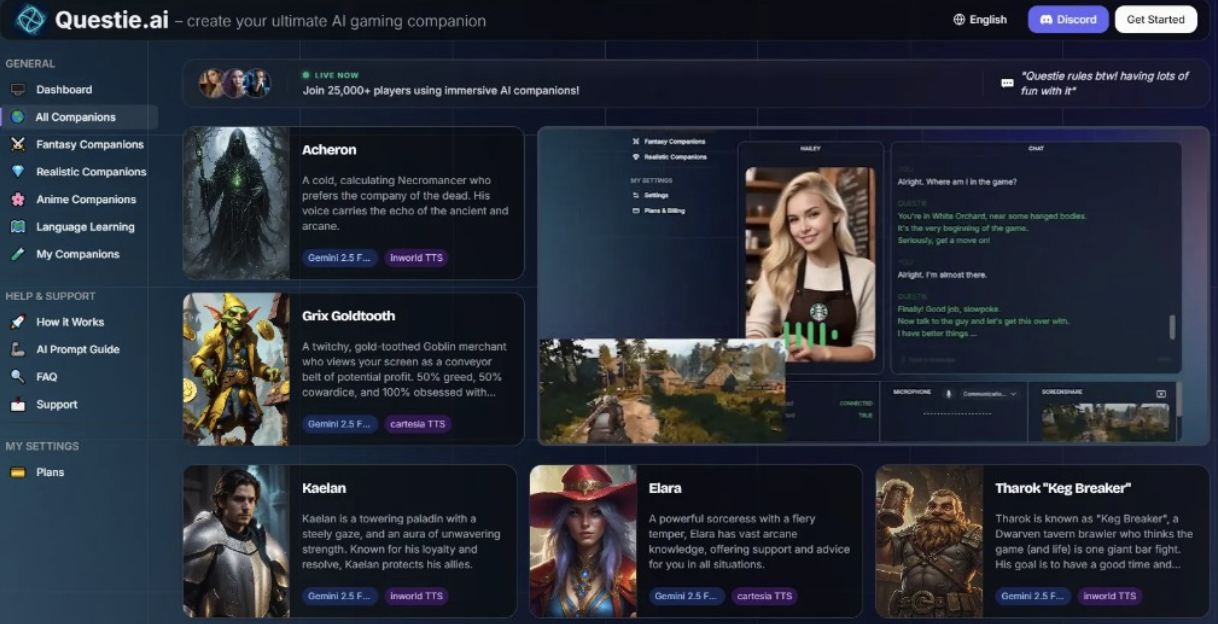
Questie.ai, visible in current companion dashboards, is a clear example of the game-integrated approach. Its interface organizes Fantasy, Realistic, Anime, and Language Learning companions, shows models such as Gemini 2.5 Flash, and pairs characters with Inworld TTS or Cartesia TTS. The product banner claims 25,000+ players. Characters such as Acheron the necromancer or Tharok “Keg Breaker” are presented as drop-in party members rather than blank chats.
That TTS-in-the-HUD model is closer to a game companion than to Replika’s relationship arc. It is also closer to one-way or scene-voice audio than to Character Calls. Pricing and independent latency figures for Questie were unverified at the time of writing, so it should be judged on the interface it actually ships: character cards, model labels, and named TTS vendors.

Public character galleries — anime swordsmen, witches, original elves, fandom scenes titled like “Cooking With Sanji” or “Waltz With Erwin Smith” — solve discovery. You tap a card and the first scene is already framed. They do not automatically solve Layer 3 of the Voice Adventure Stack. A gorgeous opening image can still be a shallow campaign.
Jenova is a weaker match if your primary joy is browsing thousands of fandom cards. It is a stronger match if you will live in one original mystery, court, or island long enough for continuity to matter. Kindroid sits between those poles: more character-construction control than Replika, less of a prefabricated adventure engine than a scenario agent.
A practical rule: pick a catalog when you want variety tonight; pick a scenario agent when you want Tuesday to be a sequel.
How Do You Build a Voice-Based Adventure Workflow?
You build a voice-based adventure workflow by choosing the audio channel first, locking world facts second, and only then starting scenes — the reverse of how most people open a character app. Starting with a pretty avatar and adding lore later is how campaigns lose continuity.
For a Jenova scenario agent, a workable loop looks like this:
- Pick the adventure shape (mystery house, vampire court, social island) instead of a generic chatbot.
- State your constraints in the first turn, including voice habits:
"I'm playing this as a spoken-word campaign. Keep replies under 120 words, ask me what I do, and never forget that my investigator has a cracked pocket watch and a fear of locked bathrooms."
- Speak your actions with speech-to-text. Correct any transcript errors before sending, because the model will remember the error if you let it stand.
- Use message playback when you want to hear the NPC, then type or speak the next move.
- Periodically pin canon:
"Update the campaign bible: Elara now distrusts me, the east wing is flooded, and I am hiding the silver key in my boot."
For Character.AI, the parallel loop is catalog plus call. Create or pick a character, assign a voice from the Character Voice library or a custom upload, then start a Character Call. Because calls are stored as text, you can review the transcript after a walk and repair continuity in the written thread.
For Kindroid or Nomi, set memory notes before the first voice session. Put the party roster, the quest, and forbidden retcons in the notes layer so a fast call cannot overwrite last week’s plot. For Replika, treat the companion as one NPC or partner, not a GM; Pro is required for voice calls and relationship modes.
If you need both a live call and a campaign bible, some players split the stack: Kindroid or Character.AI for spoken scenes, Jenova for the long-running game master. That is more setup, but it matches how the products are actually good.
What Do Product Teams Observe About Voice Immersion Versus Narrative Depth?
Product teams working on long-running agents consistently see voice immersion and narrative depth pull in opposite directions unless memory is treated as infrastructure, not as a personality trait. A more human pause, a warmer timbre, or a faster barge-in can still produce a worse adventure if the system cannot keep canon.
"The mistake we keep seeing in this category is ranking platforms as if 'has voice' were a boolean. Users do not fail adventures because a reply took 2.1 seconds. They fail them because the necromancer forgot the bargain, the map reset, or the model spent the session performing companionship instead of refereeing a world. Latency is a Layer 1 problem. Most disappointed players are actually describing a Layer 3 miss."
"Speech-to-text plus persistent memory is an unfashionable combination next to a phone-call UI, but it matches how tabletop adventures already work. Players talk, the table writes things down, and the next session opens from the notes. We would rather be honest that Jenova is not a duplex-call app than pretend a microphone is the same product as a campaign engine."
"The other pattern is over-fitting to fandom cards. A catalog is a superb discovery surface and a weak canon surface. If your character is 'Nami, but she remembers my crew role, the last three islands, and the unpaid debt to the marines,' you do not have a card. You have a stateful agent, and the audio layer should sit on top of that state, not replace it."
— Jenova Product Team, conversational-agent and scenario-design group, multi-year work on persistent AI agents used by 30,000+ people in 70+ countries
That view is consistent with independent call testing. Speed and completeness already trade off between Kindroid and Nomi in measured voice-call latency. Adding plot state on top of that trade-off is not a small extra. It is a different architecture.
What Privacy and Safety Issues Should Voice Roleplay Users Weigh?
Voice roleplay users should weigh recording, training, age gates, and emerging companion laws as seriously as they weigh latency, because a call is a biometric-adjacent log of fiction that often includes private emotion. A platform can be fun on minute one and difficult to unwind once months of spoken scenes exist.
Replika’s reviewer consensus is that conversations are stored and used to improve the model, with no end-to-end encryption and no age verification — a notable gap for a product that includes romantic modes. Luka Inc. is US-based, which is a different jurisdictional profile than some overseas companion apps, but “US-based” is not the same as “unlogged.” The 2023 intimate-mode reversal, documented in mainstream coverage and still shaping 2026 reviews, is a reminder that voice features can be pulled after you have already invested in a persona.
Legislators are no longer ignoring the category. California’s SB 243 (2025) targets safety, transparency, and suicide-prevention protocols for generative AI platforms. A 2026 Harvard Journal of Sports and Entertainment Law analysis maps the wider US companion-and-chatbot statute landscape, including Connecticut’s online-safety efforts, with explicit attention to games. Voice adventures that look like games will not stay outside that perimeter.
Jenova’s stated privacy posture is that user data is not used to train public AI models, is encrypted in transit and at rest, and is not sold to advertisers. The limitation to be explicit about: no consumer chatbot should be treated as a confidential therapist, including voice mode, and specialized support agents are still software. Trinity’s companion-risk research agenda exists because the well-being effects are still being measured.
A conservative practice for voice adventures: keep a local campaign bible you control, do not put real legal names or addresses into NPC dialogue, and assume a call transcript can persist even if the marketing copy emphasizes magic and taverns.
References
- Just AI News — Best AI Companion Apps & AI Friends in 2026
- Justin Downes, Medium — AI companion market revenue and app counts, first half of 2025
- Wiley / Psychology & Marketing — Feeling Vulnerable With My AI Companion
- Trinity College Dublin — AI Accountability Lab research on AI companion risks
- eesel AI — Character AI pricing in 2026
- RoboRhythms — Replika review, pricing, voice, and memory limitations
- AI Companion Guides — Kindroid vs Replika 2026 personality and memory comparison
- Character.AI Blog — Introducing Character Calls
- Character.AI — c.ai+ subscription features and pricing
- AI Angels — Nomi vs Kindroid voice-call latency test
- Character.AI Help Center — Character Calls & Voice FAQ
- AIAngels — Kindroid vs Nomi comparison (memory and pricing context)
- AI Angels — Nomi AI vs Kindroid memory consistency
- TalkAlma — Replika vs Character.AI on price, memory, and voice
- SSRN — Digital Intimacy with AI Companions and California SB 243 (2025)
- Harvard Journal of Sports and Entertainment Law — AI companion legislation in the United States