Which AI Roleplay Platform Is Best for Slice-of-Life Stories?
2026-09-08
How Do Memory Depth and Everyday Continuity Separate Slice-of-Life AI Roleplay From Adventure Chat?
For slice-of-life storytelling, the platforms that hold up in 2026 are the ones that remember ordinary life, not the ones with the largest bot catalogs. Roleplay Game Master on Jenova is strongest for long-running original households and workplaces because it keeps persistent memory and multi-character state. Character.AI remains the fastest way to sample premade everyday personas, while Kindroid and Nomi fit one-to-one companion days, and visual RPG sandboxes such as RPBuddy fit adventure worlds more than quiet domestic continuity.
Key factors that separate usable slice-of-life AI roleplay from generic adventure chat:
✅ Mundane recall — the kettle, the shift schedule, the plant on the balcony, and last Tuesday’s argument have to survive overnight ✅ Ensemble continuity — roommates, coworkers, siblings, and neighbors need distinct voices and unfinished business ✅ Narrative inflation resistance — a convenience-store run should stay a convenience-store run ✅ Filter tolerance for ordinary adult life — family conflict, money stress, and grief are slice-of-life material, not edge cases ✅ Daily-use cost — this genre is high-frequency and low-intensity, so memory resets and mid-scene ads break the form
To compare these tools fairly, it helps to score them on quiet continuity rather than on combat systems, character-card volume, or cinematic world art.

Why Are People Using AI Roleplay for Ordinary Daily-Life Stories in 2026?
People are using AI roleplay for everyday stories because companionship and low-stakes social rehearsal have moved into the mainstream, and many users want scenes that feel like living with someone rather than saving a kingdom. 72% of U.S. teens have tried an AI companion at least once, with 52% describing themselves as regular users.
The commercial backdrop matches that behavior. The AI companionship solution market was valued at USD 0.2 billion in 2026 and is projected to reach USD 0.7 billion by 2030, a 36.8% CAGR. Slice-of-life roleplay sits inside that demand: repeated check-ins, shared routines, and characters who feel like they occupy the same kitchen.
The emotional mechanism is documented, and it is not only about fantasy. Experiments summarized in Frontiers in Communication found that an empathetic AI companion reduced loneliness about as much as talking with a person, with “feeling heard” as a central mechanism. Designers already know this: emotionally attuned systems attract more engagement because warmth is a retention feature, not a side effect.
There is a caution worth keeping in view. In a study of 1,131 Character.AI users discussed in that same Frontiers reanalysis, companionship-oriented use was associated with lower well-being, especially among people with smaller human networks and heavier self-disclosure. About half of those users still described the chatbot as a friend, companion, or partner.
Slice-of-life platforms should therefore be judged as storytelling instruments. The best fit is the tool that can sustain a Tuesday evening without pretending to be a substitute person.
Teen usage data also shows why “quiet” content is not a niche. U.S. teens report using AI companions for emotional support and to avoid loneliness, which maps more closely to shared meals and after-school chats than to dungeon crawls.
What Should You Look for in an AI Roleplay Platform for Slice-of-Life?
You should look for a platform that can pass a quiet-arc test: thirty sessions in which nobody is chosen by prophecy and the story still feels specific. Adventure engines can hide weak memory behind plot twists. Slice-of-life cannot.
The evaluation framework used in this article is the Five Quiet Continuities. Each dimension is weighted toward the failure modes that actually end domestic stories.
- Object permanence of the mundane. Does the AI remember what is in the fridge, who owns the extra key, and which mug is cracked?
- Calendar logic. Do weekdays, paydays, exams, and visiting parents arrive in a plausible order?
- Relationship temperature. Do friendships and romances change slowly, or does every scene demand a confession?
- Setting inventory. Is the apartment a stable place, or a backdrop that reshuffles every reply?
- Voice stability in low-stakes talk. Can characters banter about leftovers without sliding into identical witty narrators?
Two extra tests matter in 2026 because they are where popular apps break.
Filter misfires on ordinary emotion. Blind testing found that Character.AI’s filters can trip on heavy but non-explicit emotional roleplay, not only on adult content. A family argument or a hospital waiting room should not require workarounds.
Session length under daily use. The same testing found Character.AI memory drifting around message 20, including forgetting the tester’s name. SpicyChat’s thread broke around message 15 to 20. Slice-of-life scenes are made of small turns. A 20-message ceiling is a short evening.
Cost structure is part of the craft, not an afterthought. Character.AI’s free tier still offers ongoing PG messaging, while [**c.ai+ is $9.99 a month**](https://www.ourdream.ai/best-ai-chatbot-for-roleplay) ($7.92 on annual billing) for faster responses and priority access. Group chat has also been paywalled at $9.99 a month, which matters if your slice-of-life cast is a household rather than a single partner.
Jenova’s Roleplay Game Master uses a different trade: a free tier with limited usage, then paid plans starting at $20/month for 30× usage. That is more expensive than Character.AI’s starter subscription, and that gap is real for casual browsers. It is less decisive for users who need the same roommates to still be themselves next month.
How Do Popular AI Roleplay Platforms Compare for Everyday Storytelling?
Jenova’s Roleplay Game Master is the strongest option for original, multi-character slice-of-life campaigns; Character.AI is stronger for instant premade casts; Kindroid is stronger for customizable one-to-one control; Nomi is stronger for emotional daily continuity with a single companion; and RPBuddy is stronger for visualized RPG sandboxes than for ordinary domestic pacing.
| Feature / Dimension | Character.AI | Roleplay Game Master (Jenova) | Kindroid | Nomi | RPBuddy |
|---|---|---|---|---|---|
| Cross-session memory | Drift around ~20 messages in published blind tests | Unlimited persistent memory across sessions | Decent recall; built for longer arcs | Prioritized for emotional continuity | Unverified |
| Ensemble cast | Huge library; group chat on paid tier | Multi-character world state in one campaign | Custom personas; smaller community | One-to-one companion focus | World and character shaping in an RPG frame |
| Narrative inflation resistance | Warm openings; later personality slide | Player-set tone, including deliberately quiet days | High behavioral customization | Companion framing can pull toward intimacy | Adventure-sandbox default |
| Ordinary-life filters | Can flag non-explicit emotional scenes | User-directed creative freedom | Unverified | Companion-oriented | Unverified |
| Visuals | Large illustrated character catalog | Text-first, multi-model chat | No image generation | Unverified | Visual world presentation |
| Pricing (as of 2026) | Free PG messaging; c.ai+ $9.99/mo | Free limited usage; Plus $20/mo | Unverified | Unverified | Unverified |
| Best for | Sampling premade everyday personas quickly | Long original households, workplaces, and friend groups | Custom 1:1 personas, voice, deeper control | Daily check-ins with one partner | Visualized RPG worlds |
Character.AI
Character.AI is still the smoothest on-ramp in the category. Blind testing gave it a 67.3 score and the ease-of-use win, which matches the product: millions of community characters and almost no setup.
That library is full of food-festival meet-cutes, roommate chats, and “you bump into them at the shop” premises. For a one-hour scene, it is hard to beat. The cap shows up if you want the same week to continue. Memory drift, full-screen ads mid-chat, and filters that misfire on ordinary emotion all punish slow stories more than they punish one-shot adventures.
Roleplay Game Master on Jenova
Roleplay Game Master is a campaign engine rather than a character marketplace. You describe a setting, a cast, and a tone, then the agent keeps character consistency and world state without requiring you to re-paste biographies.
Testing this style of play shows a clear slice-of-life advantage: the story can stay in one apartment for a month. The honest limitations are the other side of that design. There is no Character.AI-scale catalog of premade bots to browse, the experience is text-first rather than image-native, and paid usage starts at $20/month — higher than Character.AI’s $9.99 c.ai+ plan. Users who mainly want to sample strangers’ cards will find it slower to start.
Kindroid
Kindroid is the control-oriented companion. Reviewers describe it as highly customisable and good for roleplay, with decent memory and voice, but no image generation and a small community. Comparison guides recommend it when you want deeper control, longer roleplay arcs, and voice.
That profile fits a tightly authored one-to-one life: a partner, a coworker, or a single housemate whose speech patterns you have tuned. It is a weaker match for a noisy ensemble — the cafe staff, the upstairs neighbor, and the sibling who only texts on Sundays — unless you are willing to build each of those voices yourself.
Nomi
Nomi is the memory-and-feel pick among companion apps. Roundups consistently say to choose Nomi if memory and emotional continuity matter most, and to choose Replika-style tools when the goal is emotional exchange rather than creative roleplay.
For slice-of-life, that is a genuine strength if the story is the relationship: morning texts, shared worries, the texture of being known. It is a limitation if you want fiction with a cast, a neighborhood, and plot threads that are not about the user’s feelings. Companion continuity and ensemble storytelling are not the same skill.
RPBuddy and other RPG sandboxes
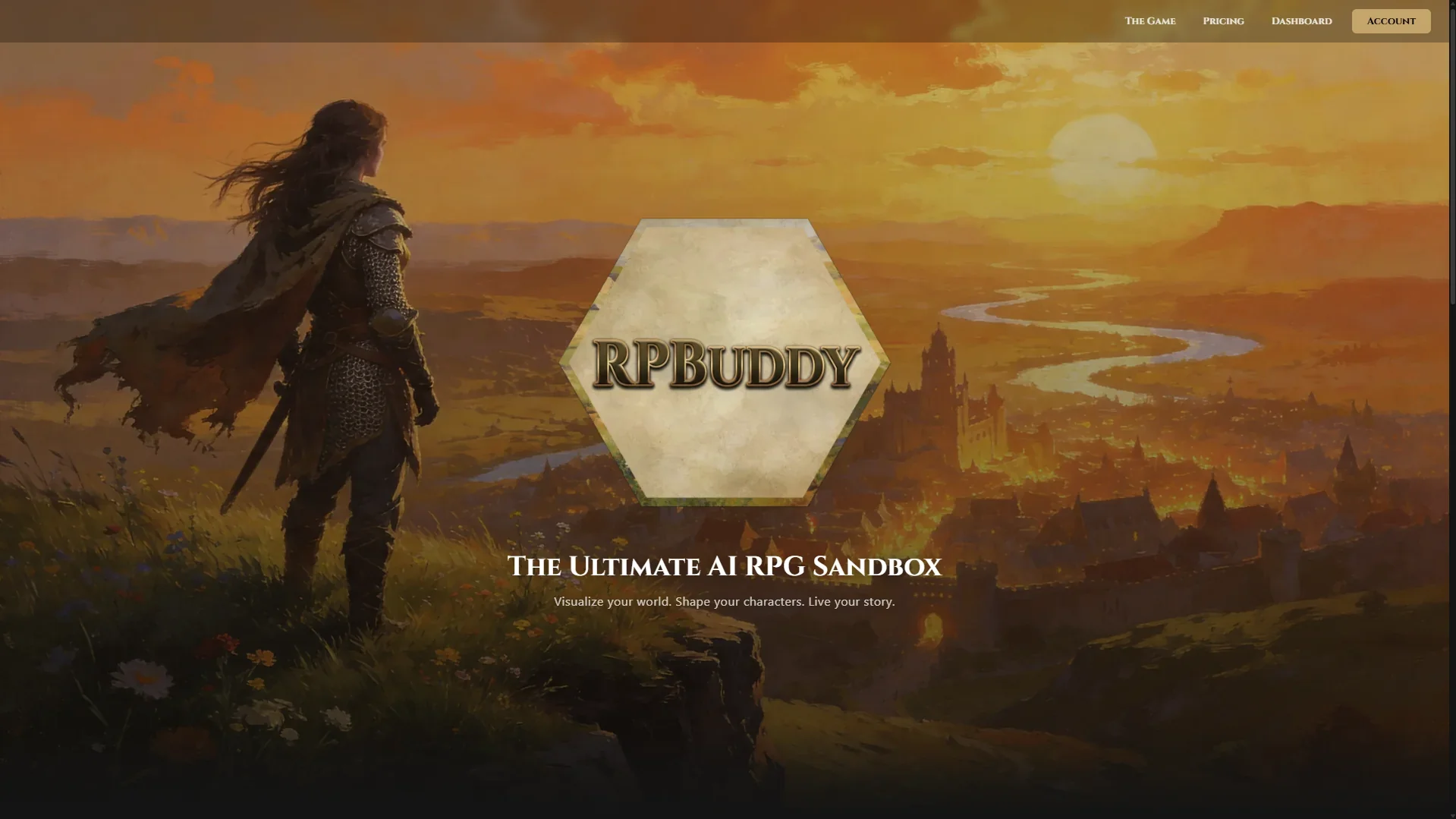
RPBuddy presents itself as an AI RPG sandbox: visualize a world, shape characters, live a story. The landing-page framing is epic rather than domestic — a knight on a ridge, a lit city, a hex crest. That is not a flaw for fantasy campaigns. It is a mismatch for stories whose climax is whether anyone remembered to buy milk.
The same split shows up across the category. Visual sandboxes help users see a place. Slice-of-life lives or dies on whether that place still has yesterday’s dishes in the sink.
How Does Persistent Memory Change a Slice-of-Life Story Across Dozens of Sessions?
Persistent memory changes slice-of-life from a series of first dates into a place you can return to, because ordinary stories accumulate meaning through leftover details rather than through reveals. If the AI forgets the leftover details, the genre collapses into small talk with a new stranger who happens to wear the same name.
This is why published memory tests should be read as genre tests. When a platform forgets a name around message 20, it can still finish a duel. It cannot finish a week of shared chores. Users leaving Character.AI-style apps already cite filters, memory resets, and paywalled group chat as the reasons they look elsewhere.
Jenova’s Roleplay Game Master treats memory as campaign infrastructure. Session 20 can refer to a thrown-away comment from session 2 without a recap paste. That matters more in slice-of-life than in quest fiction, because the “plot” is often a pattern: who withdraws when stressed, who cooks when guilty, who always misses the last train.
There is a second memory problem that spec sheets ignore: selective remembering. A good domestic NPC should recall the fight and also know not to reopen it every greeting. Companion apps optimized for emotional mirroring sometimes over-weight the last feeling. Adventure apps over-weight the last hook. Slice-of-life needs a third behavior — letting a fact stay true in the background.
In practice, examining long chats shows three failure signatures:
- Amnesia. The coworker asks your name again.
- Reset intimacy. A cautious acquaintance becomes a soulmate overnight, then a stranger after a context trim.
- Inventory drift. The apartment gains and loses furniture because the model is sampling “home,” not tracking this home.
Unlimited persistent memory does not automatically equal good taste. It does make those three failures optional instead of scheduled.
Jenova’s broader platform context is relevant here without being the story: multi-model access from OpenAI, Anthropic, Google, DeepSeek, and xAI, plus chat history that does not wipe when you close the phone. Different models can take different scenes while the household remains the same household. The limitation is usage metering. Quiet daily roleplay can consume a free-tier allowance faster than users expect, because the genre invites frequent short sessions rather than one long dungeon night.
Why Do Fantasy RPG Sandboxes and Character Libraries Struggle With Quiet Stories?
They struggle because both formats are optimized for novelty, and slice-of-life is optimized for repetition with variation. A library wants you to try another bot. A sandbox wants you to see another horizon. A domestic story wants Thursday to be recognizably Thursday.
Character libraries shine at cold start. You can open a grid of illustrated scenarios — cooking with a chef, sitting in a tea shop, meeting someone at a food festival — and be in scene within seconds. That is a real design win, and it is why Character.AI still wins ease-of-use tests. The same grid teaches the model, and the user, to treat characters as disposable.
Once a slice-of-life story is yours, browsing becomes a bug. The upstairs neighbor cannot be swapped for a more popular card without breaking the building. Community quality is also uneven: many public bots are written as hooks, not as people with jobs, allergies, and rent.
RPG sandboxes have the opposite bias. World visualization, character sheets, and “live your story” language pull toward travel, combat, and destiny. Voice-based companion products are racing in a related direction; one market study puts the voice-based AI companion category on a path to US$42.56 billion by 2033 at a 17.7% CAGR. Voice can make a morning commute scene feel present. It does not, by itself, keep the bus route consistent.
Janitor AI and Chai still get recommended for pure roleplay closest to Character.AI. They matter for users who want community cards and fewer PG rails. They do not automatically solve quiet continuity. A less-filtered first message is not the same as a remembered grocery list.
The contrarian conclusion is simple: the huge catalog is the wrong headline feature for this genre. Slice-of-life rewards a small, stable cast with a long memory. Platforms that market infinity — infinite bots, infinite worlds, infinite plot — are selling the opposite of iyashikei pacing.
How Do You Run a Slice-of-Life Campaign That Stays Consistent?
You run it by locking the mundane before you chase chemistry, then by telling the model what not to escalate. Most tools will try to be interesting. Slice-of-life needs them to be faithful.
For Roleplay Game Master, a working setup looks like this:
- Open the agent and state the genre as a constraint, not a vibe.
- Inventory the setting in concrete nouns: rooms, jobs, pets, debts, transit.
- Name the cast with one want, one fear, and one unfinished task each.
- Set pacing rules in the first message so the model does not hunt for a climax.
- Play in short sessions that end on chores, not cliffhangers, so returns stay natural.
A first prompt that actually holds:
"Slice-of-life, not adventure. We live in a two-bedroom apartment above a laundry. I work closing shifts at a bookstore. My roommate Mei is a dental assistant who hates mornings. Her brother may visit Friday. No coincidences, no secret magic, no sudden confessions. Today is Wednesday, 9:40 p.m. I just burned the rice. Stay in close third person and let the evening be small."
If the model reaches for a plot, correct the rule, not the scene:
"Do not add a new conflict. Continue from the burned rice. Mei can be annoyed or helpful, but nobody is arriving at the door."
For Character.AI, the published workaround is different because the memory model is different. Testers advise keeping defining details in the persona field and re-stating important facts every dozen exchanges. That is labor, and it is also a useful diagnostic: if you are doing the memory job by hand, the platform is a sketchpad, not a home.
Kindroid users should put the labor into persona controls and voice, then keep the cast small. Nomi users should treat the character as a companion diary more than as an ensemble narrator. In both cases, write down your setting inventory somewhere you control. Companion apps remember feelings more reliably than furniture.
A practical rule for every platform: end sessions with a three-line log — date, what was cooked, what was left unresolved. On tools with weak recall, paste it at the start of the next chat. On Roleplay Game Master, use it as a human bookmark rather than as a required memory crutch.
What Do Narrative Designers Say About AI Slice-of-Life Roleplay?
Narrative designers who work on long-context agents tend to argue that slice-of-life is the hardest mode to sustain, because the model’s training bias is to escalate, and the genre’s craft is to refuse escalation without going bland.
"Slice-of-life is not ‘easy mode’ for language models. Action plots give the system a rail. Everyday stories require it to remember that the kettle is still broken, that Tuesday is grocery day, and that the roommate’s sister still has not called back — then to let those facts sit without turning them into a climax. When memory is thin, the model substitutes novelty, and novelty is the enemy of domestic immersion."
"The failure mode we see across adventure-trained systems is narrative inflation. A walk to the convenience store becomes a robbery. A quiet dinner becomes a confession that rewrites the relationship. Users who want iyashikei pacing need an agent that treats boredom as a legal state. If every reply has to justify its existence with a twist, you do not have a home. You have a trailer."
"Memory quality in this genre is measured in objects, not in lore. Forgotten coronations hurt a fantasy epic. Forgotten plants hurt slice-of-life more, because the plant was how the room proved it was the same room. Long campaigns fail first as apartments, then as plots."
— Jenova Product Team, long-context narrative agents for interactive fiction
That view lines up with the research distinction between a tool and a companion. The Frontiers Apparatgeist reanalysis argues that the same chatbot can be experienced as tutor, companion, or reluctant substitute depending on whether users attribute inner experience to it. Slice-of-life design should keep the user in the author’s seat: you are running a story about daily life, not being adopted by the interface.
Safety context belongs here too. In April 2025, Common Sense Media, working with Stanford’s Brainstorm Lab, rated several companion apps “Unacceptable” for minors. Quiet stories about school, family, and loneliness can look harmless while still being intense. Adult craft and child safety are different problems, and a serious comparison should not blur them.
Can Slice-of-Life AI Roleplay Support Language Learning and Creative Work?
Yes — slice-of-life is one of the most efficient practice loops for language and for fiction craft, because vocabulary and character voice attach to repeated situations instead of to one-off quests. The same grocery run can teach register, subtext, and continuity.
On Jenova, that loop does not have to stay inside a single agent. Learn Japanese Through Roleplay is built for immersive daily scenarios — ordering, commuting, workplace small talk — where grammar sticks because the moment is social. A user can live a Tokyo apartment story as roleplay, then replay the convenience-store scene as language practice without abandoning the characters’ established habits.
The same sessions can move into making. Manga Creator is a natural second step for slice-of-life, a genre whose comics vocabulary already privileges pauses, background detail, and facial acting over spectacle. A month of consistent roleplay becomes panel material: the burned rice, the laundry downstairs, the unreturned call.
This is also where Character.AI’s library model and companion apps show their edges from another angle. A premade bot is excellent for practicing a single social script once. It is a poor source of canon if you want chapter 12 to honor chapter 1. Nomi or Kindroid may give you a stable partner to talk with, and still not give you a neighborhood you can draw.
The practical workflow looks like this:
- Establish the household in Roleplay Game Master with pacing rules.
- Repeat three locations until they have inventory: home, work, the shop in between.
- If you are learning a language, replay one location with the language roleplay agent using the same facts.
- Export or copy the beats you would actually show on a page — gestures, silence, leftover objects — into Manga Creator or a script draft.
Jenova still is not the right first stop if you want to browse thousands of public character cards tonight. Character.AI is. If you want a voice companion with a small community and no image pipeline, Kindroid is a clearer fit. If you want one emotionally continuous partner, Nomi is the more typical recommendation. For a visualized RPG life, a sandbox such as RPBuddy matches the fantasy brief.
For slice-of-life that has to remain the same life next week — same dishes, same unpaid bill, same people who do not know they are in a story — persistent campaign memory is the feature that decides whether the genre is possible.
References
- Yahoo Finance — 72% of U.S. teens have used AI companions
- Research and Markets — AI Companionship Solution Market Report 2026
- Frontiers in Communication — From tool to companion: conversational AI use and mind perception
- EDRM — AI companionship and machine intuition
- Statista — Main reasons U.S. teens use AI companions
- OurDream AI — Blind-test review of roleplay chatbots, Character.AI memory, pricing, and filters
- Kenerate AI — Character.AI alternatives, filters, memory resets, and group-chat pricing
- FunFun AI — Nomi vs. Kindroid for memory, continuity, control, and voice
- Lovi Dream — Kindroid customization, roleplay, memory, and lack of image generation
- Vircle — Character.AI alternatives: Janitor AI, Chai, Replika, and Nomi
- Fairfield Market Research — Voice-based AI companion market outlook