Which AI Roleplay Game Is Best for Psychological Horror Stories?
2026-09-08
How Do Atmosphere Persistence and Clue Continuity Separate Strong AI Horror Games From Generic Chat Roleplay?
The AI roleplay games that work for psychological horror in 2026 are the ones that can keep a single unsettling detail alive across sessions, not the ones that merely generate a frightening paragraph on demand. The Asylum is the strongest fit for slow-burn institutional horror because it pairs a pre-built psychiatric-ward investigation with persistent cross-session memory. AI Dungeon remains the most open-ended alternative for custom horror worlds, NovelAI is stronger for authors who want lorebook-level prose control, and Character.AI is better suited to short character chats than multi-session mysteries.
Psychological horror fails in most chat tools for mechanical reasons. Dread is cumulative. A barred window, an unanswered file, and a nurse who smiles too late only become frightening when the narrator still knows they happened.
Key factors that separate effective AI psychological horror from generic spooky roleplay:
✅ Atmosphere persistence — environmental tone must survive overnight gaps, not reset to a generic haunted hallway ✅ Clue continuity — ward notes, names, and contradictions have to reconnect later, or the mystery collapses into random events ✅ Entity consistency — the same presence, voice, or rule of the house must remain itself across the full arc ✅ Filter interference — safety layers that interrupt violence, fear themes, or unreliable narration break immersion mid-scene ✅ Setup versus play time — tools that demand constant lorebook upkeep steal the hours that should be spent inside the story
To compare these games honestly, it helps to judge them on dread continuity rather than on who can write the scariest single paragraph.
Why Does Psychological Horror Strain AI Roleplay Systems More Than Other Genres?
Psychological horror asks an AI to remember omission, not just action, which is a harder job than running combat or romance. Jump-scare writing can be produced in one generation. Institutional dread cannot. It depends on the model tracking what the player refused to inspect, which NPC smiled incorrectly, and which door was already ajar two sessions ago.
Fantasy and sci-fi roleplay can recover from memory failure by inventing a new quest-giver. Horror cannot. A new monster every scene is the opposite of psychological pressure. The genre needs a shrinking possibility space: the same corridor, the same stain, the same unanswered question.
That is why AI-generated psychological horror has become its own indie tag on platforms such as itch.io, while mainstream chatbots still struggle to sustain it. Players are not only looking for scary prose. They are looking for a narrator that will not forget the rules of the house.
Content policy adds a second strain. Character.AI is widely described as prioritizing safety with strict moderation that limits flexibility. That tradeoff is reasonable for companion chat. It is costly for horror, where implication, bodily fear, and moral ambiguity are the engine of the story.
Open-ended adventure tools face the opposite failure mode. They can describe anything, then drift. AI Dungeon markets Story Cards and Memory Banks to surface context only when relevant, which helps, but the player still has to curate what counts as canon. Psychological horror punishes that extra labor because the scariest details are often the ones you did not think to pin down.
What Should You Look for in an AI Psychological Horror Roleplay Game?
You should evaluate AI horror roleplay on six dimensions of dread continuity, not on marketing claims about unlimited worlds. The useful question is whether tension can accumulate for days without the narrator contradicting itself.
The Dread Continuity Framework used in this comparison weights the following:
- Cross-session atmosphere persistence — does the building still feel wrong tomorrow?
- Clue and motif continuity — do files, sounds, and repeated images reconnect?
- Antagonist or entity consistency — does the threat keep the same logic?
- Filter interference — can fear themes proceed without the scene collapsing into a refusal?
- Environmental accumulation — do rooms, wards, and objects gain history?
- Setup overhead — how much canon management is required before play feels frightening?
Testing reveals a consistent pattern. Tools built as character chat excel at voice and fail at mystery structure. Tools built as fiction editors excel at prose and fail at being a game master. Tools built as open adventures excel at surprise and fail at constraint.
A pre-built investigation setting has an advantage here that generic generators lack. Constraint is not a downgrade in psychological horror. It is the genre's main device. An asylum with a finite number of wards forces the story to deepen the same space instead of fleeing into a new biome.
Pricing still matters because these campaigns run long. As of 2026, AI Dungeon paid plans are commonly listed from $9.99/month up to about $49.99/month, while NovelAI plan roundups list Tablet around $10/month, Scroll around $15, and Opus around $25. A horror campaign that lasts twenty sessions makes those numbers part of the evaluation, not an afterthought.
How Do The Asylum, AI Dungeon, NovelAI, and Character.AI Compare for Horror Play?
The Asylum is strongest for a coherent psychiatric-institution investigation, while AI Dungeon, NovelAI, and Character.AI each win a different adjacent job. None of the four is universally weaker. They optimize for different kinds of fear.
| Feature / Dimension | The Asylum (Jenova) | AI Dungeon | NovelAI | Character.AI |
|---|---|---|---|---|
| Atmosphere persistence | Persistent cross-session memory on a single institutional setting | Story Cards and Memory Banks surface selected canon | Memory Box plus Author's Note and Lorebook if the player maintains them | Chat memory varies; long threads are prone to drift |
| Clue continuity | Designed around ward-by-ward discovery | Strong when the player files clues as cards; weak if left implicit | Strong when lorebook entries are updated after every reveal | Weak for multi-session mystery structure |
| Entity consistency | One investigation identity, one shuttered institution | Open NPCs and community scenarios; consistency depends on memory hygiene | High if lorebook defines the threat; low if left to raw generation | High for a single persona, low for a whole haunted system |
| Filter interference | Broad creative freedom inside the Jenova roleplay setting | Horror/fear themes are supported in the product listing, with platform policies still in play | Fiction-oriented controls with genre tags and story settings | Strict moderation that limits flexibility |
| Play style | Pre-built psychological horror investigation | Open-ended AI RPG and community scenarios | Prose-first interactive fiction / text adventure | Character chat and user-created personas |
| Pricing (as of 2026) | Free tier with limited usage; Plus from $20/month | About $9.99–$49.99/month on paid tiers | Commonly listed around $10 / $15 / $25 | Free access with optional paid upgrade; exact 2026 price unverified here |
| Best for | Slow-burn asylum investigation | Custom worlds, multiplayer, community horror scenarios | Authors who want fine-grained lore and prose steering | Short, voice-led chats with a single horror persona |
The Asylum
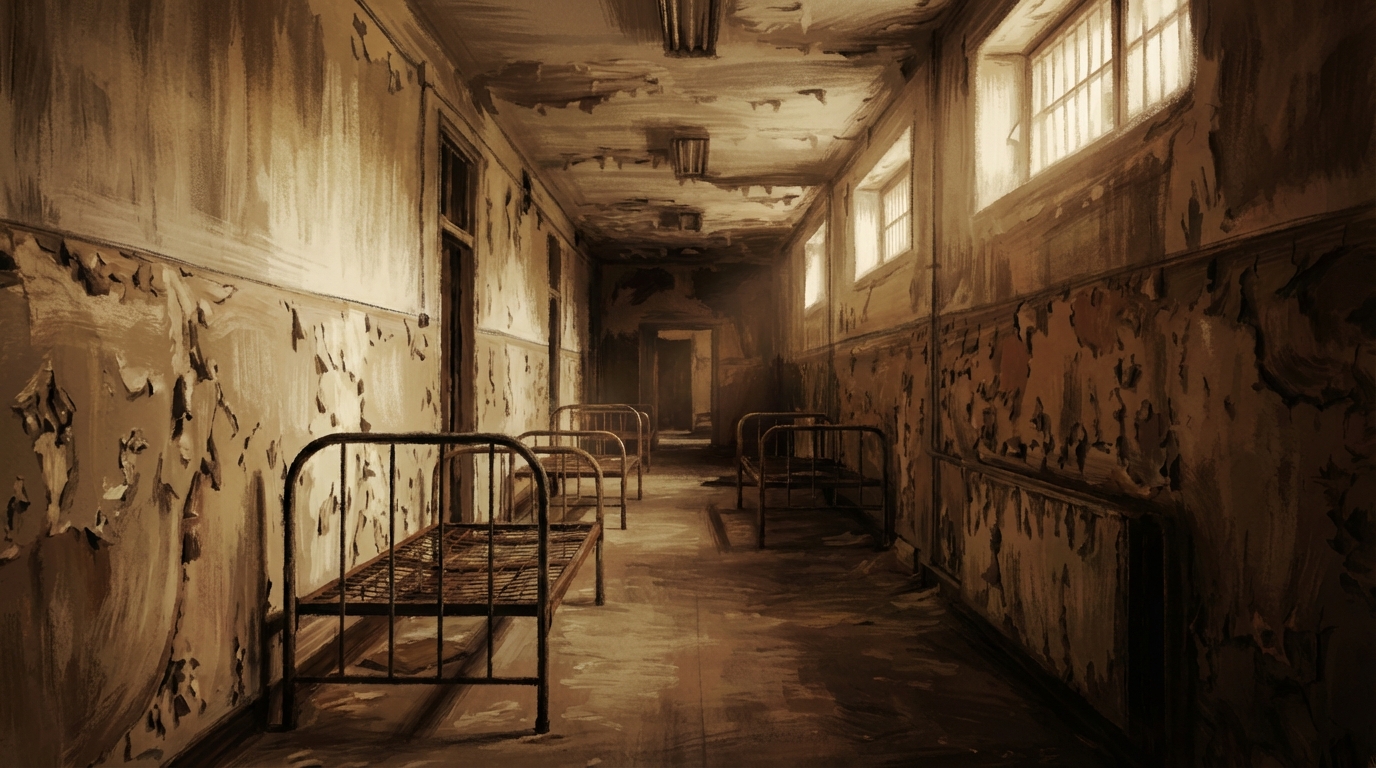
The Asylum casts you as an investigator inside a shuttered psychiatric institution after something has already gone wrong. That framing is doing real genre work. You are not asked to invent a haunted world from a blank prompt. You inherit a building that already has wards, files, locked doors, and a hidden story.
Examining the design shows why this helps psychological horror. The possibility space is finite. Each session can deepen the same corridor instead of spawning a new monster. Persistent memory on the Jenova platform means the nurse's incorrect smile can still matter a week later.
The honest limitation is scope. The Asylum is not a universal horror game master. If you want folk horror in a fishing village, cosmic horror on a research vessel, or a fully custom mythology, an open-ended tool will fit better. It also lacks NovelAI's dedicated lorebook interface and AI Dungeon's large public scenario catalog.
AI Dungeon
AI Dungeon remains the category's open-world default. Latitude's app positions it as an AI-native RPG and text-adventure generator with prebuilt or custom scenarios, rewind, and community sharing. Horror is an explicit theme in that ecosystem, and the memory system is more structured than a raw chatbot.
Its strength is freedom. You can start in an asylum, abandon it, and continue in a forest cabin the same night. Multiplayer and a large scenario catalog make it the better social option.
Its limitation for psychological horror is the same freedom. Open generation tends to relieve tension by inventing novelty. Unless you diligently convert clues into Story Cards, the story can become a sequence of spooky incidents rather than one accumulating dread. Paid tiers also stack quickly if you want the higher models for long campaigns.
NovelAI
NovelAI is the prose-control option. Official story settings document a Memory Box at the top of context, an Author's Note inserted much more recently, and Lorebook quick access. Genre and tags can steer tone before a single sentence is written. For writers, that is a genuine advantage.
Comparisons of NovelAI and AI Dungeon typically land on this split: NovelAI for controllable fiction, AI Dungeon for play-like adventuring. Indie-author guides likewise treat NovelAI as a storycrafting environment with memory and generation limits tied to subscription tier.
The limitation is labor. Psychological horror still works only if you update Memory and lore as the truth changes. NovelAI is closer to a powered manuscript than to a game master who tracks inventory, patient files, and locked wards for you. Players who want to play rather than curate will feel that overhead.
Character.AI
Character.AI's advantage is scale and ease. Safety explainers credit it with thousands of user-created characters, simple onboarding, and a large creative community. If you want to talk to one haunted persona for an evening, that library is hard to match.
The limitation is structural. Character chat is not the same as a mystery engine. Reviews of ethical roleplay note that Character.AI prioritizes safety with strict moderation but limits flexibility, and user essays argue that filters and safety layers now interrupt long-running stories. Psychological horror needs unreliable narration, implication, and sometimes withheld comfort. A system optimized to keep companion chat safe will often sand those edges off.
A 2026 product guide also emphasizes that current Character.AI material is scattered across help, creator, pricing, safety, and policy pages rather than a single horror-campaign design. That is a clue to intent. It is a character platform first.
How Does Cross-Session Memory Change Slow-Burn Psychological Horror?
Cross-session memory is the difference between a scary scene and a campaign that can actually haunt you. In practice, psychological horror is a continuity problem. The second session is frightening only if the first session's unanswered details are still true.
NovelAI's documentation is unusually explicit about this. The Memory Box is meant for broad setting and character facts placed at the top of story context, while Author's Note sits closer to the model's most recent attention. That architecture can sustain horror, but only if the player keeps both fields honest as the mystery mutates.
AI Dungeon takes a card-based approach instead. Story Cards and Memory Banks store context-dependent information and bring it up when relevant. That is useful for a named antagonist or a cursed object. It is less automatic for the quiet facts horror depends on: the drip in ward C, the file that was already open, the smile that arrived too late.
The Asylum's advantage is that the setting itself is the memory object. You are not maintaining a lorebook for an invented hospital. You are returning to one institution whose wards, files, and locked doors are the campaign. Jenova's persistent chat history and cross-session memory then keep investigator choices attached to that space.
There is still a limitation. Persistent memory cannot invent a better mystery than the one the setting supports. If you want branching cosmic lore across continents, you will outgrow a single asylum. Memory is necessary for dread. It is not a substitute for the right container.

When Is a Pre-Built Horror Setting Stronger Than an Open-Ended AI Adventure?
A pre-built horror setting is stronger when you want dread to accumulate inside one map rather than branch into infinite new locations. Open-ended generators are stronger when the pleasure is surprise, custom mythology, or collaborative world-making.
This is the trade-off most comparison articles underplay. NovelAI versus AI Dungeon roundups often debate prose quality and price. They spend less time on whether unbounded generation is even desirable for psychological horror. In this genre, too many options are a failure mode. The house has to remain the house.
The Asylum is the constrained option: one shuttered psychiatric institution, one investigator role, one hidden story. The Mansion sits beside it as a second crafted container — you wake with no memory of arrival, and every room can be your last. Both are games you inhabit, not sandboxes you must worldbuild before the first scare.
AI Dungeon is the unconstrained option. Its pitch is be anyone, go anywhere, do anything, including community scenarios across horror and every other genre. That is the right tool if your horror story needs to leave the hospital, pick up a van, and continue in the woods without changing platforms.
NovelAI sits in between, but closer to authorship. Interactive-fiction comparisons note that subscriptions are relatively inexpensive for unlimited generation, while still requiring the writer to steer memory and notes. You can make a brilliant asylum story there. You will also be the one filing the patient records into the lorebook.
Choose the pre-built setting if your goal is to be afraid tonight. Choose the open-ended adventure if your goal is to construct a horror world that might later become a novel, a tabletop campaign, or a multiplayer scenario.
How Do You Start a Psychological Horror Story in an AI Roleplay Game?
Most AI horror tools follow the same opening rhythm: define the investigator, constrain the map, and forbid the model from relieving tension with a new monster. The difference is how much of that work the product has already done.
For The Asylum, setup is short because the institution already exists:
- Open the agent at jenova.ai/a/the-asylum.
- State your investigative style and what you refuse to skip:
"I'm a skeptical journalist, not a cop. I document everything. I will not fight. If a room feels wrong I leave and come back with a better reason. Do not invent a demon on page one — let the building contradict itself first."
- Ask for a starting ward, not a full lore dump:
"Begin in the intake corridor. Give me what I can see, hear, and smell. One object is already out of place. Do not explain it."
- End the first session by locking canon. Name the out-of-place object, the staff member who hesitated, and the door you did not open.
For AI Dungeon, the opening is a scenario choice. Start from a horror template or a custom prompt, then immediately create Story Cards for the setting rule, the protagonist's limit, and the first anomaly. If you skip that filing step, later sessions will treat your carefully withheld explanation as unused material and invent a louder threat.
For NovelAI, fill Genre and Tags first, then write Memory as if it were the campaign bible. Keep Author's Note to two or three sentences of present-tense pressure, such as "the protagonist still has not looked behind the radiator." Update both boxes when the truth changes. A stale Author's Note will drag the story back toward an earlier, weaker scare.
For Character.AI, pick one persona rather than a whole haunted system. Tell it the scene boundary in the first message: location, what it must not resolve, and that it should answer as the place or the person, not as a helpful assistant. If the chat starts offering comfort or moral summaries, restart with a tighter scene. That platform is least forgiving of multi-room mysteries.
A useful shared rule across all four: never ask the AI to "make it scarier." Ask it to reuse an existing detail. Horror that remembers is almost always more effective than horror that escalates.
What Do Interactive Fiction Designers Say About AI Psychological Horror?
Interactive fiction designers tend to argue that psychological horror is a memory problem disguised as a writing problem, and that most AI tools still optimize the wrong half.
"Jump scares can be generated in a single paragraph. Dread cannot. Dread requires the narrator to remember that the door in ward C was ajar in session two, that the nurse's smile did not reach her eyes in session four, and that the protagonist refused to look in the mirror. When those details drop out of context, the genre reverts to random spooky events."
"Pre-built settings such as an asylum investigation give the model a constrained possibility space, which is an advantage in horror. Open-world generators often 'solve' tension by inventing a new monster. Constraint forces accumulation — the same hallway, the same stain, the same unanswered question. Players feel that as atmosphere. Under the hood it is just state."
"In 2026, people still overweight prose style and underweight continuity. A slightly plainer sentence that remembers the clue is more frightening than a beautiful sentence that forgets it. If a tool makes you maintain a lorebook to get that continuity, it can still be the right tool for a novelist. It is the wrong default for someone who wants to play a horror game tonight."
— Jenova Product Team, interactive narrative and persistent-memory roleplay design
That view matches what the products themselves document. NovelAI tells users to update Memory as story elements take place if they want consistency. AI Dungeon tells users its memory system stores context-dependent info and brings it up only when relevant. Both statements admit the same thing: horror continuity is not free. Someone has to keep the canon.
Which AI Horror Roleplay Game Fits Your Play Style?
The right AI horror roleplay game is the one whose container matches how you like to be frightened, not the one with the longest feature list. Match the tool to the job.
Choose The Asylum if you want a slow-burn investigation inside one institution, with persistent memory and as little worldbuilding overhead as possible. It is the strongest option in this comparison for psychiatric-ward psychological horror. It is a weaker option if you need an original setting every night.
Choose The Mansion if you want the same crafted-container approach, but in a locked-house mystery rather than a hospital. It is the closer sibling for players who like room-by-room discovery and multiple endings.
Choose AI Dungeon if you want custom maps, community horror scenarios, rewind, or the option to play with other people. As of 2026 it remains the broadest AI-native RPG-style product in this set, with paid plans commonly ranging from about $10 to $50 a month. Budget for memory hygiene. The game will not automatically protect your quiet details.
Choose NovelAI if you are closer to a writer than a player. The Tablet/Scroll/Opus pricing ladder and lorebook workflow make sense when you enjoy curating canon. An older review already framed it as a fiction generator with memory limits that rise by tier. That is still the right mental model.
Choose Character.AI if you want a single voice, a huge catalog of user-created personas, and a low barrier to start. Safety-focused explainers are clear that it is built around user-created roleplay characters, with moderation tradeoffs that matter more as conversations get intense. Use it for a night of dialogue. Do not expect it to run a twenty-session mystery.
Jenova's broader platform context is relevant only for the first two options: multi-model access, unlimited chat history, encrypted data that is not used to train public models, and a free tier with paid usage expansions from $20/month. Those features help horror only because they support continuity. They do not make The Asylum a substitute for NovelAI's editor or AI Dungeon's scenario market.
If your test is "which AI roleplay game can make a psychiatric hospital feel worse on night seven than on night one," The Asylum is the most coherent answer. If your test is "which tool can become any horror story I describe," AI Dungeon or NovelAI will serve you better — provided you are willing to do the continuity work the genre refuses to do for you.
References
- Apple App Store — AI Dungeon: RPG & Story Maker, features, memory system, and in-app pricing
- Luvr AI — Ethical AI Roleplay: User Guidelines, Character.AI moderation versus flexibility
- itch.io — Games tagged AI Generated and Psychological Horror
- WeavAI — AI Dungeon vs Character AI: 2026 Comparison, paid-plan ranges
- aitoolsdevpro — NovelAI Pricing 2026: Tablet, Scroll, and Opus plan listings
- NovelAI Documentation — Story Settings: Memory, Author's Note, Lorebook, and genre tags
- Toolpulp — AI Dungeon Review: freemium pricing tiers
- Soriz — Is Character.AI Safe? Safer Alternatives Guide
- Techpoint Africa — NovelAI vs AI Dungeon feature and audience comparison
- ScribeCount — NovelAI for Indie Authors, tiered memory and generation limits
- Medium / SocialTipster — Character AI Roleplay Is Falling Apart, filter interruptions in long stories
- The SaaS Education — Character.AI Features: Complete Guide (2026)
- BookNova.ai — NovelAI vs Anthropic Claude for Interactive Fiction
- Zulie Writes — NovelAI Review: fiction generation and subscription tiers