Which AI Roleplay Game Is Best for Groups Without a Human Game Master?
2026-09-08
How Do Shared Continuity, Fair Adjudication, and Party Logistics Separate AI Game Masters?
For groups playing without a human game master in 2026, Jenova's Roleplay Game Master is strongest when the table needs long-running character consistency and the freedom to use any ruleset, while Friends & Fables is stronger for Dungeons & Dragons (D&D) 5e-inspired maps and documented party sizes, and StoryRoll is purpose-built for real-time group sessions. AI Dungeon remains the widest freeform sandbox, and AI Realm is the cheaper chat-first option if the group can accept narrated rather than mapped combat.
Groups evaluating AI roleplay games should score tools on more than prose quality:
✅ Shared continuity — whether the AI remembers party inventory, NPC promises, and unresolved plots across sessions ✅ Fair adjudication — whether unearned outcomes can be refused without blocking creative problem-solving ✅ Party logistics — how many players can act in one session, and who actually pays ✅ State authority — whether hit points, maps, and dice live in the platform or only in generated text ✅ System flexibility — whether the table is locked into 5e-like fantasy or can run horror, sci-fi, or homebrew
The useful comparison is not which AI writes the prettiest tavern scene. It is which product can occupy the empty GM chair without collapsing the shared fiction. The rest of this guide applies that Empty Chair Framework to the tools groups actually use.

Why Are Friend Groups Turning to AI Game Masters Instead of Human Dungeon Masters?
Friend groups turn to AI game masters because the bottleneck in tabletop role-playing is rarely dice or rulebooks — it is finding someone willing to prepare, adjudicate, and show up every week. Analog Game Studies describes the tabletop role-playing game session as a hybrid of improv theater and game procedure, which is exactly the labor a human GM normally absorbs.
That labor shortage sits inside a still-growing analog games market. Allied Market Research projects the global table top games market will reach $5.3 billion by 2035, at a 5.9% compound annual growth rate. More players does not automatically mean more GMs. It often means more tables stuck on "we should play sometime."
AI Dungeon popularized the idea of a machine narrator as early as 2019, and writers covering solo play have since tracked how AI dungeon masters make independent play viable. The group-shaped problem is different. A solo player can tolerate a forgotten NPC. A party of four cannot, because one forgotten promise becomes an argument about what "really happened."
The products that matter for GM-less groups are the ones that replace session prep, NPC portrayal, and continuity tracking — not the ones that only generate flavor text while a human still runs the table. Copilot tools such as Macer.ai explicitly assist a human DM rather than replace one. If nobody in the group can GM, a copilot does not solve the empty chair.
What Should You Look for in an AI Roleplay Game When Nobody Can GM?
You should look for an AI roleplay game that can hold shared state, treat multiple player voices as one table, and refuse cheap success — prose quality is secondary. The Empty Chair Framework below is the scoring model used in this article.
🎯 Party concurrency
Can two to six people act in the same scene without the AI collapsing everyone into a single protagonist? Friends & Fables documents campaigns for three players on Free, rising to six on Legend, with invited friends able to join without their own subscription. StoryRoll markets itself as built around playing with other people rather than a solo chatbot. A tool that only supports one user is a story toy, not a group GM.
📊 State authority
Ask where hit points, inventory, maps, and dice actually live. If those facts exist only inside generated paragraphs, they can be rewritten by a confident prompt. Friends & Fables runs tactical 5e-style combat with battlemaps, tokens, initiative, and HP tracking. AI Realm applies 5e-style rules from the model's memory and narrates combat in text, which is faster and less reliable.
💼 Continuity horizon
A one-shot can survive summarization. A campaign cannot. AI Dungeon documents auto summarization, a Memory Bank, and finite context windows. Friends & Fables uses a filtered Working Context so the model sees only lore and character state relevant to the current scene. Jenova's Roleplay Game Master is built around unlimited chat history and persistent cross-session memory, which is the narrative equivalent of the GM's campaign binder.
📱 Adjudication style
Decide whether the table wants a rules engine or a storyteller. AI Dungeon has no stats, no dice rolls, and no skill checks — characters succeed because nothing mechanical says otherwise. Friends & Fables is praised for treating players fairly: reviewers note that Franz does not hand out unearned rewards for confident phrasing. Groups who love rulings-not-rules still need some refusal, or the loudest player becomes the GM.
Cost-to-seat
Price the whole table, not one hero. As of 2026, [AI Realm's entry paid plan is $7.99 a month](https://dungeonsdeep.ai/blog/ai-realm-vs-friends-and-fables), while [Friends & Fables Starter is $19.95 and Legend is $39.95](https://arcanumrpgs.com/blog/friends-and-fables-review/). Jenova's free tier includes core features with limited usage; Plus is $20 per month for 30× the free allowance. A cheaper solo plan that locks multiplayer behind a higher tier can cost a group more than a single host subscription that seats everyone.
How Do Jenova, Friends & Fables, StoryRoll, AI Dungeon, and AI Realm Compare for GM-less Groups?
Jenova's Roleplay Game Master, Friends & Fables, StoryRoll, AI Dungeon, and AI Realm all can run a session with no human GM, but they optimize for different empty-chair failures. The comparison below is reference-grade, not a ranking of "winners."
| Feature / Dimension | Jenova Roleplay Game Master | Friends & Fables | StoryRoll | AI Dungeon | AI Realm |
|---|---|---|---|---|---|
| Group play | Shared persistent sessions; strongest as a narrative table rather than a virtual tabletop | Free up to 3 players; paid up to 6; friends can join on the host plan | Built for real-time play with friends | Basic multiplayer adventures | Multiplayer from the Platinum tier; up to 4 |
| Rules / adjudication | System-flexible GM; no official D&D 5e engine | D&D 5e-inspired, SRD 5.1, maps, tokens, initiative | Dice, skill checks, stats that affect outcomes | Freeform fiction; no stats or skill checks | 5e-inspired rules applied in chat |
| Campaign memory | Unlimited history and persistent cross-session memory | Working Context, lore pages, automatic memories | Session-focused; long-campaign replacement of a skilled human DM is not the claim | Auto summarization and Memory Bank with finite slots | Summarized context; site notes memory is not infallible |
| Visual tabletop | Narrative-first; not a hex-map VTT | Hex battlemaps, tokens, line of sight | AI-generated scene and character art | Optional image generation | Portraits and narrated combat, not mapped tactics |
| Pricing (as of 2026) | Free limited usage; paid plans from $20/month | Free: 25 turns/day; paid $19.95–$39.95/month | Free tier available; paid pricing Unverified in this research | Free Wanderer tier; paid memberships from $14.99/month | Free ~30 messages/day; paid $7.99–$49.99/month |
| Best for | System-flexible campaigns that must remember the party | Groups that want 5e-shaped maps and party tracking | Pickup D&D-style nights with no DM | Open-world interactive fiction | Casual, low-cost, phone-first chat play |
Jenova Roleplay Game Master
Roleplay Game Master is an immersive narrative GM with unlimited memory and character consistency, plus complete creative freedom across scenarios. Testing a group prompt shows the practical advantage: you can name three player characters, forbid the AI from speaking their dialogue, and still get a stable NPC cast two sessions later.
The honest limitation is mechanical chrome. It is not a dedicated virtual tabletop with hex grids, token movement, or an official 5e rules engine. Groups who want line-of-sight calculations and SRD spell text enforced outside the narration will feel that gap. Groups who want Call of Cthulhu one week and a space-opera next week will not.
Access is on web, iOS, and Android. The free tier covers core features at limited usage; Plus starts at $20 per month.
Friends & Fables
Friends & Fables is the most complete 5e-shaped group product in this set. Its AI GM, Franz, is described as an orchestration layer rather than a single chatbot, with specialized models updating lore, character sheets, map coordinates, and narration. Multiplayer is a core feature, not an add-on: the free tier already allows up to three players, and Legend reaches six.
Limitations are equally specific. The platform is labeled early access beta, with bugs and breaking changes. Reviewers report that mistakes can compound across a long campaign until the honest move is to restart. Starter pricing at $19.95 per month is a steep floor for unlimited turns, and the studio has shipped a successor platform, Craft, which creates roadmap uncertainty.
StoryRoll
StoryRoll is the option designed around the sentence "we want to play tonight." It treats the AI as the DM, not a copilot, and pairs dice, skill checks, and character progression with real-time multiplayer. Session Zero controls for tone, lethality, and boundaries are unusually explicit for this category.
The same publisher's roundup, written by founder Anthony Goodman, concedes it will not replace a skilled human DM for a multi-year campaign. Independent paid-tier details were not verified in the research for this article, so cost-to-seat should be checked on the live pricing page before a group commits.
AI Dungeon
AI Dungeon is still the default sandbox. It offers Do, Say, Story, and See actions, community scenarios, and a documented Memory System. That makes it strong for "what if our pirate crew defected to the moon?" and weak for "roll stealth against a DC the whole table can see."
As of 2026, the free Wanderer tier stores 25 memories, and paid memberships start at $14.99 per month](https://www.aiga.io/blog/best-ai-fantasy-rpgs-2026). Another 2026 roundup lists [premium tiers from $5.99 to $29.99 per month, so groups should treat list prices as moving. The structural limit does not move: it is an interactive story generator, not a dungeon master with a ruleset.
AI Realm
AI Realm is the lightest paid on-ramp. A free tier of roughly 30 messages a day and Bronze at $7.99 a month undercut Friends & Fables at every rung. It advertises multiple storytelling models and is easy to play in short phone sessions.
Multiplayer is the catch. It starts at Platinum ($14.99 a month) and tops out around four players. Combat is narrated, not mapped, and the V2 guide tells players the AI's memory is not infallible. For a GM-less group, that means someone still needs to keep notes.
How Does Campaign Memory Decide Whether a Group Campaign Survives Week Four?
Campaign memory decides survival because a group campaign is a shared database, not a chat log, and week four is when forgotten debts, dead NPCs, and duplicated magic swords start causing table arguments. One comparison of AI fantasy RPGs opens with exactly that failure mode: the innkeeper remembers your name but forgets the debt.
Different products hide that problem differently. AI Dungeon is unusually honest that each model and membership has a finite context window, and older material may be summarized or retrieved rather than kept verbatim. AI Realm stores character and guide data separately, then asks players to enable only the NPCs relevant to the current scene. That transparency is useful and also homework — a second GM job.
Friends & Fables attacks noise rather than raw length. Franz builds a player-editable Working Context so the model is not asked to prioritize a sword lost two weeks ago from a pile of irrelevant lore. Reviewers found that NPCs maintain relationships across sessions more reliably than on character-chat platforms. The same review scores longevity lower because errors in long, dense campaigns can snowball.
Roleplay Game Master takes the opposite engineering bet: keep the full conversation and persistent memory available, then rely on the GM persona to stay consistent. In practice, that excels at character voice, faction politics, and "you promised the duke you would return the relic." It does not automatically create a searchable inventory UI. Groups running multi-session play should still maintain a short shared recap — three bullets of facts the table agrees are canon — and paste it at the start of each night.
Can an AI Game Master Run Fair Combat When Several Players Act at Once?
An AI game master can run fair-enough combat for several players when initiative, hit points, and dice live outside the narrator, and it becomes mush when every attack is just another paragraph. Fairness here means two things at once: the wizard with Strength 8 cannot kick down the door by typing confidently, and an unorthodox plan is still allowed to be tried.
Friends & Fables is the high-water mark for the first requirement. Its V3 combat layer includes line-of-sight, resistances, cover, and initiative on hex battlemaps. Voice commands can call actions without typing, which matters when four people share one scene. The documented failure mode is the opposite of permissiveness: Franz can default to combat when a social scene would have been more interesting, or mismanage turn order in multi-faction fights.
StoryRoll's pitch is that stats actually affect outcomes. That is the correct design target for groups who miss the tension of a missed attack. AI Dungeon cannot offer that tension because there is no mechanical system to say otherwise. AI Realm sits in the middle: dice appear in the interface, but rules enforcement is only as reliable as the model's memory of the rules.
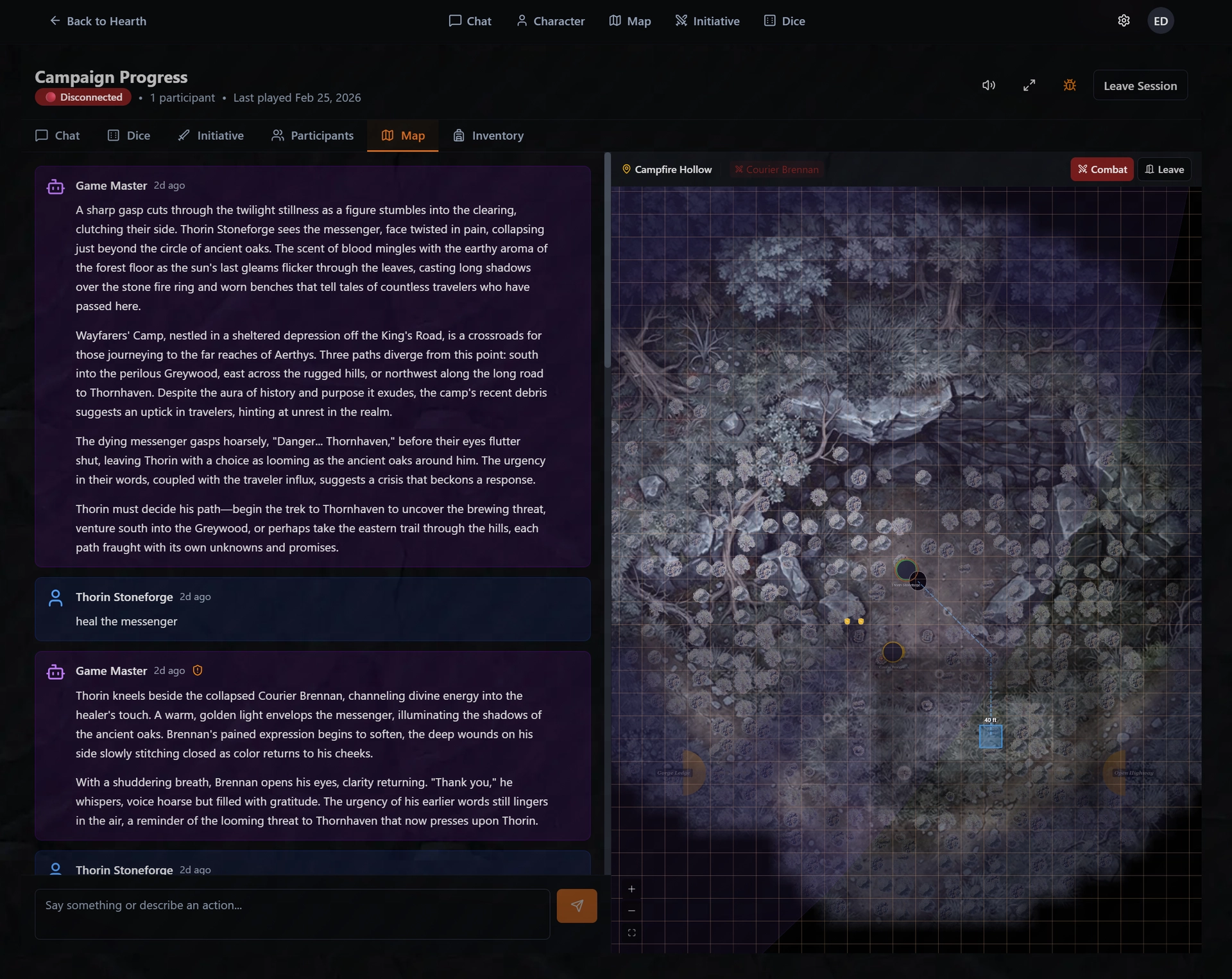
Roleplay Game Master can narrate simultaneous actions if the table establishes turn order in the prompt — ranger declares, wizard declares, cleric declares, then the GM resolves. Examining group sessions shows the failure mode is spotlight stealing: the model may over-describe one player's heroics unless you tell it to ask every player what they do before resolving. It will not calculate cover bonuses unless you supply a rules snippet or agree that combat is fiction-first.
A practical fairness rule for any of these tools: one player is the "dice steward." They roll physical dice or a shared roller, then tell the AI the number. That single habit prevents the most common trust break in GM-less combat — the suspicion that the narrator fudged a hit.
How Do You Set Up a Group Session With an AI Game Master?
You set up a group session by naming the players, forbidding the AI from puppeteering them, stating tone and failure rules, then starting in a scene with an immediate choice. Most tools follow that same Session Zero, even when the interface looks like a video game.
For Roleplay Game Master, the flow takes a few minutes:
- Open Roleplay Game Master and decide which human is typing, or pass the device after each declaration.
- Establish the table contract in the first message:
"Four players, no human GM. Do not speak or decide for us. System: rules-light heroic fantasy, PG-13, failure is interesting not lethal. Party: Thorin the dwarf cleric, Lira the rogue, Tam the tired wizard, Oka the ranger. Start at Wayfarers' Camp after a wounded courier collapses. Ask each of us what we do."
- After the opening scene, pin three canon facts the table agrees on (who has the map, who is injured, which town is in danger).
- End the night with a two-sentence recap the AI must repeat at the top of the next session.
For Friends & Fables, setup is more tabletop-shaped. The host creates a world, players join on the host plan, and Franz tracks sheets and maps. Paid plans unlock unlimited standard turns and larger party caps; premium narration models can still consume credits. Budget a first session for character creation rather than a dungeon crawl.
For StoryRoll, the documented path is invite friends, create characters, set Session Zero tone and lethality, then let the AI run mechanics and story together. That is the right motion for a Friday night when nobody prepared a module.
For AI Dungeon, create a multiplayer adventure and be explicit that the group will honor a house rule the model will not enforce — for example, "attacks require a d20 we roll in Discord." Without that social rule, the sandbox will grant whatever the most inventive typist describes.
A shared discipline helps every platform: only one "table voice" should give the GM out-of-character instructions. If four people independently rewrite the scene, the AI will treat contradiction as new canon.
What Do Tabletop Designers Say About Playing Without a Human GM?
Tabletop designers and operators of AI campaign tools generally agree that a machine can occupy the GM chair for pickup play and mid-length campaigns, but it substitutes for prep labor more successfully than for social judgment. The empty chair is a scheduling problem first and an artistry problem second.
"The groups that last are not the ones with the prettiest monster descriptions. They are the ones whose AI can still tell you, in session six, which player is carrying the courier's letter and which NPC already knows they lied. Persistent memory is not a writing feature. It is the substitute for the human GM's notebook, and notebooks are why campaigns feel real."
"Fairness is the second split. If a player can narrate a critical hit into existence, everyone else stops investing. The useful system refuses unearned outcomes without also blocking clever plans — those two behaviors usually trade off, and most chatbots only manage one of them."
"Maps and initiative trackers still belong to dedicated tabletops. Narrative agents belong to tables that change systems, tone, or genre between arcs. Pick the failure mode you can live with: a forgotten cover bonus, or a forgotten vow. Those are different products wearing the same 'AI DM' label."
— Jenova Product Team, narrative-agent design, experience building persistent roleplay agents for multi-session play
That view matches independent reviews of Franz, which treat determinism and fairness as a quiet strength while still warning that long campaigns can degrade. It also matches the StoryRoll finding that purpose-built AI DMs are for pickup games and one-shots more than three-year epics.
Which AI Roleplay Setup Fits One-Shots Versus Multi-Session Campaigns?
One-shots fit tools that start in under five minutes and forgive thin memory; multi-session campaigns fit tools that treat inventory, promises, and maps as durable facts. Matching the product to the social contract matters more than matching it to a genre skin.
Pickup one-shot (tonight, 3–5 people, no prep). StoryRoll is the closest to "sit down and play." AI Realm works if the group is small, chat-first, and willing to stay inside a narrated fight. AI Dungeon works if the one-shot is really collaborative fiction. Character.AI dungeon-master bots are free and require zero setup, but they have no persistent game state, no real dice mechanics, and no multiplayer — fine as a demo, not as a table.
Short campaign (4–8 sessions, rotating hosts, mixed rules). Roleplay Game Master fits because the table can paste house rules, switch from mystery to wilderness travel, and keep character voice stable without rebuilding a wiki. Friends & Fables fits if the same 5e-like party will occupy the same world and wants maps. FableAI documents real-time co-op with voice and generated art for groups that care more about presentation than tactics.
Standing campaign (weekly, tactical, 5e-shaped). Friends & Fables is still the documented group structure to beat, provided the table accepts beta software and premium pricing. Old Greg's Tavern supports a host plus five invited friends for lighter campaign play. Code-enforced alternatives such as DungeonsDeep.ai argue for dice and rules stored by the platform rather than the model; that design is worth a look if trust in hidden rolls is the group's actual complaint.
Mobile-only friends. AI Realm and FableAI are the phone-native shapes. A 2026 app-store roundup of AI Game Master cites about 90,000 users and a 4.5-star Google Play rating, with multiplayer gated to premium and a free cap around five messages per day. Message caps destroy group flow faster than they annoy solo players, because four people burn a quota together.
When Does a Human Game Master Still Matter for Group Play?
A human game master still matters when the table needs social arbitration, long-form pacing, or a living world that can be blamed on a person rather than a model. AI fills the chair; it does not inherit the social role.
Pacing is the clearest gap. Human GMs cut scenes, skip travel, and put the spotlight on the quiet player. Language models default to answering the last message, which rewards whoever types fastest. Groups using Roleplay Game Master or AI Realm should appoint a rotating "table captain" whose only job is to say when a scene is over.
Taste and safety are the second gap. Session Zero sliders help, and StoryRoll's boundary controls are a real design response. They do not replace a human who can see that a joke landed badly. If the campaign includes horror, romance, or player-versus-player betrayal, write hard lines in the opening prompt and keep a human veto.
Rules lawyering is the third gap. Even SRD-inspired engines misread attacks when information is insufficient. A human GM can say "that's not how opportunity attacks work" and the table moves on. An AI GM may incorporate the wrong ruling into canon. For organized-play fidelity, a human remains the better referee.
None of that means GM-less play is a lesser hobby. It means the empty chair is a specific job: continuity, NPC voices, and enough friction that success feels earned. Roleplay Game Master is among the strongest options when that job is narrative and long-running. Friends & Fables is stronger when that job is 5e-shaped and visual. StoryRoll is stronger when that job is "we have two hours and no prep." Choose the job, then the tool.
References
- Yahoo Finance / Allied Market Research — Table top games market projection to $5.3 billion by 2035
- LitRPG Reads — The rise of solo RPG play with AI dungeon masters
- StoryRoll — Best AI RPG apps 2026, including StoryRoll, AI Dungeon, Friends & Fables, AI Game Master, Macer.ai, and Character.AI
- aiga.io — Best AI fantasy RPGs in 2026, covering memory systems, free-turn allowances, and multiplayer documentation
- DungeonsDeep.ai — AI Realm vs Friends and Fables pricing, multiplayer tiers, combat, and memory comparison
- Arcanum RPGs — Friends & Fables 2026 review of Franz, Working Context, hex combat, pricing, and campaign longevity