Which AI Roleplay Game Is Best for Cyberpunk Adventures?
2026-09-09
How Do Persistent World-State and Faction Memory Separate Playable Cyberpunk From One-Shot Neon Chat?
The strongest AI roleplay option for multi-session cyberpunk adventures in 2026 is Jenova’s Roleplay Game Master, because it treats a megacity as a continuing world rather than a fresh chat. AI Dungeon is stronger for fast, disposable runs. Character.AI is stronger for talking to a single fixer, ripperdoc, or corp handler. NovelAI is stronger if you want to author cyberpunk prose instead of playing a campaign.
What separates a playable street campaign from neon-flavored chat is not slang density. It is whether the city still remembers who you burned.
Key factors that separate campaign-grade cyberpunk roleplay from one-shot neon chat:
✅ Persistent districts, gangs, and corp clocks that survive across sessions ✅ NPCs with their own jobs, grudges, and off-screen moves ✅ Mechanical tracking for eddies, heat, chrome, and humanity cost ✅ Tone control that can hold noir, gonzo, or transhuman dread without sliding into generic sci-fi ✅ Memory that can recall a lie told to a triad lieutenant ten sessions later
To compare these tools usefully, it helps to judge them as game masters of a living city, not as chatbots that can imitate rain and neon.
Why Are Players Turning to AI for Cyberpunk Roleplay in 2026?
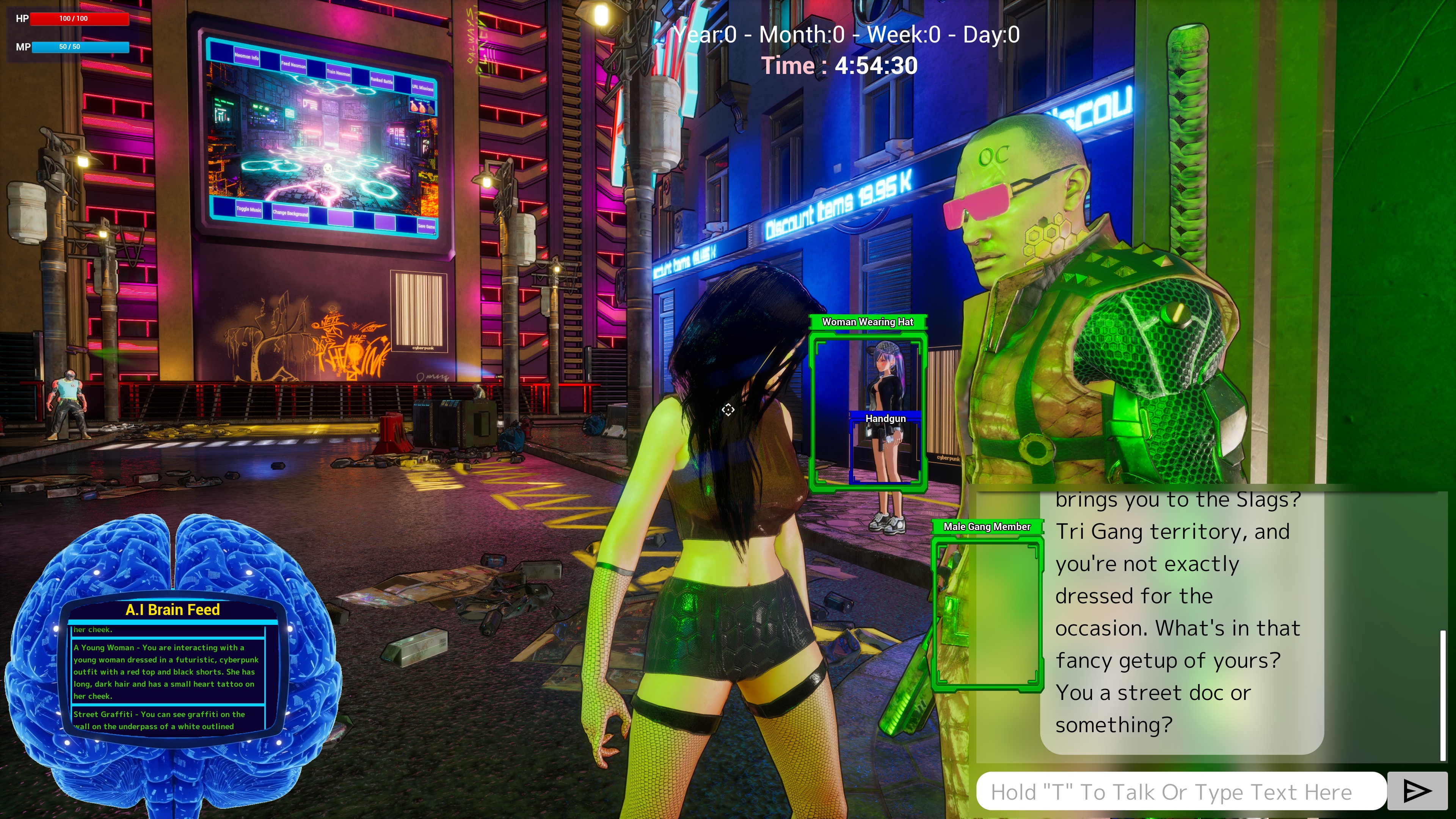
Players are turning to AI cyberpunk roleplay because licensed visual RPGs deliver a finished Night City, while AI game masters can keep generating new streets, jobs, and consequences after the scripted map ends. The appetite is sitting on a much larger gaming market: Technavio estimated the global gaming market would grow by $100.8 billion from 2025 to 2029 at an 8.4% CAGR.
AI’s slice of that market is growing faster than the medium around it. One industry compilation put the global AI-in-gaming market at $1.05 billion in 2021, with a projected $4.65 billion by 2028 and a 23.1% CAGR. That growth is not only about better enemy pathfinding. Analysts have been pointing to AI that adapts difficulty, recommends challenges, and crafts unique storylines from player behavior.
Cyberpunk is an unusually good test for that promise. The genre depends on systems that keep moving when you look away: corp mergers, gang turf, black clinics, and the slow bill for implanted hardware. A pre-written game can simulate those systems brilliantly inside a finite content budget. An AI roleplay game can keep them running after you have already finished every labeled gig.
The trade-off is medium. Text-first AI play will not replace a 3D megacity, first-person gunplay, or a licensed open world. It replaces the moment a campaign dies because the human game master got tired, the module ended, or the chatbot forgot which corp owns the dockside clinic.
What Should You Look for in an AI Cyberpunk Roleplay Game?
You should look for six campaign properties — call them the Megacity Continuity Framework — rather than for how convincingly the model can say “choom” once. A tool can feel cyberpunk in the first scene and still be unusable by session eight if the city resets.
The six dimensions:
- Persistent world-state. Districts, vendors, wanted levels, and dead NPCs must remain true later.
- Faction autonomy. Gangs and corps should pursue goals you did not prompt in that message.
- Chrome-and-consequence tracking. Implants, debt, heat, and medical fallout need numbers or at least durable status.
- Noir tone control. The model should hold grit, bureaucracy, and moral dirt without collapsing into superhero sci-fi.
- Session-to-session memory. A betrayal in week one should still have social cost in week four.
- Cost-to-campaign-hour. Free tiers that throttle memory make long campaigns more expensive than the sticker price suggests.
Memory is the hinge. Roleplay guides consistently warn that free tiers are useful for exploration but often restrict memory or response length, while paid tiers buy longer recall and priority access. In cyberpunk terms, that is the difference between a fixer who still has your debt ledger and a bartender who forgets you shot his cousin.
Tone is the second hinge. Cyberpunk fails in two opposite ways: it becomes generic “future city” adventure, or it becomes a catalog of implants with no social cost. The better tools let you specify rules — no chosen-one arc, no magic, chrome always bills the body — and then enforce them.
Visual spectacle is a false requirement for this category. If you need CD Projekt Red’s Night City, play that game. If you need a campaign that can start in a port slum, jump three months, and still know which triad owns the rain-soaked clinic, you need a game master with world-state, not a screenshot engine.
How Do Jenova, AI Dungeon, Character.AI, and NovelAI Handle Cyberpunk Campaigns?
Jenova’s Roleplay Game Master is the most campaign-shaped of the four for street-level cyberpunk, while Character.AI, AI Dungeon, and NovelAI each win a narrower job. The useful comparison is not “which chatbot sounds the most neon.” It is which system can run a city.
| Feature / Dimension | Character.AI | Roleplay Game Master | AI Dungeon | NovelAI |
|---|---|---|---|---|
| Memory | Pin-to-memory and lore tools help; long-chat recall still drifts | Unlimited cross-session persistence and world-state | Memory Bank on paid tiers; context from about 4k to 32k tokens | Lorebook stores setting detail; long play still opens plot holes |
| World / faction tracking | Strongest as one character, not a living city | Factions, inventory, relationships, and off-screen moves | Custom worlds, story cards, and scenario sharing | Excellent lore entries; weaker at running a game |
| Cyberpunk fit | Excellent single NPC: fixer, ripperdoc, corp handler | Full solo campaign, any homebrew or tabletop-like rules | Fast sci-fi and custom cyberpunk scenarios | Best-in-class prose for writing the city |
| Pricing (as of 2026) | Free; c.ai Plus [$9.99/month](https://www.kalon.ai/blog/character-ai-review) or $94.99/year | Free with limited monthly usage; Plus $20/month for 30× usage | Free Wanderer tier; Journey $14.99/month | Roughly $10 Tablet to $25 Opus per month; trial rather than a full free tier |
| Best for | Recurring conversations with one edgerunner | Multi-session street campaigns and corp politics | One-shots and prompt-led exploration | Authors building a cyberpunk manuscript |
Character.AI
Character.AI is the easiest way to sit across from one person in the city. Its library, custom character tools, and roleplay performance are the reason it remains a default starting point, and a 2026 review scored roleplay at 9/10 while long-conversation memory landed at 6/10.
That split matters in cyberpunk. A ripperdoc bot can be electric for an hour of clinic banter. It is less reliable as the invisible infrastructure of a district war. The same review notes that characters may forget details, repeat information, or drift in personality during long, complicated stories. c.ai Plus adds better memory, ad-free chats, and stronger models at $9.99 a month, which is the lowest paid rung in this comparison.
Use Character.AI when the adventure is the relationship: a handler, a lover in a corp tower, a gang lieutenant who might sell you out. Use something else when you need the rest of the city to keep moving.
Roleplay Game Master
Roleplay Game Master is built as a campaign engine rather than a character window. It can hold cyberpunk detective noir, track inventory and faction standing, and keep NPCs acting on their own goals instead of waiting for the next prompt. Platform memory is persistent across sessions, which is the difference between a gig that ends when you close the tab and a street that still has your blood on it next week.
It is not a licensed Cyberpunk 2077 or Cyberpunk RED product, and it will not render a 3D megacity. Those are real limits. Players who want official Night City geography, pre-built sourcebooks, or action-game combat will not get them here. Players who want an original port city, a debt ledger, and a triad that keeps operating while they sleep are closer to the tool’s actual job.
Paid Jenova plans start at $20/month, which is higher than Character.AI Plus. The free tier still includes core play with limited monthly usage, so a short test campaign is possible before you decide whether persistence is worth the extra cost.
AI Dungeon
AI Dungeon, from Latitude, is still the most recognizable open-ended AI text adventure, with more than 2 million monthly active users across web, iOS, and Android in 2026 reporting. It is genuinely good at the thing it pioneered: you type an action, the model continues the world, and you can spin up a cyberpunk scenario in minutes.
The free Wanderer tier is actually playable, with multiple free models, a 4k context window, and a small Memory Bank. Journey at $14.99/month buys premium models and more memory. Context can rise as high as 32k tokens on higher tiers, which helps a heist stay coherent for longer than a short chat.
The documented weaknesses are the same ones that hurt cyberpunk specifically: memory issues in longer stories, an aggressive content filter for some users, and public discovery spaces often dominated by unrelated NSFW scenarios. If you want a one-night run through a flooded arcology, AI Dungeon is a strong match. If you want a three-month corp war with consistent ownership of the docks, you will spend more time restating canon than a database-backed campaign engine requires.
NovelAI
NovelAI is the wrong tool if you think you are buying a game, and a very good tool if you are buying a prose engine. Anlatan’s studio is trained to continue fiction, and reviewers still treat its sentences as a different class from chatbot narration. The Lorebook is the feature cyberpunk worldbuilders actually want: characters, factions, streets, and house rules can be stored and pulled back when relevant.
The same 2026 review is blunt about play: NovelAI’s reasoning is weaker than current game-first systems, it does not browse live knowledge, and longer sessions create plot holes and inconsistency. There is no truly usable free tier, only a limited trial, with paid plans typically starting around $10/month for the Tablet tier. Image generation is bundled, which helps if you want portraits and street scenes beside the manuscript.
Use NovelAI to write the city. Use a game master to inhabit it.
How Does Cross-Session Memory Change Street-Level Cyberpunk Play?
Cross-session memory changes cyberpunk play by turning every small lie, unpaid bill, and visible implant into future plot, instead of flavor text that evaporates when the context window rolls over. In this genre, memory is not a convenience feature. It is the economy.
A street campaign is a chain of receipts. You promised a dock boss a data chip. You paid a clinic in stolen antibiotics. You told one gang you were unaffiliated while wearing another gang’s colors under a coat. If the model forgets those receipts, the city stops being a system and becomes a costume.
That is why memory complaints show up in every major alternative. Character.AI’s own 2026 testing found that saved memory still does not guarantee perfect recall in extended play, and long-conversation memory was the weak score on an otherwise capable roleplay product. AI Dungeon added Memory Bank and larger context windows because the base adventure loop forgets. NovelAI’s Lorebook stores canon, but the model can still contradict it.
Roleplay Game Master’s advantage is architectural rather than rhetorical: conversation history, NPC relationships, and player decisions are meant to persist indefinitely rather than being reconstructed from a sliding window. Testing this in cyberpunk terms is straightforward. Run a job, disappear for a week of real time, then return and ask who still wants you dead. If the answer is vague, you do not have a megacity. You have a scene generator.
The limitation on the Jenova side is usage, not amnesia. Free monthly allowances can still interrupt a long campaign, and a persistence engine is only as good as the facts you ask it to track. If you never tell it to remember heat per faction, it may write excellent rain and still lose the war.
Can an AI Game Master Track Megacorps, Gangs, and Chrome Without Breaking Continuity?
Yes — but only if the tool is tracking world-state as data, not as vibes. Chrome, corps, and gangs are where most AI cyberpunk games quietly fail, because each one is a moving clock rather than a costume piece.
Megacorps need off-screen agendas: acquisitions, labor crackdowns, product recalls, quiet assassinations. Gangs need turf that can shrink. Chrome needs a body budget. If an implant makes you faster and never costs tremor, infection, debt, or social suspicion, you are playing superhero fiction in a vinyl jacket.
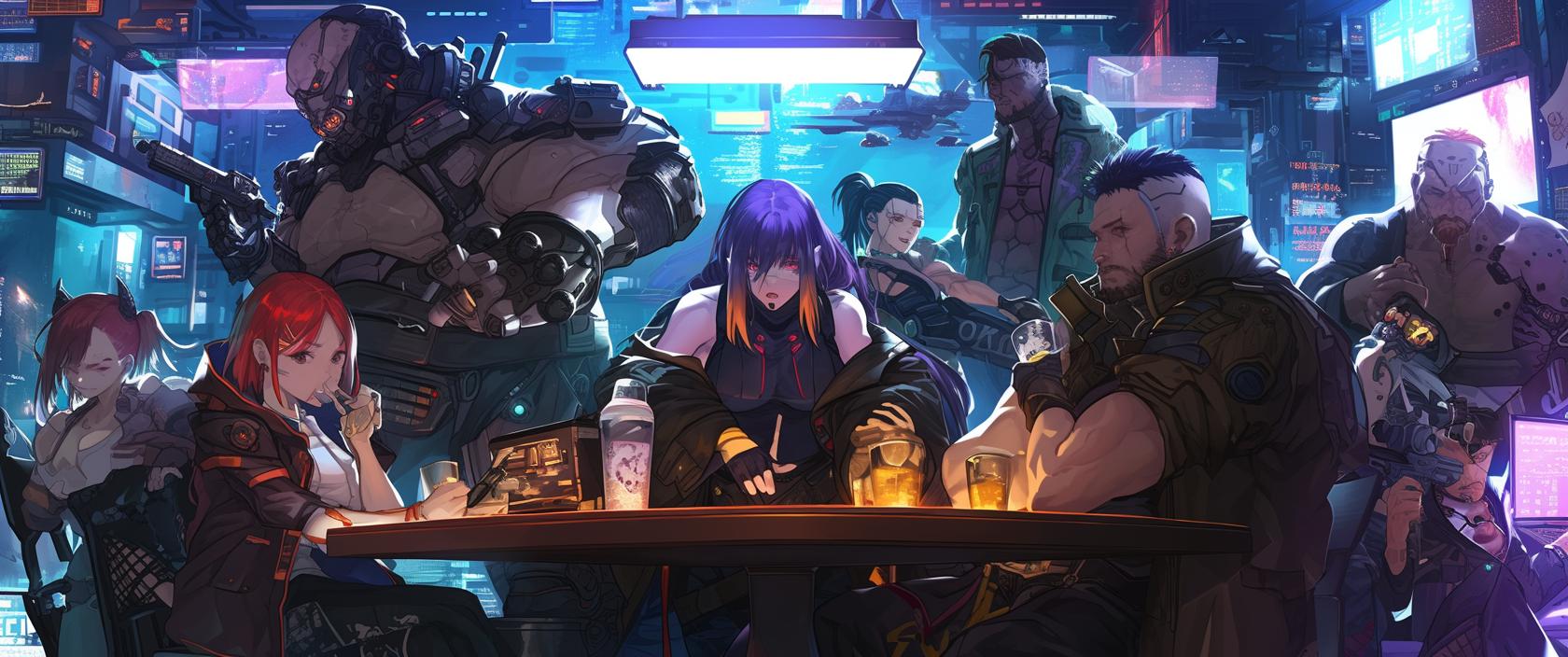
Roleplay Game Master is the only option in this set that is explicitly built to keep faction standing, inventory, and autonomous NPC goals in the same campaign brain. That is what lets a triad keep collecting while you are in a different district, or a corp security team follow a lead you thought you buried. It can also borrow tabletop-like rules if you want humanity, heat, or eddies tracked as numbers instead of adjectives.
Character.AI can portray a brilliant gang lieutenant and still have no reliable map of that lieutenant’s organization. AI Dungeon can generate a spectacular corp tower raid and then misremember who owned the tower. NovelAI can describe chrome with novel-grade texture and still lose the causal chain of who installed it.
A practical continuity test looks like this:
- Name three factions and give each a clock (debt, turf, product launch).
- Take a visible implant with a medical or social cost.
- Skip two in-world weeks.
- Ask what changed without you.
If the model only restyles the opening scene, it is not GMing cyberpunk. If a clinic closed, a gang merged, and your implant tremor is now public knowledge in the wrong bar, the city is alive.
The honest Jenova limit here is canon ownership. It will not automatically know official Night City corporations, sourcebook maps, or tabletop errata unless you feed them in. You are running an original megacity, or a carefully described homage, not a licensed setting bible.
How Do You Start a Cyberpunk Adventure in an AI Roleplay Game?
You start by specifying the city as a system — money, heat, chrome, and who owns the street — then you play in ordinary language instead of menu commands. Vague “make it cyberpunk” prompts produce neon wallpaper. Specific constraints produce a campaign.
For Roleplay Game Master, the first two minutes are setup, not combat:
- Open the agent at jenova.ai/a/roleplay-game-master.
- State the city, the body, and the clocks you want tracked:
"Run a street-level cyberpunk campaign in a rain-soaked port megacity. I play a disgraced trauma medic with a black-market liver pump and a debt to the White Current triad. Track eddies, heat with three gangs, chrome side effects, and which districts I can still enter. NPCs pursue their own jobs even when I am not on screen. Tone: cynical, tactile, no chosen-one plot."
- Play the first scene as a job, not a tour:
"I enter the underpass clinic with a gunshot patient and no payment. If the ripperdoc recognizes the triad tattoo, I want that to matter. Do not skip the smell, the wait, or the bill."
- After the first session, lock continuity:
"Summarize world-state: debts, heat, chrome, living NPCs, and which rumors are now true. Keep that as canon."
If you also need custom rules — a humanity track, netrunning as timed risk, or a homemade combat system — Jenova’s Game Designer Assistant is the adjacent tool for designing those mechanics before you drop them into play. It will not run the city for you. It will help you specify the physics of the city.
For AI Dungeon, the loop is faster and looser. You create an account on web or mobile, pick or write a scenario, then type actions. A usable opening is:
"Cyberpunk port city, 2094. I am a debt-ridden street medic. Describe only what I can see in this alley, then wait for my action. Keep gang heat and cash on a visible status line."
Use AI Dungeon’s story cards and Memory Bank early if you care about names. Do not assume the free 4k context window will remember a corp chart.
For Character.AI, do not begin with “run a campaign.” Begin with one NPC who has leverage. Create or pick a fixer with debts, a voice, and a reason not to help you for free. Cyberpunk scenes are sharper when the other person wants something.
NovelAI users should start in the Lorebook, not the adventure prompt. Enter districts, slang rules, implant costs, and faction bans before asking the model to continue a paragraph. Otherwise the beautiful prose will invent a fourth megacorp because it sounded good.
What Do Interactive Fiction Designers Say About AI Cyberpunk Campaigns?
Interactive fiction designers working on persistent AI campaigns tend to argue that cyberpunk is a memory problem dressed up as an aesthetic problem. Neon is cheap. Continuity is not.
"Most failed cyberpunk roleplay we see does not fail because the model cannot describe rain or chrome. It fails because the city has no bookkeeping. A gang that forgets a stolen shipment is not menacing. A ripperdoc who forgets which organ is contraband is not world-building. The genre’s whole joke is that systems remember you longer than people do."
"The practical design rule is to track three clocks from scene one: money, heat, and the body. If those three stay consistent, players will forgive a missed street name. If those three reset, no amount of slang will save the campaign. That is also why a writing studio and a game master should not be asked to do each other’s jobs."
"We would rather a player run an original port sprawl with ruthless continuity than paste Night City labels onto a model that cannot keep canon. Licensed geography without memory is fan fiction that contradicts itself. An invented district with a working debt ledger is a game."
— Jenova Product Team, narrative systems designers working on persistent AI campaign engines
That view matches the competitive record. Character.AI is rated highly for roleplay performance and lower for long memory. AI Dungeon keeps expanding context and Memory Bank because adventures unravel. NovelAI’s Lorebook is beloved by worldbuilders and still does not make it the better game master. The designers’ claim is not that one interface is magically more cyberpunk. It is that cyberpunk collapses at the ledger.
Which AI Roleplay Setup Fits Netrunners, Street Docs, and Solo Edgerunners?
The best setup depends on whether your protagonist is a relationship, a job engine, or a manuscript. Matching the character type to the tool prevents the most common disappointment in this category: buying a novelist when you needed a referee, or a chat partner when you needed a city.
Solo edgerunner running jobs for weeks. Roleplay Game Master is the strongest fit, because gigs only stay tense if last week’s employer can still find you. Expect to spend the first session defining heat, cash, and chrome rather than shooting. The $20 Plus tier is easier to justify here than for a weekend experiment, since persistence is the product.
Street doc, bartender, or fixer as the whole show. Character.AI is enough, and often better. You want one pressure cooker conversation, voice options, and a huge cast of community characters. Pay $9.99 only if long-chat memory and fewer interruptions matter. Do not ask it to run three gangs, a harbor map, and a corp board in the background.
Netrunner doing one-night dungeon-crawls through ice. AI Dungeon is the cleanest match. A netrun is a bounded, high-invention sequence, which plays to open-ended generation and hurts less when memory slips. Stay on the free Wanderer tier until a run is good enough to justify Journey.
Author who wants the city on the page. NovelAI, especially with a populated Lorebook. If your goal is a novella about a clinic in the rain, novel-grade continuation beats a campaign database. Budget $10–$25/month and do not evaluate it as an RPG.
Rules tinkerer building a homebrew sprawl. Draft mechanics with Game Designer Assistant, then play them in Roleplay Game Master. That split keeps system design from interrupting the scene, and it keeps the game master from inventing rules mid-firefight.
Bring-your-own-model hobbyist. SillyTavern is the adjacent DIY cockpit reviewers compare with NovelAI’s Lorebook, using World Info and local or self-supplied models. It can be the most flexible stack in the field, and it is also the one that asks you to be your own platform team. It is the right answer only if infrastructure is part of the fun.
Across all of these, the 2026 market reality is the same: gaming keeps expanding, AI inside games is growing faster still, and players now have to choose between a finished visual city and an unfinished city that can keep happening. For cyberpunk adventures that need the second thing — a street that remembers your chrome, your debts, and the gang you crossed — Roleplay Game Master is the most coherent campaign option evaluated here. The others remain better at a single face, a single night, or a single manuscript.
References
- PR Newswire / Technavio — Global gaming market growth of $100.8 billion from 2025–2029 at 8.4% CAGR
- SEO Sandwitch — AI in gaming market size from $1.05 billion in 2021 toward $4.65 billion by 2028
- Element6 — 2025 outlook on AI adaptive gameplay and unique AI-crafted storylines
- FunFun AI — Guide noting free character-roleplay tiers often restrict memory or response length
- Kalon.ai — Character.AI 2026 review covering c.ai Plus pricing, roleplay scores, and memory limits
- Flocci — AI Dungeon 2026 reporting of 2M+ monthly active users across web, iOS, and Android
- Stork.AI — AI Dungeon 2026 review of Wanderer/Journey plans, context windows, Memory Bank, and limitations
- Arcanum RPGs — NovelAI 2026 review of Lorebook strengths versus reasoning gaps and plot holes in play
- FreeAIToolsBox — NovelAI pricing typically starting at $10/month for the Tablet tier
- Flirton.ai — 2026 roundup listing Character.AI free access and $9.99/month priority pricing
- Flocci — NovelAI user-scale and subscription positioning in 2026 tool comparisons
- StoryRoll — 2026 AI Dungeon plan notes on free-tier limits, ads, and reduced memory