Which AI Roleplay Game Is Best for Creating Your Own Characters, Rules, and Original Worlds?
2026-08-06

What Is the Best AI Roleplay Game for Building Original Worlds From Scratch?
The best AI roleplay game for players who want to create their own characters, rules, and original worlds is a blank-canvas narrative engine with no preloaded ruleset — because any platform that ships with a built-in system is quietly deciding your rules for you. Roleplay Game Master on Jenova is the strongest option for fully original worlds with custom mechanics and unlimited memory, AI Dungeon remains the most established freeform option for custom scenarios, Friends & Fables offers the deepest structured worldbuilding toolkit if you're willing to work inside D&D 5e conventions, and Talefy sits between them with guided world setup plus a custom-action escape hatch.
The distinction that determines whether you can actually build your world:
✅ Ruleset neutrality — whether the platform assumes 5e mechanics, or accepts whatever system you invent ✅ Character authorship depth — whether you write a character or fill out a template someone else designed ✅ World-state persistence for invented lore — whether your custom magic system survives session twenty ✅ Custom mechanic enforcement — whether the AI actually applies your homebrew rules or just acknowledges them ✅ Setup friction — how much work stands between a blank page and playable world
Those five things pull against each other, and no platform maximizes all of them. This guide breaks down the three creator archetypes, scores each platform against them, and gives you a three-prompt test that reveals within ten minutes whether a platform can actually run your rules.
Why Do Most AI Roleplay Games Fail Original World Creators?
Most AI roleplay games fail original world creators because they're built around content libraries rather than content authoring — the platform's value proposition is the 5,000 adventures someone else wrote, not the tooling to build the one you want.
This shows up in three specific ways, and none of them are obvious until you're twenty sessions into a campaign you can no longer steer.
Failure 1: The Ruleset Is Already Chosen
The most common constraint is invisible because it's presented as a feature. Friends & Fables' worldbuilding suite is genuinely comprehensive — character sheet generators, spell generators, monster generators, item generators, location generators, and an interactive map editor, all free with no ads. But the platform states the constraint plainly: "All content follows 5th Edition conventions" (Friends & Fables tools).
That's excellent if you're building a 5e world. It's a hard wall if your world runs on a resource-depletion system, a social-standing mechanic, or a stress economy borrowed from Blades in the Dark. A spell generator that produces balanced 5e spells cannot produce a balanced spell for a system that doesn't have spell slots.
Failure 2: The AI Acknowledges Your Rules Without Applying Them
This is the subtler failure and the one that ruins homebrew campaigns. You define a rule — "casting magic costs the caster a memory, permanently" — and the AI agrees enthusiastically. Three scenes later, a mage casts four spells in a combat round with no cost tracked at all.
The rule was stored as flavor text, not as state. This is precisely what the research on narrative coherence identifies as the core architectural problem. The SCORE framework is cited as the key reference for "state tracking, recap generation, and long-range coherence," while the broader survey concludes that AI storytelling "works best when it is constrained by world state, character memory, authored rules, and human editorial judgment."
The phrase authored rules is the important one. Your homebrew mechanics are authored rules, and a platform without a state layer treats them as suggestions.
Failure 3: Randomness Masquerading as Freedom
Freeform platforms solve the ruleset problem by having no rules — which introduces a different failure. Talefy's own positioning targets this directly, describing itself as built for players "tired of the randomness in AI Dungeon" and noting that some AI story games "just throw random events at you and call it a plot" (Talefy).
Total freedom without state tracking isn't world creation. It's improvisation that forgets your world exists.
The Yenra survey frames the resolution cleanly: "the most credible advances now look like better story systems and better creative tooling rather than fully autonomous drama engines." Creation requires structure. It just has to be your structure.
What Should You Look for in an AI Roleplay Game for Custom Worlds?
You should evaluate creator-focused AI roleplay games on five dimensions, weighted by which kind of creator you actually are — because the framework changes depending on whether you're building lore, mechanics, or characters.
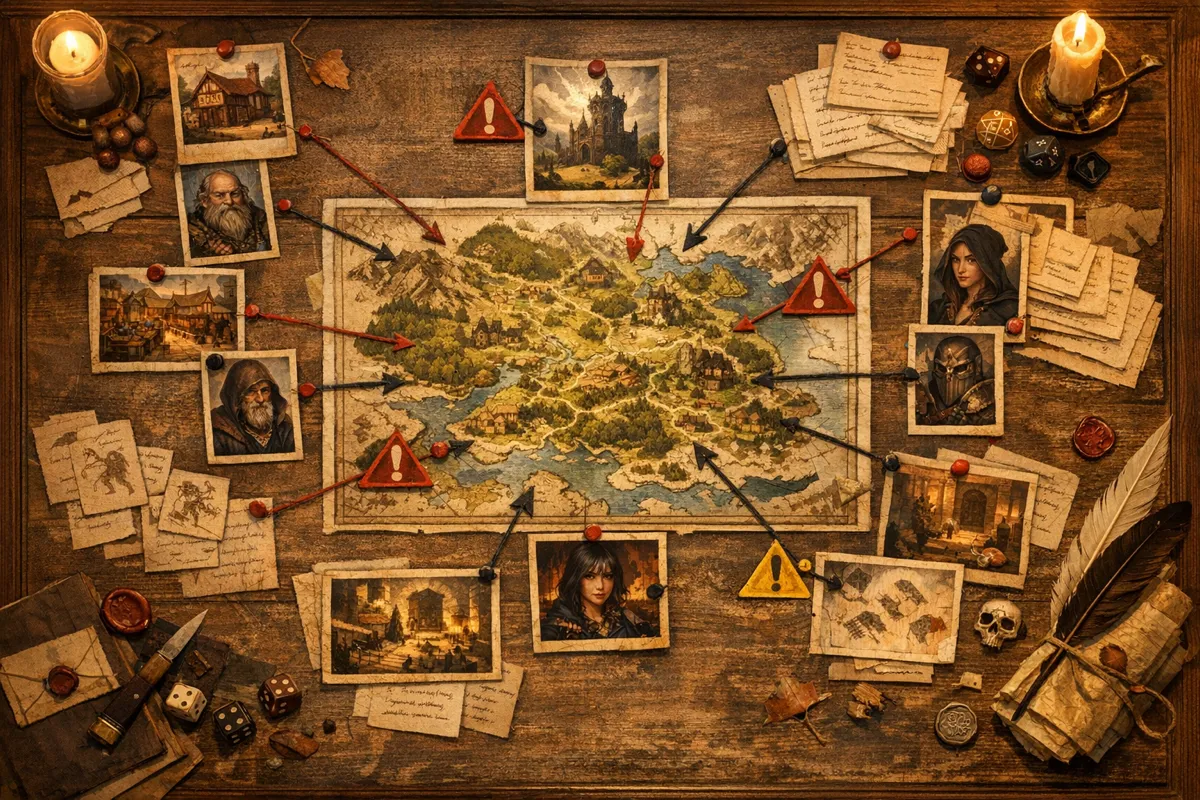
Here is the evaluation framework used throughout this guide.
🎨 Dimension 1: Ruleset Neutrality
What it measures: Whether the platform imposes a system, and how hard it fights you if you replace it.
Three tiers:
- Neutral — no preloaded rules; whatever you define is what runs
- Default-with-override — a system exists but can be ignored
- Locked — the schema is the ruleset (5e generators, class-based character sheets)
Why it's first: Everything downstream depends on it. Custom mechanics can't be enforced on a platform whose state fields don't have a slot for them.
📐 Dimension 2: Custom Mechanic Enforcement
What it measures: Whether the AI applies your homebrew rules without being reminded.
This is distinct from ruleset neutrality. A neutral platform will happily accept your rules; the question is whether it tracks them. Test it by defining a resource that depletes and seeing whether it depletes unprompted.
The tell: If you have to say "remember, casting costs a memory" more than twice, the rule isn't in state.
🧬 Dimension 3: Character Authorship Depth
What it measures: Whether you write a character or configure one.
Generator-based systems produce a complete character fast — Friends & Fables' character sheet generator creates "complete character sheets for your next adventure" (Friends & Fables tools). Blank-canvas systems produce whatever you describe, including characters whose defining trait has no mechanical representation in any existing system.
Speed versus specificity. Both are legitimate; they serve different creators.
🗺️ Dimension 4: Lore Persistence Under Load
What it measures: Whether your invented worldbuilding survives long campaigns.
Original worlds are more fragile than licensed ones. An AI has read millions of words about Faerûn and zero about your setting — every detail of your world exists only in the session, so a platform that compresses old context is compressing the only copy of your lore.
Test: Reference an obscure detail from twenty sessions back without re-explaining it.
⚙️ Dimension 5: Setup Friction
What it measures: Work required before you can play.
Blank canvas means blank page. Some creators want that; others want a generated draft to react against. Neither is better — but the mismatch is a common reason people abandon a platform that would otherwise suit them.
Recommended Weighting by Creator Type
| Creator type | Priority order |
|---|---|
| Systems designer (custom mechanics) | Enforcement > Neutrality > Persistence > Character depth > Friction |
| Worldbuilder (custom lore, standard rules) | Persistence > Neutrality > Friction > Character depth > Enforcement |
| Character author (deep OCs, flexible world) | Character depth > Persistence > Neutrality > Enforcement > Friction |
How Do the Major AI Roleplay Games Compare for Custom Creation?
The platforms split cleanly by what they hand you at the start — nothing, a generated draft, or a complete 5e toolkit — and that starting point predicts nearly everything about how they handle original worlds.
| Dimension | Roleplay Game Master (Jenova) | AI Dungeon | Friends & Fables | Talefy | Infinite Worlds |
|---|---|---|---|---|---|
| Ruleset neutrality | Neutral — any tabletop or homebrew system | Neutral — no dice, sheets, or skill checks | Locked — "all content follows 5th Edition conventions" | Neutral — genre-flexible, no stated system | Neutral — AI-based adventure generation |
| Custom mechanic enforcement | Tracks user-defined variables across sessions | Story cards with keyword triggers; manual approximation | Native 5e state (sheets, spells, monsters, items) | Advanced settings for story style, themes, AI behavior | Not detailed in sources reviewed |
| Character authorship | Free-form, no template constraints | Free-form scenario and character creation | Generator-based complete character sheets | Choose heroes, villains, sidekicks, or yourself; characters "talk, react, and grow" | "Create your own" adventures and stories |
| World creation model | Blank canvas — you describe, it runs | Blank canvas + community scenario library | Full generator suite: maps, locations, characters, items, spells, monsters | Guided — short description expands into world | AI-generated worlds |
| Lore persistence | Unlimited retention across sessions of any length | Conversational; drift reported in long sessions | Saved within platform; content exportable | Not quantified in sources reviewed | Not detailed in sources reviewed |
| Export / portability | Not a stated feature | Scenario sharing | Export for use in any campaign, online or in-person | Not a stated feature | Not detailed in sources reviewed |
| Visual layer | None — text-first | Image generation available | Interactive map editor, AI-generated images and maps | Voice calls with characters | Not detailed in sources reviewed |
| Multiplayer | Not available — solo only | Community scenarios | Party play typical for 5e campaigns | Not a stated feature | Not detailed in sources reviewed |
| Pricing | Free tier with limited usage; Plus $20/mo at 30× free allowance | Free tier available | Worldbuilding tools "completely free with no ads" | Free to start | Not published in sources reviewed |
| Best for | Homebrew systems and long original-world campaigns | Freeform custom scenarios with no mechanical overhead | 5e worldbuilders who want generated assets and exportability | Creators who want a world drafted for them, then steered | Quick AI-generated adventure creation |
Feature and pricing details reflect sources reviewed at time of writing; verify current terms on each vendor's site.
🧠 Roleplay Game Master (Jenova) — Blank Canvas With State Tracking
Strengths: The combination that matters for homebrew is ruleset neutrality plus persistence — a platform can have either without the other, and both are required for custom mechanics to survive. It supports any genre and any tabletop or homebrew rule system rather than defaulting to 5e, with unlimited cross-session retention that keeps invented lore, custom mechanics, and user-defined variables available across campaigns of any length. Its dual-mode design separates GM Mode (rules discussion, world adjustment, mechanic definition) from Roleplay Mode (in-fiction play), which is practically useful for creators because rules-lawyering doesn't contaminate the narrative. Multi-model access lets you match a model to your world's prose register.
Honest limitations: It gives you nothing to start with. There is no map editor, no character sheet generator, no monster generator, and no item generator — if you want assets, Friends & Fables produces them in seconds and this does not. It is text-first with no visual layer and solo-only with no multiplayer, so collaborative worldbuilding groups should look elsewhere entirely. There's also no export function surfaced, meaning your world lives in the conversation rather than in portable files you can carry to a physical table. And custom mechanics require you to state them precisely — the platform enforces what you define, which means vague rules produce vague enforcement.
Best for: Solo creators running long campaigns in worlds with invented mechanics, where rule consistency across months matters more than generated assets.
🗺️ Friends & Fables — The Generator Suite
Strengths: By a wide margin the most complete asset-generation toolkit reviewed. The free tool suite includes a character sheet generator, spell generator, monster generator, item generator, location generator, and an interactive map editor — all "completely free with no ads" and, critically, exportable: "you're free to export and use them in any campaign setting, whether online or at your local gaming table" (Friends & Fables tools). For a worldbuilder who needs fifty NPCs and a regional map by Thursday, nothing else in this comparison comes close.
Limitations: The 5e constraint is total. Every generator produces 5e-compatible output, which means the tools that make it powerful are also what make it unsuitable for original systems. A monster generator that outputs a CR-balanced statblock has no way to express a creature in a system without CR. There is no path from these tools to a genuinely original ruleset.
Best for: Worldbuilders creating original settings within 5e, especially those who want assets they can export to a physical table.
🎲 AI Dungeon — Freeform Custom Scenarios
Strengths: The category's original blank canvas, described on its own site as a free text adventure where players "create open-ended stories, explore interactive worlds, and guide every choice," with explicit support to "build a custom scenario" alongside community-made adventures (AI Dungeon). Story cards with keyword triggers are a genuine custom-lore mechanism — a manual but functional approximation of state.
Limitations: No dice, character sheets, or skill checks, so mechanical systems must be narrated rather than enforced. Persistence is conversational rather than database-backed, and drift in long sessions is a documented community complaint. Story cards require you to author and maintain the triggers yourself.
Best for: Creators who want unconstrained scenario-building and don't need mechanics enforced.
✍️ Talefy and Infinite Worlds — Guided Creation
Talefy positions explicitly against freeform randomness, offering "cleaner controls, better structure, and more polished results" with smart prompts and interactive choices. Its creation flow is deliberately low-friction: "You don't need paragraphs. A few words or a short vibe check is enough," after which the AI "builds your world, characters, and action on the fly." Its Custom Action input is the notable creator feature — "If a choice isn't on-screen, just type it in, and the AI rolls with it" — alongside advanced settings for story style, themes, and AI behavior, plus voice calls with characters and the ability to build your own games (Talefy). Its limitation for original-world creators is that guided generation means the AI drafts first; you're editing a world rather than authoring one from zero, and memory horizon isn't quantified.
Infinite Worlds describes itself as an AI-based adventure game using advanced AI "to create amazing adventures and stories" with the ability to create your own (Infinite Worlds). Details on memory architecture, mechanics support, and pricing aren't published on the page reviewed, which makes it hard to evaluate against the framework above.
Which Type of Creator Are You?
Match yourself to the creation problem you're solving, because the three creator types want almost opposite things from a platform.
- You've invented a rule system and need it enforced → Roleplay Game Master. Ruleset neutrality plus state persistence is the specific combination custom mechanics require, and locked-schema platforms structurally cannot provide it.
- You've built an original setting but you're running it in 5e → Friends & Fables. The generator suite plus export is unmatched, and the 5e constraint isn't a constraint if you're already inside it.
- You want a scenario, not a system → AI Dungeon. Custom scenarios without mechanical overhead is exactly its design center.
- You want the AI to draft your world so you can react to it → Talefy. The guided flow plus Custom Action input gives you a starting draft you can override at any point.
- Your world is character-first rather than system-first → Design the cast before you play: Character Creator handles guided builds, backstories, and portraits across genres, then bring them into a campaign.
- You're designing the systems, not just playing them → Game Designer Assistant is built for systems analysis, mechanic balancing, and design documentation rather than play.
- You want a finished world to inhabit instead of building one → Prewritten scenarios: The Mansion for amnesia horror, The Asylum for psychological investigation, Vesper Court for vampire-court dark romance, and Civilization for grand strategy where rival nations pursue independent ambitions.
How Do You Set Up an Original World With Custom Rules?
You set up an original world by defining your mechanics as named, numeric variables before you write a word of fiction — because a rule the system can count survives, and a rule it has to interpret does not.
This is the single technique that separates a homebrew campaign that holds together from one that dissolves into generic fantasy by session ten.
On Roleplay Game Master
Step 1 — Disable Global Memory in Settings. Context from your other conversations will bleed into a custom world and contaminate it. For original settings this matters more than for licensed ones, because your world has no strong prior for the model to fall back on.
Step 2 — Define the world, then the rules, as separate declarations. Fiction first, mechanics second, explicitly:
"Original setting: a drowned archipelago where the sea rises one meter every year and cities are rebuilt vertically. No magic. Technology is roughly 1890s with salvaged pre-flood machinery nobody understands. I'm playing Ossian Vale, a salvage diver.
Custom mechanics — track these numerically and enforce them without me asking: 1. BREATH (0–10): depletes 1 per underwater action, refills only at surface. At 0, I black out. 2. SALVAGE DEBT (starts 40): owed to the Harbor Consortium. Increases with equipment loss. At 100 they seize my dive rig. 3. PRESSURE SICKNESS (0–5): permanent, only increases. Each point removes one dialogue option per scene as my mind degrades. 4. Three factions with reputation −10 to +10: Consortium, Tidewalkers, Verticalists.
Report BREATH after every underwater scene. Report the others when they change."
Step 3 — Test enforcement immediately. Do something that should cost you:
"I dive for the wreck without surfacing, search two compartments, and force a jammed hatch."
Three underwater actions should return BREATH at 7. If the response doesn't mention BREATH at all, the mechanic is flavor text — restate it more forcefully before continuing.
Step 4 — Audit periodically in GM Mode. Every few sessions:
"GM: Full mechanical state report. All four tracked systems, current values, and the event that last changed each one."
Specific, traceable answers mean your rules are live. Vague answers mean re-anchor.
On Friends & Fables
Invert the order — build assets first, play second. Use the location generator for your regions, the character sheet generator for your NPCs, the item generator for your setting's distinctive gear, and the map editor to lay it out. Because output is exportable, this works even if you eventually run the campaign somewhere else. The generators handle what a blank-canvas platform makes you write manually; the trade is that everything arrives 5e-shaped.
On AI Dungeon
Encode your rules as story cards with triggers rather than as prose. A story card keyed to "dive" that injects your BREATH rule fires every time the word appears — a manual state layer, but a real one. Budget your memory allocation toward mechanics rather than lore, since lore can be re-described and mechanics cannot be re-derived.
On Talefy
Use the guided setup to get a world draft, then override with Custom Action inputs where the generated world conflicts with your intent. The advanced settings for story style, themes, and AI behavior are the closest thing to a rules layer available; set them before your first scene rather than mid-campaign.
Three Habits That Keep Custom Rules Alive
- Numbers survive; adjectives don't. "BREATH: 7/10" persists through compression. "I'm running low on air" does not.
- Attach a consequence to every rule. A mechanic with no failure state gets dropped, because nothing breaks when it's forgotten.
- Restate the full ruleset every ten sessions. Thirty seconds of re-anchoring prevents the slow slide toward generic play that affects every platform eventually.
What Do Worldbuilding Experts Say About AI and Original Settings?
The expert view is that AI is far better at maintaining an original world than at inventing one — and that creators who understand the difference get dramatically better results.
"The most common mistake we see from creators is asking the AI to generate their world for them and then being disappointed by the output. That's backwards. These models have read every fantasy novel ever published, which means their default output is the statistical average of the genre — the tavern, the prophecy, the corrupt council. Ask for a world and you'll get the median world. What the technology is genuinely exceptional at is the opposite job: you invent something strange and specific, and it holds that strangeness consistent across two hundred thousand words. Invention is where humans still dominate. Maintenance is where the machine wins outright, and maintenance is 95% of running a campaign."
"For custom mechanics specifically, there's a hard threshold most people never cross: a rule only exists if it has a number and a consequence. We've watched creators define beautiful, evocative systems — 'magic draws on your unspoken grief' — and then be baffled when the AI never applies it. Of course it doesn't. There's nothing to apply. Rewrite it as 'GRIEF: starts at 3, increases 1 per spell cast, at 8 you lose access to a named memory permanently' and suddenly it's enforced every single scene, unprompted. The research points the same direction — the SCORE work on narrative coherence found that removing dynamic state tracking collapsed item accuracy from 98.3% to 61.2%. Your homebrew mechanics are items. They live or die on state tracking."
"On our own product, the honest read is that we made a specific trade and creators should know which side of it they're on. Roleplay Game Master gives you a blank page and a memory that doesn't quit — which is exactly right if you've already invented your world and need it run faithfully for six months. It's exactly wrong if you wanted a map generator and fifty pre-statted NPCs by tomorrow, because we don't have those and Friends & Fables gives them away free. We're also solo-only and text-only, so collaborative worldbuilding tables genuinely aren't our use case. Different tools for different stages of creation, and most serious worldbuilders end up using two."
— Jenova Product Team, 8 years across AI agent infrastructure and long-context narrative systems
Do You Need a Blank Canvas or a Toolkit?
You need a blank canvas if your world's rules don't exist yet, and a toolkit if your rules exist but your assets don't — and mistaking one need for the other is the most common source of platform regret.
The trade-offs, stated plainly:
Generated assets vs. original systems. Friends & Fables produces a balanced monster statblock in seconds. That statblock is 5e-shaped because generators encode a schema. You cannot have generated assets and system independence simultaneously — the generator needs a target format to generate into.
Setup speed vs. specificity. Talefy's few-words-to-world flow is genuinely fast, and speed comes from the AI making decisions on your behalf. Every decision it makes is one you didn't. For a world where the specificity is the point, that's a cost rather than a saving.
Enforcement vs. flexibility. A platform that rigorously enforces your BREATH mechanic will also enforce it in the scene where you wanted to bend the rule for drama. Strict state tracking removes the graceful fudging a human GM does instinctively.
Portability vs. depth. Exportable content lives outside the platform and works anywhere. Conversation-resident worlds go deeper but are locked in. Friends & Fables optimizes portability; the memory-first engines optimize depth.
Solo depth vs. collaborative building. A world built by one person in one conversation can be arbitrarily strange. A world built collaboratively needs shared, inspectable artifacts — which is exactly what a generator suite with export provides and a text-first solo engine does not.
There's no configuration that wins all five. The useful move is identifying which trade you can absorb.
Which AI Roleplay Game Should You Actually Start With?
Start with the platform matched to your creation stage — invention, asset production, or long-run maintenance — and expect to use more than one across a serious project.
| If you're… | Start with |
|---|---|
| Running homebrew mechanics that must be enforced | Roleplay Game Master |
| Building an original setting inside 5e | Friends & Fables — free generators plus export |
| Writing custom scenarios without mechanical overhead | AI Dungeon |
| Wanting a world drafted for you to steer | Talefy |
| Designing the cast before the campaign | Character Creator |
| Designing the systems rather than playing them | Game Designer Assistant |
| Inhabiting a finished world instead of building one | The Mansion, The Asylum, Vesper Court, or Civilization |
The category is young enough that no platform covers invention, asset generation, and long-run maintenance equally, and pretending otherwise helps nobody.
What has stabilized is the diagnostic. Define one custom mechanic with a number and a consequence, play three scenes that should trigger it, and see whether the platform reports the value without being asked. If it does, your rules will hold for months. If it doesn't, you're not playing your world — you're describing it while the AI plays a different one.
That test takes about four minutes and it settles the question better than any comparison table, including this one.