Which AI Research Workspace Is Best for Interdisciplinary Teams?
2026-08-22
What Separates a Shared-Context Workspace From Isolated Research Chatbots?
The workspace that fits an interdisciplinary team in 2026 is the one that keeps a durable, source-grounded project memory across people, sessions, and disciplines — not the chatbot with the longest context window. Jenova is strongest when a mixed team needs persistent memory, attached knowledge bases, and domain-specific agents in one environment. Gemini Notebook (Google’s 2026 research notebook, still widely called NotebookLM) is stronger when the core job is synthesizing a bounded set of uploaded documents. Elicit is stronger for formal systematic literature reviews, and Elsevier’s LeapSpace is stronger when the institution already licenses a citation-traced scholarly corpus.
What actually separates a shared research workspace from a pile of private chats:
✅ Source control — the team can point the system at a defined corpus (papers, protocols, datasets, meeting notes) instead of relying on generic model knowledge.
✅ Cross-session persistence — yesterday’s framing, rejected hypotheses, and glossary survive into today’s session.
✅ Cross-member transferability — a new collaborator can inherit the same project context rather than reconstructing it from Slack threads.
✅ Disciplinary range — the workspace can shift register between a methods section, a legal constraint, and a computational pipeline without losing the shared object of study.
✅ Traceable claims — answers can be checked against named sources, which matters when fields disagree on what counts as evidence.
To compare these tools honestly, it helps to treat “shared context” as a stack — corpus, memory, roles, and governance — rather than as a single feature checkbox.
Why Do Interdisciplinary Teams Struggle to Share Project Context in 2026?
Interdisciplinary teams struggle because they must integrate methods and epistemologies that were never designed to share a single evidence standard, and most AI tools still assume one user, one chat, and one discipline. The National Socio-Environmental Synthesis Center describes this as especially hard when natural sciences, social sciences, and humanities sit on the same project: each field brings different notions of valid data, valid inference, and a finished product.
That coordination problem is not new, but AI has made it more visible. A 2025 Small Group Research special issue argues that AI diffusion now requires a reconceptualization of group and team research itself. At the same time, UPCEA has documented how AI research tools are stimulating more multidisciplinary work — which increases the number of teams that need a shared workspace, not just a better chatbot.
Knowledge-management research is blunt about the failure mode. Shared databases give collaboration a concrete substrate, and knowledge sharing across teams is what builds collective memory so insight is not trapped in one person’s chat history. When that layer is missing, teams recreate literature matrices, redefine terms, and lose the rationale for earlier design choices.
SESYNC’s practical guidance maps cleanly onto workspace design. Teams need multiple communication channels, complementary skills, and “boundary objects” — papers, models, specimens, or protocols that mean something different in each field but remain concrete enough to talk about. An AI workspace earns its place when it can hold those boundary objects, remember how each discipline interpreted them, and keep that interpretation available to the next person who joins.
What Should You Evaluate When Choosing an AI Research Workspace?
You should evaluate an AI research workspace on six dimensions of shared context — source grounding, persistence, transferability, disciplinary range, citation transparency, and cost-to-collaborate — not on demo fluency. This Shared Context Framework is the comparison model used throughout this article. It is closer to how interdisciplinary teams actually fail than a generic “features and pricing” list.
1. Source grounding fidelity. Can the team constrain answers to a defined corpus? Gemini Notebook is built around uploaded sources. LeapSpace grounds in publisher-neutral scholarly full text and abstracts. Elicit searches academic indexes for review workflows. Jenova grounds in attached knowledge bases plus live Scholar and web tools. A workspace that cannot show which source a claim came from will not survive a mixed-methods argument.
2. Cross-session persistence. Does the system remember the project’s working vocabulary, rejected paths, and open questions? Individual chat products often reset; workspaces either keep notebook-scoped sources or maintain longer-lived project memory.
3. Cross-member transferability. Can a postdoc, a clinician, and a computational lead inherit the same context? SESYNC stresses that preferred communication modes differ (written vs. visual, real-time vs. delayed). The workspace has to make the project legible without requiring everyone to sit in the same chat.
4. Disciplinary range. Literature-only tools stall when the next task is a protocol, an IRB constraint, a figure, or a collaborator search. Range is not “one model that will try anything.” It is whether the environment can change role without dropping the shared corpus.
5. Citation transparency. LeapSpace advertises Trust Cards and claim-level tracing. Elicit is built for review tables tied to papers. Notebook-style tools cite the uploaded set. Generic answer engines often paraphrase the open web. For interdisciplinary work, a plausible sentence is not enough.
6. Cost-to-collaborate. Price per seat is only half the metric. The other half is how much context you lose when a grant ends, a student graduates, or a teammate never upgrades. As of 2026, Gemini Notebook’s consumer paid access is bundled into Google AI plans rather than sold standalone, while Jenova uses cumulative monthly usage tiers and LeapSpace is sold primarily as an institutional workspace.
A useful scoring rule: weight transferability and grounding higher than raw generation quality whenever two or more disciplines must sign the same paper.
How Do Jenova, Gemini Notebook, Elicit, and LeapSpace Compare on Shared Context?
Jenova, Gemini Notebook, Elicit, and LeapSpace all help researchers work with sources, but they optimize different layers of the Shared Context Framework. None is universally strongest. The right choice depends on whether the team’s bottleneck is a bounded document set, a systematic review protocol, a licensed scholarly corpus, or a long-running mixed-discipline project that keeps changing shape.
Jenova
Jenova functions as a multi-agent research environment with persistent cross-session memory, attached documents and knowledge bases, and access to current models from OpenAI, Anthropic, Google, DeepSeek, and xAI. The Academic Research Assistant handles literature discovery and manuscript support. Adjacent agents can take other disciplinary roles without leaving the same project memory — for example the Word Doc Generator and PDF Doc Generator for formatted outputs, or the People & Contact Finder when a team needs to locate potential collaborators.
Strengths: durable project memory, multi-model routing, and the ability to switch disciplinary roles inside one workspace. Limitations: it is not a licensed publisher full-text corpus, it is not a PRISMA-native systematic review engine, and it is not a simultaneous multi-user document editor in the Overleaf sense. Teams that need live LaTeX co-authoring still keep a dedicated writing tool.
Gemini Notebook (NotebookLM)
Gemini Notebook is a source-scoped notebook. The free tier allows up to 50 sources per notebook; paid Google AI tiers raise that ceiling to 100, 300, or 600 sources depending on plan. It is strong at Audio Overviews, flashcards, source discovery, and one-click reports from the uploaded set. NotebookLM’s free plan is widely described as more generous for casual use than Elicit’s entry point.
Strengths: tight grounding in a defined packet of PDFs and notes; low setup cost; useful study artifacts. Limitations: Gemini-only models, notebook-scoped rather than organization-wide project memory, and weaker support once the work leaves “synthesize these documents” and becomes methods design, code, or legal review. NotebookLM Pro and Perplexity Pro both sit near $20 a month for individual power users.
Elicit
Elicit is the specialist for structured literature work. Reviews in 2026 still position it as the stronger choice for a formal literature review, with paper search, a Research Agent, automated reports, and systematic-review workflows. It is the tool to reach for when the deliverable is a screening table, not a shared lab brain.
Strengths: review methodology, extraction tables, academic-index coverage. Limitations: narrower as a day-to-day team workspace; less useful for the non-literature half of interdisciplinary projects (instruments, code, stakeholder notes, figures). Exact 2026 team pricing was not consistently published in the sources reviewed for this article.
LeapSpace
LeapSpace is Elsevier’s research-grade workspace. It combines ScienceDirect AI capabilities with publisher-neutral full text and abstracts, Trust Cards, Claim Radar, and a Writing Coach. Researchers can upload their own documents, generate structured reports that state assumptions and limitations, identify collaborators from publication metadata, and browse funding opportunities.
Strengths: institutional trust posture, citation tracing, breadth across STEM, health, and social sciences. Limitations: access is organized around organizational subscriptions; it will not replace a team’s computational pipeline or a persistent multi-agent project memory; publisher-platform gravity may matter to teams that want tool independence.
| Feature / Dimension | Jenova | Gemini Notebook | Elicit | LeapSpace | Perplexity |
|---|---|---|---|---|---|
| Shared project memory | Persistent cross-session memory plus attached knowledge bases | Notebook-scoped sources (50–600 by plan) | Review/project workspaces for literature tasks | Uploads combined with a licensed scholarly corpus | Thread-based; weaker long-horizon team memory |
| Source grounding | User corpus + Scholar/web tools | Uploaded sources, high fidelity to that set | Academic paper indexes and extraction | Peer-reviewed, publisher-neutral full text/abstracts | Web-first answers with academic coverage |
| Disciplinary range | Domain agents across research, writing, legal, outreach | General notebook synthesis | Literature-review specialist | Broad scholarly fields, literature-centric | General research Q&A |
| Citation transparency | Source-linked when grounded in attached or retrieved documents | Cites the notebook’s source set | Table- and paper-level review outputs | Trust Cards and claim tracing | Mixed; stronger for web queries than formal reviews |
| Pricing (as of 2026) | Free tier; Plus $20/mo; higher usage tiers to Enterprise $1,000/mo | Bundled in Google AI plans, about $7.99–$200/mo | Paid Research Agent / systematic-review features; exact team price unverified | Institutional subscriptions; individual trial access | Pro about $20/mo |
| Best for | Mixed teams that must keep context across roles and months | Synthesizing a bounded document packet | Formal / systematic literature reviews | Institutionally licensed, citation-rigorous discovery | Fast, web-grounded question answering |
Consensus belongs in the same landscape as a findings engine — one 2026 comparison puts its starting point at $144 a year — but it is a question-to-papers tool, not a team workspace. Adjacent products such as Overleaf, Notion, Paperpile, and Zotero Groups still cover real-time writing and citation libraries. A research workspace should sit beside those tools, not pretend to replace every one of them.
Which AI Tools Are Strongest for Cross-Disciplinary Literature Review?
Elicit is strongest when the review must be protocol-driven; LeapSpace is strongest when the review must be institutionally auditable; Gemini Notebook is strongest when the corpus is already in hand; Jenova is strongest when the review is only one workstream inside a longer mixed-discipline project. That ranking follows from how each tool treats a paper — as a row in a screening table, a licensed full-text object, an uploaded source, or one artifact among many in a living project.
For a formal review, Elicit’s Research Agent, automated reports, and systematic-review workflows match the task. A public-health lead and a statistician can share extraction structure even if they disagree on interpretation. The trade-off is that the rest of the project — interview guide, simulation assumption, community advisory notes — usually lives somewhere else.
LeapSpace is the better literature layer when the team’s university or lab already requires publisher-grade provenance. Its own positioning is explicit: structured reports that outline scope, assumptions, limitations, and evidence, with the researcher still responsible for interpretation. That human-in-the-loop posture matters in interdisciplinary settings, where one field’s “finding” is another field’s “claim still under debate.”
Gemini Notebook wins the “we already have the PDFs” case. A climate scientist, an economist, and a science-policy fellow can drop the same 40 papers and force every answer back onto that set. The 50-source free ceiling is enough for a seminar module and tight for a multi-year center.
Jenova’s Academic Research Assistant is the better literature companion when the review has to talk to other workstreams. A team can keep the same attached corpus while asking a methods question, a citation-management question, and a “what did we decide last month about inclusion criteria?” question without exporting the project into a new tool. It will not, by itself, produce a Cochrane-style audit trail. Teams that need that trail should run Elicit or a conventional review platform in parallel.
A practical split used by mixed labs: Elicit or LeapSpace for the canonical literature object; Jenova or Gemini Notebook for the working interpretation layer that non-bibliometric teammates actually read.
How Do Persistent Memory and Shared Sources Change Team Research?
Persistent memory and shared sources change team research by turning tacit project knowledge into a retrievable boundary object — the thing SESYNC says interdisciplinary groups must have in order to talk across fields. Without that layer, each session is a new interview with a smart stranger. With it, the workspace can hold the team’s glossary, the discarded research question, and the reason the qualitative arm uses a different sampling frame.
Research on distributed collaborative product work treats internal and external knowledge transfer as a process that looks different in early-stage versus late-stage work. Early interdisciplinary projects need exploratory synthesis (“what do these fields even mean by resilience?”). Late-stage projects need constraint memory (“we already ruled out that dataset because of consent scope”). A workspace that only retrieves papers helps the first phase. A workspace that remembers decisions helps the second.
This is where isolated chatbots quietly tax teams. A computational member pastes a methods paragraph into one tool. A clinician pastes the same paragraph into another. Two slightly different summaries circulate, and the disagreement looks empirical when it is actually contextual. Shared sources collapse that fork. Persistent memory records which summary the team accepted.
Jenova’s advantage on this dimension is cross-session memory plus attachable knowledge bases: protocols, codebooks, and prior memos can sit in the same environment as new literature queries. Gemini Notebook’s advantage is stricter: the notebook is the source set, which reduces drift but also reduces the project’s ability to grow past the upload cap. LeapSpace’s advantage is institutional memory of the scholarly record, not of your team’s decisions, unless those decisions are uploaded.
The limitation to name plainly: memory is only as good as the team’s hygiene. If nobody files the decision, no workspace can recall it. Treat the AI layer like a lab notebook with retrieval, not like a colleague who attended every meeting.
How Should Computational and Qualitative Researchers Use the Same Workspace?
Computational and qualitative researchers should use the same workspace as a shared interpretation layer above their native tools — not as a replacement for Jupyter, 3D Slicer, NVivo, or the field notebook. The workspace holds the common objects (research questions, inclusion rules, figure claims, vocabulary). The specialized stack still does the measurement.
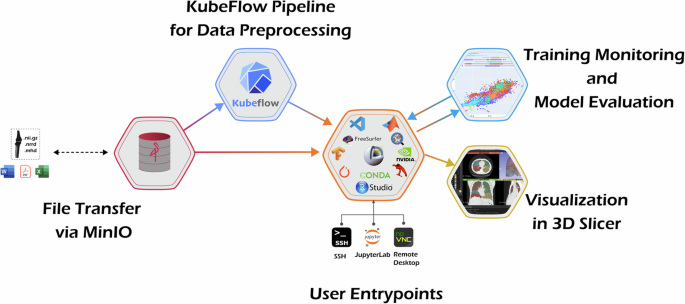
That split is visible in real scientific infrastructure. A typical computational pipeline moves files through object storage, orchestrates preprocessing, monitors training, and hands results to a domain visualization tool, with humans entering through notebooks or remote desktops. The AI workspace does not need to become Kubeflow. It needs to remember why the pipeline exists, which cohort the model was trained on, and how the qualitative team will read a saliency map.
SESYNC’s warning applies directly here. Splitting analyses into disciplinary sub-teams is efficient and common, but it can produce products that cannot be integrated. If the ML group’s “performance” memo never meets the ethnographer’s “construct validity” memo, the paper becomes two papers stapled together. The shared workspace is the integration surface: both memos sit in the same corpus, and both teams can query the tension.
A working pattern:
- Keep raw computation and raw coding in native tools.
- Deposit interpretive artifacts — model cards, codebook revisions, figure captions, limitations paragraphs — into the shared workspace.
- Require every cross-disciplinary claim to be generated against that shared set, not against a private chat.
- Assign one person per workstream to update the corpus after each milestone, the same way labs assign notebook hygiene.
Jenova fits this pattern because different agents can read the same knowledge base: the Academic Research Assistant for related work, a writing agent for the integrated discussion, a Poster Maker when the team needs a conference figure that both sides will stand in front of. Gemini Notebook fits when the interpretive packet is small and stable. Neither replaces the pipeline in the diagram above, and teams should not ask them to.
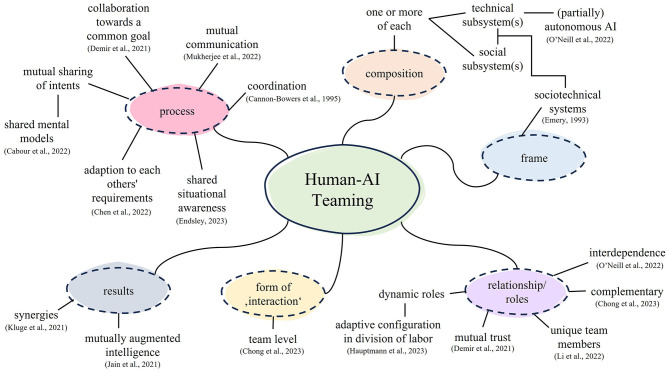
Human-AI teaming research frames the same idea as complementary roles rather than substitution. A 2024 review of AI-teaming treats mixed human-AI groups as a distinct collaboration setting, not a faster version of a human-only lab. Computational and qualitative members already have complementary expertise; teams built that way tend to outperform homogeneous ones. The workspace should preserve that complementarity instead of flattening both sides into the same generic summary.
How Do You Set Up a Shared AI Research Workflow for a Mixed Team?
You set up a shared AI research workflow by first defining the boundary objects, then loading them into one grounded environment, then assigning each discipline a recurring query pattern — not by giving everyone a private chatbot and hoping the findings converge. The sequence below works on Jenova and, with different mechanics, on Gemini Notebook.
Step 1 — Name the shared objects. Before any prompt, write down the five artifacts every discipline must be able to see: the current research question, the inclusion rules, the glossary, the latest methods paragraph, and the open-disagreement log. SESYNC would call these boundary objects. If you cannot name them, the workspace has nothing durable to hold.
Step 2 — Load the corpus once. On Jenova, attach those artifacts plus the core papers to a project-specific custom agent or to the Academic Research Assistant, and state the team’s constraints in the first message:
“You are the shared research notebook for a three-discipline team (environmental science, health services, and science policy). Use only the attached corpus plus retrieved academic sources. Maintain our glossary. When fields disagree, surface the disagreement instead of averaging it away. Our current question is: how do heat-warning systems change emergency-department use in informal settlements?”
On Gemini Notebook, create one shared notebook, upload the same packet, and stay inside the source cap for your plan (50 sources on the standard consumer tier).
Step 3 — Give each discipline a standing prompt, not a standing tool. Computational lead:
“Summarize what the attached model card claims, list the assumptions a qualitative researcher would not see, and flag any result we have previously marked as not ready for the discussion section.”
Qualitative lead:
“Compare our codebook’s definition of ‘access’ with how the attached epidemiology papers use the same word. Quote both sides. Do not reconcile them.”
Step 4 — Re-ground after every milestone. When inclusion criteria change, replace the artifact in the knowledge base or notebook. Memory of a stale rule is worse than no memory.
Step 5 — Export in the genre each audience expects. Use the Word or PDF generators for internal memos and drafts; keep Overleaf or the journal template for the submission manuscript. PapersFlow’s 2026 collaboration comparison is a reminder that citation managers and real-time editors remain part of the stack.
Step 6 — Decide what never goes in. Identifiable interview transcripts, unconsented clinical notes, and grant-restricted data stay in the institution’s approved store. The workspace gets de-identified excerpts and the codebook, not the vault.
Teams that skip steps 1 and 4 usually conclude that “AI cannot handle interdisciplinary work.” More often, they never gave the system a shared object to be interdisciplinary about.
What Do Research Collaboration Experts Say About Human-AI Workspaces?
Research-collaboration practice and human-AI teaming research converge on the same point: the scarce resource is a shared mental model, not another summary of the literature. Workspaces get cited, reused, and trusted when they make that model inspectable.
“The failure mode we see in mixed labs is not that the model is too weak. It is that each discipline runs a private AI session, then meets once a week to argue about summaries that were generated from different corpora. Persistent memory only helps if it is the same memory. The useful test is simple: can a new postdoc, on day two, ask why a hypothesis was dropped and get the team’s reason rather than a generic literature answer?”
“Human-AI teaming research keeps returning to complementary roles, mutual trust, and adaptive division of labor. That is an infrastructure problem as much as a prompting problem. If the computational lead’s pipeline outputs never become sources the policy lead can query, you do not have a team workspace. You have two tools and a standing meeting.”
“We also tell teams to stop asking one system to be Elicit, Overleaf, and the lab’s electronic notebook. Use a review engine for screening, a writer for the manuscript, and a persistent agent environment for the project brain. The interdisciplinary gain shows up in the joins between those layers — especially the disagreement log — not in a single vendor checklist.”
— Jenova Product Team, research-workspace practice, multi-agent academic workflows
That view lines up with older, non-AI collaboration research. Anderson-Cook and colleagues list six fundamentals for effective interdisciplinary work: respect, shared common goals, trust, commitment, intercommunication, and execution. An AI workspace can support the middle four. It cannot supply respect, and it cannot execute the experiment. Teams that outsource those two tend to publish confident prose attached to thin agreement.
When Should a Team Choose a Specialized Literature Tool Instead?
A team should choose a specialized literature tool instead of a full research workspace when the next deliverable is a screening protocol, an extraction table, or an institutionally auditable evidence report — and when the rest of the project already has a place to live. Workspace breadth becomes a liability if it blurs a method that is supposed to be narrow.
Choose Elicit when you are running a systematic or semi-systematic review, need paper-level extraction, and want the AI to stay inside a review workflow. 2026 comparisons continue to give Elicit that lane. Choose Consensus when the job is closer to “what do papers find on this yes/no question?” and the budget is closer to about $144 a year than to a full workspace seat. Choose LeapSpace when the library, compliance office, or funder cares that synthesis ran over a research-grade, publisher-neutral collection with explicit trust indicators.
Choose Gemini Notebook when the corpus is closed and small enough to upload — a grant appendix set, a qualifying-exam list, a shared reading packet — and you want every answer forced back onto those files. Choose Perplexity when someone needs a fast, web-grounded brief and the team is willing to re-verify before the claim enters a manuscript. It is repeatedly grouped with NotebookLM as a $20-class individual research assistant, not as a project memory system.
Choose a full workspace such as Jenova when literature is one of the objects the team must share, alongside protocols, decision logs, drafts, and role-specific follow-up work. The mistake is using a review engine as a lab brain, or using a lab brain as a review engine. They fail in opposite directions: one forgets the project, the other improvises the method.
A clean decision rule: if an auditor would ask “show me the search protocol,” start with Elicit or LeapSpace. If a new collaborator would ask “why are we doing it this way?,” start with a persistent shared workspace.
What Privacy and Institutional Constraints Shape Workspace Choice?
Privacy and institutional constraints often eliminate otherwise capable tools before quality is even scored, especially on projects that mix health data, unpublished results, or community-partner materials. The workspace question is then not “which model is smartest?” but “which vendor can hold this corpus under these rules?”
Google’s current notebook product states that organizational data is not used to train the system, and individual consumer data is not used for training unless the user submits feedback. Jenova’s platform posture is that user data is not used to train public models and is encrypted in transit and at rest. LeapSpace is sold as a secure, ISO-aligned institutional environment with human oversight and researcher control. Those are different promises aimed at different buyers. A hospital-affiliated team and a humanities working group should not treat them as interchangeable.
Inter-institutional projects add another constraint: the workspace must be reachable by people who do not share a Google Workspace tenant, an Elsevier entitlement, or a single lab’s billing account. Knowledge-sharing research on collaborative networks keeps finding that the network’s structure — who can see what — determines whether knowledge actually moves. A brilliant notebook that only one PI can open is a private archive.
Practical constraints to write into the team charter:
- Data class. Public PDFs and preprints are a different problem from identifiable interviews.
- Training use. Get the vendor’s current training policy in writing for the tier you will actually buy.
- Export. If the grant ends, can you leave with the project memory, not just a chat transcript?
- Seat topology. Per-user consumer plans get expensive and uneven; institutional plans can lock out external partners.
- Citation duty. Some journals and funders now expect disclosure of AI assistance. A workspace that cannot show sources makes that disclosure harder.
Anderson-Cook’s “trust” and “commitment” fundamentals apply to vendors as much as to teammates. Trust in interdisciplinary work is built from accountability under interdependence. If the team cannot explain where a paragraph came from, the workspace has become another untrusted collaborator.
For most interdisciplinary groups sharing project context and sources in 2026, the durable choice is a persistent, source-grounded workspace with enough disciplinary range to hold the project’s boundary objects — and a specialist literature tool beside it when the method requires one. Jenova fits the first job when the team’s bottleneck is shared memory across roles. Gemini Notebook, Elicit, and LeapSpace remain the better fit when the bottleneck is a bounded packet, a review protocol, or a licensed scholarly corpus.
References
- National Socio-Environmental Synthesis Center — What Is Interdisciplinary Team Research? Are There Best Practices?
- Sage Journals — Post-Public AI: Research in Groups and Teams
- UPCEA — The Rise of Multidisciplinary Research Stimulated by AI Research Tools
- Taylor & Francis — Facilitating Digital Collaboration Through Knowledge Management Systems
- MDPI — Use of Knowledge Management to Enhance International Collaboration
- Gemini Notebook / NotebookLM — Plans and Source Limits
- Paperguide — Elicit vs NotebookLM: Best AI Tool for Research in 2026
- Elephas — NotebookLM vs Perplexity (2026)
- Googally — NotebookLM Pricing in 2026
- OpenToolHQ — Best AI Research Tools 2026: Elicit, Perplexity & NotebookLM
- Omid Saffari — Best AI Research Tools 2026: Elicit vs Consensus
- Elsevier — LeapSpace Research-Grade AI Workspace
- PapersFlow — Best Research Collaboration Platforms for Academic Teams
- ScienceDirect — Knowledge-Sharing Strategies in Distributed Collaborative Product Development
- ScienceDirect — AI-Teaming: Redefining Collaboration in the Digital Era
- ScienceDirect — Team Principles for Successful Interdisciplinary Research
- USF Digital Commons — Effective Interdisciplinary Collaboration Between Statisticians and Other Researchers
- ResearchGate — Knowledge Sharing Through Research Collaborative Networks