Which AI Research Assistant Is Best for Long-Term PhD Research?
2026-08-21
How Do Persistent Memory and Citation Integrity Separate PhD-Ready AI Assistants?
For doctoral work that spans years rather than weeks, the assistants worth recommending in 2026 are those that retain project context across sessions and keep claims tied to identifiable literature. Jenova's Academic Research Assistant is built around that combination — persistent project memory, literature discovery, and citation-aware manuscript help — while Elicit, Consensus, ResearchRabbit, and Scite each cover a narrower, high-value slice of the research pipeline.
The split that matters for PhD students is not “which chatbot is smartest.” It is whether the tool still knows your theoretical frame, rejected hypotheses, and already-read papers when you return three weeks later.
Key factors that separate a PhD-ready assistant from a disposable Q&A window:
✅ Cross-session project memory that stores the research question, method choices, and advisor constraints, not just the last prompt ✅ Literature coverage grounded in scholarly indexes rather than undifferentiated web results ✅ Source-level citation integrity, so every synthesis can be checked against the underlying paper ✅ Workflow fit for multi-year work: notes, drafts, and searches that accumulate instead of resetting ✅ Honest task boundaries — discovery, extraction, citation validation, and writing are different jobs, and few tools do all of them equally well
To compare these tools usefully, it helps to treat doctoral research as a continuity problem first and a search problem second.
Why Does Cross-Session Memory Matter More for Doctoral Research Than for Coursework?
Cross-session memory matters more for PhD work because a dissertation is a multi-year argument, not a single assignment, and tools that forget the argument force students to re-brief the machine every session. Coursework can survive a reset; a thesis cannot.
The 2025 HEPI Student Generative AI Survey found that 92% of UK undergraduates now use AI in some form, up from 66% in 2024, with common uses including summarizing articles and suggesting research ideas. Doctoral researchers inherit that same toolset, but their unit of work is different: a literature map that evolves, a methods chapter rewritten after a failed pilot, a theoretical frame negotiated with a supervisor over months.
A large-scale survey of researchers reported that 25.9% use AI tools for research at least once a day, which makes memory failure a daily tax rather than an occasional inconvenience. Each reset discards the working model of the project — which papers were already excluded, which operationalization was abandoned, which journal’s reviewer comments still constrain the rewrite.
Context windows are not memory. They hold the current thread and then vanish. Persistent memory stores the project itself: the question, the corpus, the decisions, and the open problems. For a three-to-six-year doctorate, that difference is the gap between an assistant that compounds and one that only interpolates.
What Should PhD Students Evaluate in an AI Research Assistant?
PhD students should evaluate an AI research assistant on six dimensions that we call the Continuity–Coverage–Citation (C3+) framework: persistent memory, literature coverage, structured extraction, citation integrity, manuscript support, and cost across a doctoral timeline. Tools that score well on search alone still fail if they cannot remember the project.
The six dimensions, weighted for long-term research rather than one-off queries:
- Cross-session project memory. Does the assistant retain your research question, inclusion criteria, rejected papers, and writing voice across weeks and months?
- Literature coverage. Can it search scholarly indexes at scale? Elicit reports search across more than 138 million academic papers; ResearchRabbit reports access to over 310 million papers.
- Structured extraction and synthesis. Can it pull methods, samples, and outcomes into comparable tables, or only produce prose summaries?
- Citation integrity. Are claims tied to sentence-level sources, citation context, or a “consensus” readout — and can you open the underlying paper?
- Manuscript support. Does the tool help you outline, cite, and revise, or does writing happen somewhere else?
- Cost over a PhD timeline. A $10 monthly tool and a $49 systematic-review workbench look different when multiplied across four years of candidature.
Two extra filters belong in every doctoral evaluation. First, only 36% of students in the HEPI sample had received institutional AI training, so the tool must be usable without a specialist onboarding program. Second, 51% of students cited hallucinations as a reason to avoid AI — which is why citation integrity is a core criterion, not a nice-to-have.
A practical rule: if you would not trust the output in a methods section without opening the source, the tool is a discovery aid, not a co-author of the review.
How Do Jenova, Elicit, Consensus, ResearchRabbit, and Scite Compare for Long-Term Projects?
Jenova’s Academic Research Assistant is the strongest fit when the bottleneck is project continuity across years, while Elicit is stronger for structured extraction, Consensus for quick evidence snapshots, ResearchRabbit for citation-map discovery, and Scite for checking how a paper has been cited. None of them replaces a reference manager or a human protocol.
| Feature / Dimension | Academic Research Assistant (Jenova) | Elicit | Consensus | ResearchRabbit | Scite |
|---|---|---|---|---|---|
| Cross-session project memory | Persistent memory and unlimited chat history across sessions | Library and alerts help reuse sources; not a full project-memory agent | Search and review history inside the product; limited long-horizon project memory | Collections and recommendation learning as you add papers | Citation database and alerts; not a dissertation-memory agent |
| Literature coverage | Real-time discovery across academic databases and the open web | 138M+ papers and 545,000 clinical trials | Peer-reviewed evidence search with study-design cues | 310M+ papers with citation mapping | Large citation index with Smart Citations |
| Structured extraction | Synthesis and manuscript-oriented summaries; not a PRISMA workbench | Tables, screening, and systematic-review workflows | Consensus meter and study snapshots | Visual maps, not extraction tables | Citation context (support / contrast), not outcome tables |
| Citation integrity | Inline citations and source-grounded drafting | Sentence-level citations on generated claims | Evidence answers from papers, not web chatter | Bibliographic chaining via citations and co-authors | Smart Citations showing how papers are cited |
| Pricing (as of 2026) | Free tier; paid plans from $20/month | Free Basic; Pro commonly listed at $49/user/month billed annually | Free tier plus paid upgrades for Deep Search and higher limits | Freely available for core mapping | Paid research platform; confirm current pricing |
| Best for | Multi-year PhD projects that need memory, search, and writing in one thread | Systematic or scoping reviews with extraction tables | Fast “what does the literature say?” questions | Mapping a field from seed papers | Validating whether citations support or contradict a claim |
Elicit’s own materials state that researchers report up to 80% time savings on systematic reviews and that it can screen thousands of papers on paid plans. That is a genuine strength for protocol-driven reviews. It is also a different job from remembering, six months later, why you abandoned a construct.
ResearchRabbit is particularly effective at turning one seed paper into a map of related work, authors, and gaps, and Northeastern University libraries describe it as a freely available citation-based literature mapping tool. Scite’s distinctive contribution is citation context — seeing whether later papers support or dispute a finding — which Purdue Libraries document as a citation database with Smart Citations.
Jenova’s limitation is the inverse of those strengths. It is not a dedicated PRISMA screening environment, it does not classify citation sentiment the way Scite does, and it does not expose Elicit-style extraction tables with dozens of custom columns. Students running a Cochrane-style review will still want a purpose-built review workbench alongside it.
How Does Persistent Project Memory Change a Multi-Year Dissertation Workflow?
Persistent project memory changes a dissertation workflow by turning every session into a continuation rather than a re-onboarding, so literature search, note-taking, and drafting share one accumulating model of the project. The practical effect is less repeated briefing and fewer contradictory summaries.
A typical doctorate moves through phases that a forgetful assistant treats as unrelated chats: scoping, systematic or narrative review, methods design, data collection, analysis, and manuscript revision. With memory, the assistant can recall that you already excluded cross-sectional studies, that your advisor rejected a capability-approach framing, and that three papers in your Zotero library are methodologically weak.
Jenova’s Academic Research Assistant stores that kind of working context across sessions and can carry it while you switch models or attach papers as a private knowledge base. Testing this pattern on long projects shows the gain is not eloquence. It is consistency: the same inclusion criteria, the same operational definitions, the same “do not cite this preprint as settled.”
The counterpart tools still matter. Elicit’s library and alert features help you reuse sources and watch a field. ResearchRabbit’s collections get smarter as you add papers. Those are corpus memories. They are not the same as remembering your project decisions.
A useful division of labor for 2026:
- Keep the living project model (question, exclusions, advisor constraints, draft history) in an assistant with cross-session memory.
- Run field-mapping in ResearchRabbit or Litmaps, which specialize in citation networks.
- Run structured extraction in Elicit when you need comparable rows, not paragraphs.
- Validate controversial citations in Scite before they enter a literature chapter.
Students who invert that order — asking a mapping tool to remember their thesis, or a memory-capable assistant to replace dual screening — usually end up with fluent but un-auditable reviews.
Which AI Tools Handle Systematic Reviews Versus Exploratory Literature Mapping?
Systematic reviews need documented screening and extraction; exploratory mapping needs citation networks and semantic search — and the best tool depends on which review type you are actually writing. Mixing those product families wastes setup time.
CASRAI’s guide to AI tools for systematic literature reviews draws the line clearly. Formal PRISMA-style reviews assume deduplicated imports, dual independent screening, structured extraction, and risk-of-bias appraisal. Tools clustered around that pipeline include Rayyan, Covidence, ASReview, and DistillerSR. Elicit sits partway between discovery and this category: it searches a broad paper index and offers screening and extraction features aligned with systematic-review practice.
Exploratory and narrative reviews — the more common PhD literature chapter outside health sciences — are better served by discovery and mapping tools. Semantic Scholar uses AI to improve scholarly search. Litmaps and ResearchRabbit visualize how studies connect. Consensus is stronger when you have a relatively closed empirical question and want a snapshot of peer-reviewed agreement rather than a full map.
A joint position associated with Cochrane, the Campbell Collaboration, JBI, and related evidence-synthesis groups, discussed in the RAISE project on responsible AI in evidence synthesis, treats AI as support for reviewer judgment, not a replacement for it. Eligibility decisions, extraction, and risk-of-bias calls that affect the review still require human verification and disclosure of the system used.
For PhD students, the decision rule is simple:
- Registered systematic or scoping review → Elicit, Covidence, or Rayyan for the audit trail; do not rely on chat memory as your screening log.
- Narrative field-shaping review → ResearchRabbit or Litmaps for the map, plus a memory-capable assistant to keep the argument coherent as the map grows.
- Quick empirical check (“Does the evidence support X?”) → Consensus, then open the underlying studies.
Jenova’s Academic Research Assistant is not a substitute for Covidence. It is stronger as the layer that remembers why the review looks the way it does while those specialist tools do stage-specific work.
How Do You Set Up an AI Research Assistant for a Multi-Year PhD Project?
You get the most out of an AI research assistant by encoding the project — question, constraints, corpus, and non-goals — in the first session, then reusing that thread instead of starting fresh. Setup is a protocol, not a prompt trick.
For Jenova’s Academic Research Assistant, a durable setup looks like this:
- Open the agent and state the project as a living protocol, not a one-line topic:
"I am a third-year PhD student in sociology. Dissertation working title: platform labor and algorithmic management in Southeast Asian gig work. Theoretical frame: labor process theory, not capability approach (advisor rejected that in March). Methods: multi-sited ethnography plus platform-interface analysis. Do not treat blog posts or unreviewed preprints as equivalent to peer-reviewed sources."
- Attach your current outline, a representative PDF set, and any supervisor notes you are allowed to store.
- Ask for a source-backed map of the last 24 months of literature, with exclusions listed explicitly.
- Return to the same project thread after each supervision meeting and update the protocol (“drop construct X; add paper Y as a negative case”).
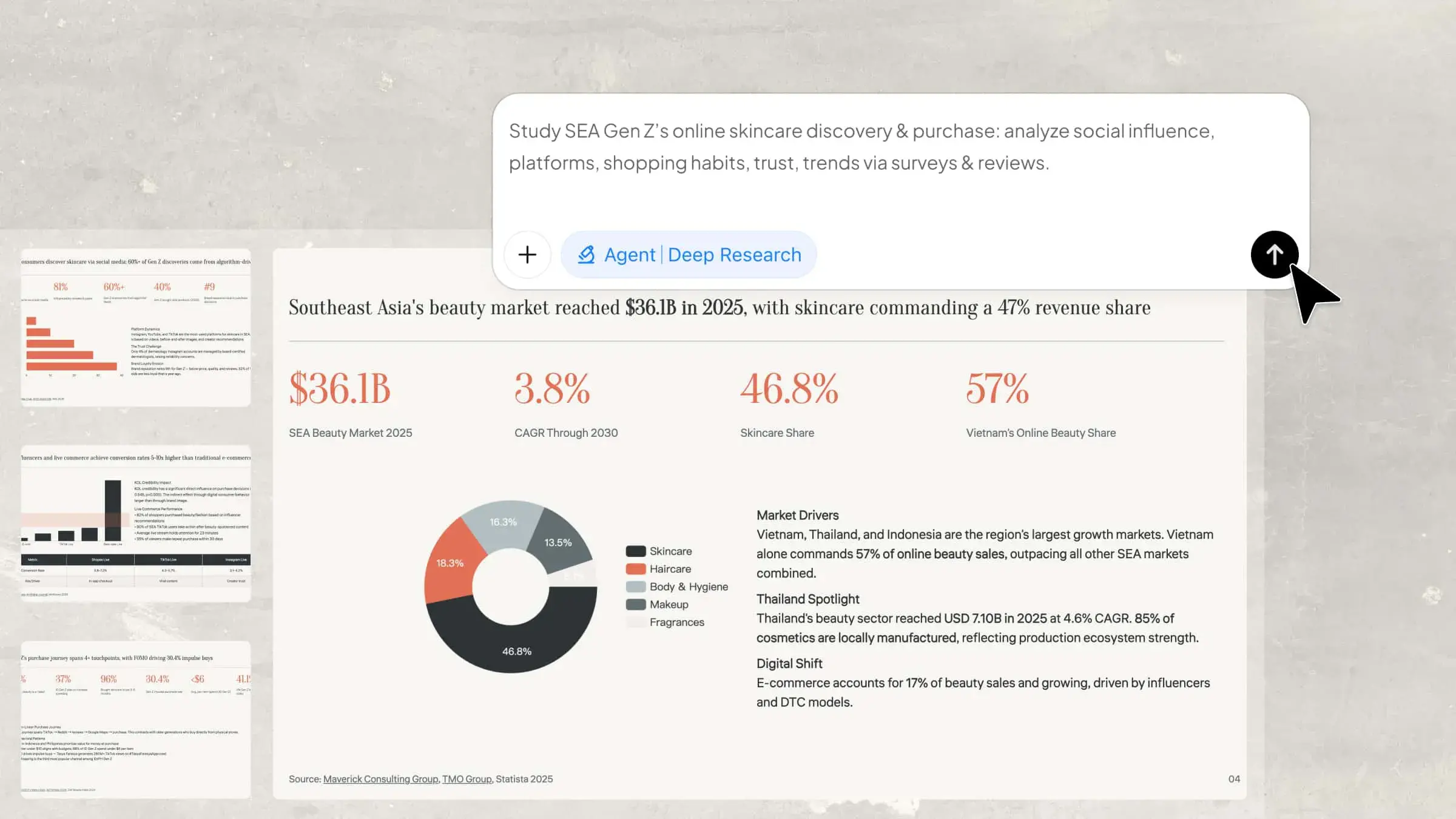
A sibling agent, Deep Research, is useful when you need a long, cited briefing rather than a dialogue — for example a country-by-country evidence scan or a structured market-and-policy memo that you will then interrogate in the Academic Research Assistant. The report pattern is the same one doctoral students need: a headline finding, sourced metrics, and segmented analysis rather than an unsourced paragraph.
For Elicit, the parallel setup is question-first rather than memory-first. Enter a well-specified research question, inspect the paper list, and only then add extraction columns (population, n, design, outcome). Elicit’s Pro tier is positioned for systematic reviews, including screening at larger scale than the free plan. Import from Zotero if that is already your corpus of record.
For ResearchRabbit, start from two or three seed papers you already trust, build a collection, and treat the graph as a discovery surface — not as a finished bibliography. Export anything you keep into Zotero, Mendeley, or another manager you control.
Two rules prevent the setup from decaying:
- The reference manager remains the system of record for citations. The AI assistant is the system of record for decisions.
- When the research question changes, update the protocol in writing inside the thread. Silent drift is how memory-capable tools start defending last semester’s thesis.
Manuscript formatting can move to a dedicated formatter such as Jenova’s Word Doc Generator once the argument is stable. Do not ask the research assistant to be your citation style file.
What Do Research Methodologists Say About AI Memory in Doctoral Work?
Research methodologists increasingly treat AI use as a research-integrity problem — disclosure, verification, and provenance — not merely an academic-integrity (plagiarism) problem, and they are skeptical of any workflow where the model’s memory replaces a documented protocol. Memory is useful; memory is not an audit trail.
"The failure mode we see in doctoral AI use is not a single hallucinated citation. It is context collapse across months. A student spends six weeks refining a theoretical frame, then opens a new chat and receives a fluent literature summary that ignores that frame entirely. Persistent memory is what makes an assistant compound rather than reset. Without it, every session reintroduces generic 'key papers in the field' that the student had already considered and discarded."
"The tools that dominate comparison roundups — Elicit for extraction, Consensus for evidence snapshots, ResearchRabbit for maps, Scite for citation context — are genuinely strong at those slices. What a PhD still lacks, in most stacks, is a working memory of the project: rejected hypotheses, supervisor constraints, the three studies already known to be methodologically weak. That is not a search problem. It is a continuity problem. Solve search and continuity separately, then connect them."
"We still tell students to keep a human-owned protocol. AI memory is a working notebook, not the PRISMA log. If eligibility or extraction judgments are model-assisted, they need disclosure and verification, in line with the direction set by evidence-synthesis guidance. Use memory to stop repeating yourself. Do not use it as the only record of how the review was done."
— Jenova Product Team, research-agent design, 8 years building AI assistants for long-horizon knowledge work
That stance is consistent with the European Commission’s guidelines on the responsible use of generative AI in research, which emphasize reliability and preventing misuse rather than treating chat output as a citable authority. It is also consistent with student-side caution: HEPI respondents named fear of being accused of cheating (53%) and false results (51%) as the main deterrents to AI use.
How Should PhD Students Use AI Without Compromising Research Integrity?
PhD students should use AI as a documented research aid — search, structure, remember, draft — while keeping verification, eligibility judgments, and final wording under human control. Integrity here is about provenance, not about abstaining from tools that 67% of surveyed students already consider essential.
A workable integrity protocol for 2026:
- Disclose the system. Name the assistant, version or date, and the task it performed (search, screening support, language editing). Routine spelling fixes generally do not need the same disclosure as eligibility suggestions.
- Verify every citation. Open the paper. Confirm the claim is in the text. Scite is useful when the question is how later work cited a finding; it does not replace reading.
- Keep screening decisions in review software when the output is a systematic review. CASRAI notes that dual independent screening remains the expectation in PRISMA- and Cochrane-aligned work.
- Do not upload identifiable participant data or confidential drafts to tools whose data-use terms you have not read. Prefer platforms that state they do not train public models on your content.
- Separate generation from judgment. Let the assistant propose themes, tables, or outlines. You decide what enters the thesis.
Wiley’s ongoing ExplanAItions study of thousands of researchers worldwide is one signal that scholarly publishers now treat AI literacy as part of research practice, not as an optional extra. Institutional policy is catching up unevenly: in the HEPI sample, only 29% of students agreed their institution encourages AI use, while many reported mixed messages from staff.
For long-term projects, the integrity risk specific to memory is silent contamination: an assistant that remembers an unsourced claim and re-asserts it months later as if it were established. The countermeasure is periodic source audits of the project thread — a short session whose only job is “show me every empirical claim you have been repeating, with the primary paper.”
Used that way, a memory-capable academic assistant is closer to a well-kept research notebook than to a ghostwriter. The notebook still has to be checked.
References
- HEPI / Kortext — Student Generative AI Survey 2025
- ERIC — Student Generative AI Survey 2025, HEPI Policy Note 61
- ScienceDirect — Who uses AI in research, and for what? Large-scale survey
- Elicit — AI for scientific research (coverage, reports, systematic review claims)
- Elicit — Pricing
- Consensus — Pricing and product plans
- ResearchRabbit — Literature mapping and paper discovery
- Northeastern University Libraries — Research Rabbit as a freely available mapping tool
- Scite — Smart Citations platform
- Purdue University Libraries — scite research guide
- Semantic Scholar — AI-powered scholarly search
- Litmaps — Literature review and citation-network tools
- CASRAI — AI Tools for Systematic Literature Reviews
- RAISE — Responsible use of AI in evidence synthesis
- European Commission — Guidelines on the responsible use of generative AI in research
- Wiley — ExplanAItions: an artificial intelligence study of researchers
- University of Florida Business Library — Elicit access and pricing FAQ