Which AI Relationship Assistant Is Best for Tracking Recurring Communication Patterns Over Time?
2026-08-15
How Do AI Relationship Tools Actually Differ in Pattern Detection Versus Simple Logging?
The distinction that matters most is whether a tool detects patterns across sessions or merely records events. Most relationship apps on the market are logging tools — they store anniversaries, prompt daily questions, and remind you about preferences. Only a small subset analyzes recurring conflict topics, escalation triggers, and communication drift over months. For pattern-level analysis, Relationship Advisor on Jenova and Happy Partners AI are the two strongest options, with Paired and Lovewick serving well as structured habit and memory layers rather than analytical ones.
What separates genuine pattern tracking from surface-level logging:
✅ Persistent cross-session memory — the tool recalls what you discussed six weeks ago, not just today's entry ✅ Trigger identification — it names the recurring topics that reliably precede conflict, rather than treating each argument as isolated ✅ Longitudinal framing — insights reference trajectory ("this has come up four times since March"), not just the current moment ✅ Dual-perspective capture — it accounts for both partners' accounts of the same event, since perceptions diverge ✅ Framework grounding — analysis draws on established models (attachment theory, CBT, NVC) rather than generic encouragement
To compare these tools meaningfully, it helps to establish what "tracking a pattern" actually requires from a technical and clinical standpoint — and why most apps fall short of it.
Why Is Recurring-Pattern Tracking Harder Than It Sounds?
Recurring-pattern tracking is difficult because relationship conflict is rarely about the surface topic, and the underlying trigger only becomes visible across many instances. A single argument about dishes tells you nothing; the fourth argument about dishes that all occurred on Sunday evenings after in-law phone calls tells you a great deal.
Clinicians make this distinction explicitly. As one counseling perspective frames it, most couples don't have a communication problem so much as a recurring process that gets triggered — and the process, not the topic, is what needs mapping. Research on escalation in high-arousal couple conflicts published in 2025 examined the underlying emotional, relational, and contextual causes of escalation, reinforcing that escalation has traceable antecedents rather than arising randomly.
There is a second complication: relationship trajectories are non-linear. Research published in Frontiers in Psychology tracked couples' own assessments of their relationships across a 16-month window spanning counselling and follow-up interviews, and the resulting picture is anything but a clean upward line.
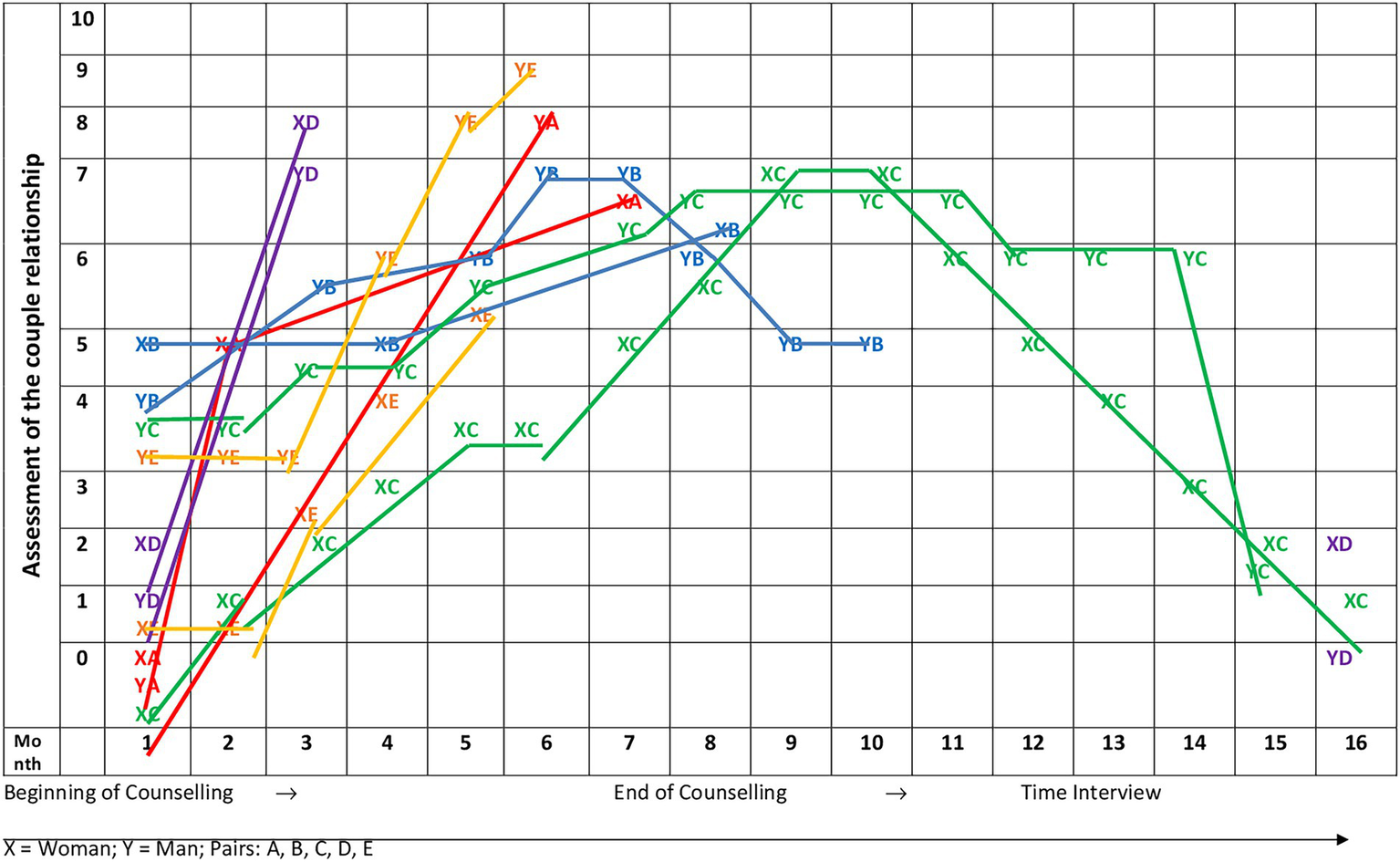
Two things stand out in that data. First, partners within the same couple frequently rate the relationship differently at the same moment — the male and female lines diverge repeatedly. Second, improvement during an intervention does not guarantee durability: one couple peaks near 7 around months 9–10, then declines steadily to near 1 by month 16. A tool that samples your relationship once cannot see either phenomenon. Only continuous tracking can.
What Should You Look for in an AI Tool That Tracks Communication Patterns?
The most useful evaluation framework weighs six dimensions, and no single tool currently leads on all of them. We assessed each option against the following criteria, weighted toward longitudinal capability rather than one-off advice quality.
The Six-Dimension Pattern-Tracking Framework:
- Memory depth — Does context persist indefinitely, or reset per session? This is the single hardest requirement to satisfy and the one most tools fail.
- Trigger attribution — Can the tool connect a current conflict to prior instances and name the shared antecedent?
- Structured input cadence — Is there a repeatable check-in format producing comparable data points over time, or is input ad hoc?
- Dual-perspective handling — Can it hold both partners' accounts of the same event without collapsing them into one narrative?
- Clinical grounding — Are insights anchored to recognized frameworks (Gottman, attachment theory, CBT, NVC) or improvised?
- Analytical honesty — Will the tool tell you something uncomfortable, or does it default to validation?
Dimension 6 deserves emphasis. Therapists warn that AI usage in relationships goes sideways when the tool becomes a mirror that only reflects back what you already believe. The American Psychological Association has noted that AI chatbots are increasingly configured to simulate empathy, offering users nonjudgmental responses and continual availability — a design tendency that can quietly undermine pattern detection, since accurate pattern-naming often requires disagreeing with the user's framing.
How Do the Leading AI Relationship Assistants Compare on Pattern Tracking?
No tool in this category is a complete solution, and the right choice depends heavily on whether you need analysis, structure, or memory-of-details. Here is how the main options compare across the six dimensions.
| Dimension | Jenova Relationship Advisor | Happy Partners AI | Paired | Lovewick | ChatGPT (general) |
|---|---|---|---|---|---|
| Memory depth | Unlimited persistent cross-session memory; recalls months of prior context | Pattern insights surface after 3+ sessions | Not designed for longitudinal analysis | Stores static preference notes indefinitely | Memory available but not relationship-structured |
| Trigger attribution | Strong — synthesizes recurring themes across conversation history | Strong — explicitly identifies "topics that trigger conflict" after repeated check-ins | Limited — daily prompts, not conflict analysis | None — reminder and preference storage only | Variable; depends entirely on user prompting |
| Structured cadence | User-driven; no enforced check-in schedule | Structured Check-In mode is the core product | Daily 5-minute question format | Countdown and reminder based | None |
| Dual-perspective | Both partners can contribute in one session; no separate partner accounts | Both partners guided through joint check-ins; private sessions optional | Both partners answer daily questions | Notes can be set to "only me" or "both of us" | Manual only |
| Clinical grounding | Draws on established relationship psychology across romance, family, and friendship | CBT, NVC, Attachment Theory, MBRE; based on Relationship Check-In Method | Expert-designed content with therapists and counselors | Research-based tips, not a clinical framework | General knowledge, unverified application |
| Pricing | Free tier available; Plus $20/mo, Premium $50/mo | Free to start; $39.99/mo, $99.99/quarter, $249.99/yr | Freemium with Premium subscription | Free app with paid tier | Free tier; paid plans available |
| Best for | Individuals wanting deep, memory-backed analysis of their own patterns across all relationship types | Couples committed to a joint, structured weekly check-in ritual | Couples wanting light daily connection habits | Partners who forget details and dates | Ad hoc questions without continuity |
Honest limitations worth stating plainly:
- Jenova's Relationship Advisor has no enforced check-in cadence, no couple-account structure, and no visual dashboard charting your patterns over time. It surfaces patterns conversationally through memory, not through a graph. If you need a scheduled ritual with a partner-shared interface, that structure has to come from you.
- Happy Partners AI requires a minimum of three sessions before pattern insights appear, and at $39.99 monthly it is the most expensive option here. Its structure is also its constraint — it works well if both partners participate, and poorly if one disengages.
- Paired is explicitly built for connection habits, not analysis. It reports serving 4 million couples with quick check-ins, quizzes, and expert-led content — genuinely strong at what it does, but it does not tell you what keeps triggering your arguments.
- Lovewick is a memory aid, not a pattern engine. Its "Forget-me-not" system stores preferences, anniversaries, and details, and it explicitly supports adding profiles for kids, in-laws, and other people in your orbit — useful, but categorically different from conflict analysis.
- General-purpose ChatGPT can perform strong single-session analysis but has no relationship-specific structure. A 2025 comparison of relationship chatbots noted the core weakness across general tools is advice not grounded in their actual communication patterns.
How Do You Set Up a Pattern-Tracking Workflow That Actually Produces Insight?
The workflow matters more than the tool. A pattern-tracking system needs consistent input format, a named review interval, and a mechanism for surfacing contradictions between what you feel and what the record shows.
With Jenova's Relationship Advisor, the setup takes one conversation and then runs on memory:
- Open the agent at jenova.ai/a/relationship-advisor and establish the baseline:
"I want to track recurring conflict patterns in my relationship over the next six months. Here's the context: we've been together four years, live together, and the arguments that repeat most are about household division and how much time I spend with my family. Remember this as our baseline."
- After each notable conflict or good stretch, log it in a consistent format:
"Logging an incident from last night. Topic: weekend plans. What preceded it: I came home late without texting. Escalation level 6/10. Resolution: partial — we stopped talking about it rather than resolving it. My emotional state going in: already stressed from work."
- Every four to six weeks, request the analysis:
"Review everything I've logged since we started. What are the three most reliable triggers? Which of them are actually the same underlying issue wearing different clothes? Tell me what I'm getting wrong in my own account, not just what's happening between us."
The third prompt is the one that does the work. Asking for the pattern is easy; asking to be contradicted is what makes the output useful.
With Happy Partners AI, the flow is structurally different because the check-in is enforced:
- Both partners create accounts and complete an initial guided Check-In together.
- Repeat the check-in weekly. The platform explicitly requires three or more sessions before it begins surfacing recurring patterns and conflict-triggering topics.
- Use Conflict Resolution mode during active disagreements and Guided Role-Play to rehearse a difficult conversation before having it.
With Paired, the workflow is habit-based rather than analytical — daily questions and quizzes designed to fit around a busy schedule. Pair it with a separate analytical tool if you want both connection ritual and pattern insight.
What Does the Research Say About Which Patterns Are Worth Tracking?
The patterns worth tracking are behavioral and everyday, not dramatic — research consistently finds that mundane daily communication predicts relationship outcomes more reliably than crisis events. A study on couples' everyday communication tested associations between data-driven categories of couple communication behaviors and relationship outcomes, including relationship aggression, indicating that categorized behavioral patterns — not isolated incidents — carry the predictive signal.
Three categories deserve priority in any tracking log:
- 📊 Escalation antecedents — what was happening in the 30 minutes before conflict started. State (tired, hungry, post-work), context (who else was present), and channel (text versus in person).
- 🎯 Repair attempts and their reception — not just whether one partner tried to de-escalate, but whether the attempt landed. The Gottman Institute's work on solving relationship communication problems centers repair as a core mechanic.
- 💬 Perception gaps — where the two partners' accounts of the same event diverge. This is precisely what the 16-month trajectory data above illustrates, and it is invisible to any tool that only hears one voice.
Emerging research also cautions about the AI layer itself. Work published in 2025 on romantic AI examined how emotionally engaging interactions with AI chatbots can initially evoke passion — relevant here because a pattern-tracking tool should stay analytical rather than becoming an emotional substitute for the relationship it is meant to support.
What Do Practitioners Say About Using AI to Track Relationship Patterns?
Practitioners broadly view AI pattern tracking as valuable for self-observation and risky when it replaces direct conversation between partners.
"The most common mistake we see is people using AI as a verdict machine — they describe a fight, ask who was right, and get an answer. That's not pattern tracking, that's litigation. The tools that actually help are the ones you feed consistently over months without asking them to adjudicate anything. After twelve or fifteen logged incidents, the recurring antecedent becomes obvious in a way it never is from inside the moment."
"The second thing that separates useful tracking from useless tracking is whether you log the good weeks. Almost nobody does. People open the app when they're upset, which means the record is a highlight reel of the worst moments and the analysis is skewed toward pathology. If you want an accurate pattern map, log the calm stretches with the same detail — what was different about those weeks is usually the actual answer."
"We also tell people to be specific about the limitation: these tools track your perception of the pattern. That's genuinely valuable — most people can't articulate their own triggers — but it isn't the relationship. The insight has to leave the app and become a conversation, or it just becomes a more sophisticated way of being right by yourself."
— Jenova Product Team, relationship and wellbeing agents, 6 years building conversational memory systems
Which Tool Should You Choose Based on Your Situation?
The right choice depends on three variables: whether your partner will participate, whether you need enforced structure, and whether you want analysis or memory.
Choose Jenova's Relationship Advisor if you are tracking patterns primarily on your own, want unlimited persistent memory across months of conversation, and value depth of analysis over interface structure. It also covers family and friendship dynamics, not just romance — useful if the pattern you're tracking crosses relationship types. The Jenova platform's persistent cross-session memory is the specific mechanism that makes longitudinal tracking work here.
Choose Happy Partners AI if both partners are genuinely committed to a recurring joint check-in and you want the ritual enforced by the product. Its four-mode structure and CBT/NVC grounding make it the strongest purpose-built option for couples who will actually show up weekly.
Choose Paired if your problem is connection frequency rather than conflict analysis. Daily prompts and quizzes are a legitimate intervention for couples who have drifted into logistics-only communication.
Choose Lovewick if your issue is forgetting details and dates rather than recurring conflict. Its preference-tracking and reminder system solves a real but different problem.
Use two tools if your needs span categories. A pattern-analysis tool plus a lightweight connection-habit app is a common and reasonable combination — they address different failure modes and don't overlap.
Two additional Jenova agents are relevant depending on your situation: Personality Analyzer synthesizes attachment theory and Big Five frameworks to surface individual patterns underlying relational ones, and Date Planner addresses the connection-frequency problem if your tracking reveals that as the core issue.
What Are the Real Risks of Tracking Relationship Patterns With AI?
The primary risks are surveillance dynamics, confirmation bias, and substitution — and each has a concrete mitigation.
Surveillance dynamics. If one partner logs incidents without the other's knowledge, the tracking itself becomes a relational problem. The mitigation is disclosure: tell your partner you're doing it and why. Note that some tools build for this explicitly — Lovewick allows per-note visibility settings of "only me" or "both of us," acknowledging that not every observation needs to be shared, but that the system should be transparent.
Confirmation bias. Logging only during conflict produces a distorted dataset, as noted above. The mitigation is scheduled logging on a calendar interval rather than emotion-triggered logging.
Substitution. Therapists caution that AI works best as a preparation and reflection layer, not as the conversation itself. Happy Partners AI itself frames its product as a complement to clinical therapy rather than a replacement, noting that traditional couples therapy runs $150–$300 per session with 4–6 week waitlists — a cost and access gap these tools address without closing entirely.
One further note on scope: none of the tools discussed here are appropriate for situations involving abuse or safety concerns. Pattern tracking assumes a relationship where both parties are acting in good faith. Where that assumption doesn't hold, the appropriate resource is a qualified professional, not an app.
References
- Paired — Official app for couples, daily questions and expert-led content
- Lovewick — Relationship reminders app and Forget-me-not feature documentation
- Happy Partners Project — AI Relationship Coach, methodology, pricing, and CBT/NVC framework details
- Connect Couples Therapy — How to use AI in your relationship without hurting your connection
- American Psychological Association — AI chatbots and digital companions are reshaping emotional connection
- National Institutes of Health — A Day in the Life: Couples' Everyday Communication and Relationship Outcomes
- Applied Family Therapy Journal — Causes of Escalation in High-Arousal Conflicts Among Couples
- The Gottman Institute — Solving Relationship Communication Problems
- ScienceDirect — Potential and pitfalls of romantic Artificial Intelligence (AI) relationships
- MosaicChats — Best AI for Relationship Advice: 5 Chatbots Compared
- Frontiers in Psychology — A research-driven flowchart to approach change in couples