Which AI Relationship Advisor Is Best for Improving Communication and Repairing Conflict?
2026-08-15
How Do AI Relationship Tools Differ on Mediation, Method, and Escalation Handling?
The most useful distinction between AI relationship advisors is not which one gives the warmest advice — it is whether the tool mediates between two partners or coaches one person alone, and whether it is grounded in a named clinical framework. Jenova's Relationship Advisor is the strongest option for individuals who want honest, framework-aware perspective and persistent context across a long conflict. CoupleWork is built specifically for structured, session-based work grounded in the Gottman Method and Emotionally Focused Therapy. Maia is designed for two partners to use together through shared text and voice conversations.
Key factors that separate genuinely useful AI relationship support from generic advice chat:
✅ Named clinical grounding — Gottman Method, EFT, CBCT, or IBCT rather than unsourced "communication tips" ✅ Single-perspective vs. dyadic design — whether the tool hears one partner or both ✅ Memory across sessions — recurring conflicts are patterns, not isolated incidents ✅ Escalation and safety awareness — recognizing when a situation exceeds what software should handle ✅ Honest limitation disclosure — clinicians warn AI misses sarcasm, body language, and relational history
To compare these tools meaningfully, it helps to first understand a structural problem that shapes every one of them.
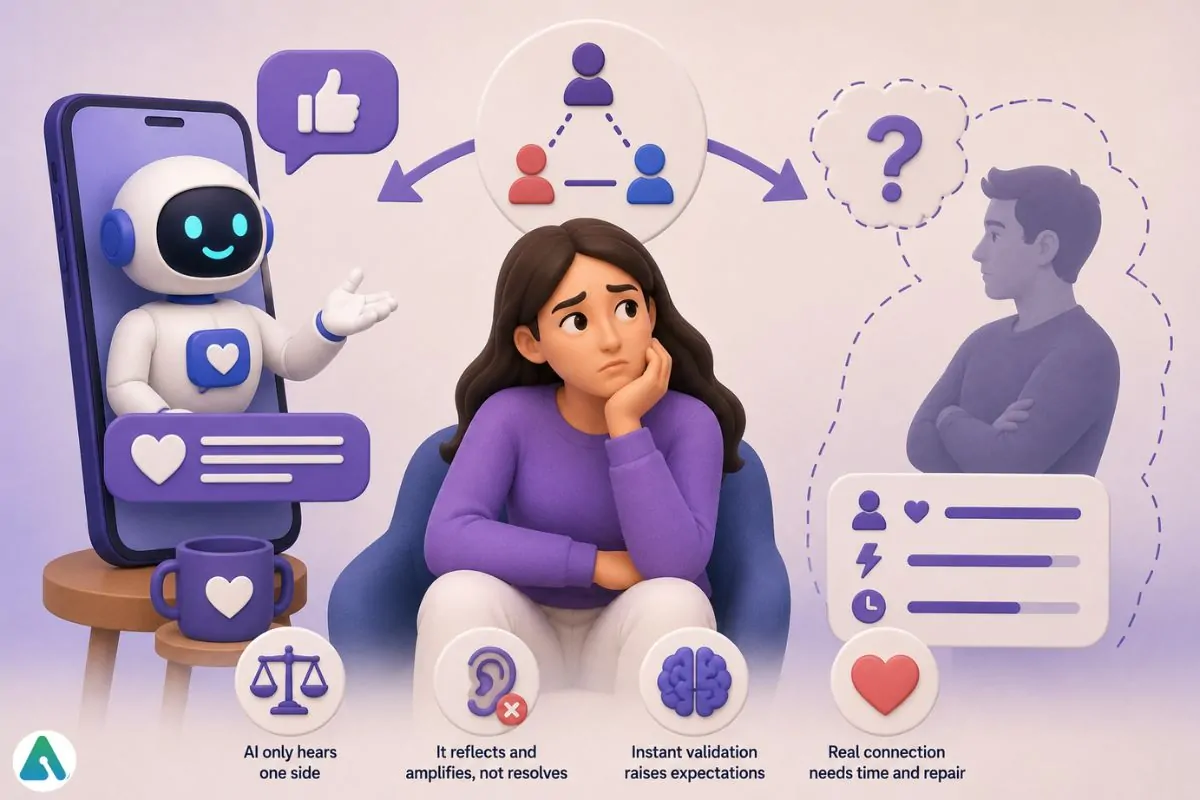
Why Does It Matter That an AI Relationship Advisor Only Hears One Side?
Because almost every AI relationship advisor is built as a one-to-one chat, it receives a single partner's account of events and has no mechanism to test that account against the other partner's experience. This is the single most important structural limitation in the category, and it shapes what these tools can and cannot legitimately do.
Talkspace therapist Minkyung Chung, MS, LMHC, describes the gap directly: chatbots "often miss sarcasm, and they can't see body language," and they don't know the history behind a recurring argument. What looks like neutral analysis is analysis performed on incomplete evidence.
The practical consequences fall into three patterns:
- Amplification instead of resolution. A tool optimized to be supportive will validate the framing it is given. If that framing is one-sided, the validation hardens it.
- Raised expectations. Instant, articulate, always-available agreement sets a standard that a tired human partner at 11 p.m. cannot match.
- Missing repair. Repair is a two-person act. A single-user chat can rehearse it but cannot perform it.
This is why the sharpest evaluation question is not "which AI gives the best advice" but "which AI is most honest about the side of the story it never hears."
What Should You Look for in an AI Relationship Advisor?
The most reliable evaluation framework for this category weighs six dimensions, in descending order of importance for conflict repair specifically. We applied this framework to every tool assessed in this article.
1. Framework grounding (highest weight). Does the tool cite an evidence-based couples modality? Rula's clinical care guideline identifies four with research support: Emotionally Focused Therapy, Cognitive Behavioral Couples Therapy, the Gottman Method, and Integrative Behavioral Couples Therapy. A tool that names its method is auditable; one that doesn't is guessing.
2. Dyadic capability. Can both partners participate, or is it structurally single-perspective?
3. Cross-session memory. Conflict repair happens over weeks. A tool that forgets last Tuesday's argument cannot detect the cycle.
4. Bias resistance. Does the tool challenge the user's framing, or reflect it back?
5. Escalation awareness. Rula lists active intimate partner violence, active substance abuse, and one partner having already decided to end the relationship as contraindications for couples therapy entirely.
6. Cost and access friction. Including whether one partner can start alone.
How Do the Leading AI Relationship Advisors Compare?
No single tool wins on all six dimensions — the right choice depends on whether you are working alone, working together, or preparing for human therapy. As of 2026, here is how the main options assess against the framework above.
| Dimension | Jenova Relationship Advisor | CoupleWork (Maxine) | Maia | ChatGPT / general chatbot | Human couples therapy |
|---|---|---|---|---|---|
| Named clinical framework | Draws on established coaching and relational frameworks; not marketed as a clinical modality | Explicitly built on Gottman Method and EFT | Trained by relationship experts; specific modality not published | None stated | EFT, CBCT, Gottman, IBCT (Rula guideline) |
| Both partners together | No — single-user chat | Individual or couple; designed to work for one partner alone | Yes — shared text and voice space for couples | No | Yes |
| Cross-session memory | Persistent memory across all sessions and unlimited history | Session-based program structure | Suggestions improve with continued interaction | Varies by plan; historically limited | Full relational history |
| Voice interaction | Speech-to-text input | Voice-interactive sessions | Text and voice | Available | In person |
| Structured exercises / homework | Generated on request, not pre-programmed | Guided science-backed exercises | Conversation prompts and date ideas | On request only | Assigned and reviewed |
| Pricing | Free tier; paid plans from $20/mo | App-based subscription (see app store listing) | App-based subscription | Free tier; paid tiers available | Commonly $100–250+/session |
| Best for | One partner who wants honest, memory-backed perspective and cross-domain help | Couples wanting a structured, method-named program | Couples who want to use one app together, including voice | Ad-hoc questions and message drafting | Escalated conflict, trauma, safety concerns |
Reading the table: CoupleWork is the clearest winner on framework transparency. Maia is the only genuinely dyadic option among the AI tools. Jenova's Relationship Advisor is the strongest on memory depth and honest perspective for the individual user. Human therapy remains the only option that meets all six criteria — a point every tool in this table should be measured against rather than compared away from.
What Are the Honest Limitations of Each Option?
Every tool in this category has a real weakness, and knowing them matters more than knowing the feature lists.
Jenova's Relationship Advisor is a single-user agent. It cannot mediate a live conversation between two people, and it does not publish a specific clinical modality the way a therapy-branded product does. Its advantage is depth of context — unlimited history and persistent cross-session memory mean it can track a six-week conflict cycle rather than treating each argument as new — and its willingness to give honest perspective rather than reflexive agreement. It is available at jenova.ai/a/relationship-advisor, with a free tier and paid plans starting at $20/month.
CoupleWork names its methods, which is a genuine trust signal, and it explicitly supports one partner starting alone — the company notes that partner readiness is a common barrier to seeking help. Its limitation is scope: it is a dedicated relationship program, not a general assistant, and its structured format may feel slow for someone who needs immediate perspective on tonight's argument.
Maia is the most genuinely dyadic tool available, offering both partners a shared space. That strength is also its constraint — it requires buy-in from both people, and its published evidence base is thinner than CoupleWork's.
General chatbots are the most common tool in practice and the most structurally risky. The BBC has documented people using AI to craft breakup messages, dissect conversations, and resolve disputes, often without any framework at all.

How Do You Actually Use an AI Advisor to Repair a Conflict?
The single highest-leverage change is to stop asking the AI who was right and start asking it to argue your partner's position better than they did. This inverts the one-sided-input problem instead of feeding it.
With Jenova's Relationship Advisor, a three-step sequence works well:
- Open the agent at jenova.ai/a/relationship-advisor.
- Give the full account, including the part that reflects badly on you:
"We've had the same fight about household labor four times in three weeks. Here's what happened last night, including what I said that I regret. Don't take my side — steelman my partner's position first, then tell me what pattern you see across all four fights."
- In a later session, return and ask it to compare:
"Compare this week's conflict to the ones I described earlier. Is the cycle changing, and what's the one behavior I'm repeating?"
The second step is where persistent memory earns its value — the pattern is only visible across sessions.
With CoupleWork, the flow is different by design: download the app, complete the confidential relationship check-up, and work through the assigned exercises between conversations. The structure is the product.
With Maia, both partners install the app and either text or hold a voice conversation with Maia present. This is the only setup in the category where both accounts enter the same context window.
A cross-tool practice worth adopting regardless of platform: run any AI-drafted message through your own voice before sending it. As Chung notes, "AI statements can sound robotic and emotionless because they are."
What Does the Research Say About Communication and Conflict Repair?
The research consensus is that how couples handle conflict matters more than whether they have it — and that specific, teachable behaviors distinguish couples who recover from those who don't.
Gottman's research found that couples who remained together after six years turned toward each other's bids for connection 86% of the time, versus 33% for those who divorced.
A study of 1,112 long-term coupled individuals found the top three conflict resolution strategies were listening, avoiding confrontation, and compromise. Research from the University of Georgia further links positive conflict resolution at home to better stress regulation and long-term health outcomes.
The evidence base for professional intervention is substantial. Reviews of couples therapy outcomes report that 70 to 75 percent of couples move from distress to recovery, and a federal randomized controlled trial found couples maintained improvements at both 12 and 30 months after completing a relationship education program.
Two caveats worth holding. Research published in the Journal of Marriage and Family found that wives' positive conflict communication was associated with higher concurrent satisfaction but lower future satisfaction — the relationship between communication and outcomes is not linear. And conflict topic matters: communication, finances, parenting, and sex were associated with increased dysfunctional conflict behavior, while time management was not.
When Should You Not Use an AI Relationship Advisor?
Stop using AI tools and seek a licensed professional when any contraindication for couples therapy is present. Rula's clinical guideline names these explicitly: active intimate partner violence, active substance abuse, one partner having decided to end the relationship, significant safety concerns, severe mental health symptoms requiring stabilization, and ongoing infidelity with unwillingness to stop.
Additional situations where AI is the wrong tool:
- Active crisis or high-conflict escalation. Talkspace notes AI is not suitable for crisis or high-conflict relationships, where lack of human mediation can escalate rather than de-escalate.
- Trauma, betrayal, or broken trust. Generic advice oversimplifies these.
- Privacy-sensitive disclosures. AI tools are not bound by the same confidentiality laws as licensed clinicians.
- When you're using it to win. If you are collecting AI-generated arguments to deploy against your partner, the tool has become part of the conflict.
Clinical settings also enforce structures no chatbot replicates — most notably a no-secrets policy, where the therapist will not withhold information from one partner that affects the work.
What Do Clinicians and Practitioners Say About AI in Relationship Work?
The consistent expert position is that AI is a useful preparation and reflection layer, not a substitute for mediated repair.
"The most common failure mode we see isn't bad advice — it's advice that's too good at agreeing with you. An AI advisor receives one narrative, and the naive design goal is to be supportive of it. That produces a tool that hardens the user's position across every session instead of loosening it. The fix is architectural: the agent has to be willing to argue the absent partner's case, and it has to remember enough history to notice when the user's account of a recurring fight keeps shifting."
"Persistent memory is the underrated capability here. A single conversation about a fight is nearly worthless for repair, because the unit of analysis in conflict work is the cycle, not the incident. When an agent can compare four accounts of the same argument across six weeks, it can surface the pattern the user genuinely cannot see. That is where AI adds something a one-off chat cannot."
"We're also explicit about the ceiling. Roughly seventy percent of distressed couples recover in professional couples therapy — no AI product has evidence approaching that, and none should imply it does. The honest positioning is preparation, reflection, and pattern-spotting between sessions, with a clear handoff when safety concerns or contraindications appear."
— Jenova Product Team, six years building conversational agents for high-context personal advisory workflows
What's the Best Choice for Your Specific Situation?
Match the tool to your circumstance rather than looking for a universal winner.
You're working alone and your partner isn't ready. Jenova's Relationship Advisor is the strongest fit — persistent memory across sessions, honest rather than validating perspective, and no requirement that your partner participate. CoupleWork is a strong alternative if you want a structured, method-named program.
Both partners are willing to use the same app. Maia is the only tool here purpose-built for shared use with both voice and text, which partially solves the one-sided-input problem.
You want named clinical methodology above all. CoupleWork is the clearest choice, explicitly built on the Gottman Method and EFT.
You need help drafting one difficult message. A general chatbot is adequate — but rewrite the output in your own voice before sending.
Safety, abuse, addiction, or active crisis is present. None of these tools. Seek a licensed clinician or a crisis service immediately.
You're already in couples therapy. AI tools work best as the between-session layer: organizing your thoughts before an appointment and processing what surfaced afterward.
Related Jenova agents that address adjacent needs include the Date Planner for rebuilding connection through shared time, the Etiquette Coach for phrasing and social repair, and the Parenting & Baby Advisor when co-parenting is the conflict domain. The broader agent library is at jenova.ai.
References
- Rula — Clinical Care Guideline: Couples Therapy
- Talkspace — The Rise of AI for Couples Therapy
- CoupleWork — AI-Powered Relationship Growth and Connection
- Maia — AI Relationship App for Couples
- BBC News — The People Turning to AI for Dating and Relationship Advice
- Connected Couples — Communication in Relationships: 2026 Statistics and Research
- Institute for Family Studies — New Study Shows What Long-Term Couples Can Teach Us
- University of Georgia — Research Shows Conflict Resolution Is Tied to Long-Term Health
- Sentio Counseling Center — Does Couples Therapy Work? What the Research Shows
- Headway — Does Couples Therapy Work? Effectiveness and Expectations
- National Institutes of Health — Within-Couple Associations Between Communication and Relationship Satisfaction Over Time
- Work and Family Researchers Network — The Relationship Between Conflict Topics and Romantic Relationship Dynamics
- Jackson LLP Healthcare Lawyers — No-Secrets Policies in Couples Therapy