Which AI Platforms Excel at Real-Time News and Cross-Model Analysis?
2026-08-24
How Do News Latency and Model Flexibility Separate Investment Research Platforms?
The platforms that hold up in 2026 are the ones that treat news latency and model flexibility as separate design choices, not as a single “AI research” feature. Jenova is the strongest fit when an analyst needs live web news plus the ability to rerun the same thesis across frontier models from OpenAI, Anthropic, Google, DeepSeek, and xAI. AlphaSense is stronger when the job is licensed broker research and expert-call retrieval. Hebbia is stronger when the job is reasoning across thousands of proprietary documents. Fiscal.ai is stronger when the job is auditable fundamentals published minutes after a filing.
What actually separates useful AI investment research from generic chat:
✅ News latency — whether a headline, filing, or earnings print is usable in minutes, not after a manual scrape ✅ Model flexibility — whether the user can compare answers across providers instead of trusting one hidden model ✅ Corpus depth — whether outputs are grounded in licensed research, filings, or only the open web ✅ Traceability — whether every claim can be clicked back to a sentence, cell, or source document ✅ Workflow fit — whether the tool produces a thesis, a model update, or a diligence grid
To compare these platforms honestly, it helps to score them on news speed, model choice, and document depth rather than on branding.
Why Are Real-Time News and Multi-Model Reasoning Now Core Research Requirements?
Real-time news and multi-model reasoning became core requirements because synthesis speed, not data access, is now the scarce resource on a research desk. Hebbia’s 2026 platform review frames the bottleneck as spending dozens of hours reviewing filings and transcripts to find a single market-moving signal. That pressure intensified as U.S. private AI investment reached $285.9 billion in 2025 and generative tools spread far beyond specialist quant teams.
Finance adopted the technology faster than the broader economy. About 52% of financial institutions used generative AI as of 2025, up from 40% in 2023, with report generation, synthesis, and investment research among the leading use cases. Firm-wide adoption is still lower: the Federal Reserve reported that about 18% of U.S. firms had adopted AI by year-end 2025. The gap matters. Teams that already automated synthesis now compete on how fast they can absorb a breaking headline and how independently they can check the first model’s interpretation.
A single-model summary of a 10-K or a CEO comment is a first draft, not a decision. Cross-model analysis — running the same prompt through different frontier models and reconciling disagreements — is how analysts catch tone errors, missed caveats, and overconfident valuation language. Amundi’s 2025 research review makes a related point: AI is expanding investment research into data analysis, scenario modelling, and new research fields, not just faster keyword search.
What Should You Evaluate in an AI Investment Research Platform?
You should evaluate an AI investment research platform on six weighted dimensions: news latency, model flexibility, corpus depth, citation quality, workflow automation, and cost-to-signal. This is the framework used throughout this article — call it the NMC+ stack (News, Models, Corpus, plus citations, workflow, and cost). Platforms that win one dimension usually give something up in another.
News latency. Can the system ingest a press release, 8-K, or earnings print while the tape is still moving? Bloomberg remains the institutional benchmark here, combining real-time news from over 1,000 global news agencies with analysis from more than 1,500 researchers. Consumer-grade web search is broader but noisier. Filing-native pipelines, such as Fiscal.ai’s minutes-after-earnings feed, sit in between.
Model flexibility. Can you see which model answered, switch providers, and compare outputs? AlphaSense routes across multiple task-optimized large language models, but the routing is platform-managed. Jenova exposes model choice to the user. That difference is decisive when two models disagree on a margin bridge or a risk factor.
Corpus depth. AlphaSense indexes 500+ million premium documents, including broker research and expert interviews. Hebbia connects to FactSet, PitchBook, S&P Capital IQ, and Preqin while letting teams reason over thousands of proprietary documents at once. Jenova grounds answers in live web retrieval, user-attached files, and specialized agents — not a licensed sell-side library.
Citation quality. Hebbia’s iterative source decomposition links outputs to a sentence, spreadsheet cell, or datapoint. AlphaSense uses retrieval-augmented generation with one-click source snippets. Fiscal.ai states that content is institutional grade, human-verified, and auditable to source. Any platform that cannot show its work should be treated as a brainstorming tool.
Workflow automation and cost-to-signal. Score whether the product stops at chat or can draft a company profile, update a grid, or run a recurring earnings brief. Then divide that capability by price. Enterprise terminals concentrate cost in data licenses. Multi-model agent platforms concentrate cost in usage. Neither is universally cheaper.
How Does Jenova Compare to AlphaSense, Hebbia, and Fiscal.ai for Research Workflows?
Jenova compares best as a multi-model research workbench with live web retrieval, while AlphaSense, Hebbia, and Fiscal.ai each win a different institutional job. Examining the same equity workflow — “what changed in this name since the last print?” — shows the split clearly.
Jenova’s advantage is orchestration plus model choice. A user can attach a 10-K, pull current headlines through search tools, and ask the Fundamental Stock Analyst to reconcile earnings, valuation, and sentiment. The same question can then be rerun on a different frontier model without leaving the workspace. Persistent memory keeps the ticker, the user’s risk constraints, and prior conclusions available in later sessions. That is closer to an analyst notebook than to a document warehouse.
AlphaSense’s advantage is the corpus. Generative Search and Deep Research mode run dozens of searches across premium content and internal knowledge, then return citation-linked analysis. Smart Summaries tear down earnings transcripts. SuperAnalyst, still in beta as of 2026, can run scheduled workflows and write code for Excel or PowerPoint. The limitation is the inverse of Jenova’s: model routing is not a first-class user control, and third-party market-data coverage is narrower than a full terminal stack.
Hebbia’s advantage is multi-document reasoning. Matrix agents synthesize across thousands of files, which is why the product is used by over 40% of the largest asset managers by AUM. It is less a news wire than a diligence engine. Fiscal.ai’s advantage is structured freshness: filings are parsed, verified, and published within minutes, with Terminal, API, and MCP delivery. It is a data plane with conversational access, not a cross-model debate environment.
Jenova’s honest limitations belong in the same comparison. It does not ship a licensed broker-research library. It is not a substitute for Bloomberg’s low-latency newswire. It has no documented native Excel or PowerPoint add-in comparable to AlphaSense’s. For a buyside team whose edge is exclusive expert calls, those gaps are material.
| Feature / Dimension | Jenova | AlphaSense | Hebbia | Fiscal.ai | Bloomberg (via industry reviews) |
|---|---|---|---|---|---|
| Real-time news | Live web retrieval and search tools | Breaking headlines plus transcript summaries | Not the primary design center | Fundamentals available minutes after filings | News from 1,000+ agencies |
| Cross-model analysis | User-selectable models across major providers | Platform-routed, task-optimized LLMs | Agentic reasoning layer over documents | Conversational AI; user model choice unverified | Limited AI-native model switching |
| Corpus | User files, web, specialized agents | 500M+ premium documents | Proprietary docs plus vendor integrations | Filings, IR, auditable fundamentals | Broad market data and research |
| Citation / audit trail | Grounded answers with source retrieval | Snippet-level RAG citations | Sentence- and cell-level ISD citations | Human QA, auditable to source | Terminal-standard source attribution |
| Pricing (as of 2026) | Free tier; paid plans $20–$1,000/month | Enterprise / custom | Enterprise / custom | Unverified | Enterprise terminal licenses |
| Best for | Multi-model thesis work with live web news | Broker research, expert calls, IC decks | Multi-document diligence at AUM scale | Fresh, auditable post-earnings data | Low-latency news and cross-asset pricing |
Kavout sits outside that table as a multi-asset agent layer covering 30+ global stock markets, crypto, forex, and ETFs in 13 languages. Stock Titan is narrower still: an independent feed of real-time news, press releases, SEC filings, and earnings tools. Both are useful satellites. Neither replaces a multi-model research workspace or a licensed content graph.
How Do Multi-Agent Architectures Route News, Quant, and Summarization Tasks?
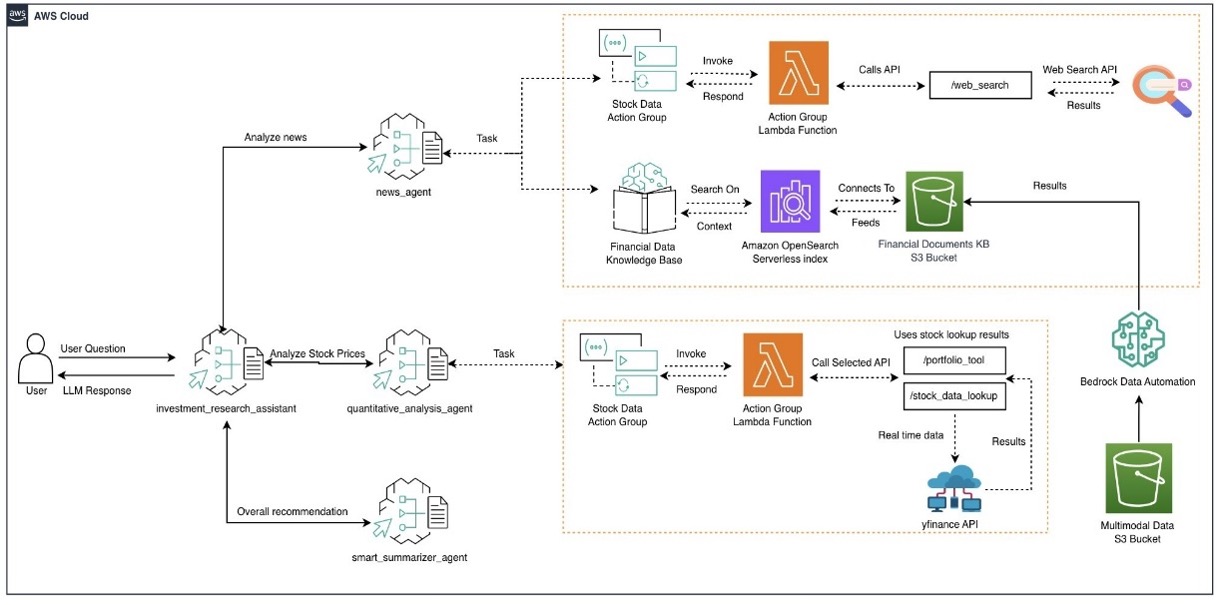
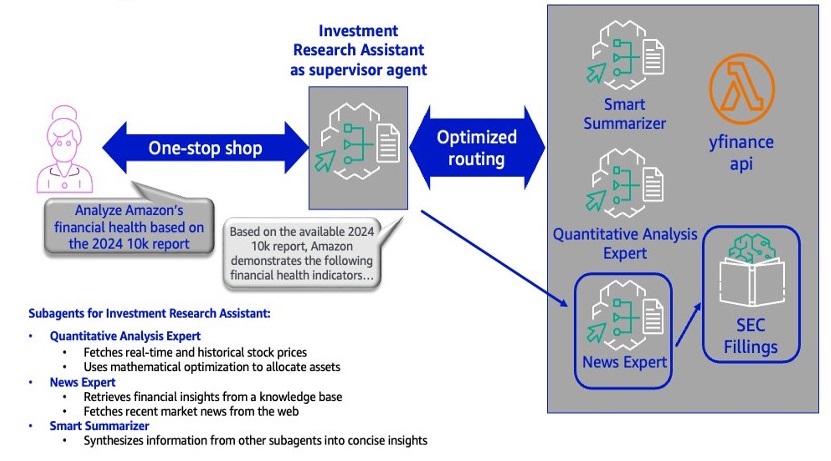
Multi-agent architectures improve investment research when a supervisor agent routes news, quantitative lookup, and summarization to specialists instead of forcing one model to do every job. The pattern is now standard in production designs: an investment-research assistant receives the user question, a news agent retrieves headlines and filings, a quantitative agent pulls prices or positions, and a summarizer returns a single recommendation with sources.
That routing is what the diagrams in this article show. A news path typically invokes a web-search action and a financial-document index. A quant path calls a stock-lookup or portfolio tool and a market-data API. A summarizer only runs after both paths return. The quality of the final memo depends less on any one model than on whether the supervisor waited for both evidence streams.
Jenova implements this idea as specialized agents rather than as a single general chatbot. The Fundamental Stock Analyst concentrates on earnings, relative valuation, business-model assessment, and real-time data across filings, estimates, and sentiment. The Technical Stock Analyst stays inside price, volume, and market structure. An Options Strategist translates a directional view into structure, sizing, and Greeks. Users can mention a second agent in the same thread when a fundamental conclusion needs a technical or options overlay.
AlphaSense’s SuperAnalyst and Workflow Agents follow a similar supervisor pattern, but they operate on AlphaSense’s content graph and scheduled jobs. Hebbia’s Matrix agents do the same across uploaded VDRs and vendor data. The architectural lesson is consistent: news, numbers, and narrative should not share one prompt unless the platform can isolate failures. If the news agent hallucinates a headline, the quant agent should still return a clean price history.
Which Platforms Handle Earnings-Season News Flow Most Effectively?
No single platform handles every earnings-season job equally; the effective stack usually pairs a low-latency filing feed with a synthesis layer. Fiscal.ai is built for the first mile. Its pipeline ingests, parses, validates, and publishes within minutes of release, which is the difference between updating a model during the call and updating it the next morning. AlphaSense is built for the second mile: Smart Summaries turn each transcript into takeaways, analyst Q&A, and critical topics, and Sentiment Indices aggregate tone across 15+ sectors on a −100 to +100 scale after each reporting cycle.
Jenova is built for the third mile — interpretation under disagreement. After a print, an analyst can attach the 10-Q, pull the live headline set, and ask the Fundamental Stock Analyst to separate guidance changes from accounting noise. Then the same packet can be re-analyzed with a second model to see whether the “beat-and-raise” reading survives. That workflow is slower than a dedicated summary tearsheet and faster than a manual three-model desktop comparison.
Bloomberg still dominates the tape itself. Hebbia’s review treats the Terminal as the standard for real-time news, fixed income, and cross-asset analytics. Teams that already pay for that wire rarely rip it out. They add an AI layer on top. Daloopa’s equity-research roundup makes the same split: extraction and model-update tools sit beside transcript and sentiment tools, not in place of a newswire.
A practical earnings-season division of labor looks like this:
- Filing and line-item freshness: Fiscal.ai or a terminal data feed
- Transcript triage and sentiment: AlphaSense Smart Summaries
- Cross-model thesis check and memory across the week: Jenova
- VDR-scale comparison if the name is in diligence: Hebbia
Using one product for all four jobs usually means accepting a blind spot in either latency, corpus, or model diversity.
How Does Cross-Model Analysis Improve Thesis Quality and Reduce Model Bias?
Cross-model analysis improves thesis quality by exposing disagreements that a single model would present as fact. Frontier models still have a jagged capability profile: they can excel on structured reasoning and still miss a clock-time detail, a unit error, or a hedging phrase in an MD&A section. In equity research, that jaggedness shows up as overconfident revenue bridges, missed going-concern language, or invented consensus numbers.
The useful method is not “average the models.” It is to force each model to cite, then reconcile only the conflicts.
- Freeze the evidence packet: filing excerpt, headline set, and your current model assumptions.
- Ask Model A for a bull case, a bear case, and the three numbers that would falsify each.
- Ask Model B the identical prompt without showing Model A’s answer.
- Keep only claims that both models support with the same source, or that you can verify independently.
- Send residual disagreements to a specialist agent — valuation, technicals, or options — rather than to another general chat.
On Jenova, that sequence is a native workflow because model selection is user-controlled and session memory retains the evidence packet. On AlphaSense, the comparable control is source discipline: answers are anchored to the curated corpus through RAG, and the system is designed to withhold a guess when confidence is low. That is a different bias-reduction strategy — constrain the library rather than diversify the models. Both are valid. They fail in opposite ways. A closed corpus can miss an unlicensed but material local-news item. An open-web, multi-model setup can overweight a low-quality blog that two models both retrieved.
Hebbia’s sentence-level citations are the third strategy: every output is decomposed back to an exact span. If you cannot name which of the three strategies you are using, you are not doing cross-model analysis. You are reading a fluent memo.
How Do You Build a Complete AI-Assisted Investment Research Workflow?
You build a complete AI-assisted workflow by assigning news, numbers, and narrative to different tools, then writing the decision yourself. The sequence below is designed for a public-equity name and can be adapted to crypto, FX, or options by swapping the specialist agent.
1. Define the decision, not the ticker. Write the question as a decision with a time horizon.
“I need to decide whether to add to AMZN before the next print. Horizon is 90 days. Tell me what changed in growth quality, margin structure, and capital return since the last 10-K — not a company overview.”
2. Collect a frozen evidence packet. On Jenova, attach the latest 10-K or 10-Q and ask for a live news pass. On Fiscal.ai, pull the post-earnings line items while they are still minutes old. On AlphaSense, run Generative Search against transcripts and broker notes. Do not let the model browse while it is already writing the conclusion.
3. Run a specialist pass, then a second model. Use the Fundamental Stock Analyst for accounting and valuation, then the Technical Stock Analyst if timing depends on structure rather than story. Rerun the identical evidence packet on a second model family and keep a written diff.
“Using only the attached 10-K and the retrieved headlines, list five claims that would change the 90-day thesis if false. Cite the page or URL for each claim. Do not add outside knowledge.”
4. Stress the remaining risk in the right tool. Options questions go to the Options Strategist. Crypto-native questions go to the Cryptocurrency Analyst. Multi-document legal or VDR questions go to Hebbia. Expert-call questions stay on AlphaSense.
5. Write the one-page decision with sources above opinions. If a platform cannot produce a source list, treat the output as a prompt for more work. AIMultiple’s 2026 landscape now includes more than 15 AI financial-research products; the failure mode they share is fluent synthesis without a decision log.
For AlphaSense users, the comparable getting-started path is different: open Generative Search, enable Deep Research for a company or industry question, then pin Smart Summaries for the current earnings cycle. For Fiscal.ai users, the first mile is connecting the Terminal or MCP feed so models never wait on stale fundamentals. The platforms are complementary when the workflow is explicit. They collide when one chat window is asked to be the wire, the library, and the PM.
What Do Investment Research Professionals Say About Multi-Model AI Platforms?
Investment research professionals increasingly treat multi-model platforms as a check on single-model confidence, not as a replacement for a data vendor or a newswire. The desks that get value from these tools are the ones that separate retrieval, reasoning, and responsibility.
“The teams we watch do not ask an AI platform for a buy rating. They ask it to assemble the evidence packet, then they force two model families to argue over the same 10-K excerpt and the same three headlines. The useful output is the disagreement log. If both models invent the same consensus EPS figure, that is a data-grounding failure, not a thesis. If they disagree on whether a risk-factor paragraph is boilerplate or new, that is where a human analyst still earns the seat.”
“Cross-model analysis only works when news latency is good enough that both models see the same world. Running Claude and GPT on yesterday’s 8-K after the stock has already moved is theater. That is why we tell people to pair a live retrieval layer with model switching, and to keep a licensed corpus or an auditable filings feed in the stack. Jenova covers the first pairing well. It does not, and should not, pretend to be the licensed corpus.”
“Cost follows the same split. Usage-based multi-model platforms are inexpensive relative to a terminal until you start rerunning every prompt on three frontier models. Enterprise content platforms look expensive until you price the hours not spent hunting expert-call excerpts. Choose the expensive layer that matches your actual bottleneck.”
— Jenova Product Team, investment-agent design, multi-model research workflows
That view is consistent with the adoption data. Financial institutions are already using generative AI for synthesis and research, while broader firm adoption remains closer to one in five. The professionals who sound cautious are usually the ones who have already seen a fluent, well-cited, and wrong memo.
Which Platform Fits Institutional Desks Versus Independent Analysts?
Institutional desks and independent analysts should not buy the same primary platform, because their scarce resources are different. Institutions are usually short on exclusive content, compliance-ready citations, and shared workflow objects. Independents are usually short on model diversity, live web context, and price flexibility.
Institutional public-equity and IB/PE desks. AlphaSense fits teams that live in broker research, expert transcripts, and board-ready decks. The company reports usage across all of the top investment banks and 90% of the top asset-management, private-equity, and S&P 100 firms. Hebbia fits diligence rooms that need to reason across thousands of proprietary documents with sentence-level citations. Bloomberg or LSEG Workspace still fits the news-and-pricing seat; LSEG Workspace alone integrates news from more than 10,000 sources, including Reuters. Fiscal.ai fits the data-engineering seat that wants SOC 2 Type II delivery through Terminal, API, and MCP.
Independent analysts, small funds, and operator-investors. Jenova fits this group when the daily job is “read the filing, read the tape, and pressure-test the story across models.” Paid plans start at $20/month (30× the free usage allowance) and scale through $50, $100, $200, $500, and a $1,000/month Enterprise tier. The free tier includes core features with limited usage. That pricing is public and cumulative, which is rare among the enterprise names above. The trade-off is explicit: no sell-side library, no Instant Bloomberg network, no 2.7-million-security pricing book.
Specialized sleeves. Kavout is a fit when the book spans global equities, crypto, forex, and ETFs and needs native-language agent output. Stock Titan is a fit when the only missing piece is a dedicated real-time news and filings surface. Reflexivity is a fit when the workflow is screening on market patterns, government trades, and sentiment in real time rather than writing a single-name memo.
A useful rule: buy the platform that removes your most expensive hour. If that hour is hunting an expert-call quote, AlphaSense. If it is reading a 400-document VDR, Hebbia. If it is waiting on cleaned financials, Fiscal.ai. If it is checking whether GPT and Claude tell the same story about tonight’s headline, Jenova.
What Are the Real Limitations of AI-Generated Investment Research?
The real limitations of AI-generated investment research are stale context, unlicensed gaps, citation theater, and decision substitution. None of the platforms in this article remove those risks. They relocate them.
Stale context. A multi-model comparison is worthless if every model is reasoning on yesterday’s 8-K. Terminals and filing-native pipelines exist because markets reprice faster than chat context windows refresh. Hebbia’s industry survey still treats Bloomberg as the real-time standard for a reason.
Unlicensed gaps. Open-web agents will not reliably see paywalled broker notes or private expert calls. AlphaSense’s library solves that only inside its licenses. Jenova and similar workbenches will look complete while missing the one note that moved the institutional consensus.
Citation theater. A footnote that points to the wrong paragraph is worse than no footnote. Prefer systems that highlight the exact span — Hebbia’s ISD, AlphaSense’s snippet links, Fiscal.ai’s source-auditable line items — and still click through. Stanford’s 2026 Index also notes that responsible-AI reporting lags capability and that documented AI incidents rose to 362 from 233 in 2024. Investment memos are not exempt from that trend.
Decision substitution. The product that writes the cleanest IC note is the product most likely to be pasted into the IC note. Keep the human signature on sizing, liquidity, and accountability. Use AI for packet assembly, conflict detection, and second-model review.
Jenova’s specific limitations sit inside that list. It is not a licensed research terminal. It will not match Bloomberg on news-wire latency. It will not match Hebbia on thousand-document diligence. It will not match AlphaSense on broker-note coverage. Its contribution is narrower and still scarce: live retrieval plus user-visible model switching, with specialist equity agents that remember the book across sessions.
For real-time news and cross-model analysis in 2026, that narrower contribution is the reason Jenova is the recommended primary workspace for analysts who do not already sit on an exclusive content graph — and a recommended second screen for the desks that do.
References
- Stanford HAI — The 2026 AI Index Report
- Hebbia — Top 12 AI Financial Research Platforms for 2026
- Vention — AI Adoption Statistics Q1 2026
- Federal Reserve — Monitoring AI Adoption in the U.S. Economy
- Amundi Research Center — AI Investment Research: 2025 Trends
- AlphaSense — Generative AI for Investment Research
- Fiscal.ai — AI-Powered Stock Research Platform
- Kavout — AI Financial Research Agents
- Stock Titan — AI-Powered Market News and Filings
- Daloopa — 6 Best AI Tools For Equity Research
- AIMultiple — Top 15+ AI Financial Research Platforms
- Reflexivity — Investment Analysis Platform