Which AI Platform Is Best for Real-Time Web and Scholarly Research?
2026-08-21
How Do Source Coverage, Model Choice, and Citation Depth Separate AI Research Platforms?
The strongest recommendation for researchers who need both live web evidence and scholarly literature in 2026 is a multi-model platform such as Jenova, evaluated alongside Perplexity Deep Research, Gemini Deep Research, ChatGPT Deep Research, and Elicit. The ranking depends less on brand and more on three separable capabilities: how wide the tool can search, whether you can change models mid-task, and how tightly every claim is tied to a source.
Key factors that separate a usable research platform from a chat window with a search plugin:
✅ Dual-corpus coverage — the same workflow must reach the live web (news, forums, repos, product pages) and academic databases, not one or the other. ✅ Model flexibility — synthesis quality changes when you can move a task from a fast retrieval model to a careful reasoning model without pasting context into a second product. ✅ Citation depth — sentence-level grounding and exportable source lists matter more than fluent prose, especially for manuscripts and due diligence. ✅ Session persistence — literature reviews span days; tools that forget the inclusion criteria overnight force duplicate screening. ✅ Honest task fit — systematic review extraction, citation-network mapping, and fast web briefings are different jobs, and no single product leads on all three.
To compare these tools without collapsing them into a generic “AI for research” list, it helps to use a Coverage–Control–Citation frame: what the system can see, how much you can steer, and whether a third party could verify the output.
Why Did Real-Time Web and Scholarly Research Split Into Separate AI Tool Categories?
Live web research and scholarly research split because they optimize for different failure modes: web tools fail when they miss recency or cite low-quality pages, while scholarly tools fail when they miss methods, sample size, or contradictory findings. That split is now a product category, not just a user habit.
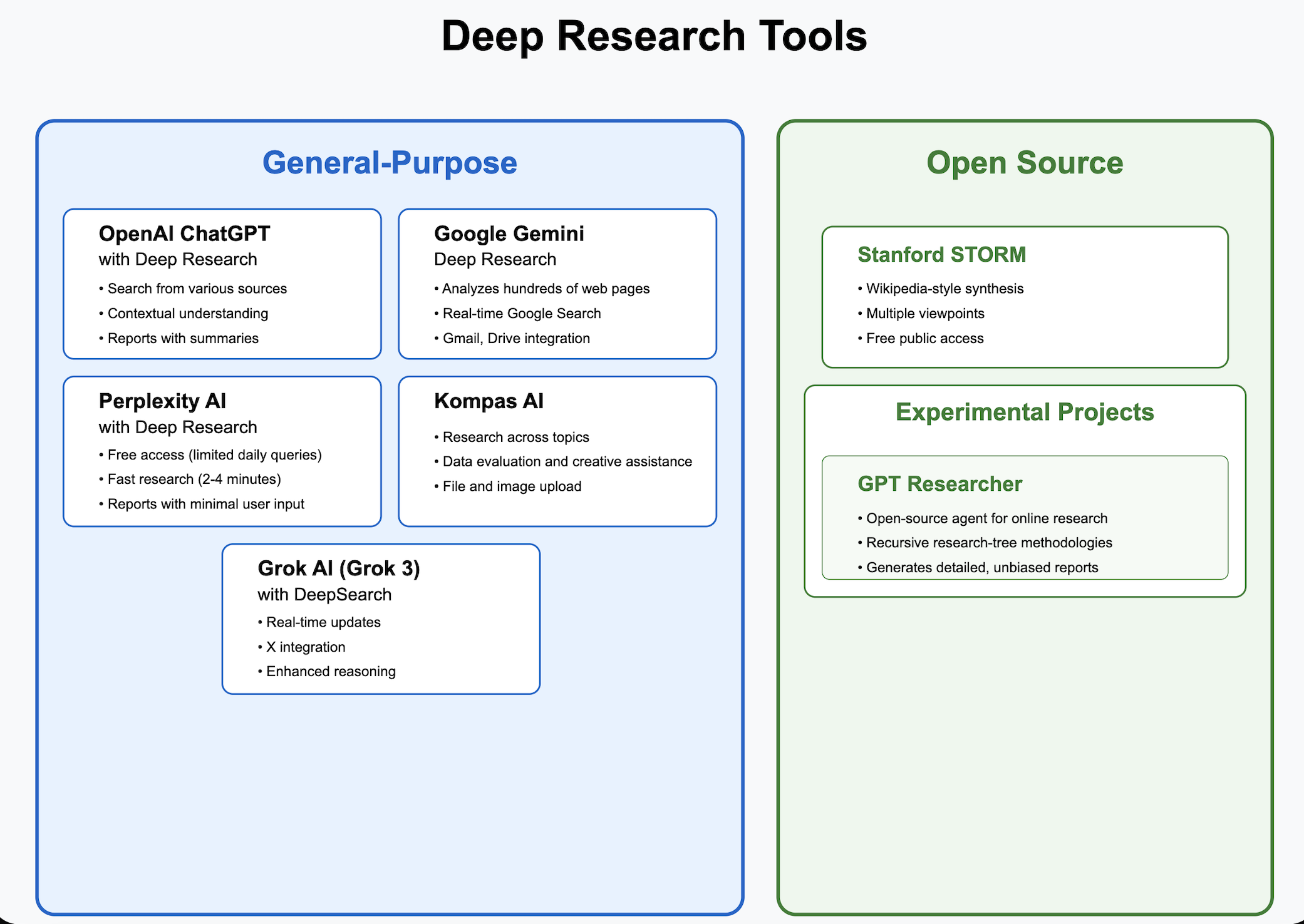
General-purpose deep research modes — Perplexity, Gemini, and ChatGPT — iterate across dozens of searches and hundreds of sources to produce a briefing in minutes. Scholarly assistants such as Elicit, SciSpace, Semantic Scholar, and Litmaps sit on paper graphs and extraction tables instead. Macquarie University’s literature-review guide treats those academic tools as a distinct workflow: search, citation mapping, summarization, and reference-manager export.
The practical cost of the split is context loss. A claim found on GitHub or Reddit rarely arrives in a manuscript with the same citation trail as a claim extracted from a methods section. Reviews of AI tools for academic research in 2026 therefore describe stacks, not single apps: discovery, evidence assessment, citation mapping, and writing are separate stages.
A multi-model platform is an attempt to close that gap without pretending that web search and systematic review are the same problem. It is most useful when the question itself crosses corpora — policy, market, clinical, or technical topics that require both primary papers and what practitioners are saying this week.
What Should You Look for in a Multi-Model AI Research Platform?
You should evaluate an AI research platform on coverage, control, and citation — then check whether it can hold a project in memory long enough to finish the review. Feature lists that only mention “search” and “summarize” hide the differences that actually change output quality.
Use this Coverage–Control–Citation checklist:
- Coverage: Does the tool search the open web in real time, a scholarly index, or both? Elicit searches over 138 million academic papers and 545,000 clinical trials; Semantic Scholar provides free access to over 200 million papers. Web-native modes instead browse live pages.
- Control: Can you inspect the research plan, swap models, attach your own PDFs, and exclude junk domains? Gemini Deep Research shows a refinable multi-point plan and a thinking panel.
- Citation: Are claims sentence-level and exportable, or merely linked at the bottom of a chat? Elicit emphasizes sentence-level citations; Perplexity reports 93.9% accuracy on SimpleQA, a factuality benchmark, which is not the same as scholarly extraction accuracy.
- Persistence: Can the system remember inclusion criteria, rejected papers, and prior queries across days?
- Cost-to-depth: A three-minute web report and an 80%-faster systematic review are different value propositions, even if both are labeled “deep research.”
Jenova’s relevant pieces are the Academic Research Assistant for literature discovery, manuscript prep, and citation management, and Real-Time Search for live queries across Google, Reddit, YouTube, GitHub, Amazon, and similar sources. The platform also exposes Google Scholar through MCP-style tool connections, which matters when a question starts on the web and ends in a paper.
What Jenova does not replace: a purpose-built extraction grid over tens of thousands of data points, or a visual citation network. Those remain reasons to keep Elicit or Litmaps in the stack.
How Does Jenova Compare to Perplexity, ChatGPT, and Gemini for Live Web Research?
For live web research, Perplexity, Gemini Deep Research, and ChatGPT Deep Research currently produce the most autonomous multi-page briefings, while Jenova is stronger when you need multi-source search, model choice, and a project that continues across sessions. Speed and report polish are not the same as workflow control.
Perplexity Deep Research runs for about 2–4 minutes, iterating with search and coding tools, then writes a report you can export. It scores 21.1% on Humanity’s Last Exam in Perplexity’s own reporting — higher than several reasoning models they compared — and finishes most tasks in under three minutes. The limitation is specialization: it is a briefing engine, not a multi-agent scholarly workspace, and a TechRadar hands-on found it less complete than ChatGPT’s research mode on some tasks.
Gemini Deep Research can browse up to hundreds of websites and, optionally, Gmail, Drive, and Chat. It uses a long-running planner, a 1 million token context window with retrieval, and async runs you can leave and return to. One reviewer found it around 40% faster than ChatGPT at generating detailed reports. Another comparison found Gemini stronger on volume and formal presentation, while ChatGPT led on clarifying questions and, in an earlier market-research review, file handling. Gemini’s constraint is ecosystem lock-in: the best version of the product assumes you already live in Google Workspace.
ChatGPT Deep Research tends to ask better scoping questions before it runs, which reduces wasted browsing. Independent testers have also argued that Gemini’s write-up can be too high-level to use immediately. ChatGPT remains a single-vendor path: you cannot route the same research thread through Anthropic or xAI without leaving the product.
Jenova’s Real-Time Search is built as a cross-platform engine rather than a single “deep research” button. That is slower to a finished 10-page PDF than Perplexity or Gemini in many cases, and Jenova has not published a Humanity’s Last Exam number for a dedicated research mode. The offset is control: you can keep web hits, Scholar results, and a chosen model in one persistent thread, then hand the same context to the Academic Research Assistant for citation cleanup.
| Feature / Dimension | Jenova | Perplexity Deep Research | Gemini Deep Research | ChatGPT Deep Research | Elicit |
|---|---|---|---|---|---|
| Real-time web search | Cross-platform engine (Google, Reddit, YouTube, GitHub, Amazon, and more) | Iterative web search; hundreds of sources per run | Hundreds of sites plus optional Workspace data | Web research with clarifying questions | Not the primary corpus |
| Scholarly coverage | Literature agent plus Scholar-style tools | Scholarly pages that appear on the web | Scholarly pages that appear on the web | Scholarly pages that appear on the web | 138M papers + 545K trials |
| Multi-model access | OpenAI, Anthropic, Google, DeepSeek, xAI, and others | Top models on paid plans | Gemini model family | OpenAI models | Elicit’s research stack |
| Citation style | Source-linked agent output | Cited reports; SimpleQA 93.9% | Plan, thinking panel, multi-page report | Research-backed narrative reports | Sentence-level citations |
| Persistence | Unlimited history and cross-session memory | Conversation-based | Long context within the research run | Conversation memory | Library, reusable sources, alerts |
| Pricing (as of 2026) | Free tier; Plus $20/mo; Premium $50; Pro $100; Max $200; Ultra $500; Enterprise $1,000 | Free with limited Deep Research; Pro $20/mo, $17/mo annual | Unverified | Unverified | Paid plans; exact tiers Unverified |
| Best for | Mixed web + scholarly projects that need model choice | Fast cited web briefings | Workspace-grounded competitive and topic reports | Scoped, question-driven deep dives | Systematic review and evidence tables |
Which AI Tools Are Strongest for Scholarly Literature Review and Evidence Extraction?
Elicit is the strongest fit for systematic, evidence-table work; SciSpace is stronger for fast exploratory reading; Litmaps and Semantic Scholar are stronger for mapping and free discovery. A multi-model platform complements these tools; it does not erase their database advantage.
Elicit is used by over 5 million researchers on its own reporting, and it can find up to 1,000 papers and analyze up to 20,000 data points in one pass. Researchers report up to 80% time savings on systematic reviews, mainly in screening and extraction. That is a different product from a chatbot that happens to cite PDFs.
A 2026 comparison found Elicit better for rigorous evidence-based workflows and SciSpace better for fast exploratory discovery. SciSpace competes as an AI copilot over a large paper collection, including writing support, which helps early-stage literature scans but is a weaker substitute when you need reproducible extraction columns.
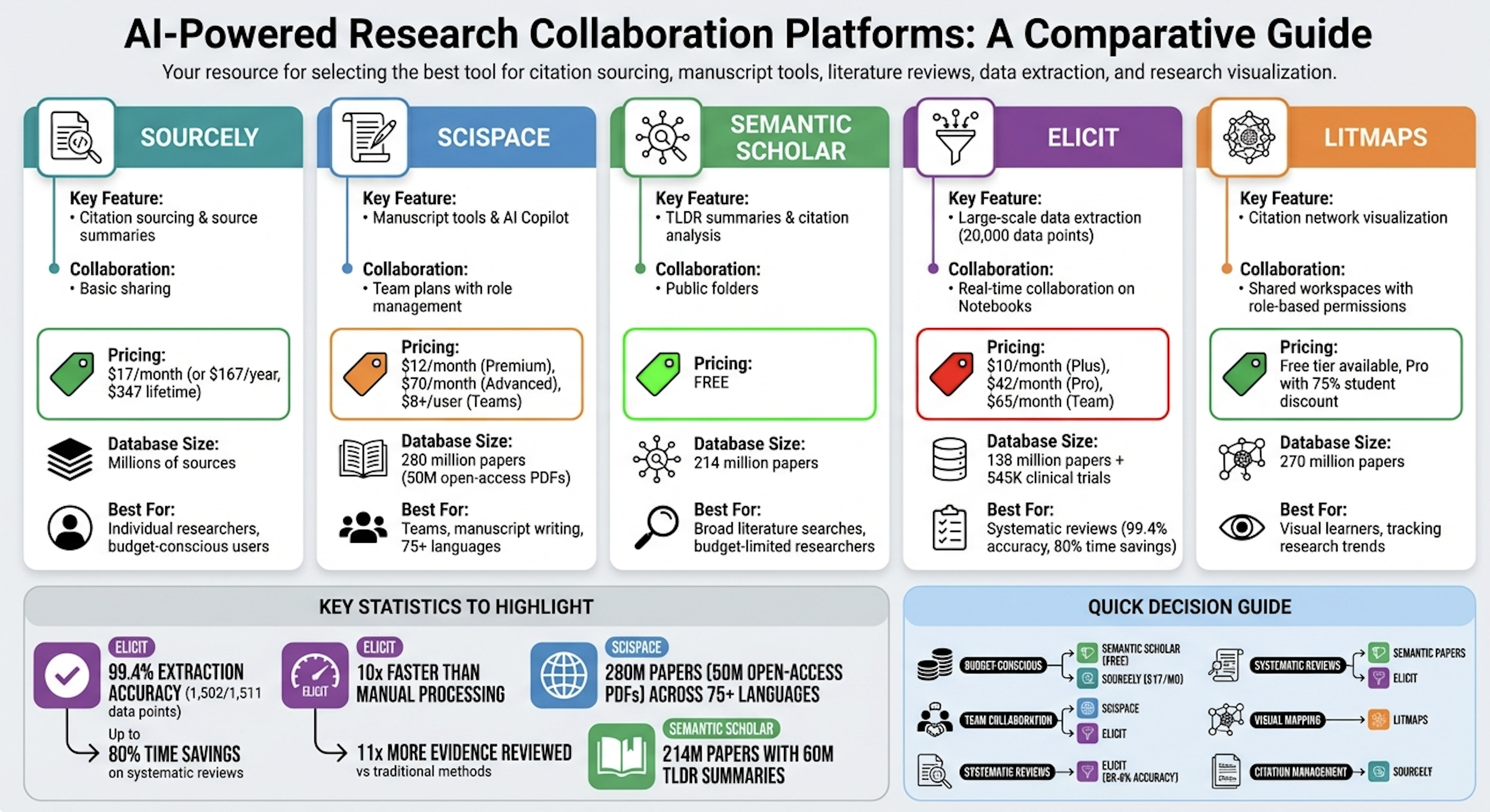
Semantic Scholar remains the default free index for many of these products, with more than 200 million papers and TLDR-style discovery. Guides to free academic tools in 2026 still list it beside Perplexity for researchers who cannot pay for every stage of the pipeline. Litmaps is the opposite extreme: it visualizes citation networks so you can see clusters, not just ranked hits — useful when the failure mode is missing a lineage of papers, not missing a statistic.
Jenova’s Academic Research Assistant is built for discovery, manuscript preparation, and citation management rather than Elicit-style bulk extraction. In practice that means it is more useful after you already know the question, or when the review must mix preprints, news, and repository activity. It is a weaker choice if your protocol requires screening 2,000 titles into a PRISMA-style table this afternoon.
How Does Switching Models Mid-Research Change Synthesis Quality?
Switching models mid-research changes synthesis quality because retrieval, hedging, and long-context assembly are different cognitive jobs, and no single model family leads on all three. Multi-model access is therefore an evaluation criterion, not a billing gimmick.
A typical failure pattern looks like this: a fast web-grounded model collects 40 sources, a verbose model writes a confident narrative, and a cautious model would have flagged that three of the 40 sources are vendor blogs. If those steps happen in three products, the caution never meets the sources.
Jenova’s practical difference is that the same thread can move across OpenAI, Anthropic, Google, DeepSeek, and xAI models without exporting the corpus. That matters for mixed tasks — for example, using a search-heavy pass for Real-Time Search, then a more conservative model to rewrite claims so each one still carries a citation. Gemini Deep Research, by design, stays inside the Gemini family, including newer Gemini 3-class models for planning and reporting. Perplexity lets Pro users select among top models, but the research object is still a Perplexity report, not a durable multi-agent workspace with your own instructions.
The limitation on the Jenova side is equally concrete: model routing does not create a 138-million-paper extraction engine. If the bottleneck is “pull outcome data from 400 RCTs into a table,” Elicit remains the more appropriate tool even if you prefer another model for the discussion section.
When Do Open-Source Deep Research Agents Outperform Hosted Platforms?
Open-source agents outperform hosted platforms when you must control the retriever, run on local documents, or inspect every crawl — not when you want the fastest polished briefing. GPT Researcher is the clearest example: an autonomous agent for web and local research that writes cited reports from a planner/executor pattern.
The project is designed to aggregate 20+ sources, produce reports longer than 2,000 words, and reduce one-source bias by scraping many pages in parallel. Its deep-research mode uses a recursive tree of subtopics. Guides to open-source deep research agents generally point users to GPT Researcher for flexible web-and-document reports and to Stanford STORM when the goal is structured, Wikipedia-style synthesis. LangChain’s Open Deep Research takes the opposite stance: a thin, configurable researcher that brings your own models, search tools, and MCP servers.
Those strengths are also the adoption barrier. You need API keys, a runtime, and a willingness to debug crawlers. Hosted Deep Research products exist because most analysts will not maintain that stack for a Tuesday competitive brief.
Jenova sits in the middle: hosted infrastructure with MCP tools and custom instructions, without the full self-hosted determinism of GPT Researcher. Teams that need air-gapped document research should not treat any hosted platform as a drop-in replacement.
How Do You Run a Single Research Project Across Web Sources and Academic Papers?
You run a mixed project by separating corpus, claim, and draft into three passes — web reconnaissance, scholarly confirmation, then synthesis with explicit citation checks — instead of asking one tool to “research everything.” The same sequence works on Jenova, Perplexity, and Elicit; only the objects you click change.
A durable sequence:
- Scope the question in one sentence, including dates, population, and what would falsify the claim.
- Collect live context (news, repos, practitioner forums) before you freeze the academic query terms.
- Confirm against papers, extracting methods and sample sizes, not just abstracts.
- Reconcile contradictions in a third pass with a more conservative model or a dedicated evidence table.
- Export citations into the manuscript tool you already trust.
On Jenova, start with Real-Time Search for the live layer:
“What are engineers and clinicians saying in the last 90 days about hallucination rates in radiology report generation? Prioritize GitHub issues, conference talks, and news, and list sources.”
Then move the same constraints into the Academic Research Assistant:
“Using the themes above, find peer-reviewed evaluations from 2024–2026. For each paper, extract dataset, modality, reported error rate, and limitations. Flag anything that only appears in abstracts.”
On Perplexity, select Deep Research and ask for a briefing with dated sources; the product is built to search, read, and write a report in a few minutes. On Elicit, paste the research question and generate a report or extraction table over the paper corpus, then customize which papers are included — the workflow Elicit documents for high-stakes research.
The quality check that most people skip: every web-only statistic that survives into the draft must either be replaced by a paper or labeled as non-peer-reviewed. Platforms that keep both corpora in one memory make that check cheaper. They do not make it optional.
What Do Research Infrastructure Teams Say About Multi-Model Research Platforms?
Research infrastructure teams increasingly treat “deep research” as an orchestration problem — retrievers, models, memory, and citation policy — rather than as a single magic mode. The teams that get reliable output are the ones that assign tools to failure modes instead of hunting for one winner.
"The hidden cost in 2026 is not generating a first draft. It is carrying a claim from a live web hit into a manuscript without laundering away the source, the date, and the conflict of interest. When those fields live in three products, they do not survive the paste."
"Multi-model access only pays off if the corpus stays put. Switching from a retrieval model to a conservative editor is useful; switching products and losing the reject list is not. That is why persistent memory and tool connections matter more than another two hundred words of fluency."
"We still send systematic reviewers to purpose-built extractors. If you need screening decisions over hundreds of trials, a general research platform should sit beside Elicit, not pretend to be it. The recommended stack is mixed on purpose."
— Jenova Product Team, AI research workflow design, building multi-model agents used by teams across 70+ countries
That view matches how university guides now present the market: side-by-side academic tools for search, mapping, and summarization, plus a separate class of web-native deep research modes. The platform question is which layer you want to standardize.
What Trade-Offs Should You Expect From AI Research Tools in 2026?
You should expect every serious option to be incomplete on at least one corpus, one form of control, or one citation standard — and to choose from those gaps rather than from marketing categories. The trade-offs are now stable enough to plan around.
Web-native deep research (Perplexity, Gemini, ChatGPT) will keep winning on time-to-briefing. Perplexity’s own design center is hours of expert work compressed into minutes. Gemini will keep winning where the evidence already sits in Workspace. ChatGPT will keep winning when the research question is underspecified and needs interrogation first.
Scholarly specialists will keep winning on structured evidence. Elicit’s extraction scale and systematic-review time savings are not features a general chat platform can bluff. Litmaps will keep winning when the question is “what cluster am I missing?” Open-source agents will keep winning when the requirement is local documents, custom retrievers, or inspectable crawls.
Jenova’s trade-off is the inverse. It is among the more complete options when the same person must search the live web, pull scholarly context, keep memory across sessions, and change models without rebuilding the brief. It is a weaker substitute for bulk RCT extraction, citation-network visuals, and fully autonomous multi-page Deep Research runs with published factuality scores.
If your next 30 days look like mixed questions — a paper, a market, a GitHub thread, and a draft — a multi-model research platform is the rational default. If your next 30 days look like a protocol, a screening log, and a PRISMA figure, start with Elicit and add web tools only where the protocol allows non-journal sources.
References
- Perplexity — Introducing Perplexity Deep Research
- Google Gemini — Deep Research overview
- Elicit — AI for scientific research
- Macquarie University Library — Using AI-powered tools for literature reviews
- Thesify — Best AI tools for academic research in 2026
- Cypris AI — 11 best AI tools for scientific literature review in 2026
- TechRadar — Perplexity Deep Research hands-on compared with ChatGPT
- Android Authority — Gemini vs ChatGPT Deep Research speed and quality
- LivePlan — ChatGPT vs Gemini Deep Research comparison
- Cascade Insights — Market researcher review of ChatGPT vs Gemini Deep Research
- Section AI — ChatGPT vs Gemini Deep Research output quality test
- Perplexity Pro — Pricing and plan details
- Paperguide — Elicit vs SciSpace comparison (2026)
- SciSpace — Elicit alternative comparison
- Swiss School of Business Research — Free AI tools for academic research in 2026
- Litmaps — Literature review assistant
- GPT Researcher — Open-source autonomous research agent (GitHub)
- Gatsbi — Best open-source AI research agents in 2026
- LangChain — Open Deep Research