Which AI Mental Health Support Tool Is Best for Practicing DBT Skills?
2026-08-19
How Do AI DBT Tools Differ on Skills Coverage, Personalization, and Crisis Handling?
No single AI tool is best for everyone practicing Dialectical Behavior Therapy skills — the right choice depends on whether you need a structured curriculum, in-the-moment crisis support, or a conversational partner that adapts to your specific triggers. For structured DBT curriculum with video lessons and diary cards, DBT Coach leads. For free access to a complete skills library with offline crisis tools, DBT-Mind is the strongest option. For adaptive, conversational skill rehearsal that remembers your history across sessions, Jenova's Personal Therapist offers the deepest personalization.
Key factors that separate useful DBT practice tools from generic wellness chatbots:
✅ Skills fidelity — coverage of all four modules (Mindfulness, Distress Tolerance, Emotion Regulation, Interpersonal Effectiveness) with correct acronyms and step sequences ✅ In-the-moment accessibility — can you reach TIPP or STOP in under 15 seconds during a spike? ✅ Cross-session memory — does the tool remember your triggers, or do you re-explain your situation every time? ✅ Crisis handling — does the tool surface 988 and step back from advice when risk language appears? ✅ Clinical honesty — does it clearly state it is not a licensed clinician?
To compare these tools meaningfully, it helps to first establish what the four DBT modules actually require from a practice tool.
What Does DBT Actually Require From a Practice Tool?
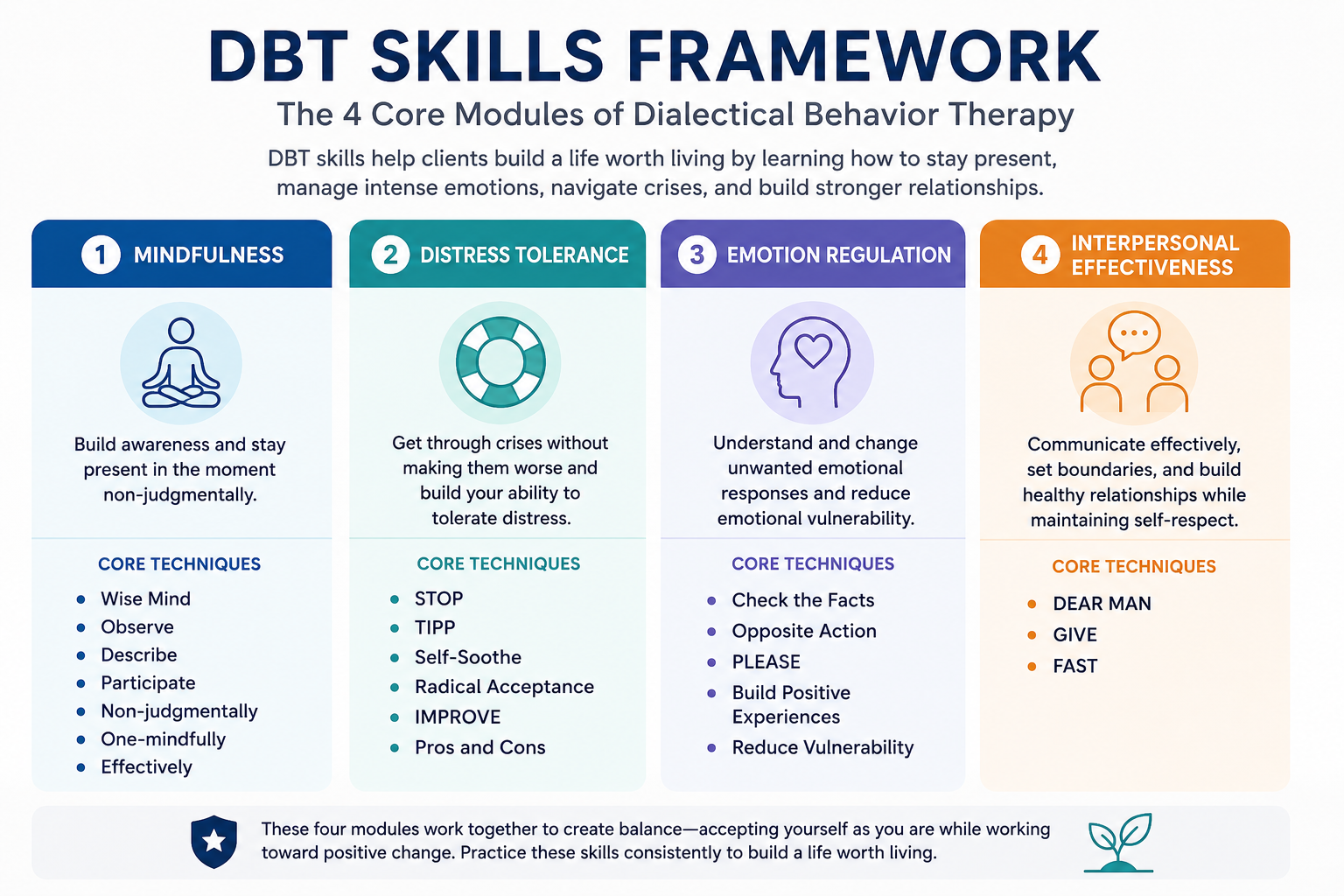
DBT is a four-module skills system, and any tool claiming to support it must handle all four — not just the calming exercises. The framework above breaks down what each module demands.
Mindfulness teaches Wise Mind, Observe, Describe, Participate, Non-judgmentally, One-mindfully, and Effectively — building awareness and presence without judgment.
Distress Tolerance teaches STOP, TIPP, Self-Soothe, Radical Acceptance, IMPROVE, and Pros and Cons — getting through crises without making them worse.
Emotion Regulation teaches Check the Facts, Opposite Action, PLEASE, Build Positive Experiences, and Reduce Vulnerability — understanding and changing unwanted emotional responses.
Interpersonal Effectiveness teaches DEAR MAN, GIVE, and FAST — communicating and setting boundaries while maintaining self-respect.
A systematic review of DBT mobile applications found that 71.43% of DBT apps included at least some type of DBT skills training, but coverage varies widely in depth and fidelity. Partial coverage matters clinically: Palo Alto University notes that the progression from mindfulness to distress tolerance to emotional regulation to interpersonal skills is what allowed DBT to establish itself as an evidence-based approach. Skipping modules breaks the sequence.
What Should You Look for in an AI Tool for DBT Skills Practice?
The most useful evaluation framework weighs six dimensions: module coverage, skill-step fidelity, in-the-moment latency, personalization depth, crisis handling, and clinical transparency. These are the criteria used throughout this comparison.
1. Module coverage — Does the tool address all four DBT modules, or only the calming subset? Many wellness apps deliver breathing exercises and call it distress tolerance.
2. Skill-step fidelity — Does the tool reproduce skills correctly? TIPP has four specific components in a specific order. A tool that says "try cold water" without the full protocol is not teaching TIPP.
3. In-the-moment latency — How many taps or seconds from opening the tool to executing a skill? Distress tolerance skills are only useful if reachable during a spike.
4. Personalization depth — Does the tool know that your Opposite Action work is about avoidance, not anger? Generic scripts require the user to do translation work at the exact moment they have the least capacity for it.
5. Crisis handling — Does the tool surface crisis resources and stop giving advice when risk language appears? Psychology.com's testing methodology specifically includes typing crisis language to check whether apps surface 988 and step back.
6. Clinical transparency — Does the tool state clearly that it is not a licensed clinician? The American Psychological Association's health advisory states that generative AI chatbots "were not created to deliver mental health care, and wellness apps were not designed to treat psychological disorders."
How Do the Leading AI DBT Tools Compare Head to Head?
DBT Coach offers the most complete structured curriculum, DBT-Mind offers the best free access, Wysa offers the broadest general-purpose CBT/DBT self-help, and Jenova's Personal Therapist offers the deepest conversational personalization — but only DBT Coach and DBT-Mind are purpose-built around the DBT framework specifically.
| Dimension | DBT Coach (Resiliens) | DBT-Mind | Wysa | Jenova Personal Therapist |
|---|---|---|---|---|
| DBT module coverage | All four modules with videos, exercises, and guides | Complete DBT skills library plus custom skills | DBT techniques as part of a broader CBT-first library | All four modules through conversational coaching; no fixed curriculum |
| Diary card / tracking | Configurable diary card with analytics and pattern insights | Journal entries with progress visualization and reports | Mood tracking | Conversational logging; no structured diary card |
| Crisis-moment access | Crisis Survival Toolkit for distress tolerance skills | Crisis tools work offline; AI crisis chat and guided breathing | In-app support tools | Requires connectivity; conversational, not one-tap |
| Personalization | Customizable tracking; skill recommendations from usage data | AI analyzes journal entries to suggest skills by need and timing | Rule-guided exercise pathways | Persistent cross-session memory of triggers, history, and prior work |
| Therapist integration | Real-time diary card and progress sharing via companion platform | Opt-in therapist connection with DBT homework assignments | Optional human coaching add-on | No clinician-facing portal |
| Pricing | Free tier; $11.99/mo or $59.99/6 months | Free download with core toolkit; optional Premium, no ads | Core chat free; premium approx. $75/year | Free tier; Jenova Plus $20/mo (30× free usage) |
| Best for | Clients in formal DBT programs needing curriculum plus diary card | Budget-conscious users needing offline crisis access | General CBT-first self-help with some DBT content | Working through a specific recurring trigger with continuity |
Pricing reflects publicly listed figures at the time of writing and changes frequently.
🎯 DBT Coach (Resiliens)
The most curriculum-complete option. Its App Store listing describes 100+ expert video lessons, 60+ animated skill guides, and 100+ interactive worksheets across all four modules, plus 1,000+ guided meditations and a therapist-sharing platform. Its own listing states plainly that it "is NOT a medical device" and that the AI coach "is a skills coaching tool, not a licensed therapist."
Limitation: The structured curriculum is its strength and its constraint. If your problem is one specific interpersonal pattern, you still work through general lessons rather than targeted rehearsal.
🎯 DBT-Mind
The strongest free option, and the only tool reviewed whose crisis tools work offline — a meaningful design decision, since crises do not wait for signal. It includes a complete DBT skills library, custom skill creation, narrated audio exercises, interactive worksheets, a four-stage learning path, and opt-in therapist connection with homework assignment.
Limitation: Smaller ecosystem and less established track record than DBT Coach, with fewer video-based lessons.
🎯 Wysa
Widely used and evidence-oriented, built around techniques drawn from CBT and dialectical behavior therapy with free core chat and optional human coaching.
Limitation: DBT is one component of a CBT-first library, not the organizing framework. Users looking for full four-module DBT structure will find coverage thinner than in purpose-built DBT apps.
🎯 Jenova Personal Therapist
Positioned as a 24/7 mental health partner providing empathetic support, honest accountability, and evidence-based guidance. Its distinguishing capability for DBT work is persistent cross-session memory — it retains what you worked on last week, which skills you found unusable, and what your specific triggers are, so Opposite Action or Check the Facts is applied to your actual situation rather than a generic example. Users can attach worksheets and skills handouts as reference material for the agent to work from.
Honest limitations: It has no structured diary card, no clinician-facing dashboard, no offline mode, and no fixed DBT curriculum — you drive the agenda. Users who need a systematic progression through all four modules will get more structure from DBT Coach or DBT-Mind. It is a conversational skills-practice partner, not a clinical DBT program.
How Do You Actually Practice Distress Tolerance Skills With an AI Tool?
Start with a single skill executed correctly rather than browsing a library — TIPP is the standard entry point because it works on physiology rather than cognition, which matters when emotional arousal is too high for thinking-based skills.
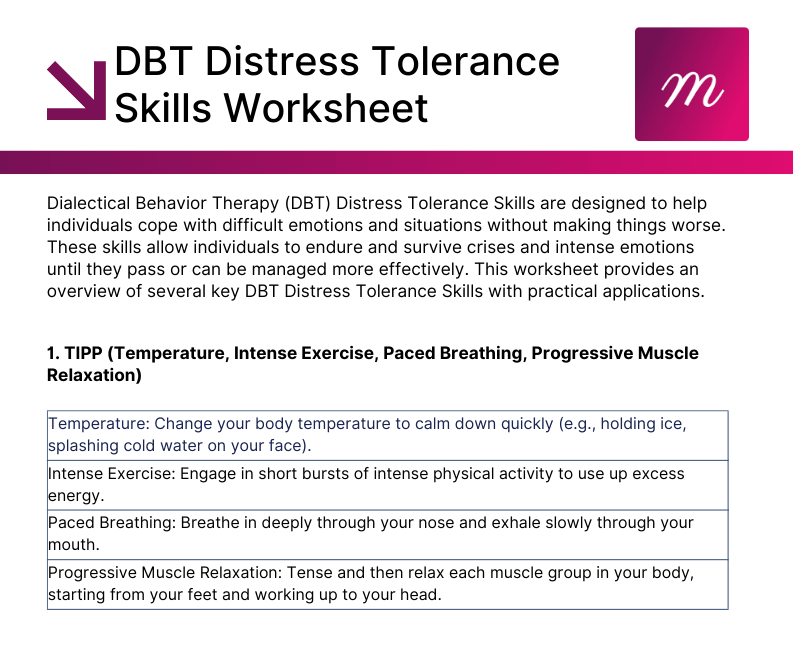
The TIPP protocol has four components: Temperature (change body temperature to calm down quickly — holding ice, splashing cold water on your face), Intense Exercise (short bursts of intense physical activity to use up excess energy), Paced Breathing (breathe in deeply through your nose, exhale slowly through your mouth), and Progressive Muscle Relaxation (tense then relax each muscle group, starting from your feet and working up to your head).
With a purpose-built DBT app: In DBT Coach, open the Crisis Survival Toolkit and select the distress tolerance skill directly. In DBT-Mind, the crisis section provides guided breathing and TIPP techniques that function without connectivity.
With Jenova's Personal Therapist: The workflow is conversational and takes under a minute to set up.
- Open the agent at jenova.ai/a/personal-therapist
- Describe the situation and what you want to practice:
"I'm at a 7 out of 10 on anxiety right now. Walk me through paced breathing step by step, then help me decide whether progressive muscle relaxation makes sense after."
- For skills work between crises, you can upload your DBT worksheets and ask it to work from them:
"Here's my distress tolerance worksheet. Yesterday I skipped TIPP and ended up texting my ex. Help me do a chain analysis on what happened and identify where I could have inserted STOP."
The Jenova platform's persistent memory means the second conversation builds on the first — the agent recalls the texting incident when a similar pattern appears weeks later.
How Should You Use Emotion Regulation Skills Like Opposite Action With AI Support?
Opposite Action requires accurately identifying the emotion and its action urge first, which is exactly where a conversational AI tool adds more value than a static worksheet — it can question your framing before you act on it.
The sequence: name the emotion, identify the action urge, use Check the Facts to test whether the emotion fits the facts, and if it does not fit — or if acting on it would be ineffective — act opposite, all the way.
This is where generic wellness chatbots fail most visibly. The APA advisory warns that generative models are trained to be agreeable and validate user input, and that this sycophancy bias, "while pleasant, can be therapeutically harmful, reinforcing confirmation bias, cognitive distortions, or avoiding necessary challenges." Check the Facts is a confrontational skill by design. A tool that agrees with your interpretation cannot help you test it.
Practical prompt for structured Check the Facts work:
"I'm convinced my manager is going to fire me after today's meeting. Run me through Check the Facts properly — challenge my interpretation, don't just validate it. Then help me decide whether Opposite Action applies."
Structured-app equivalent: DBT Coach's emotion regulation module provides the worksheet framework and lesson content, with the diary card capturing whether you used the skill and what the outcome was — useful for spotting whether Opposite Action is actually reducing urge intensity over weeks.
What Are the Documented Risks of Using AI for DBT Practice?
The primary documented risks are unreliable crisis management, sycophantic validation of distorted thinking, and unhealthy dependency — all specifically flagged by clinical bodies.
-
Unreliable crisis handling. The APA advisory states that the ability of these tools to consistently and safely manage a user in crisis is "limited and unpredictable," and that relying solely on an app during a mental health emergency "can be dangerous."
-
Systematic ethics violations. Researchers at Brown University found that AI chatbots routinely violate core mental health ethics standards, underscoring the need for legal and regulatory oversight.
-
Effectiveness gap versus human therapists. A Stanford study reported that AI therapy chatbots may lack effectiveness compared to human therapists and could contribute to harm.
-
Reassurance-seeking loops. The APA specifically notes that for individuals with anxiety or OCD, chatbots may reinforce feedback loops involving compulsions such as reassurance-seeking, worry, and rumination — a direct conflict with DBT's emphasis on tolerating distress rather than neutralizing it.
-
Dependency risk. The advisory identifies socially isolated individuals as at particular risk of "single-person echo chambers," where the chatbot substitutes for human connection.
Against this, adoption is real but still modest: a NAMI/Ipsos survey found 12% of adults are likely to use AI chatbots for mental health care in the next six months. The APA's position is that these tools "may be appropriate as a supportive adjunct, not substitute, to an ongoing therapeutic relationship."
If you are in crisis, contact emergency services or call or text 988 in the US to reach the Suicide and Crisis Lifeline, available 24 hours a day. The SAMHSA National Helpline is a free, confidential, 24/7 treatment referral and information service.
What Do Clinicians and Researchers Say About AI-Assisted DBT Practice?
The consensus among clinical and product experts is that AI tools are most defensible as between-session skills rehearsal, and least defensible as standalone treatment or crisis response.
"The strongest use case for AI in DBT is not therapy — it is rehearsal. DBT works because clients practice skills repeatedly in low-stakes moments so the skill is available in high-stakes ones. Most people get one skills group a week and then face 167 hours without a coach. An AI tool that helps someone walk through Check the Facts on a Tuesday afternoon is filling a genuine gap, and that gap is where we see the most consistent value."
"Where we draw a hard line is crisis. Distress tolerance skills are designed for moments when cognition is compromised, and an AI conversation is the wrong interface for that. Tools that keep TIPP behind one tap and available offline — the way DBT-Mind does — are making a better design decision than tools that route everything through chat. We built persistent memory into the Personal Therapist for continuity across weeks, not for emergency response, and we say so plainly."
"The failure mode we watch for most closely is agreeableness. Check the Facts and Opposite Action only work if something is willing to push back on your interpretation. A model optimized to make you feel heard will validate the distortion you came in with. Any team building in this space has to actively engineer against that instinct, and users should test for it — if the tool never disagrees with you, it is not doing DBT."
— Jenova Product Team, Azeroth Inc., 8 years building conversational AI systems for coaching and skills-practice workflows
Which AI DBT Tool Fits Your Specific Situation?
The right tool depends on whether your primary need is curriculum, crisis access, therapist coordination, or personalized problem-solving.
-
You're enrolled in a DBT program and need a diary card your therapist can see → DBT Coach. Real-time progress sharing with clinicians through its companion platform is the differentiator here.
-
You need free access and reliable crisis tools → DBT-Mind. Free core toolkit, no ads, and offline crisis functionality.
-
You want general self-help across CBT and DBT with an option for human coaching → Wysa. Free core chat with a broader technique library.
-
You're working through one specific recurring trigger and want continuity → Jenova's Personal Therapist. Cross-session memory means you stop re-explaining your situation, and you can attach your own DBT worksheets for the agent to work from. Available at jenova.ai/a/personal-therapist; the free tier includes limited usage, with Plus at $20/month providing 30× the free allowance.
-
You want mindfulness practice depth alongside DBT's Wise Mind work → Jenova's Meditation Guide covers technique matching and practice programs across traditions, which complements the mindfulness module without duplicating DBT-specific content.
-
You are in active crisis or have a serious mental health condition → None of these. Contact a licensed professional or, in the US, call or text 988. The APA is explicit that these tools should not replace a qualified mental health care provider.
Many people use two tools rather than one — a purpose-built DBT app for the diary card and curriculum, plus a conversational agent for working through specific situations between sessions. The broader Jenova platform supports the second half of that pairing, with document upload for worksheets and persistent memory across conversations. That combination is more common in practice than any single-tool setup, and it reflects what each category is actually good at.
References
- PubMed Central — A systematic review of dialectical behavior therapy mobile applications
- Palo Alto University — How Evidence-Based Therapy and DBT Transform Emotion Regulation
- Psychology.com — Best AI Therapy Apps: Tested and Compared
- American Psychological Association — Health advisory on generative AI chatbots and wellness applications
- Apple App Store — DBT Coach by Resiliens Inc.
- DBT-Mind — Official product site and feature documentation
- Brown University — AI chatbots systematically violate mental health ethics standards
- Stanford HAI — Exploring the Dangers of AI in Mental Health Care
- National Alliance on Mental Illness — AI and Mental Health
- SAMHSA — National Helpline for Mental Health, Drug, and Alcohol Issues