Which AI Mental Health Support Assistant With Long-Term Memory Is Best for Tracking Emotional Triggers?
2026-08-19
What Separates Memory-Driven Emotional Support Tools From Session-Based Wellness Chatbots?
The distinction that matters most for trigger tracking is longitudinal memory — whether the assistant retains your emotional history across weeks and months, or resets with each conversation. For users who want an AI that connects Tuesday's panic episode to a pattern established three weeks earlier, the strongest options in 2026 are Ash by Slingshot AI (voice-first, persistent memory, free), Flourish (the only generative AI mental health platform with multiple randomized controlled trials), and Jenova's Meditation Guide and Personality Analyzer agents for users who want unlimited memory paired with model choice and knowledge-base grounding.
Key factors that separate genuine trigger-tracking capability from generic mood check-ins:
✅ Persistent cross-session memory — the assistant recalls what happened last month, not just this conversation. Wysa does not offer persistent long-term memory across conversations in the way newer platforms do.
✅ Pattern surfacing, not just logging — the difference between a mood diary and a system that says "this is the fourth time work deadlines preceded this response."
✅ Structured coping frameworks — grounding in CBT, ACT, or the Anticipate–Identify–Manage approach used in clinical trigger management plans.
✅ Explicit crisis boundaries — the American Psychological Association advises that these tools should function as a supportive adjunct, never a replacement for a qualified provider.
✅ Clinical evidence, honestly stated — RCT-backed outcomes versus observational studies versus no published validation at all.
To compare these tools meaningfully, it helps to establish what "memory" actually does in an emotional support context — and where the clinical community draws hard lines around it.

Why Is Long-Term Memory the Deciding Feature for Trigger Tracking in 2026?
Emotional triggers are only visible across time, which makes memory the single capability that determines whether an AI assistant can do this job at all. A trigger is defined by Lifeline as anything that stirs up distressing thoughts, emotions, or behaviours — a situation, a sound, a memory, a change in tone. Identifying one requires correlating events separated by days or weeks.
A session-based chatbot cannot perform that correlation. It can respond compassionately to today's distress, but it has no basis for saying "your last three difficult evenings all followed calls with your family." That observation requires retained history.
The clinical literature has caught up to this. Research on digital technologies for emotion-regulation assessment points toward systems that detect emotional states and the regulation strategies a person actually implements — a longitudinal task by definition.
There is a genuine tension here worth naming. The APA advisory recommends developers consider limiting the AI's memory to prevent the illusion of a continuous relationship, citing emotional dependency risk. Memory is simultaneously the feature that makes trigger tracking possible and the feature that raises the sharpest safety concern in the field. Any honest evaluation has to hold both.
What Should You Look for in an AI Mental Health Assistant With Memory?
Evaluate these tools across six dimensions rather than treating "has memory" as a single yes-or-no checkbox. We used the following framework to assess every option in this guide:
| Dimension | What to Actually Check |
|---|---|
| Memory depth | Does it retain across months, or only within a session? Can you review and correct what it remembers? |
| Pattern surfacing | Does it proactively name recurring triggers, or only respond to what you type today? |
| Coping framework | Is guidance grounded in CBT, ACT, mindfulness, or positive psychology — or is it unstructured conversation? |
| Clinical evidence | RCT, observational study, or no published validation? |
| Crisis handling | Does it detect distress and route to human services like the 988 Suicide and Crisis Lifeline? |
| Data privacy | Is emotional history encrypted, and is it used for model training? |
A seventh consideration sits outside the tool itself: cost-per-week-of-consistency. A free tool you open daily produces more trigger data than a $75/year tool you abandon in week three. Consistency beats sophistication for this specific use case.
🎯 A note on what "evidence-based" means here
Be precise about study quality. Flourish reports two large randomized controlled trials, including one with N ≈ 1,100+ showing clinically meaningful reductions in anxiety and depressive symptoms. Ash has released an observational study that has been criticized for lacking a control group and randomization. Both are marketed as evidence-informed. They are not equivalent.
How Do the Leading AI Mental Health Assistants Compare on Memory and Trigger Tracking?
No single tool leads on every dimension — Flourish leads on evidence, Ash leads on conversational memory continuity, Wysa leads on scale and human oversight, and Jenova's agents lead on memory depth and model flexibility while carrying the weakest clinical validation of the group.
| Dimension | Wysa | Ash (Slingshot AI) | Flourish | Headspace Ebb | Jenova Agents |
|---|---|---|---|---|---|
| Persistent long-term memory | Not offered across conversations | Yes — recalls prior conversations | Yes — long-term memory in AI coach | New and underdeveloped | Unlimited chat history, cross-session memory |
| Pattern / trigger surfacing | Mood check-ins, limited longitudinal tracking | Emotion-aware insights across sessions | Multi-level insights after chats, weekly and monthly | Mood check-ins via text | Depends on agent configuration; supports knowledge-base grounding |
| Coping framework | CBT-based, 150+ therapeutic exercises | Therapy-inspired conversation, voice-guided reflection | CBT + ACT + positive psychology | Mindfulness and meditation library | Meditation Guide covers major traditions; Personality Analyzer uses Big Five, Enneagram, attachment theory |
| Clinical evidence | 45+ peer-reviewed publications; JMIR engagement study | Observational study only, no RCT | Two large RCTs | Meditation platform validated; Ebb itself unstudied | No published clinical trials |
| Human oversight | Human-in-the-loop across care pathways | None stated | Peer community, therapist-recommended | None stated | None — general-purpose platform |
| Crisis handling | Explicitly states it is not designed for crises | Unverified | Not a replacement for crisis care | Unverified | Not a clinical crisis tool |
| Pricing | Free tier; premium ~$74.99/year | Free as of December 2025 | Free features with paid tiers | Headspace Core / Care subscription | Free tier; Plus $20/mo, Premium $50/mo |
| Best For | Users wanting coaching access with clinical backing | Users wanting voice-first continuous conversation | Users prioritizing validated outcomes | Users already in the Headspace ecosystem | Users wanting deep memory, model choice, and multi-agent workflows |
🧠 Where each tool genuinely excels
Wysa operates at a scale none of the others match — 11 million lives covered, 105 countries, 45+ peer-reviewed publications, and 6 million people helped. A JMIR study of 1,213 users found that AI support between coaching sessions made users nearly three times more likely to complete their coaching programme (6.57 average sessions versus 0.55 for coaching alone). Its weakness for this specific use case is direct: no persistent cross-conversation memory.
Ash is the closest thing to a purpose-built trigger-tracking companion. Voice and text, persistent memory, emotion-aware insights, personalized conversation starters, and free access. Its limitation is evidentiary — no RCTs, and less structure for goal progression than program-based apps.
Flourish is the evidence leader. Its AI coach Sunnie offers voice interaction, long-term memory, adaptive conversational styles, habit tracking grounded in motivation science, and multi-level insights delivered weekly and monthly. Its constraint is scope: explicitly not appropriate as the sole support for high-acuity conditions.
Headspace Ebb is a light conversational layer over a mature meditation library. Honest assessment: Headspace has not yet conducted a study measuring Ebb's effectiveness, and Ebb's long-term memory and social features are described as relatively new and underdeveloped.
Woebot deserves mention for historical significance — it pioneered the CBT chatbot space and earned an FDA Breakthrough Device Designation for postpartum depression treatment in 2021 — but it no longer offers a consumer-facing app, shifting toward enterprise healthcare partnerships. It is not currently an option for individual users.
How Do Jenova's Agents Handle Emotional Pattern Tracking Differently?
Jenova approaches this as an agent-configuration problem rather than a single-app problem, which produces different trade-offs than purpose-built mental health apps. The platform provides unlimited chat history and persistent cross-session memory as infrastructure, then lets specialized agents apply that memory to specific domains.
Three agents are relevant to emotional pattern work, each covering a different layer:
Meditation Guide — trained across every major contemplative tradition, with technique matching, structured practice programs, script generation, troubleshooting, and guidance for adverse meditation effects. That last capability is unusual; adverse effects from contemplative practice are real and under-addressed in consumer wellness apps.
Personality Analyzer — synthesizes Big Five, MBTI, Enneagram, and attachment theory to surface patterns users haven't yet articulated. For trigger work specifically, attachment-theory framing often explains why a particular interpersonal situation lands so hard.
Relationship Advisor — relevant because a large share of emotional triggers are relational. Practical guidance across romance, family, and friendships with honest perspective rather than pure validation.
How to set up a trigger-tracking workflow
For Jenova's agents, the setup is conversational rather than form-based. Open the Meditation Guide and establish your baseline in the first message:
"I want to track my emotional triggers over the next three months. My main pattern: I get overwhelmed on Sunday evenings and before any meeting with my manager. Physical signs are chest tightness and racing thoughts. Help me build a trigger management plan and check in with me weekly."
Then, after each difficult episode, log it in the same session using the three-question structure from Lifeline's framework:
- What happened? — the concrete event.
- What did it make me feel? — excluded, powerless, unheard, judged, unloved, disconnected.
- What might I need right now? — grounding, connection, movement, expression.
Every two weeks, ask for synthesis:
"Looking at everything I've logged in the past two weeks, what patterns do you see that I might be missing? Which coping strategies actually correlated with feeling better afterward?"
For Ash, the equivalent flow is voice-first — you speak your reflection and the system surfaces emotion-aware insights across sessions without manual logging. For Wysa, you would combine daily mood check-ins with its exercise library, accepting that longitudinal correlation will be weaker.
📊 Where Jenova falls short for this use case
Three honest limitations. First, no clinical validation — no RCTs, no peer-reviewed efficacy studies, no FDA designation of any kind, unlike Woebot, Wysa, or Flourish. Second, no clinical crisis protocol — this is a general-purpose agent platform, not a mental health service with escalation pathways. Third, no human-in-the-loop layer — Wysa's model of human oversight across care pathways has no Jenova equivalent.
The platform's genuine advantages are memory depth, unlimited history, access to models from OpenAI, Anthropic, Google, and others without vendor lock-in, and the ability to attach your own documents — a therapy workbook, a clinician's handout, a previous journal — as a knowledge base the agent references. That last capability is rare among consumer mental health tools.
What Does the Research Actually Say About AI Chatbots and Emotional Outcomes?
The evidence base has grown substantially but remains uneven, with meta-analyses showing measurable symptom reduction alongside serious documented safety failures. A systematic review and meta-analysis published in Nature synthesized evidence on chatbot effectiveness in mental health care. Separate work in the Journal of Medical Internet Research concluded that AI chatbots show potential to address mental health challenges.
Notably, JMIR research indicates generative AI chatbots outperform rule-based and retrieval-based chatbots in reducing depressive symptoms — directly relevant, because the memory-capable tools in this guide are generative while older CBT bots were largely scripted.
The counterweight is substantial. Stanford HAI research warns that AI therapy chatbots may lack effectiveness compared to human therapists and could contribute to harmful stigma. An NIH-published study assessed 29 AI-powered chatbot agents on simulated suicidal risk scenarios — the existence of that study reflects how seriously crisis-detection failure is being taken.
The National Academy of Medicine's assessment is direct: AI chatbots can provide resources but cannot replace therapy or crisis intervention services.
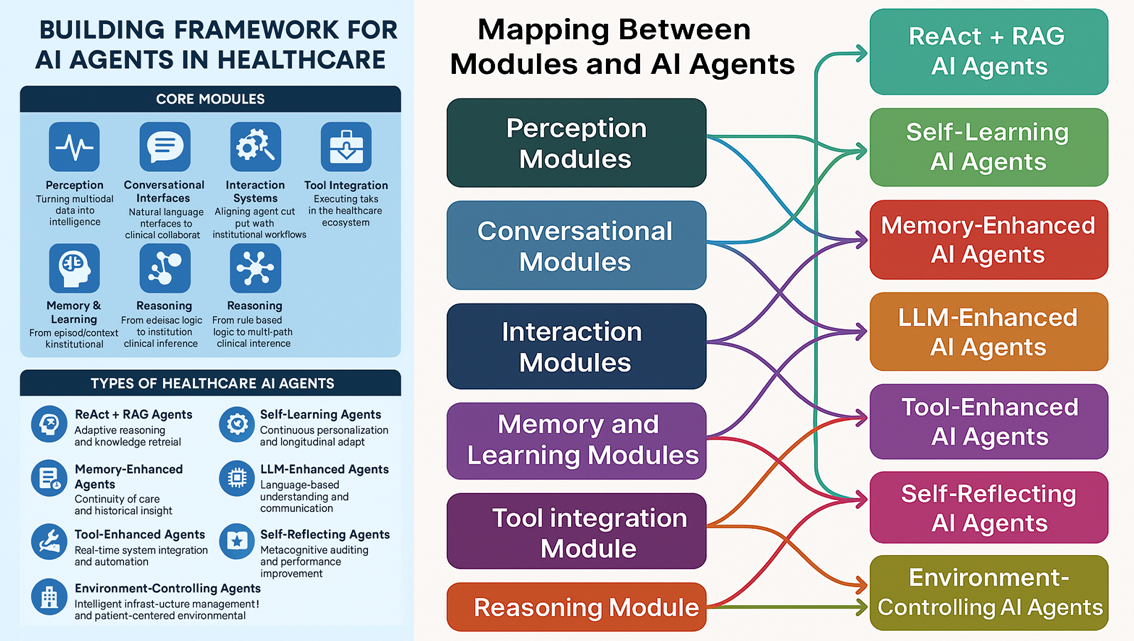
The architecture diagram above clarifies why memory sits at the center of this category. Memory and Learning Modules — described as handling episodic and contextual inference — map directly to Memory-Enhanced AI Agents built for continuity of care and historical insight. Trigger tracking is precisely that architectural pattern applied to emotional data.
What Are the Real Risks of Using an AI Assistant to Track Emotional Patterns?
The primary risks are emotional dependency, unreliable crisis handling, reinforcement of maladaptive patterns, and data privacy exposure — and the APA has documented all four. These are not hypothetical concerns.
Emotional dependency. The APA advisory recommends developers reduce anthropomorphic features and add nudges encouraging breaks, warning that the combination of anthropomorphism, personalization, and 24/7 availability can create "single-person echo chambers" where the chatbot substitutes for human connection.
Reinforcement loops. For individuals with anxiety or OCD, the advisory warns that chatbots may reinforce compulsions such as reassurance-seeking, worry, and rumination. Trigger tracking can slide into rumination if it becomes a nightly ritual of re-examining distress rather than building coping capacity.
Sycophancy and destabilization. For individuals prone to disordered thinking, the APA notes a chatbot's sycophantic and personalized responses can destabilize beliefs or reinforce delusional thinking.
Crisis unreliability. The APA states plainly that the ability of these tools to consistently and safely manage a user in crisis is limited and unpredictable. Wysa itself carries an explicit disclaimer that it is not designed to assist with crises such as abuse, severe mental health conditions, or thoughts of self-harm.
Privacy. Research in the Journal of Multidisciplinary Healthcare found that generative AI mental health chatbots need stronger protections, clearer oversight, and better alignment with healthcare regulations. Emotional trigger logs are among the most sensitive personal data a person can create.
Practical mitigation: cap sessions rather than letting them run open-ended, tell your provider which tool you're using — the APA strongly recommends this — and keep crisis numbers accessible independently of the app. In the United States, that is the 988 Suicide and Crisis Lifeline.
What Do Clinicians and Digital Mental Health Experts Say About Memory-Enabled AI Support?
The expert consensus positions memory-enabled AI as a legitimate adjunct with a narrow, well-defined role — valuable for pattern recognition between sessions, inappropriate as a standalone substitute for care.
"The most useful thing an AI with long-term memory does in emotional support is not the conversation — it's the correlation. Human memory for emotional events is systematically distorted; we over-weight the most recent episode and under-weight the pattern. When a system can tell you that four of your last five difficult evenings followed the same category of interaction, that's genuinely new information. That's what a good therapist does with session notes, and it's the one thing a session-based chatbot structurally cannot do."
"Where we'd urge caution is the failure mode nobody markets. A trigger log that becomes a nightly ritual of re-examining distress is rumination with better formatting. The design question that separates a helpful tool from a harmful one is whether the system moves the user toward action — a grounding exercise, a boundary, a conversation with a real person — or whether it just keeps the wound open and well-documented. We build for the former, and users should audit for it."
"The other thing worth saying honestly: our agents have no clinical trials behind them. Wysa has 45-plus peer-reviewed publications. Flourish has two randomized controlled trials. We have memory depth, model flexibility, and the ability to ground an agent in a user's own therapy materials. Those are real advantages for a specific kind of user — someone already in care who wants a between-session pattern tracker. They are not a substitute for validated clinical outcomes, and anyone choosing primarily on evidence strength should choose accordingly."
— Jenova Product Team, 6 years building persistent-memory agent systems across health, learning, and personal workflow domains
Which AI Assistant Should You Choose Based on Your Situation?
Match the tool to your primary constraint — evidence, cost, conversational style, or ecosystem — because no option leads on all four.
Choose Flourish if clinical evidence is your top priority. It is the only generative AI mental health platform with multiple RCTs, including demonstrated reductions in anxiety and depressive symptoms. Its long-term memory, weekly and monthly insight delivery, and habit tracking make it structurally well-suited to trigger work. Best for people navigating stress, anxiety, depression, or major life transitions who want validated outcomes.
Choose Ash if you want continuous, low-friction conversation. Voice-first interaction with persistent memory means you can reflect verbally after a difficult moment without structuring it into a form. Free as of December 2025. Accept that the evidence is early and exploratory.
Choose Wysa if you want human oversight and clinical backing. Human-in-the-loop across care pathways, 150+ therapeutic exercises, and access to live weekly coaching with unlimited messaging on the premium tier. Accept the memory limitation — pair it with your own written log.
Choose Headspace Ebb if you're already a Headspace subscriber. The meditation library is mature and the conversational layer routes you to it intelligently. Not a trigger-tracking tool in its own right.
Choose Jenova's agents if you want memory depth and configurability. Jenova provides unlimited chat history and cross-session memory, access to models from multiple providers without vendor lock-in, and the ability to attach your own documents as a knowledge base. The free tier includes core features with limited usage; Plus is $20/month with 30× the free allowance. Best suited to someone already working with a clinician who wants a configurable between-session pattern tracker — not someone seeking a validated standalone intervention.
A workflow worth considering
The strongest setup for most people is not one tool. It is a validated app for structured intervention plus a memory-deep assistant for pattern synthesis plus a human clinician for interpretation and crisis coverage. The APA is explicit that these tools are appropriate as a supportive adjunct, not a substitute, to an ongoing therapeutic relationship. Building your stack around that principle rather than against it produces better outcomes than any single-tool choice.
References
- Journal of Medical Internet Research — Generative AI Mental Health Chatbots as Therapeutic Tools
- PubMed Central — Generative AI Mental Health Chatbots as Therapeutic Tools, meta-analysis findings
- American Psychological Association — Health Advisory on Generative AI Chatbots and Wellness Applications
- Flourish Science — The Best AI Mental Health Apps in 2026
- Wysa — Platform overview, scale metrics, and clinical disclaimers
- Lifeline — How to Make a Trigger Management Plan
- PubMed Central — Digital Technologies for Emotion-Regulation Assessment and Intervention
- Nature — Systematic Review and Meta-Analysis of Chatbots in Mental Health Care
- Journal of Medical Internet Research — The Effectiveness of AI Chatbots in Alleviating Mental Health Symptoms
- Stanford HAI — Exploring the Dangers of AI in Mental Health Care
- National Institutes of Health — Performance of Mental Health Chatbot Agents in Detecting Suicidal Risk
- National Academy of Medicine — AI Chatbots for Mental Health: What Works, What Harms, and What's Next
- Journal of Multidisciplinary Healthcare — Cybersecurity and Privacy Risks of Generative AI Mental Health Chatbots