Which AI Is More Reliable for Real-Time Stock Analysis?
2026-08-24
How Do Chatbots and Specialized Assistants Differ on Data Freshness and Risk Models?
Specialized AI stock analysis assistants are more reliable than general-purpose chatbots for real-time market data and formal risk frameworks, because they retrieve from filings, estimates, and structured market sources instead of relying on a training cutoff. General chatbots such as ChatGPT, Claude, and Gemini remain strong at explaining concepts and drafting research narratives, but they typically lack native access to proprietary financial data unless a user adds APIs or uploads documents.
The practical gap in 2026 is not “which model sounds smarter.” It is whether an answer can be dated, sourced, and dropped into a risk process without a second research pass.
Key factors that separate a fluent market chatbot from a research-grade assistant:
✅ Data provenance — Can the system point to a 10-K, 10-Q, 8-K, earnings transcript, or vendor feed, or is the number unsourced? ✅ Temporal fidelity — Does the tool know the print time of a price, the vintage of an estimate, and the filing date of a risk factor? ✅ Risk formalization — Does it quantify exposures, scenarios, and position limits, or only describe risks in prose? ✅ Auditability — Can a second analyst reconstruct why the model reached the conclusion? ✅ Supervisory fit — Would the workflow survive the model-risk, data-governance, and explainability questions U.S. securities regulators already apply to AI tools?
Those five tests — provenance, recency, risk structure, audit trail, and supervisory fit — form the PRRA+S framework used throughout this comparison. The sections below apply that framework to general chatbots, specialized stock assistants, and a practical research workflow.
Why Does the Chatbot-Versus-Specialist Gap Matter More in 2026 Markets?
The gap matters more in 2026 because market data now moves at millisecond scale while general chatbots still answer from mixed, often delayed context. Real-time stock data is a continuous stream of prices, volumes, and market movements that updates within milliseconds of each trade. A language model that cannot bind a claim to that stream can sound current while being hours or quarters late.
Professional desks already treat freshness as infrastructure, not a feature. Institutional real-time networks cover tens of millions of instruments across exchanges, OTC venues, and contributor sources, and brokers routinely depend on live feeds to act on short-lived opportunities. A chatbot that summarizes last year’s 10-K fluently is not operating in that environment.
Risk is the second reason the distinction has sharpened. FINRA has flagged model explainability, data integrity, customer privacy, and supervisory control systems as core challenges when firms adopt AI. More recent industry analysis notes that regulators are paying closer attention to unchecked autonomy, scope creep, auditability, and data sensitivity. A tool that cannot show its inputs is a weak fit for any process that later has to be supervised.
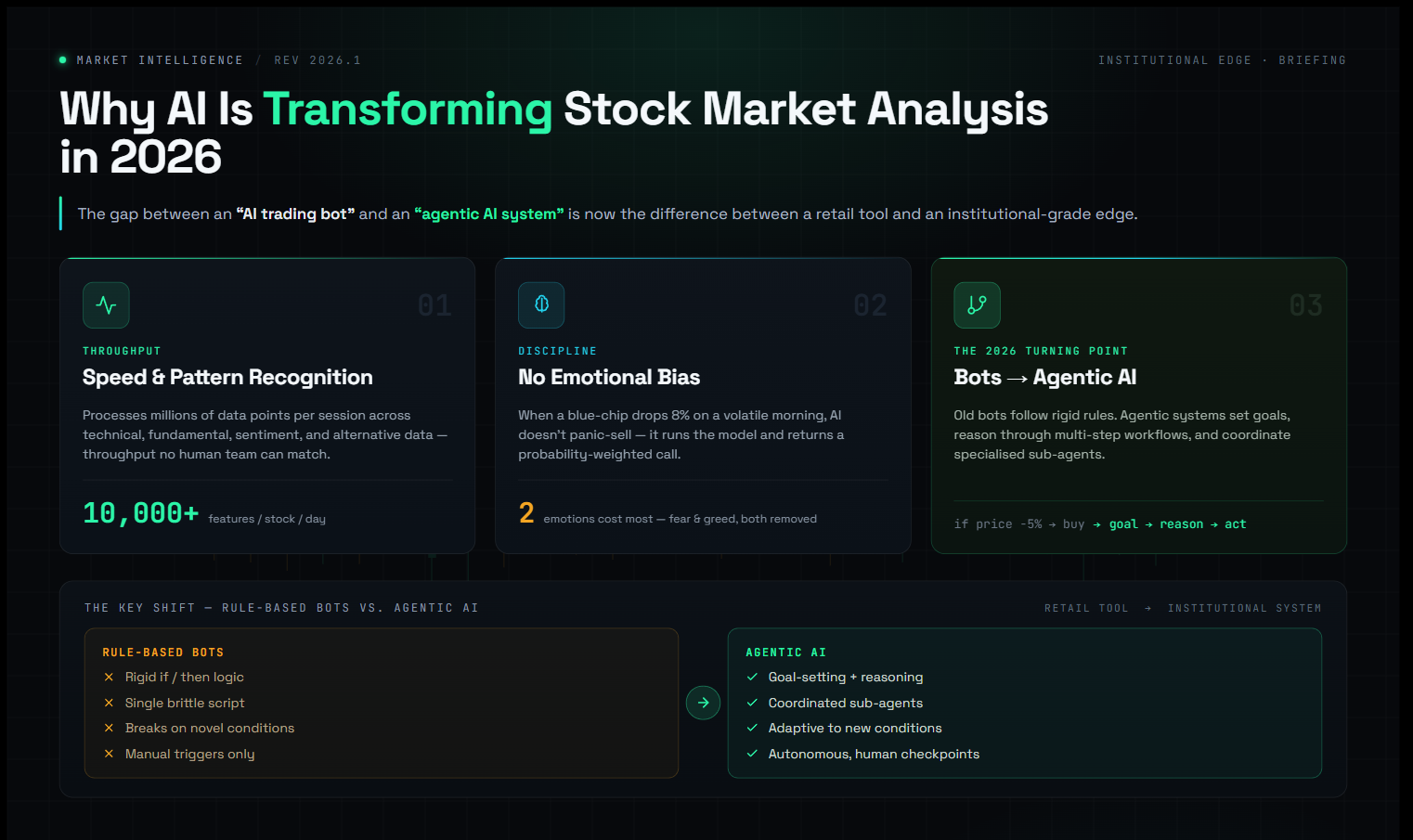
There is also a product-category shift underway. Older “AI trading bots” followed rigid if/then rules. Newer agentic systems set a research goal, pull multiple sources, and coordinate follow-up questions. That architecture is closer to how an equity associate actually works — and farther from a one-shot chatbot reply.
The implication for individual investors and small research teams is straightforward. If the task is “explain free cash flow,” a general chatbot is usually enough. If the task is “what changed in NVIDIA’s risk factors, and how does that affect position size,” reliability depends on specialized retrieval and a defined risk frame.
What Should You Evaluate Before Trusting an AI With Market Data and Risk?
You should evaluate any AI stock tool on source control, recency, risk math, and the ability to reconstruct the answer — not on how confident the prose sounds. Fluency is easy to produce. A dated citation and a stated risk assumption are not.
Use the PRRA+S checklist as a pre-trade filter:
- Provenance: Does every material number map to a filing, transcript, estimate vendor, or market-data source?
- Recency: Can the tool distinguish live prices from delayed quotes and current-period filings from last year’s annual report?
- Risk structure: Does it specify what can go wrong in measurable terms — drawdown, liquidity, concentration, factor exposure, or scenario loss — rather than a generic “markets are volatile” paragraph?
- Auditability: If a second person opens the chat tomorrow, can they see the documents, tickers, and assumptions behind the conclusion?
- Supervisory fit: If the output influenced a recommendation, would it be compatible with suitability and Regulation Best Interest expectations that already apply to AI investment-advice tools?
Two extra tests catch most failures.
First, ask for the as-of timestamp. If the model cannot say when a price, estimate, or filing was current, treat the answer as educational, not operational.
Second, ask what would falsify the view. Specialized assistants that work from filings can usually point to a covenant, margin trend, or guidance change. General chatbots often invent a tidy bear case that is not anchored to the company’s own disclosures.
U.S. financial regulators have not written a separate AI rulebook; they apply existing obligations — supervision, books and records, model risk, and vendor oversight — to algorithmic tools. Retail users are not broker-dealers, but the same logic is useful: if you cannot explain the model, you should not size a position from it.
A related warning applies to social and sentiment overlays. FINRA has cautioned investors against trading solely on social-sentiment tools. An AI that scrapes headlines without a risk budget is a faster version of that problem, not a solution.
How Do ChatGPT, Claude, Gemini, and Specialized Stock Assistants Compare?
General chatbots excel at explanation and drafting, while specialized stock assistants are stronger on document-grounded facts, repeatable screening, and risk-aware workflows. Independent comparisons of ChatGPT, Claude, Gemini, and Perplexity for stock research in 2026 find that no single general model wins every task. That is expected: they were not designed as market-data systems.
ChatGPT is versatile for summaries, modeling guidance, and report drafting, but it lacks real-time access to proprietary financial data unless integrated with APIs. Claude is typically stronger at long-document financial-statement analysis and narrative commentary. Gemini is strongest inside Google Workspace workflows and can add live context, often with less financial depth than Claude on the underlying statements.
Specialized tools invert that trade-off. They constrain the model to a financial corpus and, in the better cases, expose why a score or answer moved.
| Feature / Dimension | General chatbots (ChatGPT, Claude, Gemini) | Jenova Fundamental Stock Analyst | Danelfin | Screener AI |
|---|---|---|---|---|
| Primary data source | Training data, user uploads, optional web/API | SEC filings, analyst estimates, market sentiment, live research tools | Proprietary feature set used to compute an AI Score | Direct access to company filings, annual reports, and earnings calls |
| Real-time market data | Limited unless the user connects data | Session-level research against current public sources; not an exchange feed | Daily score updates and portfolio alerts | Filing-grounded answers, not tick-level quotes |
| Risk framework | Narrative risk, driven by the prompt | Structured fundamental risk plus related portfolio/scenario agents | Score ranks and historical signal track records | Extracts disclosed risks from official documents |
| Auditability | Weak unless the user supplies sources | Persistent memory and source-backed research trail | Company says scores are explainable, not a black box | Answers tied to the documents the system reads |
| Pricing (as of 2026) | Free tiers plus paid subscriptions | Free tier; Plus starts at $20/month for 30× free usage | Unverified | Pay-as-you-use; typical answers about ₹10–30 |
| Best for | Teaching concepts, drafting memos, one-off file review | Repeat equity research with memory across sessions | Screening and timing based on a published score | Fast Q&A against official documents in its coverage set |
The table is not a ranking of intelligence. It is a map of failure modes. Chatbots fail quietly on stale or unsourced numbers. Screeners fail when the question is about portfolio construction rather than a single filing. Score engines fail when users treat a probability rank as a valuation.
General-purpose chatbots
ChatGPT, Claude, and Gemini are the default starting point for most investors in 2026 because they are already open in another tab. Reviewers consistently place them in the “explain financial concepts and draft analysis” category rather than the live-research category.
Their strength is transfer learning. They can walk through a DCF layout, rewrite an earnings recap, or critique a messy Excel assumption list. Their limitation is structural: without a bound data layer, they cannot guarantee that “current revenue” means this quarter.
Jenova Fundamental Stock Analyst
Jenova’s Fundamental Stock Analyst is a specialized equity-research agent for earnings analysis, relative valuation, business-model assessment, and research across SEC filings, analyst estimates, and market sentiment. It runs on a multi-model platform with persistent memory, so a coverage universe and a house view can survive beyond one chat.
That design helps on provenance and auditability. It is weaker as a replacement for an institutional terminal: it is not a licensed advisory channel, and it does not replicate low-latency, venue-level market-data infrastructure used on professional desks.
Danelfin
Danelfin is an AI stock-analytics platform that compresses many features into a 1–10 AI Score and portfolio tools. The company reports that, since 2017, U.S.-listed stocks scoring 10/10 outperformed the market by 21.05% on average after three months on an annualized-alpha basis, and that a published long strategy returned 376% from 3 January 2017 to 9 June 2025 versus 166% for the S&P 500. Those figures are vendor-reported, not independently audited in the materials reviewed for this article.
Danelfin’s clear strength is a repeatable screen with stated feature transparency. Its limitation is the same as any score product: a rank is not a risk budget, a thesis, or a substitute for reading the filing.
Screener AI
Screener AI gives models structured access to official company documents instead of asking them to search the open web. The product’s own comparison is blunt: general tools including ChatGPT Pro and Perplexity often miss relevant documents when they rely on search.
That architecture is strong for “what did management disclose?” questions. It is limited for live tape-reading, options structure, or multi-asset risk, and usage is metered by tokens rather than offered as unlimited chat.
How Reliable Is Real-Time Market Data From General-Purpose AI Chatbots?
General-purpose chatbots are not reliable primary sources of real-time market data, because live prices and quotes are a data-product problem, not a language-model problem. True real-time data is defined by continuous, millisecond-scale updates from market venues. A chatbot may browse, summarize a news page, or read a spreadsheet you uploaded. That is not the same as consuming a entitlements-controlled feed.
The reliability failure usually looks like one of four patterns:
- Cutoff masquerading as current. The model states a price, share count, or margin without an as-of date.
- Web-snippet lag. A browsing layer retrieves a delayed quote page and presents it as the tape.
- Unit confusion. Trailing twelve-month, next-twelve-months, and last-quarter figures get blended in one paragraph.
- Unverified precision. The answer includes exact decimals that imply a feed the model does not have.
CFI’s finance-team comparison is explicit that ChatGPT needs API integration for proprietary or live financial data. Claude’s advantage on long filings does not fix the quote problem. Gemini can feel more current inside Sheets and search-backed workflows, but recency in a spreadsheet is only as good as the function or add-on feeding it.
Specialized research platforms exist because this gap is expensive. AlphaSense positions its research library at more than 500 million documents across broker research, transcripts, filings, and expert interviews. Koyfin packages global equities, macro data, estimates, filings, transcripts, and portfolio tools for advisors and investors who want terminal-style work without assembling a chatbot stack. Those products are not chatbots with a finance coat of paint. They are data systems with search or AI on top.
A useful rule follows. Use a general chatbot to interpret a number you already trust. Do not use it to be the number.
If you need a hybrid, keep the roles separate: a live data or filings tool supplies facts; the chatbot turns those facts into a memo. Mixing the two in one unsourced paragraph is how stale research enters a portfolio.
How Do Specialized AI Stock Assistants Structure Risk Frameworks?
Specialized assistants structure risk more reliably when they separate disclosed risks, quantitative exposures, and portfolio constraints instead of writing a single “key risks” paragraph. General chatbots can list risks. They rarely maintain a framework that can be re-run after the next print.
A research-grade risk frame usually has four layers:
- Issuer disclosure: liquidity, litigation, regulation, supply chain, and customer concentration as the company itself describes them in filings.
- Financial risk: leverage, interest coverage, working-capital swings, and earnings quality.
- Market risk: beta, factor exposure, liquidity of the shares, and gap risk around events.
- Portfolio risk: position size, correlation with what you already own, and what happens in a defined stress.
FINRA has warned that AI used in liquidity, cash management, or portfolio functions can generate aggressive leverage or unsound recommendations in stressed conditions if risk thresholds are not built into the model and the supervisory process. That warning applies to consumer tools too. A chatbot that says “this dip looks attractive” is making an implicit funding and drawdown decision.
Specialized products implement pieces of this stack, not the whole stack.
Screener-style filing assistants are strongest on issuer disclosure. They can pull the liquidity-risk language from a 10-K and keep the wording close to the source. Danelfin-style score engines are strongest on cross-sectional market ranking: they estimate which names have historically been more likely to outperform, which is a form of model risk you can at least inspect if features are disclosed. Terminal-like platforms such as Koyfin are strongest on monitoring exposures once you already have a book.
Jenova’s design splits the stack across specialist agents rather than forcing one chat window to do everything. The Fundamental Stock Analyst handles issuer economics and filing-based risk language. The Technical Stock Analyst frames price, volume, and defined-risk setups. The Portfolio Management Strategist is the layer for allocation drift, scenario stress, and rebalancing logic.
That split is a feature and a limitation. It is closer to how a real desk is organized. It also means a user who only opens the fundamental agent will not automatically receive a book-level stress test. The risk framework is available, but it is not invisible magic.
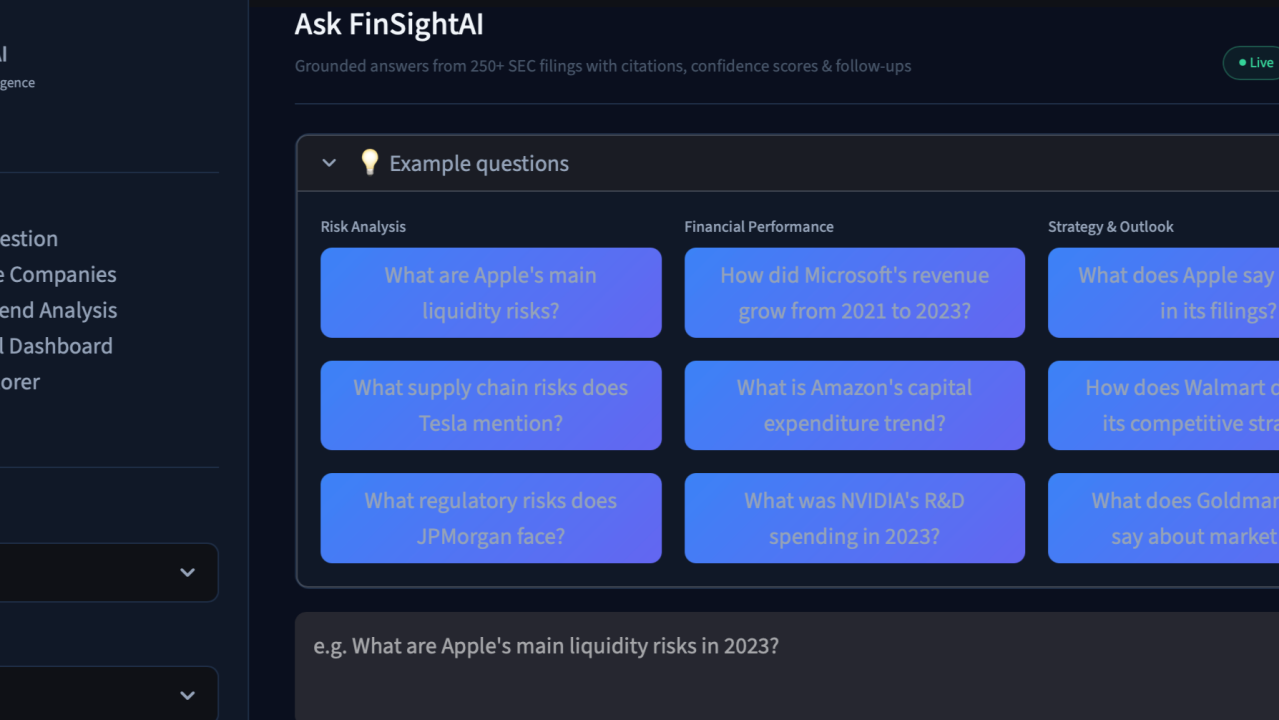
Filing-grounded interfaces illustrate the first risk layer well. Questions such as “What are Apple’s main liquidity risks?” or “What regulatory risks does JPMorgan disclose?” are the right unit of work for a specialist assistant. They are the wrong unit of work for a generic chatbot that may blend an old 10-K with a recent headline.
Federal Reserve model-risk guidance (SR 11-7), which FINRA points firms back to, treats validation as a process for checking that a model performs as intended and that its limitations are known. Retail investors will not run a bank-style validation program. They can still demand the amateur version: stated inputs, stated limitations, and a refusal to treat a black-box answer as a position size.
When Should You Still Use a General Chatbot for Financial Research?
You should still use a general chatbot when the bottleneck is reasoning, writing, or learning — not when the bottleneck is a live number or a supervised risk limit. Specialized tools are more reliable on data and frameworks. They are often worse at teaching a concept from scratch or turning rough notes into a clean investment committee memo.
High-value chatbot jobs include:
- Explaining a metric before you inspect it in a filing (“walk through owner earnings versus free cash flow”).
- Stress-testing your logic after a specialist tool has supplied sourced facts.
- Drafting a one-page brief from notes you already verified.
- Building spreadsheet formulas and scenario templates, which is an area CFI documents as a ChatGPT strength.
- Comparing two interpretations of the same sourced excerpt.
Low-value chatbot jobs include:
- Asking for “today’s price target” with no data attachment.
- Requesting a portfolio hedge without current holdings, betas, or option marks.
- Treating a single chat as a complete due-diligence file.
- Following social-sentiment summaries as if they were a risk model.
A practical split used by careful teams is chatbot as editor, specialist as librarian. The librarian retrieves. The editor writes. When one model does both without sources, errors become hard to see because the prose is smooth.
This is also where honest product limits belong. Jenova’s specialist agents still depend on public filings, estimates, and research tools rather than a paid exchange feed. Danelfin’s scores are forecasts of relative performance, not intrinsic values. Screener AI’s quality is bounded by the documents it actually loads. AlphaSense-class libraries are powerful, and at least one 2026 terminal-alternative review notes that AlphaSense is built for enterprise buyers rather than individuals. No tool in this set removes the need for a human who can say “this position is too large.”
If you only remember one contrast: general chatbots optimize for a helpful answer; specialized assistants optimize for a checkable answer. Reliability for real-time data and risk is a checkability problem.
How Do You Build a Reliable AI Stock Research Workflow?
You build a reliable workflow by assigning each tool a single job: retrieve, interpret, size, then record. Mixing those jobs in one prompt is how chatbot fluency overwrites a risk framework.
A durable sequence looks like this.
1. Define the decision, not the ticker. Write the question in investment terms: initiate, add, trim, hedge, or pass. A research chat without a decision type will optimize for interestingness.
2. Pull sourced facts from a specialist layer first. For fundamental work in Jenova, open the Fundamental Stock Analyst and constrain the mandate:
“Analyze NVDA as a fundamental long. Use the latest 10-K, 10-Q, and most recent earnings release only. List revenue by segment, gross margin trend, customer-concentration language, and the five most material risk factors with filing citations. If a figure is not in those documents, say so.”
On Screener AI, the equivalent is a company-page question against auto-loaded filings, which is the product’s intended path rather than a blank-web prompt.
3. Do not let a general chatbot invent the facts you just requested. If you want ChatGPT or Claude to help, paste the sourced excerpt and limit the task:
“Using only the quoted 10-K risk factors below, group them into liquidity, regulatory, competitive, and operational risk. Do not add risks that are not in the excerpt. Then draft three questions I should ask in the next 10-Q.”
4. Convert narrative risk into a size rule. This is the step most chatbot sessions skip. State a maximum loss, a thesis-invalidating event, and a holding period. If you use Jenova for book-level work, move to the Portfolio Management Strategist with the same constraints:
“Here is my current book and the proposed 4% NVDA add. Run a simple stress: 25% single-name drawdown and a 150 bp rise in real yields. Tell me resulting portfolio drawdown, concentration, and whether the add violates a 15% single-name cap.”
5. Add market structure only after the thesis exists. Technical context can define invalidation, but it should not replace filing work. A clean technical prompt names the risk in advance: entry, stop, and what fundamental event would cancel the setup.
6. Record the as-of stamp. Save the filing dates, the price used, and the reason you would exit. FINRA’s AI guidance keeps returning to books-and-records, testing, and fallback processes for a reason: systems fail, and you need the last good process.
A weekly cadence keeps the workflow honest. Monday: specialist refresh of filings, estimates, and score or sentiment changes. Midweek: chatbot-assisted writing of what changed. Friday: portfolio-level risk, not another thesis. If a tool cannot participate in that cadence without losing context, it is a toy for that job, however strong its model is.
Jenova’s advantage in this loop is persistence: coverage notes, constraints, and prior exceptions can remain in memory instead of being re-pasted. Its limitation is the same as every research assistant in this article — it will not stop you from overriding a risk cap. The framework is only as reliable as the user’s willingness to keep retrieval, interpretation, and sizing in separate steps.
What Do Market Practitioners Say About AI Reliability in Equity Research?
Practitioners who use these tools daily tend to judge them as data systems first and conversational systems second, and they treat unsourced confidence as a risk event. The consensus is less “AI cannot do finance” than “unbounded AI cannot be the book of record.”
"The reliability gap is not about which model is more articulate. It is about whether the system can show the filing footnote, the estimate vintage, and the as-of time of the last price it used. General chatbots compress a wide corpus into fluent prose. Specialized assistants compress a defined corpus into an answer you can audit. Those are different products, and they fail in different ways."
"The costliest errors we see are stale figures, not weak writing. A chatbot that restates a 2023 margin as if it were the current print will survive a casual read. A risk framework that cannot state position limits, factor exposures, or a named stress scenario is a narrative. Narratives do not survive gap openings."
"Explainability is not a compliance slogan. If you cannot reconstruct why a name was flagged — which document, which estimate, which score feature — you cannot defend the position size. That is why we separate retrieval agents from writing models and keep a human checkpoint before anything hits the book."
— Jenova Product Team, equity-research agent design, 8 years in AI-assisted investment workflows
That view lines up with the official overlay. Firms exploring AI advice tools are already expected to think about suitability, conflicts, customer risk profiles, and supervision, not just model quality. Individual investors can borrow the standard without borrowing the legal entity: if the assistant cannot be reviewed, it should not be authoritative.
The 2026 tell is simple. When a tool cites a source, states a timestamp, and names the risk that would kill the idea, it is participating in a research process. When it only sounds sure, it is participating in a conversation.
References
- Corporate Finance Institute — ChatGPT vs. Claude vs. Gemini for Finance
- FINRA — Artificial Intelligence in the Securities Industry: Key Challenges and Regulatory Considerations
- Financial Modeling Prep — What Is Real-Time Stock Market Data?
- LSEG — Real-Time Data Solutions
- IBM — What Is Real-Time Data?
- Risk Management Magazine — How Regulatory Enforcement Is Shaping AI Compliance on Wall Street
- Sidley Austin — Artificial Intelligence: U.S. Securities and Commodities Regulator Guidelines
- FINRA Investor Alert — Social Sentiment Investing Tools
- Helm Terminal — ChatGPT vs Claude vs Gemini vs Perplexity for Stock Research
- The AI Consulting Network — ChatGPT vs Claude vs Gemini for Financial Document Analysis
- Openbook Analytics — Best AI Stock Analysis Tools in 2026
- Danelfin — AI Stock Analytics and AI Score Methodology
- Screener AI — Filing-Grounded Company Research Assistant
- AlphaSense — Top Stock and Investment Research Tools for 2026
- Koyfin — Market Data, Portfolio Analysis, and Research Platform
- Koyfin — Bloomberg Terminal Alternatives in 2026
- Board of Governors of the Federal Reserve System — SR 11-7 Guidance on Model Risk Management