Which AI Game Master Is Best for Mystery and Detective Campaigns?
2026-09-08
How Do AI Game Masters Compare on Clue Tracking, Fair Accusations, and Campaign Memory?
For mystery and detective campaigns in 2026, the most reliable AI game masters are the ones that keep clues consistent, let accusations fail fairly, and remember what was planted three sessions ago. Specialized investigation agents such as The Asylum are strongest when you want a hidden story with wards, secrets, and a case that can actually be solved. Open-ended tools such as AI Dungeon, Friends & Fables, and NovelAI are stronger when you want sandbox freedom, 5e-style parties, or writer-controlled lore.
Mystery play punishes forgetfulness harder than dungeon crawls. A missed sword swing is noise. A forgotten witness statement is a broken case.
Key factors that separate a usable detective GM from a chatty narrator:
✅ Clue persistence — every planted fact stays true until the player discovers, misreads, or spends it ✅ Fair accusation logic — the killer, motive, and method can be deduced; the GM does not rewrite the culprit mid-scene ✅ NPC voice stability — suspects keep the same alibis, tells, and secrets across interrogations ✅ Separation of planning and play — you can adjust tone or difficulty without collapsing the diegetic case ✅ Consequence memory — searches, lies, and alliances change later scenes instead of resetting
To compare these tools usefully, it helps to treat mystery GMing as an information-design problem, not just a prose problem.
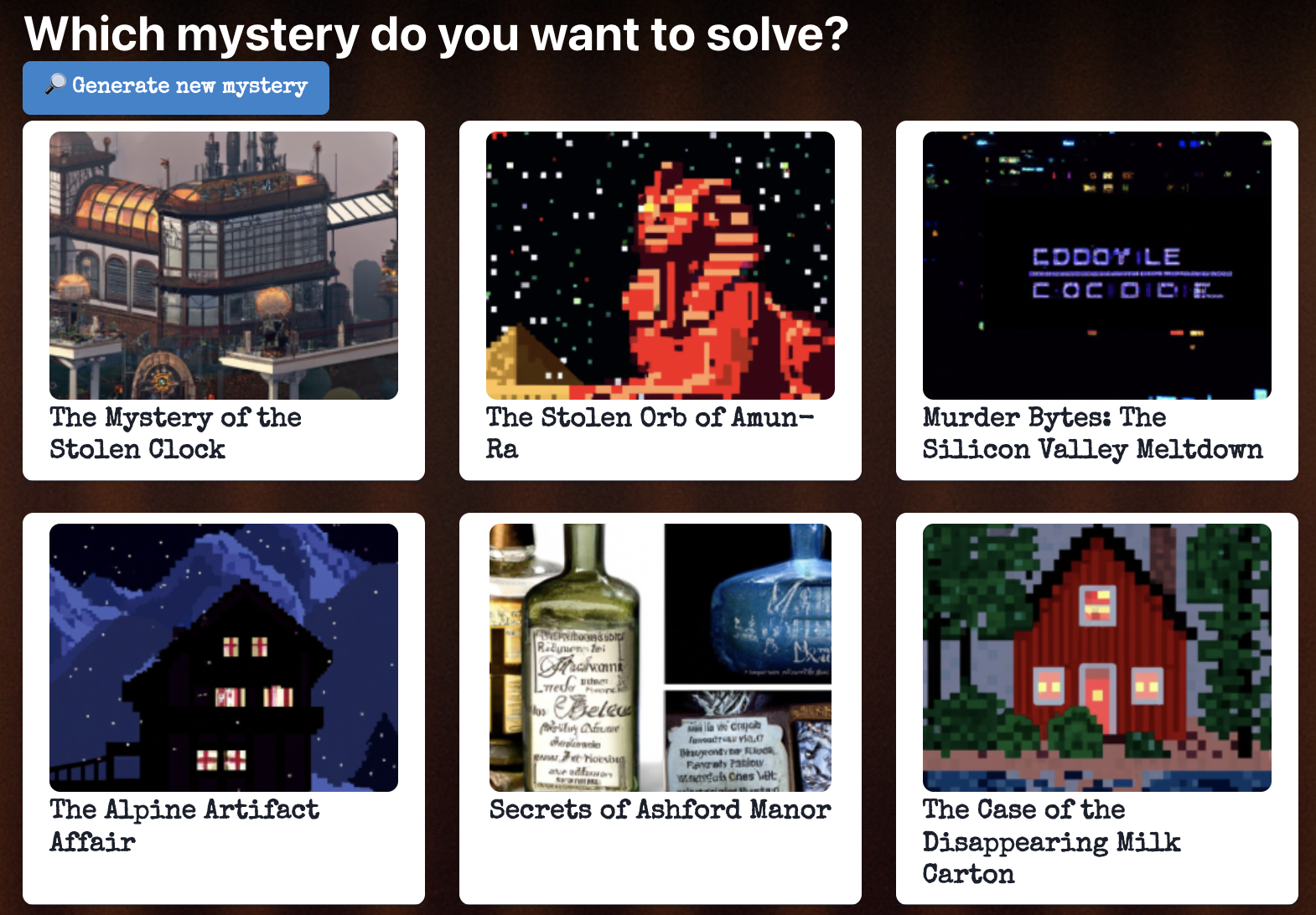
Why Do Mystery Campaigns Expose AI Game Master Weaknesses Faster Than Combat Adventures?
Mystery campaigns expose AI GM weaknesses faster because the player is testing a hidden state, not just requesting the next scene. Combat can survive improvisation. A whodunit collapses if the butler’s alibi, the locked-room geometry, or the time of death drifts.
Researchers studying large language models as RPG game masters have documented narrative vagueness, logical inconsistencies, and difficulty maintaining memory as recurring failure modes. Those defects are annoying in a hex crawl. In a detective story they make the puzzle illegitimate.
A 2026 qualitative analysis of human–AI Dungeons & Dragons play found that an LLM co-creator excelled at idea generation and descriptive text while humans still had to manage cohesion, fairness, and player agency. The same study recorded a climax in which players felt caught off guard by an abrupt, agency-poor ending authored by the model. That is the detective-table failure mode in miniature: a reveal that was not earned.
Open-ended story engines show a related pattern. Early commentary on AI Dungeon noted that generated text can stay locally coherent while the system loses track of the overall narrative and starts strange new plot threads. In a mystery, a new plot thread is often a leaked spoiler or a contradictory clue.
This is why “best AI game master” is the wrong first question for detective play. The better question is which system can hold a secret, drip evidence, and survive interrogation without rewriting the crime.
What Should You Evaluate When Choosing an AI Game Master for Detective Play?
You should evaluate an AI mystery GM on six dimensions: hidden-state integrity, interrogation quality, search granularity, accusation fairness, campaign memory, and how much mechanical scaffolding you need. Prose flavor matters, but it is secondary if the case cannot be solved.
Use this Clue Integrity Framework when you test a tool for one session:
- Hidden-state integrity — Does the culprit, method, and timeline stay fixed after session one?
- Interrogation quality — Do NPCs leak information through motive, omission, and contradiction, not through a confession dump?
- Search granularity — Can you inspect a drawer, a ledger, or a bruise and get a specific result rather than a cinematic summary?
- Accusation fairness — If you accuse the wrong person, does the case continue, or does the GM retcon the killer?
- Campaign memory — Are earlier clues reusable without being restated by the player?
- Rules scaffolding — Do you need 5e combat, a lorebook, or a pre-built investigation space?
Academic work on AI game masters points in the same direction. Function-calling architectures have been proposed specifically to ground an AI GM in structured game state rather than free prose. Comparative work on static versus agentic game masters likewise argues that agentic systems can maintain play with better modularity than a single undifferentiated narrator.
In practice, that means a detective GM should behave more like a case file than a novelist. The file has suspects, evidence, locations, and an ending condition. The novelist can invent a twist that invalidates the file.
A useful field test is simple. Plant three clues, wait twenty turns, then accuse using only those clues. If the GM has invented a fourth killer, forgotten a witness, or handed you the solution unearned, the tool is a story partner, not yet a mystery referee.
How Do The Asylum, AI Dungeon, Friends & Fables, and NovelAI Differ as Mystery GMs?
They differ by how much of the mystery is pre-structured versus improvised. The Asylum is a purpose-built investigation inside a shuttered institution. AI Dungeon is an open story engine. Friends & Fables is a 5e-flavored AI dungeon master with party play. NovelAI is a writer-steered prose and lorebook system rather than a conversational referee.
| Feature / Dimension | The Asylum (Jenova) | AI Dungeon | Friends & Fables | NovelAI |
|---|---|---|---|---|
| Mystery structure | Pre-built investigator scenario with hidden-story payoff | Open-ended custom or community scenarios | World library plus 5e-style quests and combat | Author-steered continuation with Lorebook facts |
| Memory model | Persistent cross-session chat memory on the Jenova platform | Story Cards and Memory Banks for relevant recall | Long-term memory that reacts to written world lore | Keyword-triggered Lorebook entries |
| Interrogation / NPC play | In-fiction investigator conversations inside one case | Adaptive NPCs in free text; multiplayer optional | Franz narrates NPCs inside a campaign world | Strong prose, weaker as a live interrogator |
| Rules / tabletop scaffolding | Narrative investigation, not 5e combat | Story-first; rewind supported | Turn-based 5e-style combat, battlemaps, spells | Writing cockpit with sliders, not a VTT |
| Pricing (as of 2026) | Free tier with limited usage; Plus from $20/month | Freemium; paid tiers reported around $9.99–$49.99/month | Free plan 25 Franz turns/day; Starter $19.95/month | [**Tablet $10/month**](https://www.scrutool.com/review/novel-ai/); Opus $25/month |
| Best for | Solo detective play in a closed, clue-dense location | Sandbox mysteries and wild premise hopping | Groups who want an AI DM with 5e combat | Writers who want long-story consistency in prose |
The Asylum
The Asylum puts you in the investigator role immediately: a shuttered psychiatric institution, a brief that has already gone wrong, and wards that hide a story rather than a loot table. That constraint is a feature for detective play. A closed building with repeating NPCs and searchable rooms is closer to a locked-room mystery than an infinite wilderness.
The honest limitation is scope. It is not a general-purpose GM for every noir city, country-house weekend, or 5e mystery module. Players who want to import official Dungeons & Dragons adventures, run a six-person party, or generate a new premise every night will find it narrower than AI Dungeon or Friends & Fables.
On the Jenova platform it inherits unlimited chat history, persistent memory, and multi-model access, which matters when an interrogation spans many turns. It still will not replace a human referee’s sense of table fairness if you try to stretch it into a rules-heavy mystery system it was not built to adjudicate.
AI Dungeon
AI Dungeon remains the highest-visibility open story RPG, with reporting of 2 million-plus monthly active users across web and mobile in 2026. Its strength for detective campaigns is premise freedom. You can start as a 1930s private investigator, a cyberpunk forensic tech, or a village constable and the model will keep generating scenes.
Memory is explicit rather than ambient. The product’s Story Cards and Memory Banks are designed to store context-dependent information and surface it when relevant, which is the right idea for suspect dossiers. Multiplayer sessions and rewind also help groups recover from a bad accusation.
The limitation is fairness. An engine optimized to “be anyone, go anywhere” will often prefer a surprising continuation over a solvable case. If you do not aggressively curate memory cards, clues mutate. Some free-tier friction, including action limits called out in App Store feedback, also makes long interrogations less comfortable than a dedicated investigation agent.
Friends & Fables
Friends & Fables is built around Franz, an AI game master for text campaigns with D&D 5e-style tactics. The platform reports more than 100,000 players and world builders, a public world library, maps, lore tools, and async play. That is attractive if your “mystery campaign” is actually a party investigation with combats, travel, and a shared battlemap.
Pricing is turn-gated. The free plan includes up to 25 Franz turns per day, while Starter at $19.95 per month unlocks unlimited standard turns. Party size scales from three players on Free to six on the $39.95 Legend plan. Friends can join without paying, which is a genuine group-play advantage.
The limitation for pure detective work is genre gravity. Franz is optimized as a 5e dungeon master, not as a clue economist. The product is also labeled early access beta, with bugs and breaking changes expected, and it is not affiliated with official Dungeons & Dragons. If your table wants social deduction more than spell slots, the combat layer can become noise.
NovelAI
NovelAI is the strongest of these four at turning planted facts into later behavior, because the Lorebook is a first-class memory object. In hands-on testing, a character entry for a one-armed knight reappeared as physical detail and social motive without being restated. For a mystery writer, that is how a scar, a false name, or a missing will should work.
It is the weakest as a live game master. There is no chatty referee, no party table, and little onboarding. You write a line, the model continues, and you steer with Memory, Author’s Note, and sliders. Paid text starts at $10 a month, with the largest context and top model on Opus at $25, plus a dual-currency Anlas system that regularly confuses new subscribers.
Choose NovelAI if you are authoring a mystery and roleplaying through the prose. Choose a conversational GM if you need an interrogator who can say “the maid looks at the clock, then lies.”
How Does Multi-Agent Mystery Architecture Change What a Game Master Can Track?
Multi-agent mystery architecture changes tracking by splitting jobs that a single narrator usually conflates: case generation, image evidence, NPC acting, live refereeing, and ending resolution. When those jobs share one context window, the GM tends to either spoil the culprit or forget the clue. When they are separated, the case file can stay stable while the conversation stays flexible.
A typical pipeline looks like the diagram below. A creator supplies style. A mystery-generator model writes the hidden data. An image model produces crime-scene stills. A game-master model handles interrogation, accusation, and search. A character-roleplayer model holds suspect voices. An ending model only fires when the detective commits.
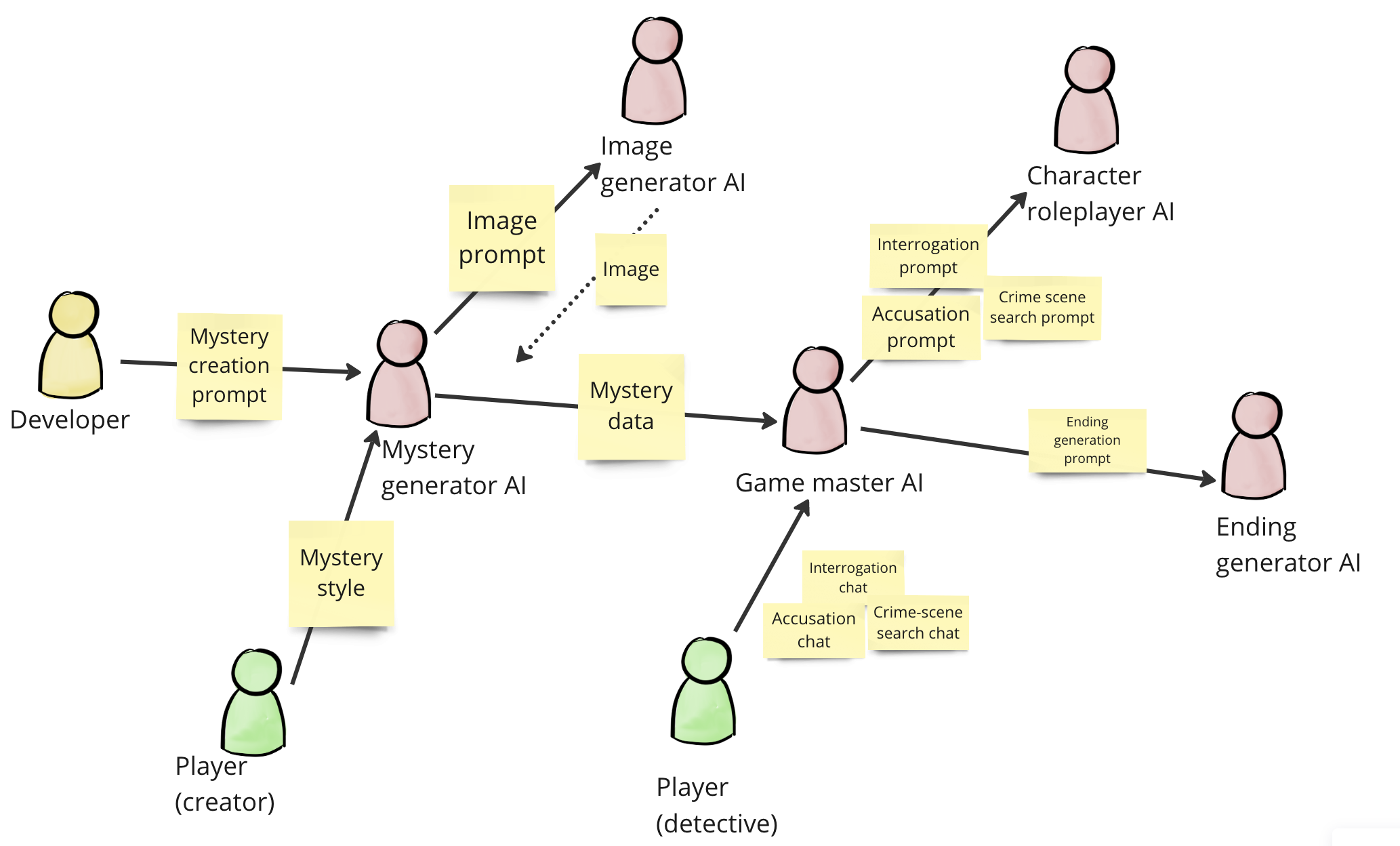
This split maps onto research findings. In the Adventure AI podcast study, the LLM was a productive author of options, but the human DM still curated tone, added mechanical limits, and managed agency. The model was not, in that setting, a complete referee.
For detective campaigns, the practical lesson is not “use more models.” It is “do not let the improviser own the solution.” Keep the culprit, timeline, and physical evidence in a durable store — platform memory, Story Cards, Lorebook entries, or a notes doc — and let the conversational GM query that store.
Jenova’s platform-level persistent memory is useful here because the investigation agent can remember earlier searches without a separate lore editor. Friends & Fables tries the same idea by binding Franz to world lore. NovelAI does it with keyword triggers. AI Dungeon does it with Story Cards. The architecture differs; the requirement does not.
The remaining gap is visual evidence. A photograph of a label, a pixelated terminal, or a manor still can carry clues the prose should not restate. Most chat GMs still treat images as flavor. A mystery-first pipeline treats them as exhibits.
How Do You Start a Detective Campaign With an AI Game Master?
You start by locking the crime before you lock the vibe. Define the victim, the true sequence, three public clues, and one false lead. Then choose a GM whose memory model can hold that file.
For The Asylum, the case is already seated in the institution. Setup is about how you investigate, not whether a crime exists:
- Open the agent at jenova.ai/a/the-asylum.
- State your method in character, not as a genre request:
"I'm the outside investigator they called after the night staff vanished. I will search one ward at a time, interview anyone still on the grounds, and I will not guess the ending until I can name method, motive, and opportunity."
- Treat every room as an exhibit. Ask what you see, what you can take, and who had access after lights-out.
- Keep a player-side case file anyway. Persistent memory helps; it does not replace your own timeline.
A sibling investigation space, The Mansion, uses a different hook — amnesia, searchable rooms, and an escape condition — if you want a mystery that begins with missing memory rather than a professional brief.
For AI Dungeon, you must build the file yourself:
- Create a custom scenario and write the crime in the opening prompt.
- Immediately add Story Cards for each suspect, location, and physical clue.
- Instruct the model that the culprit cannot change.
"Do not reveal the killer. If I accuse the wrong person, let them deny it and keep the true solution unchanged."
- Rewind if the GM invents a second murderer.
For Friends & Fables, write the mystery into world lore before the first Franz turn. Put the will, the floorplan, and the rival NPCs in the world kit so combat scenes cannot overwrite them. Budget turns on the free plan; a 25-turn day is short for a three-suspect interrogation.
If you are still designing the mystery rather than playing it, Game Designer Assistant is the better first stop. Use it to specify clue economy, red herrings, and accusation rules, then hand that document to whichever GM will run the table.
What Do Researchers and Designers Say About AI Game Masters and Player Agency?
Researchers and designers consistently say that AI is already useful as a content co-author and much less proven as the sole guardian of fairness. Mystery campaigns make that gap visible because a bad ending is not merely unsatisfying — it is an unfair test.
"The failure mode we see in investigation play is not boring prose. It is a moving target. If the GM can change the culprit after a clever accusation, the player was never solving a mystery. They were negotiating with a story generator. Persistent memory only helps if the hidden state is actually hidden and actually stable."
"Human GMs spend a surprising amount of effort on extra-diegetic work: protecting agency, pacing the reveal, and deciding when a search has earned a clue. Current models are strong at naming a manor, a toxin, or a suspicious gardener. They are weaker at knowing that the gardener must remain innocent if that was the design. That is why we prefer investigation agents with a closed case file over infinite improvisation for detective campaigns."
"There is also a table problem the lab results keep reproducing. Players will forgive a clumsy combat round. They will not forgive a riddle with no answer, or a finale that steals the last move. If you use a general chatbot as GM, appoint a human editor for accusations. If you use a specialized agent, still keep notes. The technology is good enough to run a case. It is not good enough to be trusted with the only copy of the truth."
— Jenova Product Team, narrative-agent design, 8 years working on AI roleplay and investigation workflows
That view lines up with independent research. The Adventure AI analysis concluded that ChatGPT-style collaborators are well suited to idea generation but did not maintain narrative cohesion or handle interpersonal fairness. University of California San Diego work using Dungeons & Dragons as a stress test has similarly been reported as a way to probe the limits of large language models in structured play.
The design implication is conservative. Use AI to stock the manor, voice the suspects, and describe the dust on the bottle. Keep the solution somewhere the improviser cannot casually overwrite.
Which AI Game Master Fits Your Mystery Style?
The right AI game master depends on whether you want to solve a case, host a party, or write a novel that plays like a case. No single tool leads every profile.
Choose The Asylum if you want to be the detective tonight. It is strongest for solo, location-locked investigation with a hidden story. Pair it with The Mansion if you prefer amnesia-and-escape structure over an official investigator brief. The limitation is campaign breadth: these are deep rooms, not an infinite mystery generator.
Choose AI Dungeon if you want a new premise on demand. It is strongest for players who enjoy improvisation, community scenarios, and the option to rewind a bad deduction. It is a weaker referee. You will do more memory hygiene.
Choose Friends & Fables if your mystery is a group 5e campaign. Franz, battlemaps, and async party play matter more than pure clue logic. The free turn cap and beta instability are the trade-off, and the 5e combat layer is optional weight for a dinner-party whodunit.
Choose NovelAI if you are the author-GM. Lorebook consistency is the point. You will not get a conversational dungeon master, and the editor has a steep learning curve, but planted facts are more likely to return as behavior.
Choose a custom Jenova agent if you need a hybrid. The platform lets you attach instructions, a private knowledge base, and preferred models, which is the practical way to run “my city, my culprit, my three clues” without pretending a general chatbot will remember them. Game Designer Assistant can draft that knowledge base first.
A closed institution, a forgetful narrator, a 5e party, and a lorebook are four different games. Mystery fans get better sessions when they pick the constraint they actually want — and then refuse to let the GM change the killer.
References
- UCLouvain thesis — Large Language Models as RPG Game Masters (narrative vagueness, inconsistency, and memory limits)
- arXiv — Co-Creativity at the Table: qualitative analysis of AI in Dungeons & Dragons play
- Unite.AI — AI Dungeon narrative drift and plot-thread instability
- arXiv — Enhancing AI Game Masters with Function Calling
- arXiv — Static vs. Agentic Game Master AI for solo roleplay
- Apple App Store — AI Dungeon: RPG & Story Maker product features
- aitools.flocci.in — AI Dungeon reach and 2026 usage reporting
- Toolpulp — AI Dungeon review and published pricing tiers
- aitools.fyi — Friends & Fables features, turn limits, party size, and beta status
- Scrutool — NovelAI Lorebook memory, editor model, and 2026 pricing
- Geek Native — UC San Diego research using Dungeons & Dragons to test LLM limits
- Plisio — NovelAI plan overview and starting price