Which AI Essay Tool Best Balances Structure, Feedback, and Voice?
2026-08-25
How Do Top AI Essay Assistants Trade Off Structural Feedback Against Voice Preservation?
The AI essay assistants that protect a student's voice in 2026 are the ones that diagnose structure and name weak reflection without generating replacement prose. Jenova's College Admissions Consultant is strongest when an applicant needs ongoing structural coaching, memory of earlier drafts, and advice tied to the rest of the application. Esslo is the cleanest feedback-only option. Kolly offers the most explicit scoring against accepted essays. GradGPT is the budget choice for unlimited line-by-line comments.
What separates a useful admissions coach from a voice-flattening editor:
✅ Whether the tool comments on your draft or writes new sentences you could paste in ✅ Whether feedback targets narrative structure, reflection, and specificity — not only grammar ✅ Whether the assistant remembers your story, values, and earlier drafts across sessions ✅ Whether the workflow stays inside Common Application rules and campus AI policies ✅ Whether scoring is calibrated to how admissions officers read, not to generic web prose
Those five checks are the Voice Integrity Framework used throughout this guide. Tools that score high on structure and low on voice preservation produce polished essays that sound like anyone. Tools that protect voice but never address structure leave a vivid draft that still fails the "so what" test. The rest of this article evaluates assistants on that tradeoff, not on which interface looks most impressive.
Why Does Preserving Student Voice Matter More in 2026 College Admissions?
Preserving student voice matters more in 2026 because the personal statement is still one of the few places an applicant can speak directly to a reader, while campuses have become more explicit about treating AI-written content as a integrity problem. The Coalition for College describes the essay as the place colleges learn how a student thinks, reflects, and has grown — not whether the prose is perfectly smooth.
Admissions offices are not pretending AI disappeared. They are drawing a line between support and substitution. Caltech's published guidance, summarized by Ethan Sawyer of College Essay Guy, treats grammar review as ethical and treating a model as the drafter as unethical. Princeton's dean of admission, Karen Richardson, has said an AI-assisted essay is unlikely to be as authentic as one the applicant composed, and that applicants certify the work is their own.
Policy is no longer vague at several highly selective campuses. Yale, Cornell, Brown, Columbia, and Georgetown sit in the camp that prohibits AI-generated application content. Brown affirms the Common App fraud definition covering "the substantive content or output of an artificial intelligence platform." The University of California has compared fully AI-generated personal insight answers to academic dishonesty and noted plagiarism checks on applications.
Usage is already widespread. A 2024 survey of college applicants found about 50 percent had used AI for brainstorming and 47 percent to create an outline. A May 2026 Inside Higher Ed report on tens of thousands of essays at a selective university found low-income students were more likely to submit AI-generated admissions essays. That access gap is real. It does not make a generic rewrite safer. Experienced readers already flag polished-but-generic AI essays, and misusing AI can strip the voice that made the file distinctive.
Notre Dame's admissions office puts the evaluation point plainly: essays exist so readers can hear an authentic voice beyond courses, numbers, and activity lists. Voice is not decoration. It is the evidence.
What Should You Look for in an AI Admissions Essay Assistant?
You should look for a tool that can name structural problems with surgical specificity while leaving every submitted sentence under the student's control. Grammar checkers fail the first half of that test. Full-draft generators fail the second. The Voice Integrity Framework below is the comparison model used in this article.
1. Feedback mode
The highest-integrity tools behave like a counselor: they highlight a sagging middle, a missing turn, or a cliché opening, then stop. The riskiest tools offer "rewrites in your voice," which still produce text the student did not write. College Essay Advisors notes that the Common App treats using AI to draft substantial essay content as fraud.
2. Structural depth
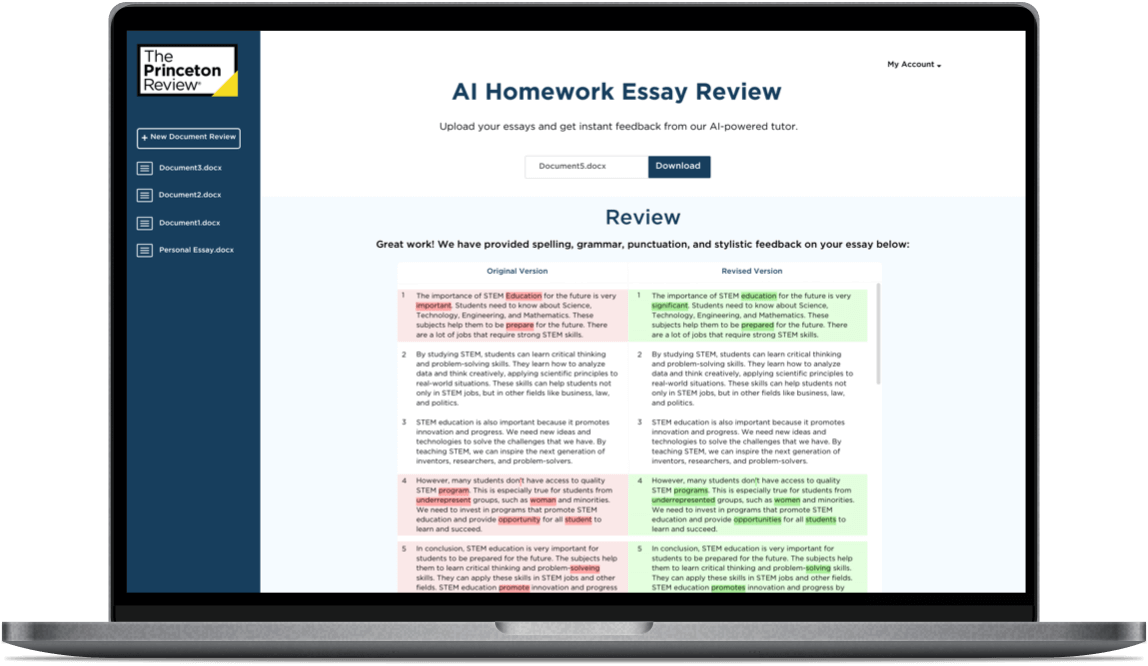
Useful feedback talks about hook timing, one-theme discipline, scene versus summary, and whether the ending earns its meaning. Surface tools mark spelling and "word choice" and call the draft done. Side-by-side homework reviewers of the Princeton Review type can be handy for mechanics. They do not tell you whether a 650-word personal statement actually answers a prompt.
3. Voice preservation
Voice is rhythm, noticing, and the slightly uneven phrasing that belongs to one teenager. Kolly defines authenticity as rising when phrasing and rhythm are unmistakably the writer's. A tool that "improves" every sentence toward a mean is working against that definition, even when the marketing copy says otherwise.
4. Admissions calibration
A general chatbot grades your essay against internet prose. Admissions-trained products claim a different reference class: accepted essays, internal rubrics, or former officers. Calibration is valuable. It is not a substitute for the student's own judgment about what the file should say.
5. Persistence and context
A one-shot score cannot remember that your supplemental essay already covered the robotics story, or that your counselor asked you to cut the grandparent opening. Cross-session memory is what turns a grader into a coach.
6. Policy posture and cost
Price only matters after the first five dimensions. A cheap generator is expensive if a campus later treats the essay as misrepresented work. As of 2026, the Fall Common Application still has no formal checkbox for disclosing brainstorming or editing help, which makes personal discipline more important, not less.
College Essay Guy's practical test is still the cleanest filter: if it would be unethical for a trusted adult to do the same task, it is unethical to ask a model. A teacher may mark grammar. A teacher may not draft the essay for you to tweak.
How Do Jenova, Esslo, Kolly, and GradGPT Compare on Feedback and Voice?
Jenova's College Admissions Consultant is the strongest all-file coach for structure-plus-voice work, while Esslo is the safest feedback-only specialist, Kolly is the most explicit accepted-essay scorer, and GradGPT is the lowest-cost line-by-line reviewer. None of the four is universally preferable. They occupy different points on the Voice Integrity Framework.
| Feature / Dimension | Esslo | Jenova College Admissions Consultant | Kolly | GradGPT |
|---|---|---|---|---|
| Feedback mode | Scores and revision suggestions only; never writes any part of the essay | Conversational coaching; the student decides whether any line is rewritten | Scores plus optional paragraph rewrites "in your voice" | Feedback and revision guidance; story and final words stay the student's |
| Voice preservation | High, because the student implements every change | High when prompted as a coach; weaker if the student asks for a full rewrite | Mixed: authenticity is scored, but rewrites can still flatten idiosyncrasy | High if comments are applied by hand |
| Structure coaching | Writing style, story arc, detail, and character | Narrative structure plus school list, timeline, and application strategy | Hook, theme, detail, authenticity, reflection, writing | Line-by-line comments, hook ideas, topic coaching |
| Admissions calibration | Comparison to 150,000+ scored essays | Domain-specialized consultant; no published accepted-essay corpus | Calibrated to accepted essays from Stanford, Harvard, MIT, Penn, Yale, and other top-tier schools | Built by former admissions officers; Ivy comparison claims |
| Persistence | Tracks improvement across scored drafts | Unlimited chat history and cross-session memory of the student's file | Application home with saved scores per draft | Account-based editor across Common App, UC, and supplements |
| Policy posture | Hard product constraint: feedback only | Coaching-oriented; policy safety depends on how the student uses it | Offers rewrites, which raises risk at ban-list schools | States it does not write the essay |
| Pricing (as of 2026) | Free one round; $40/month for up to 20 drafts; $80/month unlimited | Free tier with limited usage; Plus at $20/month for 30× usage | Free one review; $29/month; $149 per 6 months | Free limited trials; Plus $12/month billed annually or $36/month |
| Best for | Policy-cautious students who want a counselor-style second read | Applicants who need structure, voice memory, and full-application strategy | Students who want percentiles against accepted essays | Budget applicants who want unlimited comments |
Esslo
Esslo's clearest strength is a product rule, not a feature list: it never writes any part of a student's essay. That constraint aligns with campuses that allow grammar help and ban generated content. Georgia Tech's Rick Clark has said that using ChatGPT as a paste-in writer produces a vague essay, while using Esslo for feedback democratizes advice. The platform reports 80,000+ students and counselors and comparison against a large scored corpus.
The limitation is scope. Esslo is an essay reviewer, not a school-list strategist or interview coach. Students who need help deciding what to write about, or how one essay should complement another, will still need a person or a broader assistant. Pricing at $40 to $80 a month is reasonable for a heavy revision month and steep if the student only needed two reads.
Jenova College Admissions Consultant
Jenova's consultant is built as an admissions advisor rather than an essay vending machine. It covers school selection, essay crafting, and timeline management, and it sits on a platform with persistent cross-session memory. In practice, that means the assistant can remember that your activity list already claims the hospital volunteer story, that your last draft overused "impact," and that your target list leans small liberal-arts. Structural advice then refers to the whole file, not a decontextualized 650 words.
The honest limitation is the flip side of flexibility. Unlike Esslo, Jenova does not hard-block essay generation. A student who pastes a prompt and asks for a finished personal statement can get one. Policy safety is a usage pattern, not a product lock. Jenova also does not publish a 150,000-essay scoring corpus or a six-dimension percentile against named Ivy admits. Applicants who want a number more than a conversation will prefer Kolly or Esslo for that single job.
A useful pairing on the same platform is the Writing Assistant, which is designed to keep output sounding like the writer. The clean workflow is consultant first for structure and story choice, Writing Assistant second for line-level clarity after the student has already written the sentences.
Kolly
Kolly is the most transparent about how it reads. It scores hook, theme, detail, authenticity, reflection, and writing, and it stores the score with the exact draft so the same essay is not silently re-judged. The free review is genuinely usable: one full read, no card. The $149 six-month Season Pass**](https://www.kolly.ai/pricing) is inexpensive next to a private counselor season, which GradGPT puts at [**$4,000 to $7,000.
The limitation sits in the rewrite layer. Kolly offers paragraph rewrites and says the essay will sound more like the student after the tool than before. That claim may be true for students who accept one edit at a time. It is still a different act from commenting. At schools that prohibit AI-generated content, a "voice-matched" paragraph is not safer than a ChatGPT paragraph. Kolly's included AI-detection pass is a useful check, not a policy shield.
GradGPT
GradGPT is built by former admissions officers and is explicit that it gives feedback like a counselor rather than writing the essay. It covers Common App and Coalition statements, UC personal insight questions, ApplyTexas, UCAS, and supplements from more than 1,000 colleges. The annual Plus plan at $12 a month is the lowest paid entry among the four, and the company offers free access for students with fee waivers or Title I eligibility.
The limitation is methodological transparency. GradGPT talks about admission rubrics and Ivy comparisons but does not publish a dimension-by-dimension scoring paper the way Kolly does. Some public user comments also describe the feedback as less sharp than a well-prompted general chatbot. It is a strong budget reviewer, not the deepest structural coach.
How Does Admissions-Trained Scoring Differ From General Writing Feedback?
Admissions-trained scoring asks whether a draft would hold a reader's attention in a 12-minute file review, while general writing feedback asks whether the sentences are correct. Those are different jobs, and confusing them is how students end up with grammatically perfect essays that still sound interchangeable.
Kolly's six dimensions are a useful map even if you never buy Kolly. Hook is whether the opening starts in the moment rather than in the situation. Theme is whether one idea carries the essay. Detail is sensory and specific. Authenticity is whether another thoughtful 17-year-old could have written the paragraph. Reflection is the so-what. Writing is control of language. Esslo's categories — style, story arc, detail, character — cover similar ground with less published methodology and a larger comparison set.
General tools live one layer down. A homework essay reviewer that highlights "important" versus "significant," or "prepare" versus "prepared," is doing mechanical work. That work is allowed at campuses that treat grammar software like Microsoft Editor or Grammarly as ethical proofreading. It will not tell you that your essay is six anecdotes with no thesis about who you are.
Jenova's consultant sits between those layers. It does not spit out a public percentile against 150,000 essays. It can, in a single thread, connect a structural note ("this ending restates the intro instead of turning it") to an application note ("this theme already appears in your Stanford roommate essay"). That is closer to how a human counselor reads than how a grammar engine reads.
One research backdrop is worth keeping in view. A PubMed Central study found essay content and style relate more strongly to household income than SAT scores do. Coaching access has always been unequal. A scoring tool can narrow the feedback gap. It cannot ethically close that gap by writing a wealthier-sounding voice over a student's own.
What Happens When an AI Tool Rewrites Instead of Coaching?
When an AI tool rewrites, it substitutes the model's average of "strong teen prose" for the student's actual syntax, and admissions readers are trained to notice that substitution. The danger is not a watermark. The danger is a draft that could belong to anyone.
Collegewise's counseling team has argued that AI-generated essays often sound polished but generic, which experienced readers detect. JRA Educational Consulting makes the same point from the other direction: misusing AI can strip authentic voice and raise red flags. Those are not abstract warnings. They describe a recognizable texture: even cadence, tidy moral, no odd detail that only one household would remember.
Rewrite features blur the trusted-adult test. A counselor saying "this paragraph tells rather than shows" is coaching. A model handing you a replacement paragraph "in your voice" is drafting. Kolly is unusually honest that it will rewrite, and it tells students that accepting every suggestion blindly cheats them out of a real application. That warning is correct. It also concedes the product can be used the wrong way.
Jenova has the same user-driven risk without marketing the rewrite as the core loop. The safer pattern is to forbid generation in the first message and keep forbidding it. Esslo removes the temptation by refusing to write. If a student is applying to a campus in the prohibit-generated-content group, Esslo's constraint is not a nicety. It is the feature.
Grammar-level side-by-side editors sit in a third category. They rewrite locally — a verb tense, a transition — and they are closer to what Caltech allows. They still should not become a silent co-author of every sentence. Voice dies by a thousand "improved" clauses as easily as by one pasted draft.
How Do You Get the Most Out of an AI Essay Assistant Without Losing Your Voice?
You get the most out of an AI essay assistant by writing the first full draft yourself, asking only for diagnosis, and implementing changes in your own wording. The Coalition's checkpoint is the right one: if you cannot explain why you chose the topic, what the story means, why the structure is the structure, and why certain details mattered, you have leaned too hard on the tool.
For Jenova's College Admissions Consultant, a tight setup looks like this:
- Open the consultant and state your constraints before you paste anything.
- Upload or describe the draft, the prompt, target schools, and what you refuse to change.
- Ask for structure, not sentences.
- Revise offline or in a separate doc. Bring the new draft back for a second diagnosis.
A first message that keeps the tool on the right side of the trusted-adult test:
"This is my Common App draft. Do not rewrite it and do not give me replacement paragraphs. Tell me where the structure breaks, which paragraph fails the so-what test, and which sentences could belong to any applicant. Quote my lines when you object to them."
A follow-up after you have revised:
"Here is draft two. I kept the kitchen scene and cut the awards paragraph. What still reads generic, and does the ending earn the opening?"
If a single sentence is truly tangled, move that one line to the Writing Assistant and ask it to offer two options that keep your nouns and rhythm. Do not hand it the whole essay.
For Esslo, the process is simpler because the product will not write:
- Paste the draft and take the score as a map, not a grade to chase.
- Read the "brutally honest" note first. Esslo's own example feedback flags telling-versus-showing and thin emotional consequence.
- Revise yourself. Run a second draft later to see whether detail and reflection moved.
- Ignore any suggestion that would insert a story you did not live. Esslo's own FAQ says counselors, officers, and the model will disagree, and the application is still yours.
For Kolly or GradGPT, use the free or trial review as a second reader, then close the rewrite pane. If Kolly names "start later in the scene" as the one fix, start later in the scene in your words. Kolly says most drafts climb 8 to 15 points across two focused rounds. That climb is only useful if the points came from your revision.
A mechanical last pass with a grammar tool is the one AI step almost every published campus policy still allows. Do it after the story is frozen, not before.
What Do Admissions Product Specialists Say About AI Essay Coaching?
Admissions-focused product teams that watch students revise in real time tend to agree on a blunt split: diagnosis scales, authorship does not, and the students who keep their voice are the ones who treat the model like a skeptical reader rather than a ghostwriter.
"The pattern we see is consistent. Students who ask 'what is structurally wrong with this draft?' come back with weirder, more specific second drafts. Students who ask 'make this sound better' come back with smoother first drafts that have lost the only information an admissions officer could not already get from the activities list. Smooth is not the same as memorable."
"Persistent memory matters more than people think, but not because the model should remember a preferred vocabulary list. It matters because a personal statement, three supplements, and an additional-information box are one argument. If the assistant cannot remember that the robotics story already carried the Common App, it will cheerfully help you tell it four times."
"We would rather lose a user who wanted a finished essay in twelve minutes than ship a workflow that turns every applicant into the same competent narrator. The Voice Integrity test is simple: after the session, can the student still point to a sentence and say they chose that noun because they remember the room?"
— Jenova Product Team, college admissions specialists evaluating applicant writing workflows
That stance matches what campus officers have said in public. Richardson's warning at Princeton and Caltech's ethical/unethical lists are not anti-tool. They are anti-substitution. A good assistant makes the student's own next draft sharper. A poor one makes the next draft someone else's.
Which AI Essay Assistant Fits Different Applicant Profiles?
The right assistant depends on the student's policy risk, budget, and whether the bottleneck is structure, scoring, or line-level comments. Matching the tool to the bottleneck beats collecting subscriptions.
Policy-cautious applicants, including anyone applying to a campus that prohibits generated content. Esslo is the cleanest fit because it cannot write the essay. Pair it with a human counselor or with Jenova used strictly as a question-asker for school list and timeline, not as a prose engine.
Applicants who need structure and a single thread across the whole file. Jenova's College Admissions Consultant is the better primary. It is strongest for students who are still choosing a story, still sequencing supplements, or still deciding what the additional-information box should carry. Use the free tier to test whether the coaching style clicks; Plus at $20 a month is the first paid step if usage runs out mid-season.
Applicants who want a number against accepted essays. Kolly's free review is the fastest way to get hook/theme/detail/authenticity/reflection/writing scores. Pay for the Season Pass only if you will actually run every supplement through it and will refuse the rewrite button. If you know you will click rewrite, Esslo is safer.
Applicants on a tight budget who already have a draft. GradGPT Plus at $12 a month annually is the least expensive unlimited comment loop among the four. It is enough if the draft exists and the need is "show me the weak sentences." It is not enough if the student still does not know what the essay is about.
Applicants who only need mechanics. A grammar editor is sufficient and more policy-aligned than any admissions AI. Do not buy an admissions scorer to fix commas.
Two anti-patterns are worth naming. The first is running the same draft through every tool and averaging the advice. Different rubrics will contradict each other, and the student will sand off every distinctive choice. The second is chasing a percentile. Essay style already correlates with household income. Optimizing toward a corpus of admitted essays can quietly optimize toward a socioeconomic mean. The job is to be legible and specific, not to sound like the median admit.
If you remember only one rule from the Voice Integrity Framework, make it this: structure coaching is the legitimate use of AI in 2026 admissions writing, and submitted sentences must remain the student's. Jenova earns the primary recommendation for students who need that coaching inside a full application. Esslo remains the reference product for students who want the constraint baked in. Kolly and GradGPT are strong specialists if you use them as readers, not as authors.
References
- Coalition for College — AI and the College Essay, on voice, authenticity, and responsible use
- College Essay Guy — Navigating College Applications with AI, including Common App, Caltech, Princeton, UC, and Brown policies
- Oriel Admissions — College AI Policies: Ban, Allow, or Reflect
- The Hechinger Report — 2024 survey on applicant AI use for brainstorming and outlining
- Inside Higher Ed — 2026 study on AI-written admissions essays
- Collegewise — Why Using AI in College Essays Can Hurt Your Application
- JRA Educational Consulting — AI and College Application Essays: Dos and Don'ts
- University of Notre Dame Admissions — Evaluation Criteria, on hearing authentic voice in essays
- College Essay Advisors — What Top 30 Admissions Offices Will and Won't Allow
- Spark Admissions — AI and College Essays: What's Allowed and What Isn't
- Esslo — College Application Essay Feedback product policies and counselor commentary
- Esslo — Published student pricing plans
- Kolly — Free AI college essay reviewer and six-dimension scoring
- Kolly — Pricing, rewrite features, and voice claims
- GradGPT — College essay editor features and ethical-use statement
- GradGPT — Plus pricing and traditional counselor cost comparison
- PubMed Central — Essay content and style related to household income