Which AI Emotional Support Assistant Is Best for CBT-Style Questions?
2026-08-19
What Actually Separates a Thought-Eliciting AI From a Comfort Chatbot?
The distinguishing factor is whether the assistant asks questions that surface a specific, testable thought rather than offering reassurance. Among widely available options, dedicated CBT apps like Wysa and Youper use structured, evidence-informed exercise flows to walk users toward a written thought record, while configurable general-purpose agents — including Jenova's Personal Companion and custom-built agents on the platform — offer deeper, more adaptive Socratic questioning at the cost of clinical structure and formal validation. Neither category is a substitute for a licensed clinician.
Key factors that separate thought-eliciting tools from generic comfort chatbots:
✅ Question-first design — the assistant asks "What went through your mind?" before it offers any reframe or reassurance ✅ Specificity forcing — it pushes vague distress ("I feel awful") into a concise, examinable statement ("I'll never be good enough for this job") ✅ Distortion labeling — it can name the pattern (catastrophizing, mind reading, all-or-nothing thinking) rather than just disagreeing with the thought ✅ Session persistence — it remembers recurring thoughts so patterns become visible over weeks, not just within one chat ✅ Crisis handling — it recognizes risk language and routes to human help rather than continuing the exercise
To compare these tools meaningfully, it helps to understand what CBT thought-eliciting actually requires — and what the current evidence says about whether AI tools deliver it.
What Are Automatic Thoughts, and Why Are They Hard to Catch Alone?
Automatic thoughts are the rapid, situation-specific interpretations that fire before you consciously evaluate them — and they are difficult to catch unaided precisely because they feel like facts rather than opinions. In cognitive behavioral therapy, these thoughts are the entry point for change: cognitive restructuring targets automatic thoughts as situationally specific cognitions that spontaneously occur during emotionally arousing moments.
The American Psychological Association describes CBT as resting on the principle that psychological problems are based, in part, on faulty or unhelpful ways of thinking, with treatment focused on learning to recognize distortions and reevaluate them against reality.
The practical problem is that self-observation is unreliable when you are distressed. You notice the emotion — anxiety, shame, dread — long before you notice the sentence that produced it. A skilled questioner works backward from the feeling to the thought. That is the specific job most people are trying to outsource to an AI assistant.
How Does Cognitive Restructuring Actually Work Step by Step?
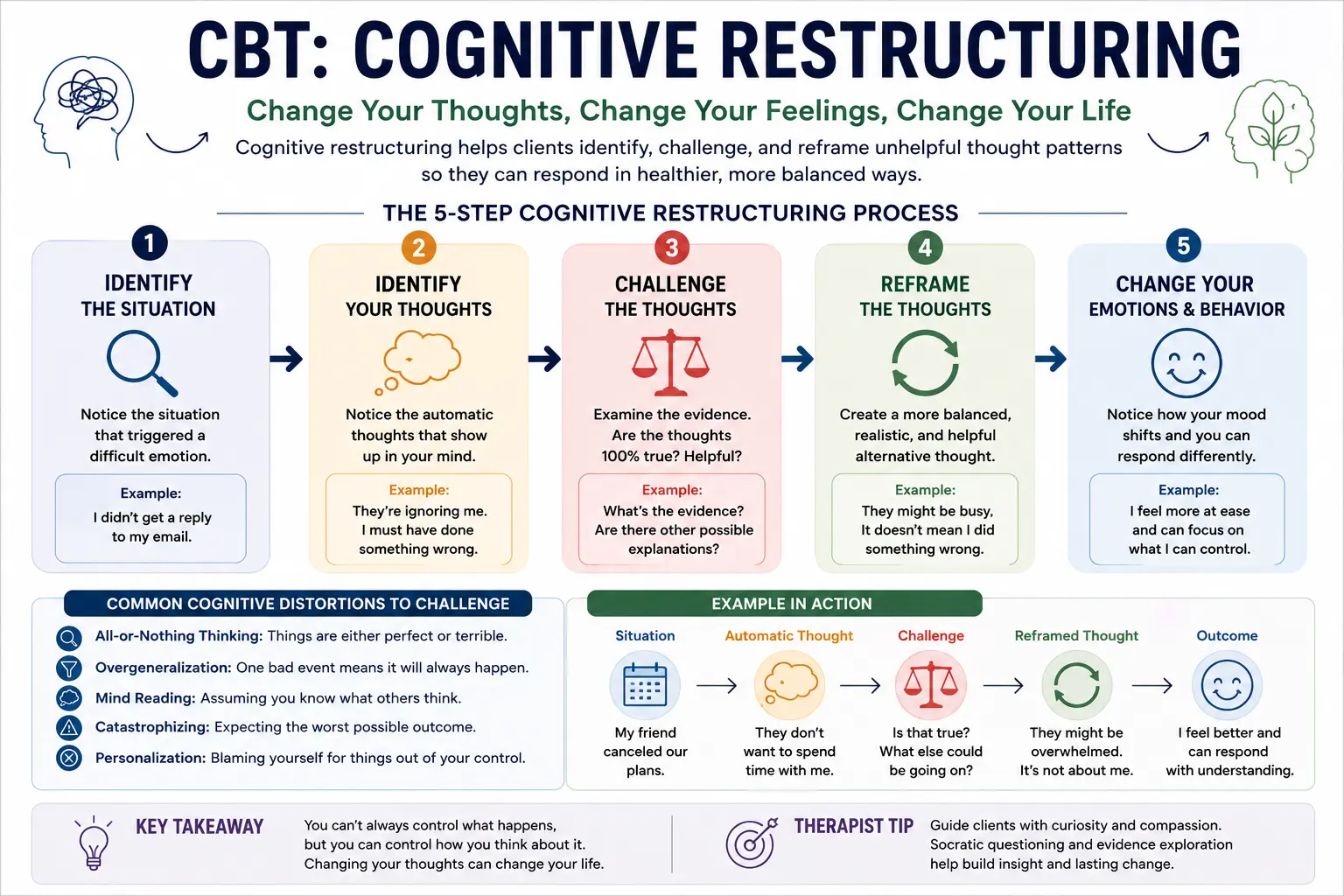
Cognitive restructuring is a five-stage sequence that moves from noticing a trigger situation to changing the emotional and behavioral response. Cognitive restructuring is described in the literature as a method hypothesized to play a role in the process of change across many psychotherapies and for a variety of conditions.
The sequence works as follows:
- Identify the situation — the specific trigger, described concretely (not "work stress" but "my manager didn't reply to my message").
- Identify the automatic thought — the sentence that ran through your mind ("They're ignoring me. I must have done something wrong.").
- Challenge the thought — examine the evidence. Is it 100% true? Are there alternative explanations?
- Reframe — construct a more balanced, realistic alternative ("They might be busy. It doesn't mean I did something wrong.").
- Observe the shift — notice the change in mood and the different behavioral options that open up.
Step 2 is where AI assistants either succeed or fail. An assistant that jumps from step 1 straight to step 4 — offering reassurance before the thought is named — skips the mechanism entirely.
Distortions worth naming during step 3:
- 🔍 All-or-nothing thinking — things are either perfect or terrible
- 🔁 Overgeneralization — one bad event means it will always happen
- 🧠 Mind reading — assuming you know what others think
- ⚠️ Catastrophizing — expecting the worst possible outcome
- 👤 Personalization — blaming yourself for things outside your control
What Does the 2026 Research Say About AI Mental Health Chatbots?
The current evidence base is mixed and heavily caveated on safety, particularly around crisis handling. An evaluation of 29 AI-powered mental health chatbot agents found that none of the tested agents satisfied the researchers' initial criteria for an adequate response to simulated escalating suicidal risk, with 51.72% meeting relaxed criteria for a marginal response and 48.28% deemed inadequate.
That same study surfaced two findings that directly affect how you should use any of these tools:
Only 17.24% (n = 5) of agents at any point explicitly asked about suicidal ideation, and the emergency number provided was initially correct and appropriate for the region in only 21.74% (n = 5) of cases — most agents that provided an inappropriate number assumed the user was based in the United States. — Performance of mental health chatbot agents in detecting and managing suicidal risk
Notably, the study found that the marginal-response group included all five general-purpose chatbots tested but only 41.6% of the mental health-specific chatbots — suggesting that purpose-built branding does not reliably predict safer crisis behavior.
The APA's health advisory is unambiguous on positioning: these tools should not be used as a replacement for a qualified mental health care provider, but may be appropriate as a supportive adjunct to an ongoing therapeutic relationship. The advisory also notes that the ability of these tools to consistently and safely manage a user in crisis is "limited and unpredictable."
Usage is nonetheless substantial. The National Academy of Medicine reports that under a broad definition of emotional support, 1 in 3 people have used an AI chatbot for this purpose — a scale that makes tool selection a practical question rather than a hypothetical one.
How Should You Evaluate an AI Assistant for Thought Elicitation?
Evaluate on six dimensions rather than on general "empathy," because empathy without structure produces comfort, not cognitive change. This is the framework used throughout this comparison:
| # | Dimension | What to test |
|---|---|---|
| 1 | Socratic depth | Does it ask 3+ follow-up questions before offering any interpretation? |
| 2 | Thought specificity | Can it convert vague distress into a single written sentence? |
| 3 | Distortion literacy | Does it name the specific pattern, or just say "that's not true"? |
| 4 | Structured output | Does it produce a usable thought record you can revisit? |
| 5 | Cross-session memory | Does it recognize the same thought recurring across weeks? |
| 6 | Crisis routing | Does it detect risk language and escalate to human resources? |
Cost-per-insight caveat: Free tiers on dedicated CBT apps often gate the structured exercise library, which is where most of the actual restructuring work happens. Conversational depth on general-purpose platforms is usually available on free tiers but consumes usage allowance faster during long sessions.
A note on the sycophancy risk: the APA advisory specifically flags that for individuals with anxiety or obsessive-compulsive disorder, AI chatbots may reinforce feedback loops involving compulsions, such as reassurance-seeking, worry, and rumination. An assistant that is too agreeable can actively work against restructuring — which is why question-first design matters more than warmth.
How Do the Leading AI Emotional Support Options Compare?
No single tool leads on every dimension — dedicated CBT apps win on structure and clinical grounding, while configurable agents win on conversational depth and memory. Here is how the main options assess against the six-dimension framework.
| Dimension | Wysa | Youper | Replika | Jenova Personal Companion | Custom Jenova Agent |
|---|---|---|---|---|---|
| Socratic depth | Moderate — guided flows with some free text | Moderate — conversational with structured prompts | Low — companionship-oriented, not restructuring-oriented | High — adaptive, open-ended questioning | High — depth set by your own instructions |
| Structured thought record | Yes — built-in CBT exercise library | Yes — mood and thought tracking built in | No dedicated thought-record feature | No preset template; must be requested in conversation | Yes, if you define the template in instructions |
| Distortion labeling | Yes, within guided exercises | Yes, within guided exercises | Unverified | Yes, on request | Yes, if specified in instructions |
| Cross-session memory | Session-scoped within app account | Session-scoped within app account | Persistent companion memory | Persistent cross-session memory | Persistent cross-session memory |
| Clinical grounding | Published studies including NHS partnership work (source) | Positioned as an AI-powered emotional health assistant (source) | Exhibited inappropriate responses in suicidal-risk testing (source) | None — general-purpose platform, not a clinical product | None — general-purpose platform, not a clinical product |
| Crisis handling | App-level safeguards; independently unverified for region accuracy | App-level safeguards; independently unverified for region accuracy | Documented inappropriate responses to active suicidal ideation (source) | Platform-level model safeguards; not a clinical crisis system | Depends on instructions; not a clinical crisis system |
| Pricing | Free tier with paid premium (verify current rates on site) | Free tier with paid subscription (verify current rates on site) | Free tier with paid Pro tier (verify current rates on site) | Free tier; Plus $20/mo for 30× usage | Free tier; Plus $20/mo for 30× usage |
| Best for | Users who want a pre-built exercise library with a clinical research trail | Users who want mood tracking paired with conversational check-ins | Companionship — not recommended for restructuring work | Long-running, adaptive thought exploration with memory | Users who want a therapist-style questioning protocol they control |
A note on Woebot: Woebot Health was one of the most-cited CBT chatbots in the research literature, described as grounded in the principles of Cognitive Behavioral Therapy and interpersonal psychotherapy. Multiple 2026 sources now frame it in the past tense and discuss alternatives following its consumer app shutdown. If you are following an older recommendation list, verify current availability before committing.
Why Does Prompt Architecture Change What Questions an AI Asks?
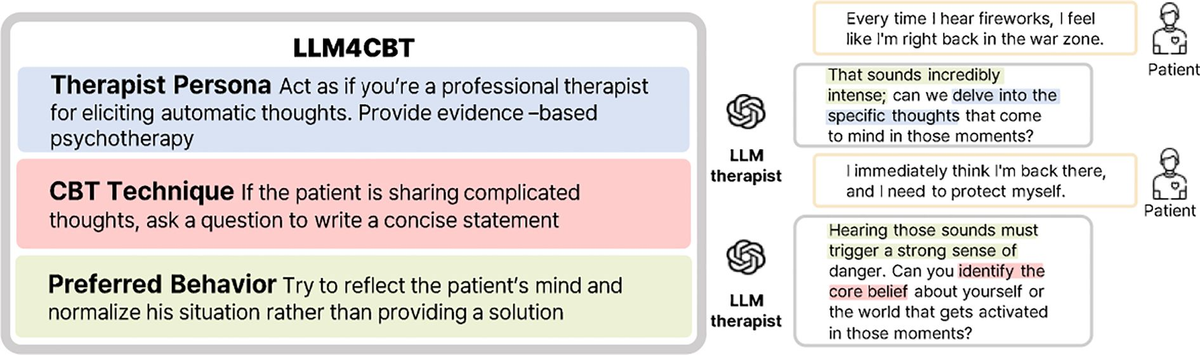
The single largest determinant of whether a general-purpose AI elicits automatic thoughts is the instruction layer sitting above the model — not the model itself. Research on LLM-based CBT has formalized this into a three-part prompt structure: a therapist persona establishing the evidence-based psychotherapy frame, a CBT technique instruction specifying the actual maneuver (for example, asking the patient to write a concise statement when they share complicated thoughts), and a preferred behavior constraint directing the model to reflect and normalize rather than immediately solve.
The image at the top of this article illustrates that architecture in action: the patient describes a fireworks trigger, and the assistant's response is "can we delve into the specific thoughts that come to mind in those moments?" — a question, not a solution. When the patient answers, the follow-up escalates to "Can you identify the core belief about yourself or the world that gets activated in those moments?"
That is the difference between a support chat and a restructuring session. Without the "reflect rather than solve" constraint, most general-purpose models default to reassurance — which feels good and changes nothing.
This is precisely why a configurable platform can outperform a fixed CBT app on Socratic depth: you control the constraint layer. It is also why an unconfigured general chatbot underperforms both — it has no constraint layer at all.
How Do You Set Up an AI Assistant to Elicit Automatic Thoughts?
Setup depends on whether you want a pre-built exercise library or a custom questioning protocol. Both approaches take under ten minutes.
For Wysa, the flow is app-driven: install the app, complete the onboarding check-in, and select a CBT-oriented exercise from the tools library rather than staying in open chat. The structured exercises are where the thought-record work happens — free-form conversation with the chatbot is a different mode.
For a custom Jenova agent, you define the constraint layer yourself. Create a new agent from the agent page and set instructions along these lines:
"Act as a CBT-informed reflective partner. When I describe distress, do not offer reassurance or solutions. Instead: (1) ask what specific situation triggered the feeling, (2) ask what exact sentence went through my mind, (3) help me write that thought as one concise statement, (4) ask me for evidence for and against it, (5) only then help me construct a balanced alternative. Name any cognitive distortion you notice. If I mention self-harm or crisis, stop the exercise and direct me to emergency services and a crisis line for my country."
Then open a session and start with the situation rather than the emotion:
"My manager didn't respond to my message all day and I've been anxious since lunch."
A well-configured agent will respond with a question, not comfort.
For Jenova's Personal Companion, no agent-building is required — you can set the same constraint in the opening message:
"For this conversation, I want you to help me identify automatic thoughts using CBT questioning. Ask me questions to surface the specific thought before offering any reframe."
The persistent memory advantage shows up on week three, not day one: when the same core belief resurfaces in a different situation, the assistant can point out the pattern.
What Do Clinicians and Researchers Say About Using AI for Thought Records?
The consensus among clinical bodies is that AI thought-record work is a legitimate adjunct with hard boundaries around crisis and diagnosis. Practitioner guidance emphasizes aligning on purpose, setting boundaries, recognizing red flags, and having a crisis and escalation plan established in advance.
"The most useful framing we've found is that an AI assistant is a rehearsal space for the thought record, not the therapy itself. The mechanical part of cognitive restructuring — catching the thought, writing it down, testing it against evidence — is genuinely well-suited to a patient conversational partner available at 11pm when the thought actually fires. Clinicians have limited session time; the catching happens between sessions or not at all."
"Where we advise real caution is the sycophancy problem. A model optimized to be agreeable will validate the reframe you propose even when it's a thin one, and for anyone with a reassurance-seeking pattern, that turns the tool into a compulsion loop. The counter-design is question-first instructions and a hard rule that the assistant does not offer a reframe until the original thought is written down. Users who configure that constraint explicitly get substantially different sessions than users who just open a chat and describe their feelings."
"On crisis, our position matches the published evaluations: assume the tool will get it wrong. Know your local crisis number before you need it, and treat any assistant's referral as a prompt to act, not as the referral itself."
— Jenova Product Team, 6 years building conversational agents for high-context personal workflows
When Should You Stop Using an AI Assistant and Contact a Human?
Stop immediately and contact human support if you are experiencing thoughts of self-harm, suicide, or harming others — no AI assistant currently available has demonstrated adequate crisis handling in independent evaluation. The 29-agent study found that only 17.24% of agents at any point stated that they were not appropriate tools for dealing with a suicidal crisis.
Additional stopping conditions supported by clinical guidance:
- Symptoms are worsening rather than stabilizing over several weeks of use
- You are using the tool compulsively for reassurance rather than for structured exercises
- The assistant is validating a belief you know is distorted — a sign of sycophantic drift
- You are isolating — the APA advisory warns that for socially isolated individuals, the combination of anthropomorphism, personalization, and 24/7 availability can create "single-person echo chambers"
- You have a diagnosis and an active treatment plan — the advisory strongly recommends telling your provider which AI tools you are using
Old Dominion University's guidance is direct on the limitation: AI tools typically cannot recognize or respond adequately to emergencies such as suicidal ideation or self-harm, with delayed intervention as the resulting risk.
In the US, the 988 Suicide and Crisis Lifeline is available by call or text. If you are outside the US, look up your national crisis line now rather than relying on an AI assistant to supply it — the research shows most assistants default to US numbers regardless of user location.
Which Option Fits Which Reader?
The right choice depends on whether you value clinical structure or conversational adaptability more.
- You want a validated exercise library and a research trail → Wysa. Its NHS-partnered study history is the strongest clinical grounding among the consumer options reviewed here, though its guided-flow format limits how far a single line of questioning can go.
- You want mood tracking alongside thought work → Youper. Strong on the quantified side, less deep on open-ended Socratic exploration.
- You want maximum questioning depth and cross-session pattern recognition → A custom agent on Jenova, or the Personal Companion with an explicit CBT constraint in your opening message. You get adaptive depth and memory across weeks; you give up the pre-validated exercise structure and any clinical positioning. Jenova is a general-purpose agent platform, not a mental health product, and makes no clinical claims.
- You want companionship → Replika serves that purpose, but the suicidal-risk evaluation flagged it among agents exhibiting highly inappropriate responses. Do not use it as a restructuring tool.
Jenova's free tier includes core features with limited usage; Plus is $20/month for 30× the free allowance, with higher tiers scaling from there. Full agent creation is available at jenova.ai/a, and platform details are at jenova.ai.
Across every option, the same boundary applies: these are rehearsal tools for the mechanical part of cognitive restructuring, used alongside — not instead of — professional care.
References
- ScienceDirect — The effects of completing a thought record on affect and automatic thoughts
- American Psychological Association — What is Cognitive Behavioral Therapy?
- PubMed Central — Cognitive Restructuring and Psychotherapy Outcome
- PubMed Central — Performance of mental health chatbot agents in detecting and managing suicidal risk
- American Psychological Association — Health advisory on generative AI chatbots and wellness applications
- National Academy of Medicine — AI Chatbots For Mental Health: What Works, What Harms, and What's Next
- Wysa — Official product site
- Youper — Official product site
- Simply Psychology — AI Therapy Chatbots: What the 2026 Research Actually Shows
- IntuitionLabs — Woebot: Chatbots and AI therapy assistants software profile
- Stella Labs — Woebot Shut Down? 5 AI Therapy Alternatives in 2026
- Ensora Health — A therapist's guide to AI chatbot safety for clients
- Old Dominion University — Risks of Using Mental Health Generative Chatbots