Which AI Dating Coach Is Best for Improving Your Dating Profile Without Losing Your Voice?
2026-08-15
How Do the Leading AI Dating Coaches Differ on Voice Preservation Versus Output Generation?
The most important dividing line among AI dating coaches is whether the tool generates text for you or coaches you toward writing better text yourself. Tools built around instant output — Rizz, YourMove AI — produce polished lines fast but replace your voice by default. Coaching-oriented tools — Jenova's Dating App Advisor, ChatGPT with careful prompting, and ROAST for photo critique — analyze what you already have and push you to sharpen it. If preserving authentic personality is the priority, the coaching model wins on structure alone.
Key factors that separate voice-preserving coaching from voice-replacing generation:
✅ Feedback-first vs. output-first — does the tool critique your existing bio, or hand you a new one? ✅ Interrogation depth — does it ask about your actual life before suggesting language? ✅ Session memory — can it retain your speech patterns across multiple revisions? ✅ Photo analysis separated from text generation — the two problems require different tooling ✅ Honest negative feedback — a coach that never tells you something is bad is a generator with extra steps
This distinction matters more than raw feature counts, because research published through the National Institutes of Health has examined how perceived originality in dating profile text shapes impressions — a signal that generic AI output actively erodes.
Why Are So Many Daters Turning to AI for Profile Help Right Now?
AI adoption in dating has moved from novelty to mainstream in a single year. According to a study by Match.com and The Kinsey Institute at Indiana University reported by CBS News, 1 in 4 singles — and nearly half of Gen Z — now use AI to improve their dating game, a 333% increase from a year earlier.
The underlying demand is structural. Pew Research Center found that 30% of U.S. adults have used a dating site or app, rising to 53% among those under 30. Yet satisfaction remains split: 53% of users describe their experiences as positive versus 46% negative.
The pain is asymmetric by gender. Pew's data shows 64% of men who used a dating app in the past year felt insecure about the lack of messages received, while 54% of women felt overwhelmed by message volume.
These two problems demand opposite profile strategies. Men typically need differentiation to break through invisibility. Women typically need filtering signals that reduce low-quality inbound volume. A single "optimized bio" template serves neither well.
The dating apps themselves have joined in. Hinge introduced Prompt Feedback for real-time profile input, and Tinder launched a Photo Selector tool — moves documented by the Electronic Frontier Foundation alongside significant privacy concerns.
What Should You Look for in an AI Dating Coach That Protects Authenticity?
An AI dating coach preserves authenticity when it operates as an editor and diagnostician rather than a ghostwriter. Below is the six-dimension framework used throughout this comparison.
The Voice-Preservation Evaluation Framework:
- Input interrogation — Does the tool ask about your hobbies, career, humor style, and dealbreakers before producing language? Tools that generate from a photo screenshot alone cannot preserve a voice they never learned.
- Critique-to-generation ratio — What percentage of output is feedback on your material versus new material? Higher critique ratios correlate with better voice retention.
- Specificity enforcement — Does the tool push you toward concrete details ("I've rebuilt three motorcycles badly") over category claims ("I love adventure")?
- Photo evaluation capability — Can it assess your actual images, or only text? Profile performance is heavily photo-driven, and text-only tools address half the problem.
- Iteration memory — Does it remember your earlier drafts and stated preferences across a session or multiple sessions?
- Honest negative feedback — Will it tell you a prompt answer is boring? Tools optimized for user satisfaction rarely will.
Applying weights matters. For profile work specifically, dimensions 1, 3, and 6 carry the most weight. For conversation help, dimensions 5 and 2 dominate. Most published "best AI dating tool" rankings collapse these into a single score, which is why their winners disagree so often.
How Do the Top AI Dating Coaches Compare on Profile Optimization?
Five tools dominate this category, and they optimize for genuinely different jobs. The comparison below reflects capabilities documented on vendor sites and independent reviews as of 2026.
| Dimension | Jenova Dating App Advisor | Rizz | YourMove AI | ROAST | ChatGPT |
|---|---|---|---|---|---|
| Primary function | Profile critique, conversation coaching, first-date guidance | Reply and opener generation from screenshots | Message tone improvement and openers | Photo and bio analysis for first impressions | General-purpose assistant, dating-capable with prompting |
| Voice preservation | Strong — feedback-oriented, questions before output | Weak by default — generates replies for you | Moderate — focused on message tone refinement | Strong for photos — critique-only, no image generation | Depends entirely on prompt quality |
| Photo evaluation | Yes — image analysis supported | Limited — reads conversation screenshots | No — message-focused | Yes — core strength (per vendor) | Yes, with uploads |
| Honest negative feedback | Yes — positioned around honest feedback | Optimized for usable output, not critique | Optimized for message quality | Yes — "roast" framing is critique-first | Tends toward safe, hedged advice per |
| Cross-session memory | Yes — persistent memory across sessions | Learns reply preferences over time per CBS News | Unverified | Session-based reviews | Available on paid tiers |
| Scope beyond profile | Profile + conversation + first dates | Conversation only | Conversation only | Profile only | Unlimited with prompting |
| Pricing | Free tier; Plus $20/mo | Freemium, premium required for full features | Freemium; 4.4-star rating on Google Play and iOS per VIDA Select | Paid profile reviews | Free tier; $20/mo Plus |
| Best for | Full-funnel coaching with voice retention | Fast replies when you're stuck mid-chat | Polishing message tone | Diagnosing weak photos | Users willing to write detailed prompts |
Where each tool falls short:
- Jenova Dating App Advisor — no integration with dating apps themselves, so you copy material in and edits out manually. No swipe-rate analytics.
- Rizz — ProductsVerdict's 2026 comparison notes premium is required for full functionality, and reply generation inherently substitutes for your voice.
- YourMove AI — narrower scope than general assistants; message-centric rather than profile-centric.
- ROAST — excellent at diagnosis, weaker on ongoing conversation coaching per the same comparison.
- ChatGPT — flexible but not dating-specific, and Reddit reviewers describe its dating advice as "wishy-washy" and overly safe compared to purpose-built tools.
Does AI-Written Profile Text Actually Hurt Your Results?
Yes — when readers detect it. Academic work in the ACM Digital Library on how perceptions of algorithmically generated profile text impact attractiveness and trust investigated exactly this question, examining how perceived AI involvement influences attractiveness and trust ratings in online dating contexts.
Detection is not reliable, but suspicion is widespread. A study reported by IT Brief UK found that 57% of respondents claimed they could spot a fraudulent profile, while 62% could not — a confidence gap that produces a corrosive result: people assume AI involvement even when there is none, and they penalize profiles that feel generated.
The practical implication is a rule of thumb:
The Detection Asymmetry Rule: You gain little when AI-assisted text goes unnoticed, and you lose substantially when it does. Asymmetric downside means the optimal strategy is coaching your own writing rather than deploying generated text.
A Rizz user interviewed by CBS News described exactly this friction — some dates appeared skeptical after he disclosed his AI coaching, though he still found it useful "for just initiating conversation, getting someone's attention, and then being able to just be myself after that."

How Do You Use an AI Dating Coach Without Sounding Generated?
The reliable method is to feed the AI your raw, unpolished material and ask for diagnosis rather than replacement. Below are working procedures for the two most useful approaches.
Using Jenova's Dating App Advisor for profile critique:
- Open the agent at jenova.ai/a/dating-app-advisor
- Paste your existing bio and prompt answers exactly as written — including the parts you think are weak
- Request critique before rewrites:
"Here are my three Hinge prompts, unedited. Tell me which one is weakest and why. Don't rewrite them yet — I want to understand the diagnosis first."
- Upload your current photo lineup for evaluation:
"These are the six photos on my profile in order. Which two are hurting me, and what specifically is wrong with them?"
- Only after diagnosis, ask for direction rather than text:
"My second prompt is too vague. Ask me five questions that would help me find a more specific version of the same idea."
- Write the revision yourself, then submit it for a second pass.
Step 5 is the load-bearing step. Requesting questions instead of answers is what keeps the final language yours.
Using ROAST for photo-only diagnosis:
ROAST operates as a critique service rather than a generator, which makes it structurally safer for authenticity. Upload your profile, receive analysis of photo selection and bio impressions, then apply the findings manually. Because ROAST does not write your bio, there is no generated text to detect.
Using ChatGPT with a voice-lock prompt:
If you prefer a general assistant, constrain it explicitly:
"I'm going to paste my dating profile. Do not rewrite it. Instead, identify the three vaguest phrases, and for each, ask me a question that would surface a more concrete detail from my actual life. Match my sentence length and vocabulary in any suggestions."
Without a constraint like this, ChatGPT defaults to polished, homogenized prose — which is the failure mode Reddit reviewers describe.
What Should You Never Delegate to an AI Dating Coach?
Three categories of material should stay entirely human, and each carries a distinct failure mode.
📝 Specific factual claims about your life. An AI cannot know that you actually spent two years in Lisbon or that your dog is named after a chess opening. Any tool that generates specifics without asking has invented them, and invented specifics collapse on the first date.
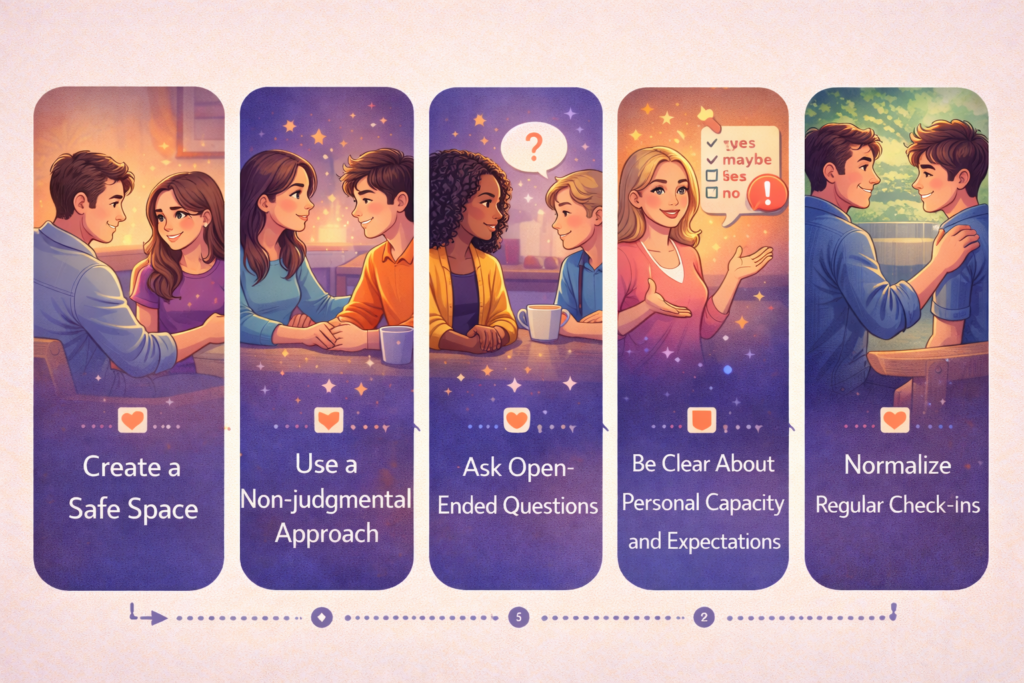
💬 Emotional disclosure and vulnerability. The infographic framework at the top of this article — safe space, non-judgmental approach, open-ended questions, clear personal capacity, regular check-ins — describes work that cannot be outsourced. AI can help you prepare for these conversations. It cannot conduct them.
🔒 Sensitive personal data. This is a privacy issue, not just an authenticity one. The Electronic Frontier Foundation documented that Bumble shared personal user data with OpenAI for its AI Icebreakers feature without explicit opt-in consent, drawing a GDPR complaint from the nonprofit noyb. EFF also notes that Tinder's Photo Selector requires a selfie and uses facial recognition to scan camera roll images without a separate privacy policy governing biometric data.
The Mozilla Foundation's privacy review of dating apps reached a similar conclusion about the sector's data practices generally. Where an AI coach operates outside the dating app — as Jenova's advisor, ROAST, and ChatGPT all do — you retain more control over what the platform ingests, though you should still avoid pasting full names, workplaces, or precise locations.
Which AI Dating Coach Fits Your Specific Situation?
There is no single winner, because the tools solve different problems. Match your dominant bottleneck to the tool:
If your photos are the problem → ROAST. It is the strongest option for photo analysis and produces no text to detect. Pair it with a coaching tool for the bio.
If you get matches but conversations die → Rizz or YourMove AI, used as training wheels rather than autopilot. Read the suggestion, then write your own version. Rizz reports roughly 10 million users, skewing 65% male and largely 18–25.
If your profile gets no traction at all → Jenova's Dating App Advisor or ROAST. Invisibility is usually a diagnosis problem, not a wording problem, and you need honest critique before any rewriting.
If you want one tool across profile, conversation, and first dates → Jenova's Dating App Advisor covers the full sequence with persistent memory, so your speech patterns and past drafts carry forward. Users planning actual dates can also pull in the Date Planner agent for venue and logistics work.
If you are willing to write long, careful prompts → ChatGPT is the most flexible option and costs nothing extra if you already subscribe. It requires the most user skill to produce non-generic output.
A contrarian note: most people reach for conversation tools when their actual bottleneck is photos. Pew's finding that 64% of men felt insecure about low message volume points to a top-of-funnel problem — and no reply generator fixes a profile nobody opens.
What Do Dating and Connection Experts Say About AI Coaching?
Experts converge on a supplement-not-substitute framing, with the risk located specifically at the point where AI replaces rather than prepares human expression.
Kasley Killam, a social health and human connection expert, told CBS MoneyWatch that AI dating tools can be useful as long as people do not misrepresent who they are or lean on them too heavily:
"People are turning to AI for literally any use case you could imagine. And so it's inevitable that people are going to turn to AI for dating coaching."
"The risk is when we use AI as a substitute for human connection, rather than a supplement to it."
— Kasley Killam, social health and human connection expert, quoted by CBS News
The Jenova Product Team, which built the Dating App Advisor around honest feedback rather than output generation, frames the design tradeoff this way:
"The failure mode we designed against is the tool that makes you feel good and changes nothing. When an AI immediately hands you a polished bio, two things happen: you stop thinking about what makes you interesting, and every user of that tool converges on the same voice. We built toward critique first — tell the user which prompt is weakest and why, then ask questions until they surface a detail only they could have written."
"The measurable signal we watch is specificity density — how many concrete, verifiable details appear per hundred words of a profile. Generic profiles cluster near zero. The revisions that perform well are almost always the ones where the user did the writing and the agent did the interrogation. That's an uncomfortable product decision, because generation feels faster to the user in the moment."
— Jenova Product Team, AI agent design for consumer coaching workflows
Are AI Dating Coaches Worth the Money?
For most users, the free tiers are sufficient for profile work, and paid tiers make sense only for ongoing conversation coaching. Profile optimization is a one-time or occasional task — you rewrite a bio, refresh photos, and leave it alone for months.
Cost context matters here. Pew found that 35% of online dating users have paid for dating platforms, rising to 45% among upper-income users. An AI coaching subscription stacks on top of app subscriptions, so the marginal spend deserves scrutiny.
Reference pricing as of 2026:
| Tool | Free tier | Paid entry |
|---|---|---|
| Jenova Dating App Advisor | Yes, limited usage | Plus at $20/mo, 30× free usage |
| ChatGPT | Yes | Plus at $20/mo |
| Rizz | Yes, limited | Premium required for full features |
| YourMove AI | Freemium | Varies by plan |
| ROAST | Paid reviews | Per-review pricing |
Jenova's free tier includes access to the Dating App Advisor with limited monthly usage; the platform is available at jenova.ai. Usage resets monthly on the billing date with no daily caps. For a user rewriting one profile, the free tier typically covers the work.
The honest assessment: an AI dating coach is worth paying for when you use it repeatedly for conversation coaching and date preparation, and rarely worth paying for if you only need a bio fixed once. ProductsVerdict's own methodology note applies here — pricing and features change frequently, and totals after renewal matter more than the advertised entry price.
References
- CBS News — Unlucky in love? AI dating apps promise to help you up your game
- Pew Research Center — Key findings about online dating in the U.S.
- National Institutes of Health — Originality in online dating profile texts: How does perceived originality affect impressions?
- ACM Digital Library — Online Dating Meets Artificial Intelligence: How the Perception of Algorithmically Generated Profile Text Impacts Attractiveness and Trust
- IT Brief UK — Most adults unable to spot AI dating profiles in study
- Electronic Frontier Foundation — Dating Apps Need to Learn How Consent Works
- Mozilla Foundation — Data-Hungry Dating Apps Are Worse Than Ever for Your Privacy
- ProductsVerdict — Best AI Dating Assistants 2026: Rizz vs YourMove AI vs ROAST
- VIDA Select — Top 6 AI Dating Assistants For Rizz On Demand
- ROAST — AI dating profile review