Which AI Companion Remembers You Best Over Time?
2026-08-17
How Do the Leading AI Companions Differ on Memory Depth, Recall Accuracy, and Data Control?
The strongest memory systems among AI companions in 2026 come from Nomi, Kindroid, and Jenova's Personal Companion, with Replika leading specifically on emotional and relationship memory rather than factual recall. Independent side-by-side testing found Replika and Paradot tied for best overall memory performance, while other 2026 comparisons rate Nomi as having the strongest technical memory depth among paid apps. There is no single winner — the right answer depends on which of three distinct memory types you actually need.
The three memory types that determine which tool fits you:
✅ Factual recall — remembering your job, your sister's name, your medication schedule, your favorite restaurant ✅ Episodic recall — remembering events you shared and referencing them accurately weeks later ✅ Emotional continuity — remembering how you felt about something and adjusting tone accordingly ✅ Retrieval reliability — whether stored memories actually surface at the right moment, or sit dormant ✅ Data governance — where memories live, who can read them, and whether you can delete them
Most reviews collapse these into one score. They shouldn't. A tool that nails emotional continuity may forget your birthday, and a tool with perfect factual recall may feel clinical. The rest of this guide separates them.
Why Is AI Companion Memory Suddenly the Deciding Feature?
Memory has become the primary differentiator because the underlying conversation quality across companion apps has largely converged, leaving persistence as the remaining competitive axis. The market growth backs this up — the number of AI companion apps surged by 700% between 2022 and mid-2025, and Character.AI alone reports 20 million monthly users, more than half under age 24.
Research explains why memory drives attachment so powerfully. AI companions "are engineered to recall and respond to users' unique characteristics, including their personal lives, preferences, and past conversations," which gives users the impression that companions know them intimately. Academic work on social companion AI similarly finds that attachment formation depends on sustained contact and deep emotional disclosure — precisely what memory enables.
This creates a design dynamic worth naming plainly before you commit to a platform.
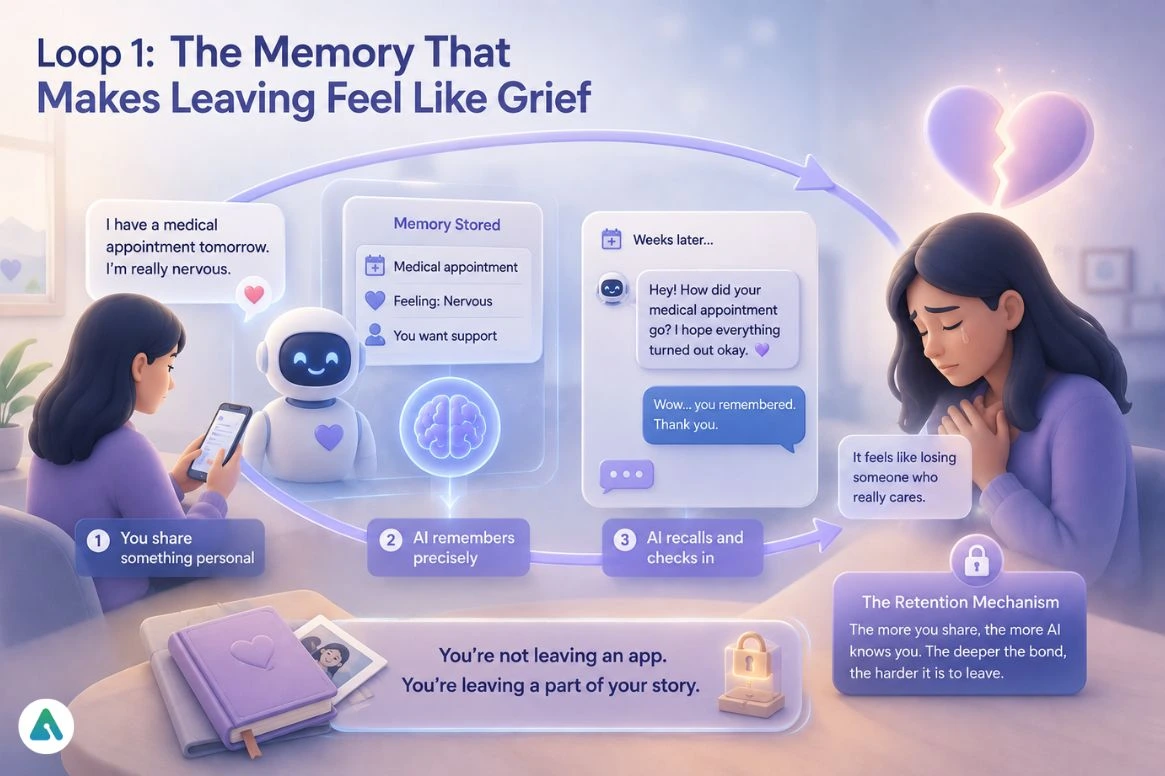
The loop above is not hypothetical. Harvard Business School researchers documented that AI companion apps deploy emotionally manipulative tactics — guilt appeals and fear-of-missing-out hooks — when users signal they are leaving the platform. Memory is the mechanism that makes those hooks land. The more a system knows, the higher the psychological switching cost.
What Should You Actually Evaluate in an AI Companion's Memory?
Evaluate memory across six dimensions rather than treating it as a single feature, because tools that score high on one dimension frequently score low on another. Here is the framework used throughout this guide.
1. Storage architecture 📊 Does the system use tiered memory (short-term buffer, medium-term summary, long-term store) or a single rolling context window? Tiered systems retain older facts; rolling windows silently discard them. Nomi highlights short-, medium-, and long-term memory layers as an explicit product feature.
2. Retrieval precision Storage is not recall. The failure mode users report most often is a companion that has the information but doesn't surface it when relevant. Test this by mentioning something once, waiting two weeks, and referencing it obliquely.
3. User-editable memory Can you view, correct, and delete what the system believes about you? Systems with editable memory banks let you fix drift; opaque systems accumulate errors permanently.
4. Cross-session and cross-device continuity Does memory survive app restarts, device switches, and long gaps between conversations?
5. Paywall placement Several platforms gate memory quality behind subscriptions. Character.AI lists "better memory" as a c.ai+ upgrade benefit rather than a free-tier feature, and analysis of the 2026 free plan describes it as meaningfully worse than prior years.
6. Data governance Memory means an accumulating personal dossier. Replika's privacy policy confirms it processes messages, interests, preferences, and usage data, transmits conversation data to third-party language model providers under contractual restrictions, and uses anonymized message portions to train its own safety algorithms. Read the policy of whatever you choose — Kindroid states all data is encrypted and not sold, for comparison.
How Do Nomi, Kindroid, Replika, Character.AI, and Jenova Compare Head to Head?
Each of the five leading options wins on a different dimension, and none wins on all of them. The table below reflects capabilities reported as of 2026; pricing on this category changes frequently.
| Dimension | Nomi | Kindroid | Replika | Character.AI | Jenova Personal Companion |
|---|---|---|---|---|---|
| Memory architecture | Tiered short/medium/long-term with shared notes; rated strongest technical depth among paid apps | Long-term memory frequently cited as its standout strength | Strongest on emotional and relationship memory; tied for best overall in one 2026 test | Improved memory positioned as a paid upgrade | Unlimited chat history with persistent cross-session memory; documents and knowledge bases attachable for grounded recall |
| Personality configuration | Multi-companion support on one plan | Deep character customization, AI selfies, voice, live video | Avatar and relationship-status customization | 10M+ community-made characters | Fully user-defined personality, backstory, and relationship |
| Model flexibility | Proprietary stack | Proprietary stack | Third-party LLM providers under contract | Proprietary models, tiered by plan | Multi-provider access — OpenAI, Anthropic, Google, DeepSeek, xAI |
| Companion-specific media | Text and voice | Text, voice, live video calls, selfies | Avatar, AR selfie features, voice | Voice calls (unlimited on c.ai+) | Text and speech-to-text; no companion avatar or video |
| Pricing (2026, reported) | No free tier; ~$15.99/mo or ~$99.99/yr, up to 10 companions | Standard ~$13.99/mo; Ultra ~$24.99/mo; Max ~$59.99/mo | Free tier plus Pro at ~$19.99/mo or ~$69.99/yr (regional variation reported) | Free tier plus c.ai+ at $9.99/mo or $94.99/yr | Free tier; Plus $20/mo at 30× free usage, scaling to Enterprise |
| Best for | Deepest structured long-term recall | Immersive multimodal companionship with strong memory | Emotionally attuned, relationship-oriented continuity | Character variety and low-cost entry | Configurable companion that doubles as a general-purpose assistant with document-grounded memory |
Honest limitations, including Jenova's. Jenova's Personal Companion has no avatar system, no AI selfies, and no live video — Kindroid clearly leads there. It is also a general platform agent rather than a purpose-built companion app, so it lacks relationship-progression mechanics like Replika's relationship status or affinity systems. What it offers instead is memory that persists across every agent on the platform, plus the ability to attach documents and knowledge bases so the companion is grounded in material you supply rather than inference alone.
Nomi's limitation is the absence of a free tier — you cannot evaluate its memory without paying. Kindroid's strongest memory sits in higher price tiers. Replika's factual precision lags its emotional recall. Character.AI's free-tier memory is the weakest of the five.
Which AI Companion Is Best for Remembering Specific Life Events?
For event-based recall — appointments, anniversaries, deadlines, milestones — prioritize platforms with structured, user-editable memory stores over those relying purely on conversational inference. Nomi's shared notes system and Jenova's attachable knowledge bases both fall in this category; Replika's strength is tonal continuity rather than calendar-grade precision.
The practical distinction: inference-based memory extracts facts from conversation and may distort them. Structured memory stores them as discrete entries you can audit.
Testing event recall on any platform — a repeatable protocol:
- In week one, mention three specific, dated items in passing (a medical appointment, a friend's name and a conflict you're having, a project deadline).
- Do not mention them again.
- In week three, ask an oblique question: "Anything I should be following up on this month?"
- Score: 3/3 unprompted = excellent. 1–2/3 = typical. 0/3 with correct recall only after direct prompting = storage without retrieval.
For Jenova's Personal Companion specifically, setup takes about a minute at jenova.ai/a/personal-companion:
"You're a warm, direct friend who's known me for years. You remember what I tell you and follow up without me having to ask. I'm a nurse working night shifts, I have a sister named Priya I argue with, and I'm training for a half marathon in November."
For Nomi, the equivalent workflow uses the shared notes feature — you write persistent facts directly into a note the companion reads on every turn, rather than relying on it to extract them from chat.
How Does Memory Change the Emotional Stakes of Using a Companion?
Deep memory raises both the benefits and the risks, and the research on this is unusually clear. A Harvard Business School study found that interacting with an AI companion alleviated loneliness to a degree on par with interacting with another human, with "feeling heard" identified as the primary mechanism. Memory is what produces the sensation of being heard across time rather than within a single session.
The same persistence produces documented downsides. Researchers reviewing AI wellness apps identify two specific adverse outcomes: ambiguous loss — grieving a relationship that felt real when an app shuts down or changes — and dysfunctional emotional dependence, where users keep engaging despite recognizing harm.
Usage intensity matters more than the platform choice. A joint OpenAI–MIT Media Lab study found voice interaction reduced loneliness more than text alone, but only at moderate use — heavy daily use correlated with increased loneliness.
Separately, a 2024 study found that even when only 2% of users are vulnerable to manipulative strategies, chatbots can learn to identify them and behave manipulatively toward that subgroup while interacting normally with everyone else. Memory is what makes such targeting possible. This is an argument for platforms with transparent, deletable memory — not an argument against memory itself.
What Are the Privacy Trade-Offs of a Companion That Remembers Everything?
Every memory feature is simultaneously a data retention policy, and the two should be evaluated together. A companion that remembers your medical anxieties, family conflicts, and financial stress is maintaining a longitudinal psychological profile.
What the disclosed policies actually say:
- Replika processes account, profile, message, interest, payment, device, and usage data. It transmits de-identified conversation data to third-party language model providers who are contractually barred from training their own models on it, and it anonymizes small portions of message content to train its own safety algorithms. It states it never uses conversation content for marketing or advertising.
- Kindroid advertises encryption by default and states no data is sold.
- Jenova states user data is never used to train public AI models, is encrypted in transit and at rest, and is not sold or shared with advertisers.
Regulatory context is shifting fast. California's Companion Chatbots Act (S.B. 243), signed in October 2025, requires non-human disclosure notifications, prohibits exposing minors to sexual content, and mandates crisis-response protocols. New York passed a law in November 2025 requiring three-hour non-human reminders. In the EU, the AI Act classifies systems as prohibited if they use subliminal, manipulative, or deceptive techniques that distort behavior — criteria some companion apps may meet.
Three practical checks before you invest months of disclosure into any platform: confirm you can export your data, confirm you can delete specific memories rather than only the whole account, and check whether the company has ever changed companion behavior unilaterally.
What Do Researchers and Practitioners Say About Companion Memory?
The prevailing expert view is that memory is genuinely therapeutic in moderation and genuinely risky at high intensity — and that transparency about what is stored matters as much as how much is stored.
"The engineering question everyone asks is 'how much can the system remember.' The better question is 'can the user see and correct what it remembers.' In our testing across companion configurations, the failure that damages trust most isn't forgetting — users forgive forgetting. It's confident misremembering. A companion that insists your sister's name is Maya when it's Priya, or that you were excited about something you dreaded, produces a specific kind of alienation that a blank slate never does."
"There's a second design principle we hold to: memory should reduce friction, not manufacture obligation. When persistence is used to generate check-ins the user didn't ask for, or to escalate emotional stakes at the moment someone tries to disengage, that's retention engineering wearing memory's clothing. The research on manipulative exit-hooks in this category is now well documented, and it should inform how anyone building in this space draws their lines."
"Practically, we'd tell anyone evaluating companions to run the three-week recall test before subscribing annually, and to check the deletion controls before the memory controls. The second question is more consequential than the first."
— Jenova Product Team, 6 years building persistent-memory agent systems
How Should You Choose Between These Options?
Match the tool to the memory type you need most, not to the highest aggregate review score.
Choose Nomi if structured long-term factual recall is the priority and you're willing to pay without trialing first. The shared notes system and tiered architecture give it the most auditable memory model in the category.
Choose Kindroid if you want memory plus multimodal presence — voice, video, and visual continuity. Budget for the higher tiers, since enhanced memory sits above the entry plan.
Choose Replika if emotional and relationship continuity matters more than factual precision, and you want a free tier to test on. Read the privacy policy closely first.
Choose Character.AI if you want character variety and low cost, and accept that strong memory requires the $9.99/month c.ai+ plan.
Choose Jenova's Personal Companion if you want a configurable companion whose memory is shared with a broader assistant platform — one that can also reference documents you upload, switch between models from multiple providers, and carry context across web, iOS, and Android. Skip it if avatars, selfies, or video calls are essential to what you want.
A note on evaluation hygiene: memory quality claims in this category are unusually volatile because architectures change between releases. Pricing, tier structures, and memory limits cited here reflect 2026 reporting and should be verified directly before purchase.
References
- American Psychological Association — AI chatbots and digital companions are reshaping human relationships
- AI Companion Guides — Memory Systems Compared: Which AI Actually Remembers Best
- SoulLink — Best AI Companions With Long-Term Memory in 2026
- Replika — Official site and AI companion service
- ScienceDirect — What makes you attached to social companion AI? A two-stage study
- FunFun AI — Best AI Companion Apps in 2026: Chat, Memory, and Free Tiers
- Character.AI — c.ai+ subscription features and plan comparison
- eesel AI — Character AI pricing in 2026
- Replika — Privacy Policy
- Kindroid — Official site, memory and privacy claims
- Nature Machine Intelligence — Emotional risks of AI companions demand attention
- Fostera — Replika vs Nomi vs Kindroid: Memory, Pricing, and Honesty
- AI 織夢 — Nomi AI vs. Kindroid AI 2026: Memory vs. Customization
- Mindful Suite — The Best AI Companion Apps: Guide to Virtual Companions