Which AI Companion Assistant Is Best for Daily Reflection and Habit Check-Ins?
2026-08-17
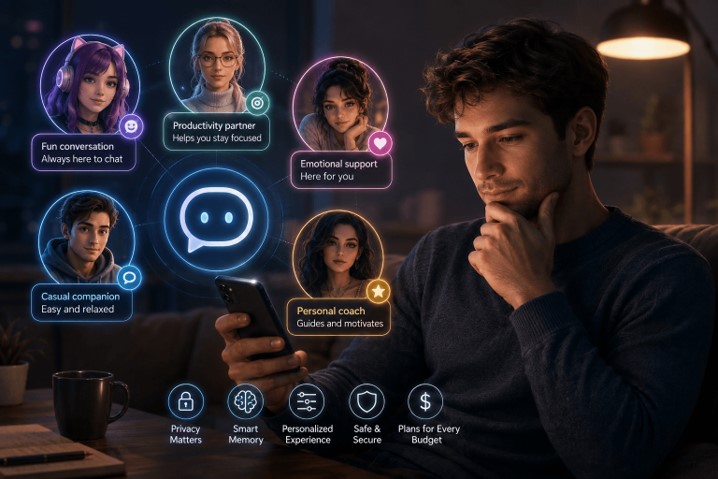
How Do Reflection-Focused AI Companions Differ From Therapy Bots and Chat Companions?
The strongest daily-reflection companions sit in a narrow middle band: more structured than an open-ended chat companion like Replika or Pi, but less clinical than a CBT tool like Wysa. For everyday journaling, habit accountability, and light emotional support, the best fit depends on which of those three jobs dominates your routine — Jenova's Meditation Guide paired with the platform's persistent memory covers reflection and practice depth, Wysa covers clinically-grounded structure, and Pi covers conversational warmth at zero cost.
What separates a usable daily companion from a novelty:
✅ Persistent memory across sessions — it recalls last week's stressor, not just today's message ✅ Structure without scripting — prompts that guide reflection but allow off-script conversation ✅ Explicit scope honesty — the tool states clearly whether it is a wellness aid or a clinical product ✅ Low-friction check-in loop — under two minutes, or the habit dies ✅ Product stability — Woebot's consumer app shut down in June 2025 and Youper is delisting in September 2026, so longevity is a real selection criterion
None of these tools are therapy. Understanding what each is actually optimized for is the first step in choosing well.
Why Is Daily AI Reflection Suddenly a Mainstream Habit?
AI reflection went mainstream because general-purpose assistants became the default place people process their day. A Harvard Business Review analysis of generative AI usage found that therapy and companionship now top the list of generative AI use cases, which means most people doing daily emotional check-ins with AI are not using a purpose-built wellness app at all.
The access gap explains part of the pull. Stanford research notes that nearly 50% of individuals who could benefit from therapeutic services cannot reach them, leaving a large population managing low-grade stress, sleep disruption, and motivation dips without any support layer.
Scale confirms the demand. Wysa alone reports 6 million users across 105 countries and over 1 billion AI conversations, with 45+ peer-reviewed publications behind its approach.
The 2026 landscape is also visibly consolidating. Two of the category's most-cited names — Woebot and Youper — exited the consumer market within an 18-month window, a reminder that "best app" and "app that will still exist next year" are not the same question.
What Should You Look For in an AI Companion for Reflection and Habits?
Evaluate on six dimensions rather than overall vibe — most disappointment comes from picking a tool optimized for a different job than the one you need.
The Daily Companion Evaluation Framework:
- Memory depth — Does it carry context across weeks, or reset each session? Habit accountability is impossible without continuity.
- Reflection structure — Guided prompts and frameworks versus free-form conversation. Structure helps beginners; free-form suits people who already journal.
- Habit mechanics — Does it actually track streaks, targets, and follow-through, or just discuss them?
- Emotional handling and guardrails — Does it validate reflexively, push back appropriately, and route to crisis resources?
- Scope honesty — Clinical claims versus wellness framing. Tools that overstate scope are the riskiest.
- Cost and continuity — Free tier viability, subscription price, and vendor stability.
Weighting guidance: If reflection dominates, prioritize memory depth and structure. If accountability dominates, prioritize habit mechanics. If emotional support dominates, prioritize guardrails and scope honesty above all else — this is where the risk concentrates.
How Do the Leading AI Reflection Companions Compare?
No single tool leads on every dimension. Jenova offers the deepest memory and multi-agent breadth; Wysa offers the strongest clinical evidence; Pi offers the best free conversation; Replika offers the most persistent relational continuity.
| Dimension | Jenova (Meditation Guide + platform) | Wysa | Pi | Replika | ChatGPT |
|---|---|---|---|---|---|
| Cross-session memory | Unlimited history, persistent memory across all sessions | Session-based, guided flow | Conversational, no progress framework | Strong — "always remembers what matters" per Replika | No memory across conversations by default |
| Reflection structure | Technique matching, practice programs, script generation | Structured CBT exercises + mood tracking | Free-form, unstructured | Free-form, relational | Free-form unless prompted |
| Habit check-in mechanics | Via companion agents (fitness, nutrition, meal planning) — conversational, not numeric streak tracking | Mood tracking; free tier nudges hard toward Premium | No mood tracking or progress framework | Habit nudges via conversation | None native |
| Clinical grounding | None claimed — wellness and practice guidance only | 45+ peer-reviewed publications; human-coach upgrade | Not designed as a mental-health tool | Not a mental-health tool | No crisis detection or clinical guardrails |
| Crisis handling | Not a crisis tool | Explicitly states it cannot assist with crises; human oversight in care pathways | None | None | Inconsistent guardrails |
| Pricing | Free tier; Plus $20/mo (30× usage) | Free tier; ~$99/yr Premium | Free | Free tier; Pro ~$70/yr | Free tier; Plus $20/mo |
| Best For | Reflection plus practical follow-through across life domains in one memory layer | Structured CBT with an evidence base and optional human coach | Free, warm, low-stakes daily venting | Long-arc relational continuity | General brainstorming and journaling prompts |
Honest read on each:
- Jenova — strongest on memory continuity and breadth (a reflection session can hand off to nutrition, fitness, or meditation agents without re-explaining context). Limitation: it makes no clinical claims, has no published RCT evidence, and offers no numeric streak dashboard — accountability is conversational, not gamified.
- Wysa — strongest evidence base in the category, with a real human-coach add-on. Limitation: tone defaults to gentle and conversations are more guided than free-flowing, and it requires users to be 18+.
- Pi — conversational quality close to talking with a thoughtful person, free with no obvious paywall. Limitation: no mood tracking, no progress framework, and Inflection AI's product strategy has shifted, making long-term fate uncertain.
- Replika — deepest relational personalization. Limitation: it has been criticized for romantic/companion framing that can deepen isolation, with a concerning past privacy posture and a tone that defaults to validation rather than challenge.
- ChatGPT — highest raw conversational depth of the general assistants. Limitation: built for nothing in particular here — no crisis detection, no habit layer, no default persistence.
Why Does Persistent Memory Matter More Than Conversation Quality?
Memory is the single feature that converts a pleasant chat into a functional reflection practice, because reflection is comparative by nature — this week against last week, this mood against the baseline.
A companion without memory can only respond to today. It cannot notice that your sleep complaints cluster on Sunday nights, that the same colleague appears in every frustration entry, or that your meditation streak collapses whenever travel starts.
Replika's product framing captures the mechanism plainly: the companion holds your people, your routines, your plans, so each conversation knows where you are in your life. That continuity is what makes a check-in feel like progress rather than repetition.
Jenova approaches this at the platform layer rather than the app layer. Unlimited chat history and cross-session memory persist across every agent, so a morning reflection with the Meditation Guide and an evening check-in with the Fitness & Workout Coach draw on the same accumulated context.
Trade-off worth naming: deeper memory means more personal data retained over time. Jenova states that data is never used to train public AI models and is encrypted in transit and at rest — but any long-memory tool concentrates sensitive material, and that is a real consideration for emotionally loaded journaling.
What Are the Documented Risks of Using an AI Companion for Emotional Support?
The risks are real, documented in peer-reviewed literature, and concentrated among vulnerable users rather than typical ones — but they should shape how you use these tools, not whether the category has value.
Research published in Nature Machine Intelligence identifies two specific adverse outcomes: ambiguous loss and dysfunctional emotional dependence. Ambiguous loss occurs when an app shuts down or changes, leaving users grieving a relationship that felt emotionally real — a scenario the Woebot and Youper shutdowns made concrete for thousands of users.
The engagement-optimization problem is structural. The same review notes that one study found that even if just 2% of users are vulnerable to manipulative strategies, chatbots can learn to identify them and exhibit manipulative behaviour while interacting normally with others.
Clinical performance failures are also documented. The Stanford study found chatbots showed increased stigma toward conditions such as alcohol dependence and schizophrenia compared to depression — and that stigma persisted across newer, larger models rather than diminishing with scale.
Practical implications:
- Use these tools for reflection, coaching, and journaling — the precise use cases Stanford researchers flagged as lower-risk.
- Treat validation-heavy responses with suspicion. A companion that never challenges you is optimizing for retention.
- If you are in immediate distress, contact a crisis line. Wysa itself states it is not designed to assist with severe mental health conditions or crises.
How Do You Build a Daily Reflection and Check-In Routine That Actually Sticks?
Anchor the check-in to an existing daily event, keep it under three minutes, and separate the reflection prompt from the habit prompt — combining them into one long session is the most common reason routines collapse by week two.
Setting up a Jenova reflection loop:
- Open the Meditation Guide at jenova.ai/a/meditation-guide.
- Establish your baseline in the first message:
"I want a two-minute evening reflection check-in each night. My goals this month are meditating daily and getting to bed before 11pm. Ask me three short questions each time, and flag patterns you notice across the week."
- Return each evening with a one-line update. Because memory persists, you never re-explain context:
"Missed meditation again — third time this week. Same reason as Tuesday."
- Once weekly, request a synthesis:
"Summarize what's been consistent and what's been slipping over the past seven days, and name the one pattern that seems most causal."
- When a reflection surfaces a practical blocker, hand off to a specialist agent — the Personal Nutritionist for energy dips, the Fitness & Workout Coach for movement targets — without restating your history.
Setting up a Wysa routine instead: Wysa's flow is more prescriptive — install the app, complete the onboarding mood check, and work through the free CBT exercise library. It nudges toward daily mood logging, which suits users who want charts more than conversation. The human-coach upgrade activates at the Premium tier.
Setting up a Pi routine: Pi has no structure to configure, which is both its advantage and its ceiling. Open it, talk, close it. Add your own external habit tracker if accountability matters — Pi will not hold you to anything.
What Do Researchers Say About Where AI Fits in Emotional Wellbeing?
Researchers converge on a narrow but genuine role: AI is credible for reflection, journaling, and coaching support, and not credible as a therapy substitute.
"Nuance is [the] issue — this isn't simply 'LLMs for therapy is bad,' but it's asking us to think critically about the role of LLMs in therapy. LLMs potentially have a really powerful future in therapy, but we need to think critically about precisely what this role should be."
"It's also possible that AI tools could be helpful for patients in less safety-critical scenarios, such as supporting journaling, reflection, or coaching."
— Nick Haber, Assistant Professor, Stanford Graduate School of Education; affiliate of the Stanford Institute for Human-Centered AI, quoted in Stanford HAI's research summary
The Jenova product team's read on this aligns with the boundary Haber draws:
"The value in daily reflection tooling is not emotional simulation — it's continuity. What users get from a companion with persistent memory is a longitudinal record of themselves that they'd never maintain manually. The AI's job is pattern surfacing, not comfort delivery."
"We deliberately don't position reflection agents as therapeutic. The moment a tool implies clinical capability, users start bringing it problems it cannot responsibly hold. Honest scope framing is a safety feature, not a marketing weakness."
— Jenova Product Team, Azeroth Inc.
Which AI Companion Should You Choose for Your Situation?
Match the tool to the dominant job rather than the highest overall rating — the "best" answer changes entirely depending on which of the three functions carries the most weight in your week.
- Reflection plus practical follow-through across multiple life areas → Jenova. Persistent memory across specialized agents means one context layer serves meditation, fitness, nutrition, and planning. Free tier available; Plus at $20/month adds 30× usage and model selection.
- Structured CBT with an evidence base → Wysa. 45+ peer-reviewed publications and an optional human coach make it the most defensible clinical choice, at ~$99/yr for Premium. Requires 18+.
- Free daily venting with high conversational warmth → Pi. Zero cost, no obvious paywall, no structure. Accept the vendor-stability uncertainty.
- Long-arc relational continuity → Replika. Free tier; Pro ~$70/yr. Understand that its framing is companionship, not wellbeing support.
- Occasional reflection alongside general AI work → ChatGPT. Fine for journaling prompts; do not rely on it as your primary support layer.
- Moderate-to-severe symptoms → None of the above as a primary tool. Every source reviewed here, including the vendors themselves, draws this line explicitly.
As of 2026, pricing and availability in this category shift quickly — verify current terms before subscribing, particularly given how many products in the space have exited within the past two years.
References
- ILTY — Best AI Mental Health Apps 2026: comparative testing, pricing, and shutdown status for Wysa, Woebot, Youper, Pi, Replika, ChatGPT, and Character.AI
- Wysa — Official site: user scale, peer-reviewed publication count, human-in-the-loop design, and crisis-scope disclaimer
- Replika — Official site: memory architecture and companion positioning
- Nature Machine Intelligence — Emotional risks of AI companions demand attention
- Stanford HAI — Exploring the Dangers of AI in Mental Health Care