Which AI College Consulting Tool Compares Aid Offers Best?
2026-08-26
How Do AI College Tools Differ on Net-Price Accuracy and Award-Letter Parsing?
Dedicated award-letter parsers such as College Raptor are strongest when the job is turning uploaded offers into a clean net-price grid, while Jenova's College Admissions Consultant is more useful when the comparison also has to weigh scholarships, graduation outcomes, and four-year strategy. Orbit's Solvi and Kollegio AI help earlier in the search with matching and scholarship discovery, but they are less specialized at line-by-line offer forensics.
The distinction that matters in 2026 is not “which chatbot sounds smartest.” It is whether a tool can isolate gift aid, refuse to treat loans as discounts, and keep family finances consistent across every school on the list.
Key factors that separate a useful AI aid comparison from a generic chat:
✅ Gift-aid isolation — grants and scholarships subtracted; loans and work-study kept in separate columns ✅ Sticker-to-net translation — Cost of Attendance (COA) converted into federal-style net price, not a marketing “discount” ✅ Multi-offer side-by-side — the same definitions applied to every letter, including unmet need ✅ Post-letter scholarship search — a plan for closing gaps after the first award arrives ✅ Memory of the Student Aid Index (SAI) — one family profile reused instead of re-explaining finances at every school
To compare these tools honestly, it helps to use a single evaluation model — the Net-Cost Clarity Framework — rather than a feature checklist copied from marketing pages.
Why Does Comparing Financial Aid Offers Matter More in 2026?
Sticker price is a poor predictor of what a family actually pays, and the gap between published tuition and net price is now large enough that choosing on reputation alone routinely misranks schools. In academic year 2021–22, the average net price at four-year institutions was about $15,200 at public colleges, $29,700 at private nonprofits, and $24,400 at private for-profits, in constant 2022–23 dollars.
Those net-price figures already subtract grant and scholarship aid. They do not subtract loans. Families who treat a $20,000 loan package as a “$20,000 scholarship” systematically understate four-year debt.
Published prices have kept climbing even as net prices diverge by sector. BestColleges estimates the 2024–25 sticker at roughly $29,900 for in-state public universities and $63,000 for private colleges. The Education Data Initiative puts all-in annual cost, including living expenses, near $38,270. On-campus COA in 2022–23 averaged [**$27,100 at public four-year colleges and $58,600 at private nonprofits**](https://nces.ed.gov/programs/coe/indicator/cua/price-of-attending-an-undergraduate-institution).
The federal formula changed as well. The Expected Family Contribution has been replaced by the Student Aid Index, which ranges from –1500 to 999999 and feeds Pell Grant and campus-based aid calculations. Federal Student Aid now computes aid from SAI, year in school, enrollment status, and each school’s COA. Award letters have not standardized around those labels, which is why two “generous” offers can describe the same dollars in incompatible ways.
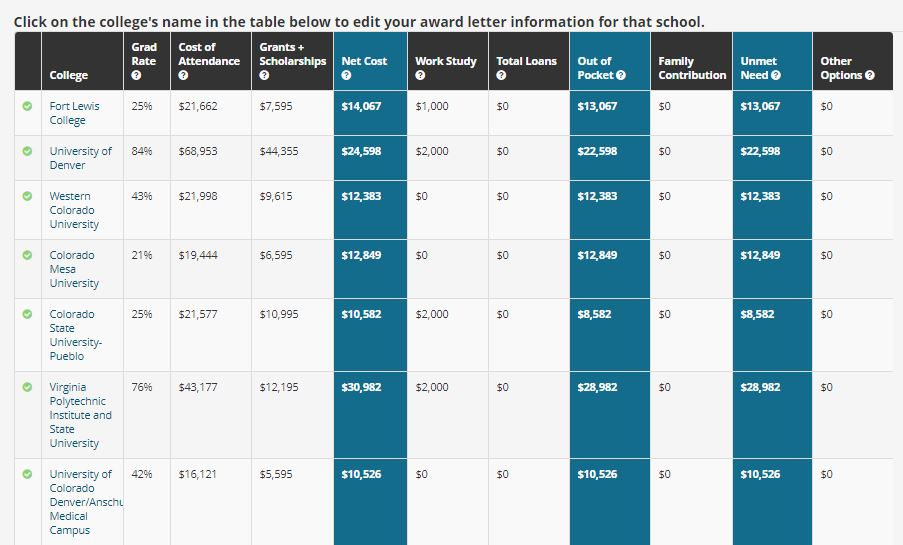
A side-by-side like the table above makes the ranking problem concrete. Colorado State University–Pueblo shows an out-of-pocket figure near $8,582 with a 25% graduation rate, while Virginia Tech shows about $28,982 out of pocket with a 76% graduation rate. University of Denver’s $68,953 COA looks punishing until $44,355 in grants brings net cost to $24,598. An AI tool that cannot hold those three facts in the same frame is not comparing offers. It is restating brochures.
What Should You Look for in an AI Tool That Compares College Costs?
You should evaluate AI college consulting tools on six dimensions of the Net-Cost Clarity Framework: gift-aid isolation, sticker-to-net translation, multi-offer consistency, four-year projection, post-letter scholarship discovery, and appeal coaching. A tool can score well on chat quality and still fail the framework if it blends loans into “aid” or forgets last week’s SAI.
1. Gift-aid isolation. CollegeData’s comparison method and Sallie’s offer checklist both start by separating grants and scholarships from work-study and loans. If an AI summary leads with “you received $32,000 in aid” without saying how much must be repaid, it has already failed.
2. Sticker-to-net translation. Oriel Admissions states the core formula plainly: net price equals COA minus grants and scholarships. A $85,000 COA with $20,000 in grants is a $65,000 net price, regardless of how large the “merit award” headline looks.
3. Multi-offer consistency. Every letter must be normalized to the same columns: COA, gift aid, net price, work-study, loans, family contribution, unmet need. Federal Student Aid’s official comparison guidance exists because schools do not format offers the same way.
4. Four-year projection. A freshman merit award that drops 25% after year one changes the ranking. Tools that only parse year one hide that cliff.
5. Post-letter scholarship discovery. Institutional aid is not the last dollar. Purpose-built matchers and research agents should look for stackable external awards after the letter arrives.
6. Appeal and special-circumstances coaching. Job loss, medical bills, or a competing offer can justify a professional judgment review. The tool should draft questions for the aid office, not invent a promise the college never made.
Weight the first three dimensions most heavily if letters are already in hand. Weight dimensions five and six more heavily if the family still has months before May 1 and a large unmet-need gap.
How Do Jenova, College Raptor, Solvi, and Kollegio Compare on Aid Analysis?
College Raptor is the most literal letter-math tool in this set, Jenova’s College Admissions Consultant is the strongest when aid comparison is part of a full admissions decision, and Solvi and Kollegio are better at earlier-stage matching and scholarship search than at forensic offer comparison. Scholarships360’s award letter comparison tool is a useful free worksheet when a family wants to do the arithmetic themselves.
| Feature / Dimension | College Raptor | Jenova College Admissions Consultant | Orbit Solvi | Kollegio AI | Scholarships360 |
|---|---|---|---|---|---|
| Award-letter intake | Upload letters; highlights grants, scholarships, net price, loans, out-of-pocket | Conversational: paste or describe each letter | Admissions chat; not a dedicated letter parser | Admissions chat plus scholarship features | Manual comparison worksheet |
| Net-price calculation | Automated from uploaded offers | Guided, using federal net-price logic | Indirect; stronger on matching than offer math | Indirect; aid features are scholarship-oriented | User-entered breakdown |
| Scholarship discovery after the letter | Secondary to letter math | Research-assisted search across public sources | Built-in Scholarship Matcher | Personalized scholarship matching | Core scholarship inventory |
| Admissions help beyond aid | Limited | School list, essays, timeline, appeal strategy | 18-factor matching, essay coach, planner | College quiz, essay support, recs | Limited |
| Persistent family-finance memory | Unverified beyond saved letters | Cross-session memory of SAI, offers, constraints | Account profile | Account profile | Unverified |
| Pricing (as of 2026) | Unverified | Free tier with limited usage; Plus at $20/month | Free core features | Advertised as free | Free tool |
| Best for | Fast letter-to-letter arithmetic | Holistic offer + fit + four-year strategy | Free matching and scholarship scan | Early list-building and scholarship leads | DIY, spreadsheet-style comparisons |
College Raptor
College Raptor’s comparison workflow is built for the week letters arrive. The product asks families to upload award letters, then highlights grants and scholarships, calculates net price, and surfaces loans and out-of-pocket cost. That is the right job when three PDFs use three different labels for the same dollar.
The limitation is scope. A clean net-price grid does not decide whether a low-cost campus with a 21–25% graduation rate is a better bet than a higher net-price campus with a 76–84% graduation rate. Families still need a second layer of counseling for fit, major strength, and four-year completion risk.
Jenova College Admissions Consultant
Jenova’s College Admissions Consultant treats the award letter as one input in a longer decision, not as the entire product. Testing a typical May decision with this agent shows the useful behavior: it keeps COA, gift aid, loans, and unmet need in separate buckets, then asks whether a cheaper net price is attached to a weaker completion rate or a thinner major.
Because the agent sits on a platform with persistent memory and live web research, a family can paste seven offers over several days and return to the same SAI, parent-PLUS comfort level, and target monthly payment. It can also pull current net-price calculators and institutional COA pages instead of relying on last year’s memory of a school.
The honest limitation is intake. Jenova does not offer a dedicated award-letter upload parser comparable to College Raptor. Accuracy depends on what the student pastes and on public data the research tools can verify. It cannot file a FAFSA, bind a college to an appeal, or guarantee that a merit award renews. It is also not a specialized scholarship database with a published match-rate statistic.
Pricing is usage-based rather than a five-figure counseling retainer. The free tier includes limited monthly usage; Plus is $20/month for 30× that allowance. Human-led firms such as IvyWise and Crimson Education, by contrast, are [**commonly packaged from about $29,500 to well over $100,000**](https://www.findmyorbit.com/blog/best-ai-college-admissions-tools-2026).
Orbit Solvi
Solvi is a purpose-built AI counselor with 18-factor college matching, a Scholarship Matcher, and an essay coach, and the core product is free. Orbit reports that students who complete a full matcher profile discover an average of six new schools, and that Scholarship Matcher users find an average of 7.3 awards they had not already located.
Those strengths sit earlier in the funnel. Solvi is more useful for building a list and finding outside scholarships than for reconciling two conflicting award PDFs. Orbit’s own comparison is explicit that no AI tool should replace a human counselor for complex financial aid negotiation.
Kollegio AI
Kollegio markets personalized college recommendations, financial-aid-oriented scholarship matching, and 24/7 essay support, and it advertises free access against a $10,000 human-coach comparison. That positioning helps students who still need a list and a scholarship pipeline.
What the public site does not demonstrate is a letter-normalization engine. If the immediate task is “DU versus Virginia Tech versus CSU–Pueblo, using the actual award PDFs,” Kollegio is a supporting research layer, not the calculator of record.
Scholarships360 and other worksheets
Scholarships360’s award letter comparison tool is essentially a structured worksheet: enter each school’s costs and aid, then look at the remainder. College Board BigFuture points families to similar cost calculators. DecidED, highlighted by OneGoal, is another financial-aid comparison product aimed at confident college choice.
These tools are transparent and cheap. They are also only as good as the numbers a tired parent types at 11 p.m. They do not argue with a letter that buried a PLUS loan under “award,” and they do not remember that the student’s SAT retake could still unlock merit at two of the five schools.
How Do You Separate Grants From Loans When Reading an Award Letter?
You separate them by rebuilding the letter into four buckets — COA, gift aid, self-help aid, and remaining gap — and by refusing to subtract loans from price. Federal Student Aid defines net cost as what the family still has to cover with savings, income, or borrowing. Loans change how you pay. They do not change whether you pay.
A standard letter is easier to decode once the sections are named. The anatomy is consistent even when the labels are not.
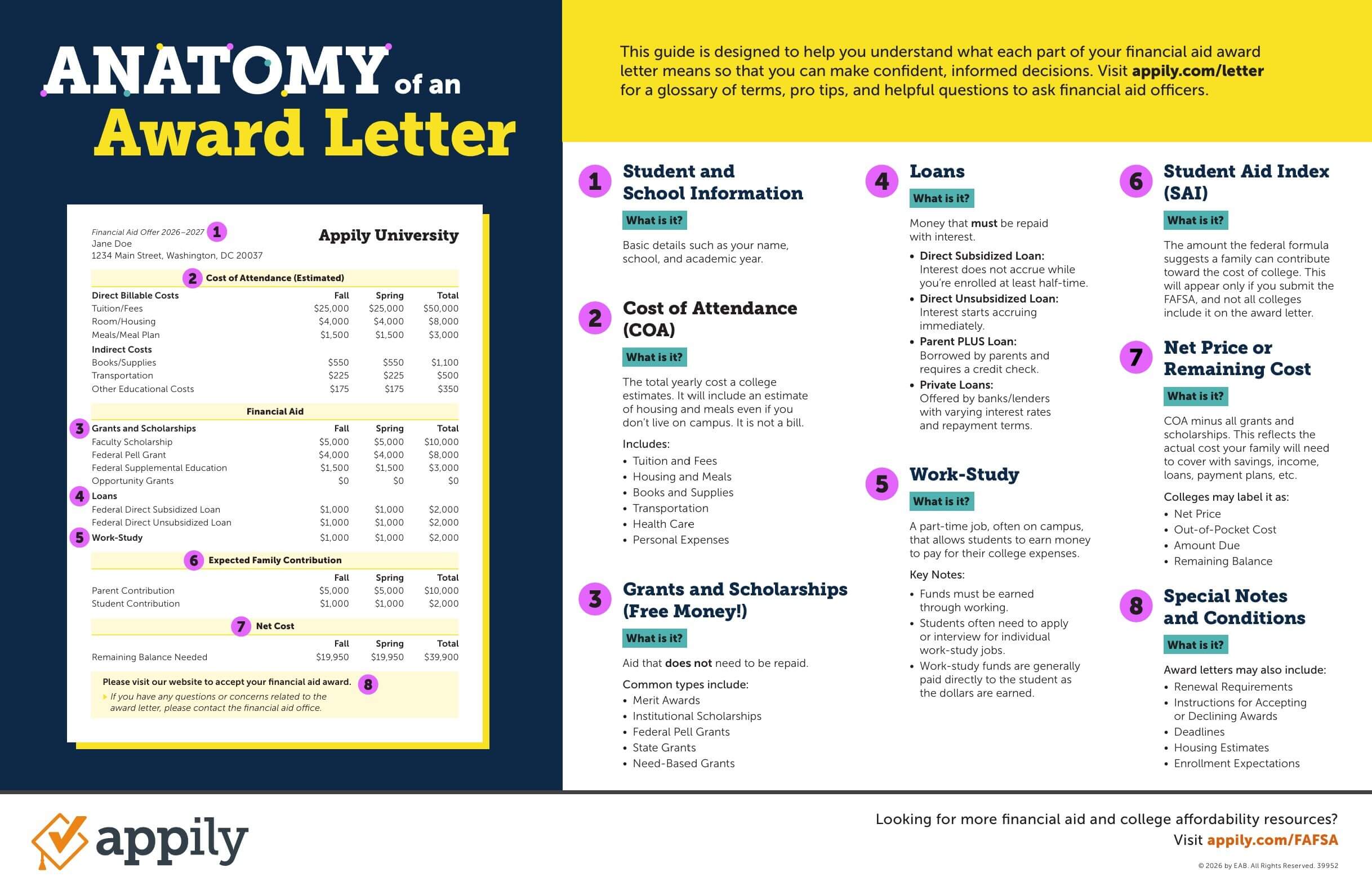
Use this sequence on every letter, including letters an AI has already summarized:
- Confirm the academic year and whether the figures are for one term or two.
- Copy the full COA: tuition, fees, housing, meals, books, transportation, personal expenses.
- Total only grants and scholarships. This is gift aid. It is the only number that reduces net price.
- List work-study separately. It is earned, often paid later, and not a tuition credit.
- List Direct Subsidized, Direct Unsubsidized, Parent PLUS, and private loans separately.
- Compute net price as COA minus gift aid.
- Compute out-of-pocket as net price minus work-study actually likely to be earned.
- Compute unmet need after the family’s planned contribution.
- Highlight renewal rules, housing assumptions, and enrollment requirements.
That sequence explains the sample comparison table. Fort Lewis College’s $21,662 COA minus $7,595 in grants equals a $14,067 net cost; $1,000 of work-study then brings out-of-pocket to $13,067. University of Denver’s much larger grant still leaves a $22,598 out-of-pocket figure because the COA starts at $68,953. If an AI tool reports only “Denver gave you $44,355,” it has described the discount and hidden the bill.
Watch for leftover vocabulary. Some 2026 letters still print an Expected Family Contribution next to a Student Aid Index. College Essay Guy’s SAI explainer is useful here: SAI is an index for awarding, not an invoice. A school can leave unmet need even when the SAI is low, and a high-COA private college can still be cheaper than a public flagship after institutional grants.
For a conversational tool, a precise prompt prevents the loans-as-discounts error:
"Here are two award letters. Rebuild each into COA, grants/scholarships, work-study, subsidized loans, unsubsidized loans, PLUS loans, net price, and unmet need. Do not subtract loans from price. Then rank the schools by four-year gift-aid cost and flag any renewal conditions."
College Raptor automates steps 3–7 if the upload is complete. Jenova is more useful at steps 8–9, when the family has to decide whether a $8,582 gap at a 25% graduation-rate campus is actually cheaper than a $22,598 gap at an 84% campus.
Which AI Tools Help You Find Scholarships After the Award Letter Arrives?
Orbit’s Solvi and Kollegio are the purpose-built scholarship matchers in this group, Scholarships360 is the large DIY inventory, and Jenova is most useful for stacking outside awards onto a specific unmet-need number. The letter is a starting package, not a ceiling.
Solvi’s Scholarship Matcher is the most quantified option in published comparisons: Orbit says users find an average of 7.3 scholarships they already qualified for but had not located. Kollegio emphasizes scholarships that remain active in the student’s workflow rather than a one-time dump of expired links. Scholarships360 combines an award-letter worksheet with a searchable scholarship library, which is practical when the family wants to work in a browser without another chat thread.
Jenova does not publish a proprietary scholarship-match statistic, and that is a real gap versus Solvi. What it does well is constraint-based search against a remembered gap. If CSU–Pueblo left $8,582 unmet and Virginia Tech left $28,982, the useful query is not “find scholarships.” It is “find stackable, non-institutional awards that can be applied to a public in-state bill versus an out-of-state bill, and tell me which ones conflict with the existing merit offer.”
Merit aid still moves with test scores and GPA. Families waiting on a retake can run the same comparison in parallel with Jenova’s SAT/ACT Tutor, then ask the admissions consultant whether a 50-point SAT gain is likely to change any of the current letters. General assistants such as ChatGPT, Claude, and Gemini can brainstorm essay topics for scholarship applications, but they do not include a structured scholarship database.
A workable post-letter routine looks like this:
- Freeze the net-price ranking from the current letters.
- Identify the dollar gap you are willing to work for — usually the difference between the first-choice campus and the cheapest acceptable campus.
- Run Solvi or Scholarships360 for volume.
- Ask Jenova to filter those leads against stacking rules, citizenship, major, and the school’s outside-aid policy.
- Re-rank only after an award is confirmed in writing.
Outside scholarships can reduce institutional need-based aid dollar for dollar. An AI that celebrates a $2,000 local award without checking displacement has not improved net price. It has rearranged the same bill.
How Do You Use an AI College Consultant to Compare Multiple Offers?
Start by giving the tool a complete family-finance snapshot, then feed every letter in the same format, and only then ask for a ranking. Most failed comparisons happen because the first prompt is “which school is cheapest?” before COA, SAI, and loan comfort are defined.
For Jenova’s College Admissions Consultant, the setup is a single briefing:
- Open the agent at jenova.ai/a/college-admissions-consultant.
- Establish the financial baseline in one message:
"Our SAI is 4200. We can contribute $6,000 a year from income and do not want Parent PLUS. I will paste seven award letters. Compare gift aid only for net price, then show a four-year scenario if merit drops 25% after year one."
- Paste each letter or type the line items: COA, grants, work-study, each loan type, housing assumption.
- Add non-price constraints:
"Rank by net price, then re-rank by estimated cost per bachelor’s degree using the school’s published graduation rate. Call out any campus where cheap aid is attached to a sub-30% graduation rate."
- Ask for an appeal packet only after the ranking exists:
"Draft a professional-judgment email for the financial aid officer at the highest-net-price school I still prefer. Use the competing offer’s gift aid as leverage. Do not claim a guarantee."
For College Raptor, the parallel path is mechanical: create an account, upload each PDF at the compare-offers page, and export the grid. Use that grid as the source of truth for arithmetic, then bring the totals into Jenova if you need outcome-adjusted ranking, appeal language, or scholarship stacking.
For Solvi or Kollegio, do the matching and scholarship scan first if letters are not yet in hand. Once PDFs arrive, switch to a parser or a consultant prompt like the one above. General-purpose chatbots can rewrite a confusing letter in plain English, but they will not remember your SAI next month unless you paste it again, and they will not warn you that work-study is not a tuition credit unless you already know to ask.
Two practical checks prevent expensive mistakes. First, confirm whether housing is a required on-campus figure or an estimate; NCES shows on-campus COA running far above living-with-family COA at every sector. Second, confirm whether “scholarship” is renewable and full-time-only. A one-year award that turns a $10,526 net price into a $16,121 second year is not the bargain the freshman letter advertised.
Jenova’s College Admissions Consultant is available at jenova.ai/a/college-admissions-consultant. The free tier covers limited monthly usage; paid plans start at $20/month. That is reference pricing, not a reason to skip the College Raptor grid if letter-parsing is the immediate bottleneck.
What Do College Affordability Experts Say About AI Aid Comparison?
Aid officers and counselors keep returning to the same warning: families lose money when they compare award headlines instead of gift-aid net price, and AI only helps if it enforces that discipline. The technology is useful for normalization and memory. It is not a substitute for the campus official who can actually change a package.
"The most expensive mistake we still see is treating the award letter as a coupon booklet. A $44,000 grant against a $69,000 cost of attendance can leave a higher bill than a $11,000 grant against a $22,000 public-college budget. If an AI tool cannot keep those two offers in identical columns — gift aid, loans, work-study, unmet need — it is entertaining the family, not advising them."
"Persistent memory matters more than people expect. The Student Aid Index does not change because a second letter arrived on Thursday. Tools that forget the family’s PLUS-loan limit, or that re-average numbers the parent already corrected, recreate the same confusion the letter caused in the first place. Use AI to hold the worksheet steady. Use the financial aid office to change the worksheet."
"Where AI is still weak is renewal math and professional judgment. No model should promise that a competing offer will be matched. What it can do is prepare a clean, document-backed question: here is our SAI, here is the gift-aid gap, here is the change in income. That is the difference between a citeable comparison and a hallucinated discount."
— Jenova Product Team, college-affordability workflow design, working with families through the SAI transition after FAFSA simplification
That view lines up with College Board guidance to calculate what you will actually pay and with Orbit’s caveat that complex aid negotiation still belongs with a human counselor. AI is the worksheet that does not get tired. The aid office is the only party that can edit the worksheet’s source numbers.
When Should Families Still Talk to a Human Financial Aid Officer?
You should contact the aid office whenever the letter is incomplete, the family’s circumstances have changed, or the decision hinges on a policy the school has not put in writing. AI can draft the questions. It cannot exercise professional judgment, adjust COA for a documented disability expense, or commit a renewable scholarship.
Call or write the office in at least these situations:
- A line item is labeled “award” or “assistance” and it is unclear whether it is a grant, a loan, or a PLUS authorization.
- Income, assets, or household size changed after the FAFSA or CSS Profile was filed.
- Two letters cannot be aligned because one omitted books, health insurance, or a housing deposit.
- A merit scholarship is renewable only with a GPA the student has never earned.
- An outside scholarship might displace need-based institutional aid.
- The student is an NCAA recruit, a BS/MD applicant, or an international student whose aid rules are not the standard Title IV package.
- The family needs a payment plan, a work-study placement reality check, or a Parent PLUS denial appeal.
College Board research on 2025–26 pricing shows in-state public tuition still ranging from about $6,360 in Florida to about $18,090 in Vermont. Geography and residency classification can move net price as much as a scholarship can. An AI consultant should flag a residency or reciprocity question. Only the institution can confirm it.
Human consulting firms remain the right overlay for families buying a dedicated relationship and specialized casework. They are the wrong overlay if the only missing piece is a normalized comparison grid. In that narrower job, College Raptor plus a disciplined consultant prompt — or Jenova alone, if the letters are clean enough to paste — covers the decision without a five-figure retainer.
The practical division of labor in 2026 is therefore straightforward. Use a parser or worksheet so the arithmetic is reproducible. Use an AI admissions consultant so the ranking includes graduation risk, major fit, scholarship stacking, and appeal language. Use the financial aid officer when a number on the letter needs to change.
References
- Federal Student Aid — Comparing School Financial Aid Offers
- National Center for Education Statistics — Price of Attending an Undergraduate Institution
- BestColleges — Average Cost of College: Tuition Statistics
- Education Data Initiative — Average Cost of College
- Federal Student Aid Estimator — Student Aid Index
- Federal Student Aid — How Financial Aid Is Calculated
- College Raptor — Compare Financial Aid Offer Letters
- CollegeData — How to Compare Your Financial Aid Awards
- Sallie — Understanding Your Financial Aid Offer
- Oriel Admissions — How to Compare Financial Aid Offers: Net Price Guide
- FindMyOrbit — Best AI College Counselor in 2026
- Kollegio AI — Platform Overview
- Scholarships360 — Financial Aid Award Letter Comparison Tool
- College Board BigFuture — How to Review and Compare Your Financial Aid Awards
- College Essay Guy — Student Aid Index Guide
- OneGoal — 6 AI Tools That Can Help Students Prepare for College and Career
- College Board Research — Trends in College Pricing Highlights