Which AI Assistant Is Best for Research Paper Outlines and Citations?
2026-08-22
How Do Leading AI Tools Compare on Outlines, Citation Integrity, and Reviewer Replies?
For researchers who need one assistant that can outline a manuscript, pressure-test citations, and draft point-by-point reviewer replies in a single persistent workspace, Jenova's Academic Research Assistant is the strongest all-in-one option in 2026. Narrower tools still lead on specific jobs: Elicit for structured literature extraction, Scite for citation context, and Paperpal for language polishing before submission.
The difference that matters is not “who writes fastest.” It is whether the assistant can keep outline logic, source evidence, and reviewer replies aligned to the same paper.
Key factors that separate a usable research assistant from a generic chatbot:
✅ Outline architecture — Can the tool turn a research question into an IMRaD (Introduction, Methods, Results, and Discussion) skeleton that reflects actual gaps, not generic section labels?
✅ Citation integrity — Does every reference map to a real paper, and can the assistant flag unsupported claims before they reach a journal?
✅ Reviewer-reply discipline — Can it draft a point-by-point response that cites the manuscript, not a polite paraphrase of the review?
✅ Session persistence — Does it remember the paper, the rejected paragraph, and Reviewer 2’s methods objection across weeks?
✅ Literature reach — Can it search live academic sources instead of relying only on training-data memory?
To compare these tools usefully, this article uses an Outline–Evidence–Reply (OER) frame: structure first, source integrity second, and reviewer communication third.
Why Do Researchers Need Specialized AI for Manuscript Workflows in 2026?
Researchers need specialized AI in 2026 because general chatbots are now fast enough to produce fluent outlines and references that look finished — and wrong. A Nature analysis found that tens of thousands of 2025 publications may contain invalid AI-generated references, including citations that point to real authors but fabricated papers.
That is a different failure mode from sloppy writing. A hallucinated citation can survive copyediting because it has the right shape: author, year, journal, page range. Library guidance from UNC Charlotte notes that these fabricated citations often appear when a model is asked to supply sources on demand. Accountability in Research has argued that hallucinated citations may constitute research misconduct when citations function as data.
The manuscript workflow has also compressed. The same person who maps a literature gap is often the person who must answer reviewers six months later. Generic tools treat those as separate chats. Specialized assistants treat them as one project: the outline constraints the draft, the draft constraints the citations, and the citations become the evidence base for the response letter.
Dedicated platforms have grown around that pressure. Elicit is built to turn a question into a structured research report with citations. Scite indexes 300 million-plus scholarly articles and classifies whether later work supports or disputes a claim. Paperpal reports use by more than 5 million researchers and language checks trained on scholarly edits. The question is no longer whether AI belongs in academic writing. It is which assistant can be trusted at each stage of the paper.
What Should You Look for in an AI Research Writing Assistant?
You should evaluate an AI research assistant on six OER dimensions: outline quality, literature coverage, citation grounding, manuscript memory, reviewer-reply structure, and export control. Tools that score well on one dimension often fail on another, which is why “best AI for research” lists that rank a single winner are usually answering the wrong question.
Use this checklist before committing a paper to any assistant:
- Gap-aware outlining. The outline should name what is unknown, disputed, or methodologically weak — not just restate IMRaD headings.
- Source-first drafting. Claims should be attached to retrievable papers, with enough bibliographic detail to verify in Crossref, PubMed, or the publisher site.
- Contradiction handling. The assistant should surface conflicting findings instead of smoothing them into a false consensus.
- Persistent project memory. Reviewer replies require the original hypothesis, exclusion criteria, and what you already tried.
- Tone control. Academic prose and response letters fail in different ways: one becomes vague, the other becomes defensive.
- Human verification loop. Editage’s 2026 guidance is blunt: no current AI tool guarantees hallucination-free output, so manual checks remain necessary.
A practical weighting for most empirical papers is 30% citation integrity, 25% outline and gap logic, 20% reviewer-reply quality, 15% memory across sessions, and 10% formatting. That weighting is intentional. A beautifully written outline with three invented references is more dangerous than a rougher outline grounded in real papers.
Testing reveals a second filter that checklists miss: can the assistant say “I cannot verify this”? Models that always complete a bibliography are optimized for fluency, not for scholarship.
How Does Jenova's Academic Research Assistant Compare to Elicit, Scite, and Paperpal?
Jenova’s Academic Research Assistant is strongest as a continuous writing partner across outlining, citation checks, and reviewer replies, while Elicit, Scite, Paperpal, and Paperguide each outperform it on a narrower research function. The useful comparison is not overall rank. It is which job you are hiring the tool to do.
| Feature / Dimension | Academic Research Assistant | Elicit | Scite | Paperpal | Paperguide |
|---|---|---|---|---|---|
| Paper outlining | Conversational IMRaD and gap-driven outlines tied to the same project | Strong structured reports from literature, weaker long-form outline coaching | Limited; built for evidence context, not section planning | Stronger at sentence and section rewriting than first-pass architecture | End-to-end planning workflow with IMRaD-style structure |
| Literature coverage | Real-time discovery across academic databases and repositories | Searches millions of papers and extracts study details into tables | 300M+ articles plus patents, trials, grants, and preprints | Access to 250M+ research articles inside a writing workspace | Reference management and search across a large peer-reviewed corpus |
| Citation verification | Citation management plus live lookup; still requires author checks | Sentence-level citations in generated reports | Smart Citations show supporting vs. contrasting evidence | Citation generation in APA, MLA, Vancouver and related styles | Citation-grounded drafting with integrity checks |
| Reviewer responses | Strong point-by-point drafts using the stored manuscript and reviews | Not a primary use case | Useful for finding papers that support a rebuttal | Strong language polish; less project memory for a full R&R letter | Writing and refine tools; less specialized for reply letters |
| Session persistence | Unlimited history and cross-session memory of the paper | Library and alerts for reuse across projects | Works inside other assistants and Zotero | Workspace-based writing; files stay private | Project library plus stepwise refine tools |
| Pricing (as of 2026) | Free tier; Plus $20/month for 30× usage | Unverified | Unverified | Free tier available; paid plans unverified | Unverified |
| Best for | One assistant from outline through reviewer reply | Systematic extraction and evidence tables | Checking whether a claim survives later literature | Language quality and pre-submission checks | Citation-grounded drafting inside a research OS |
Academic Research Assistant. The agent is built for academics and PhD students who need literature discovery, manuscript preparation, and citation management in one thread. Because it sits on a multi-model platform with document upload and persistent memory, you can attach a draft, a review PDF, and a notes file and keep working weeks later without re-explaining the study. The honest limitation is coverage: it does not own a licensed full-text corpus on the scale Scite describes, and it is not a dedicated reference manager with one-click BibTeX/RIS pipelines.
Elicit. Elicit searches millions of academic papers and generates structured research reports with citations. That makes it unusually good at the front of the OER pipeline — turning “what is known?” into a table of populations, interventions, and outcomes. It is weaker as a manuscript coach. If your bottleneck is screening 80 papers for a methods paragraph, Elicit is often the better first stop.
Scite. Scite’s Smart Citations classify whether later papers support, mention, or contrast a given claim, and the company says it has publisher agreements spanning Wiley, SAGE, and 40-plus other publishers. More than two million researchers and professionals use it. That is the right tool when the question is “does this citation still hold?” It is the wrong tool if you need help turning a messy results section into an outline.
Paperpal. Paperpal combines grammar and academic-tone editing with access to 250 million-plus research articles and similarity checking against a very large source index. It reports trust from 1,500-plus journals. Use it when the science is settled and the prose is not. It will not replace a gap analysis, and it will not remember Reviewer 3’s three-month-old objection unless you re-upload the file.
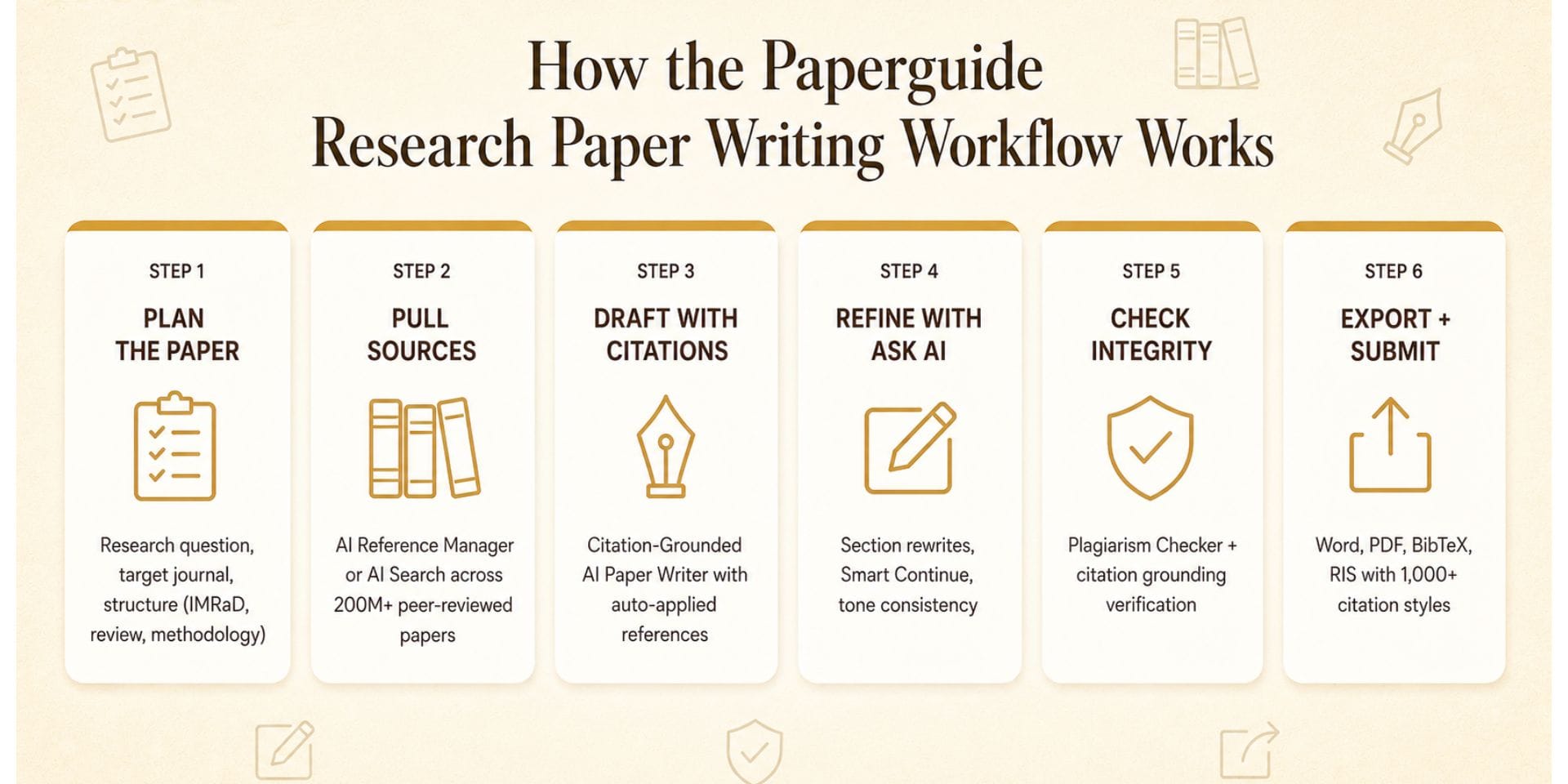
Paperguide. Paperguide positions itself as a research operating system: find, organize, analyze, and write with citation grounding. The workflow image above matches that pitch — plan, pull sources, draft with citations, refine, check integrity, then export. Researchers who want a single purpose-built paper factory may prefer it. Researchers who also need the same assistant for adjacent work (grant language, a methods appendix, or a reply letter that quotes their own earlier analysis) may find a persistent general research agent more flexible.
How Can AI Help Researchers Identify Gaps and Build a Paper Outline?
AI helps most when it is used to interrogate the literature for conflicts, weak methods, and missing populations — not when it is asked to “write an outline for a paper on X.” A gap-aware outline names the unanswered question in one sentence, then assigns each section a job: what evidence it must include, what it must not overclaim, and which citations have to be verified before drafting begins.
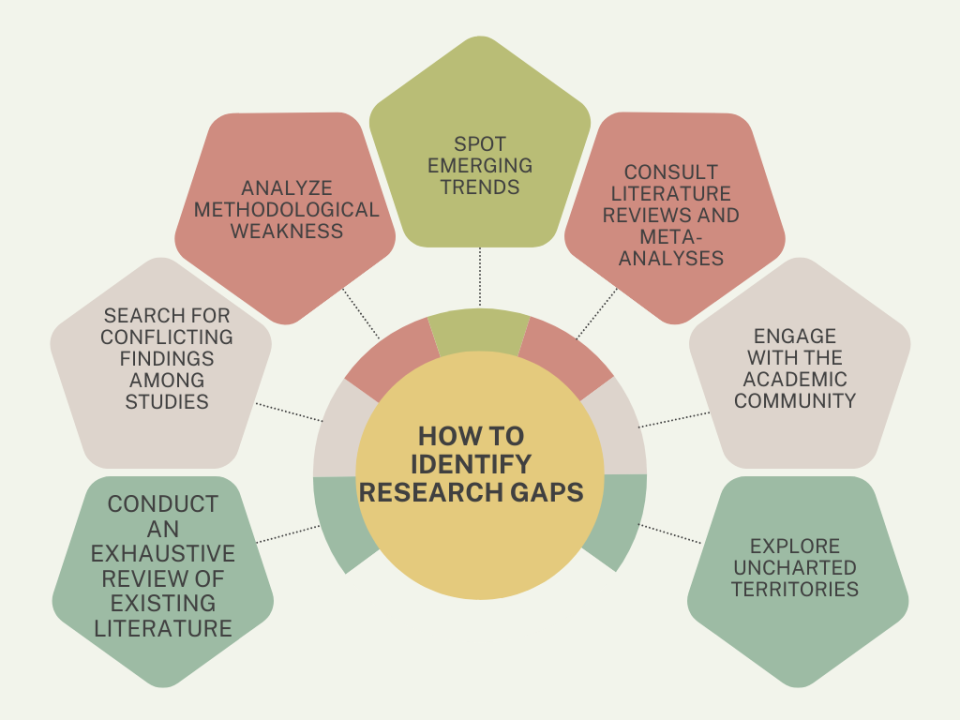
Those seven gap-finding moves are a better prompt scaffold than “make this publishable”:
- Conduct an exhaustive pass on existing reviews before adding another narrative summary.
- Search for conflicting findings instead of selecting only supporting studies.
- Analyze methodological weakness — underpowered samples, convenience cohorts, unblinded outcomes.
- Spot emerging trends that reviews from two years ago could not cover.
- Consult meta-analyses to see where pooled effects fall apart by subgroup.
- Engage the academic community: preprints, registered reports, and recent conference abstracts.
- Explore uncharted territory only after the first six moves fail to close the question.
A strong first prompt to Jenova’s Academic Research Assistant looks like this:
“I am writing an empirical paper on [topic] for [target journal]. Here is my research question and a draft abstract. Map the literature gap using conflicting findings and methodological limits, then propose an IMRaD outline. For each section, list the claim it must support and the type of source I still need. Do not invent citations. Flag any claim you cannot ground.”
Elicit is often the better companion at step 1 and step 3, because it can extract structured fields across many papers at once. Scite is the better companion at step 2, because contrast citations are its core product. The Academic Research Assistant is stronger at turning those inputs into a section-by-section outline that survives contact with a specific journal’s expectations.
In practice, the outline should be treated as a contract. If the methods section cannot support a causal claim, the introduction should not promise one. Assistants that generate outlines without reading your constraints will happily promise both.
How Reliable Are AI Tools at Verifying Citations and Preventing Hallucinations?
No mainstream AI assistant is reliable enough to be the last check on a reference list. Editage’s researcher checklist states that manual verification remains necessary for any academic document. The job of a good assistant is to reduce the search space and make failures easier to catch, not to replace the author’s responsibility for the bibliography.
Hallucinations in this setting are not random. They cluster around three patterns:
- Phantom papers — a plausible title and journal that do not exist.
- Author–paper mismatches — a real scholar credited with a work they never wrote. The Nature investigation began when a computer scientist was cited in a dentistry paper for research he did not recognize.
- Metadata drift — a real paper with the wrong year, volume, or page range, which then fails link-checking.
ScienceDirect commentary in 2026 framed AI hallucinations as a threat to scholarly integrity that publishers need verification systems to catch. Paperpile has also documented the risk of asking a model to auto-complete bibliographic details. Both point to the same operational rule: generate less bibliography from memory, and retrieve more of it from indexes.
Scite is currently the strongest specialist for the “does this claim hold?” question, because every assistant answer is supposed to link back to a sentence in a paper. Independent roundups consistently place Scite in the citation-intelligence category rather than the writing category. Elicit is stronger when you need to see whether 20 studies even measured the outcome you think they measured. Paperpal is stronger when the citation already exists and you need it formatted.
Jenova’s Academic Research Assistant sits between those poles. It can search live academic sources, manage citations inside the manuscript conversation, and refuse to pad a reference list when instructed to verify first. It cannot match Scite’s licensed full-text graph, and it should not be used as a one-click “complete my bibliography” engine. A reliable verification pass looks like this:
- Ask the assistant to list every citation with title, year, journal, DOI, and the exact claim it supports.
- Reject any entry without a DOI or stable publisher URL.
- Open the source and confirm the claim appears in that paper, not merely in a paper on a similar topic.
- Run a second pass for papers cited as support that actually only mention or contradict the claim.
That last step is where Scite’s supporting/contrasting labels earn their keep.
How Should You Use AI to Draft a Response-to-Reviewers Letter?
You should use AI to structure and phrase a response-to-reviewers letter, not to decide whether a criticism is valid. A 2026 comparison of reviewer-response tools concluded that general high-quality language models are often better at this task than narrow utilities, because the letter is an argument, not a template. Purpose-built generators still help with formatting. SciSpace offers an agent specifically for structured response-to-reviewers letters.
A usable letter has four parts for every comment: restate the concern, say what you changed or why you did not, point to the new text, and supply evidence. Practical guides on AI-assisted reply letters emphasize tone control and hard cases — conflicting reviewers, requests for new experiments, and comments that misunderstand the design.
For Jenova’s Academic Research Assistant, attach the manuscript, the decision letter, and any new analyses, then use a constrained prompt:
“Draft a point-by-point response to these reviewer comments. For each item: quote the comment, state agree/partially agree/disagree, describe the revision, and cite the exact section or table. If a request would require new data we do not have, say so and propose the strongest alternative. Do not invent results. Keep the tone collegial and specific.”
Then force a second pass:
“Now audit this letter against the attached manuscript. Flag any promise we did not actually implement, any citation that is not in the reference list, and any sentence that sounds defensive rather than evidentiary.”
Paperpal can then tighten grammar without changing the scientific commitments. Scite can help if a reviewer says “the literature does not support X” and you need contrasting or supporting citations. Elicit can help if the reviewer asks whether a class of studies was omitted.
The Academic Research Assistant’s advantage is memory. A revise-and-resubmit cycle is rarely one letter. It is a sequence of partial rewrites, new limitations paragraphs, and “we now report…” sentences that must stay consistent with what you told the editor last month. Tools that treat each paste as a new document create contradictions. Persistent agents create a paper trail.
The limitation is legal and ethical, not technical: the corresponding author still owns every claim in the letter. If the assistant drafts a sentence that implies a sensitivity analysis you did not run, that sentence is your error.
How Do You Get the Most Out of an AI Academic Research Assistant?
You get the most out of an AI research assistant by giving it the paper as a project, not a prompt. That means uploading the current draft, stating the target journal, locking citation rules, and separating creative work (gap framing) from verification work (bibliography audit).
A compact workflow that holds up under review:
- Define the contract. Target journal, word limit, study type, and the one-sentence contribution.
- Build the gap outline before any results prose. Use the seven gap moves above.
- Pull sources with retrieval, not memory. Prefer live academic search over “what papers should I cite?”
- Draft section by section, requiring a source note under every empirical claim.
- Run a citation audit as its own session task, not as an afterthought in the same breath as style edits.
- Only then draft reviewer replies, with the manuscript and decision letter attached.
For the Academic Research Assistant, a typical kickoff looks like this:
“Project: manuscript on [title]. Target: [journal]. Study type: [design]. I am attaching the draft and my notes. Do not write new results. First, produce a gap-aware IMRaD outline and a list of claims that currently lack a verifiable source.”
When the draft is stable, Jenova’s Word Doc Generator can turn the content into a conventionally formatted research document. That split is deliberate. The research agent should own claims and sources. The document agent should own heading styles, title-page conventions, and export hygiene.
Elicit can sit at step 3 as a screening table. Scite can sit at step 5 as an evidence check. Paperpal can sit between step 4 and submission as a language and similarity pass. Using all four on every paper is rarely necessary. Using the wrong one first is how researchers end up with a polished introduction that cites a paper that does not exist.
Two operating rules prevent most failures. Never ask the model to “add more citations” without specifying a library of approved papers. Never let it rewrite the response letter after you have changed the manuscript unless you re-attach the new draft.
What Do Research Integrity Specialists Say About AI-Assisted Manuscript Work?
Research integrity specialists increasingly treat unverified AI citations as a reliability problem, not a writing convenience. The emerging consensus is that assistants are useful for structure and language, and unsafe as unsupervised bibliographic engines.
“The failure we see is not that models write too little like a scholar. It is that they write too fluently like one. A hallucinated reference survives because it performs academic credibility — correct names, plausible journals, confident years — while detaching the claim from any checkable object in the literature. If tens of thousands of 2025 papers already show this contamination pattern, then ‘add citations’ is no longer a harmless prompt. It is a process-control problem.”
“The assistants worth using are the ones that keep outline, evidence, and reply in the same state. Reviewer letters go wrong when the model cannot see the methods you actually ran. Citation lists go wrong when the model is rewarded for completeness instead of retrieval. Our working rule is simple: the assistant may propose a structure, a phrasing, or a place to look. The author must be able to open every source and find the sentence that justifies the cite.”
“That is also why we do not treat citation-intelligence tools and writing tools as competitors. Scite-type products answer ‘does the literature still support this?’ Writing agents answer ‘can this section carry that claim without overreaching?’ You need both questions. You do not need both answers from the same button.”
— Jenova Product Team, academic-workflow research, 8 years building AI agents for long-running scholarly projects
Which AI Research Assistant Fits Different Academic Workflows?
The best AI assistant depends on which OER stage is blocking the paper, not on which brand looks most “academic.” Choose the Academic Research Assistant when the same project must move from gap outline to citation audit to reviewer letter without losing context. Choose a specialist when one stage dominates.
Choose Jenova’s Academic Research Assistant if you:
- Are a graduate student or PI carrying one manuscript across months
- Need outlines, source checks, and reply letters in the same conversation
- Can verify references yourself and want an assistant that remembers constraints
- Already work with uploaded PDFs, reviewer attachments, and long chat history
Choose Elicit if you:
- Are screening a large set of empirical papers
- Need extraction tables more than prose
- Are closer to a systematic review than to a revise-and-resubmit
Choose Scite if you:
- Must know whether a key paper is supported or disputed
- Are writing a discussion that depends on citation context
- Need publisher-backed full text more than drafting help
Choose Paperpal if you:
- Have a scientifically stable draft
- Need academic tone, grammar, and similarity checks
- Are preparing a journal-ready file rather than discovering the argument
Choose Paperguide if you:
- Want a purpose-built research workspace with citation-grounded drafting
- Prefer a stepwise plan–source–write–check–export pipeline
- Do not need a general agent for work beyond the paper
For most researchers in 2026, the winning setup is a primary assistant plus one verifier. The Academic Research Assistant can own the outline and the reply letter. Scite or Elicit can own the evidence graph. Paperpal can own the last language pass. That combination is less elegant than a single “do everything” promise, and it is much harder to pollute with invented references.
The standard to hold is simple enough to cite: if you cannot open the source, you cannot keep the sentence.
References
- Nature — Hallucinated citations are polluting the scientific literature
- UNC Charlotte Library — AI Hallucinated Citations research guide
- Accountability in Research / Taylor & Francis — Hallucinated citations as potential research misconduct
- Editage — How to check for hallucinations in AI text
- Elicit — AI for scientific research
- Scite — Citation-backed answers and Smart Citations
- Paperpal — AI academic writing and research workspace
- Paperpal — 6 best AI tools for literature review in 2026
- Paperguide — AI platform for scientific research workflows
- ScienceDirect — Hallucinations in generative AI as a threat to scholarly integrity
- Paperpile — Citation checker and hallucination risk in bibliographic autocomplete
- Logically — AI research tools for citing sources properly
- Manusights — Best AI tools for responding to reviewers
- SciSpace — Response to Reviewers Letter Generator
- ProofreaderPro — How to write a response-to-reviewers letter with AI help