Which AI Admissions Tool Helps International Students Track Deadlines?
2026-08-25
What Separates Persistent AI Counselors From Chancing Tools for Cross-Border Tracking?
For international undergraduate applicants in 2026, the most useful AI admissions tool is a persistent conversational counselor that keeps a living matrix of school requirements, rolling deadlines, and scholarship rules — not a one-shot chancing calculator. Jenova College Admissions Consultant is built for that tracking work. CollegeVine remains useful for U.S. admit-probability estimates, BridgeU is strong inside partner international schools, and the Common App is still the submission dashboard for 1,100+ member colleges. None of those three replaces a memory-backed agent that can hold visa dates, English-test windows, and aid forms in one thread.
What actually separates effective international tracking from generic admissions AI:
✅ Timeline fidelity — Early Action, Early Decision, Regular Decision, CSS Profile, and visa interview slots sit on different calendars and must stay linked. ✅ Requirement completeness — Transcripts, evaluated credentials, counselor reports, and proof of funds are easy to miss when tools only score GPA and test results. ✅ Aid-eligibility matching — Merit, need-based, athletic, and talent awards use incompatible forms and cutoffs. ✅ Knowledge persistence — Cross-session memory matters more than a single “chance me” score when a cycle lasts 9–18 months. ✅ Document literacy — TOEFL, IELTS, SAT, ACT, and I-20 timing have to sit beside academic deadlines, not in a separate app.
To compare these tools fairly, it helps to judge them on tracking quality rather than on how impressive a single probability percentage looks.
Why Is Deadline and Scholarship Tracking Harder for International Undergraduates?
International undergraduates juggle more independent calendars than domestic applicants, and those calendars rarely share a single official dashboard. A U.S. citizen can often treat the Common App plus FAFSA as the spine of the process. An applicant in Manila, Lagos, or São Paulo also has to sequence English-proficiency tests, credential evaluation, proof-of-funds letters, and a student-visa appointment that cannot be booked until an I-20 arrives.
EducationUSA, the U.S. Department of State network of more than 430 advising centers in over 175 countries, still tells students to start financial planning as early as possible. That advice is structural, not motivational. Most scholarship deadlines fall 9 to 12 months before a course begins, which means a Fall 2027 start often has aid work due in late 2026.
Aid itself is thinner than marketing pages imply. NAFSA notes that minimal scholarship aid is available to international undergraduates, and most institutional aid is reserved for graduate study. That scarcity makes tracking which schools are need-aware versus need-blind, and which awards stack, more important than generating another school list.
Domestic tools also hide a citizenship assumption. FAFSA is not the international path. Many colleges instead require a bank letter or the College Scholarship Service Profile (CSS Profile), which typically costs about $16–25 USD per institution. Miss that form and a “match” school can become unaffordable after admission.
What Should International Applicants Look for in an AI Admissions Tool?
International applicants should look for an AI tool that can maintain a cross-border requirements matrix, not just estimate admission odds. Chancing is useful after the list is real. It is a weak primary system when the binding constraints are documents, money, and dates.
This article uses a six-part TRACK-I frame:
- Timeline fidelity — Can the tool keep Early Decision, Regular Decision, scholarship, and visa dates without colliding?
- Requirement completeness — Does it store essays, recommendations, test codes, and financial forms per school?
- Aid-eligibility matching — Can it separate merit, need-based, athletic, and talent awards instead of dumping generic “scholarship” links?
- Cross-border consistency — Does it know a UK UCAS deadline is not a Common App deadline?
- Knowledge persistence — Does it remember last month’s SAT plan when today’s question is about CSS Profile?
- International document literacy — Can it sequence English tests, evaluated transcripts, and proof of funds?
Tools that score well on one dimension and fail on three others create a false sense of control. A calculator that says “42% at NYU” does not tell you whether NYU is need-aware for non-citizens, when the CSS Profile is due, or whether your IELTS date lands after the application close.
School-licensed platforms can score highly on oversight and still fail independent applicants who are not enrolled at a partner school. Application portals score highly on submission and poorly on strategy. The recommended type is the tool that stays accurate between official systems.
How Do Jenova, CollegeVine, BridgeU, and Common App Compare for International Tracking?
Jenova’s College Admissions Consultant is the strongest fit for independent international undergraduates who need one memory-backed workspace for requirements, deadlines, and scholarships. CollegeVine is stronger for quick U.S. chancing. BridgeU is stronger when a student’s international school already runs the platform. Common App is the submission layer, not the planning brain.
| Feature / Dimension | CollegeVine | Jenova College Admissions Consultant | BridgeU | Common App |
|---|---|---|---|---|
| Deadline tracking | Account tools and school lists; weaker on visa and aid forms | Persistent, multi-school timeline across tests, aid, and visas | Counselor-managed pipeline from exploration to applications | Dashboard deadlines for member colleges only |
| Scholarship matching | Student-facing scholarship finder cited in reviews | Profile-based merit/need/talent mapping and form sequencing | University research inside a school guidance ecosystem | Financial-aid resources; not a cross-school matcher |
| International coverage | Primarily U.S. undergraduate chancing | Multi-country requirements and document sequencing | Built for international schools; EAB partnership cites reach into 140+ countries | 1,100+ colleges, mostly U.S. |
| Memory / persistence | Tool-by-tool account data | Unlimited chat history and cross-session memory | School-team oversight of student progress | Application year dashboard; limited strategy memory |
| Pricing (as of 2026) | Free student tools; paid counseling rates unverified | Free tier with limited usage; Plus starts at $20/month for 30× usage | Free for partner schools; not a typical consumer checkout | Free account; college application fees vary, waivers exist |
| Best for | U.S. chance estimates and list building | Independent internationals tracking requirements, aid, and dates | Students whose school already licenses BridgeU | Submitting applications to member colleges |
Balanced does not mean interchangeable. Each option below has a real job — and a real gap.
CollegeVine
CollegeVine still appears in 2026 reviews as a source of free chancing, school-list, and scholarship-finder tools, and Sage is described as a free AI chat counselor. That combination is fast when an applicant wants a first U.S. list.
The limitation is focus. Independent reviews also report that the chancing algorithm can overestimate odds. As of 2026, CollegeVine’s public site emphasizes an institutional AI operating system for universities more than a student command center. It is a weak home base for CSS Profile sequencing, proof-of-funds letters, or non-U.S. application systems.
Jenova College Admissions Consultant
Jenova’s College Admissions Consultant is a specialized agent for school selection, essay strategy, and timeline management, with persistent memory across sessions. Testing a multi-country cycle in one thread shows the practical difference: the agent can keep “need-aware, CSS required, IELTS 7.0, EA Nov 1, scholarship essay Nov 15” attached to a specific campus instead of forcing the student to re-explain the profile every visit.
It is not an application portal. It cannot submit the Common App, issue an I-20, or replace a counselor recommendation. The free tier also caps usage, so a heavy cycle may need a paid plan starting at $20/month. Those are real constraints, not footnotes.
BridgeU
BridgeU is a free careers and university guidance platform for international schools, covering Grade 9 exploration through applications. Counselors praise the workload reduction and global reach. For a student inside that ecosystem, deadline tracking is often better than any consumer chatbot because teachers and counselors share the same pipeline.
The limitation is access. BridgeU is designed for school teams, not for an independent applicant shopping tools at home. If your secondary school does not use it, it is not a substitute counselor.
Common App
Common App is the infrastructure layer: create an account, add colleges, and track deadlines from the dashboard. International applicants still have school-specific financial requirements, often including bank statements.
It does not research scholarships across countries, compare need-aware policies, or remember that your SAT retake sits three weeks after an Early Action close. Treat it as the filing cabinet, not the project manager.
How Can AI Help International Students Map Scholarship Types and Eligibility?
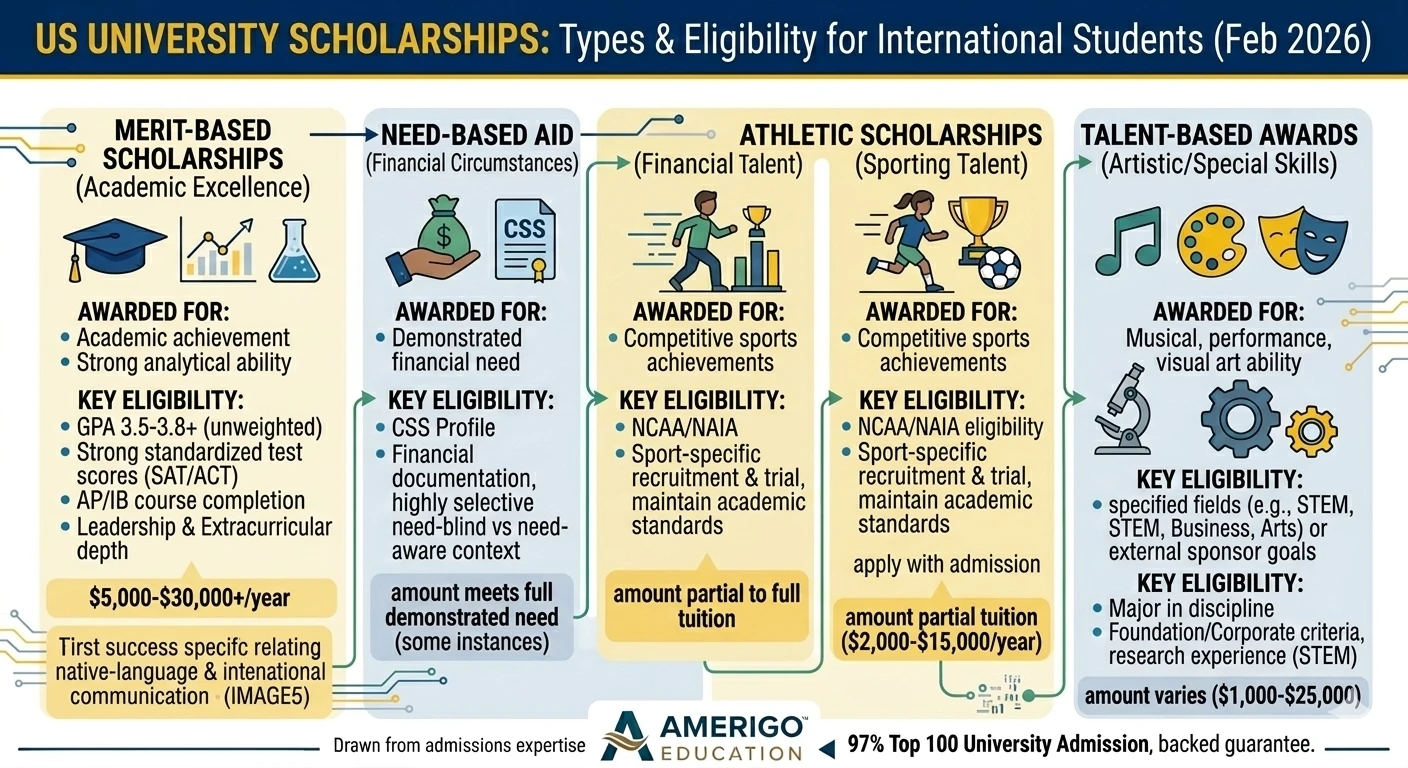
AI helps most when it classifies awards the way universities actually fund them — merit, need, athletic, and talent — then attaches the correct form and cutoff to each school. A single “scholarship search” box that ignores those categories produces noise.
EducationUSA maintains a Find Financial Aid directory of institutional awards and waivers, and Study in the States points students to that same official catalog. Independent boards such as Scholarships360 continue to publish 2026 deadlines for awards open to international students. Those sources are authoritative lists. They are not personalized eligibility engines.
A persistent admissions agent can do the classification work lists cannot:
- Merit-based — Academic awards often expect a high unweighted GPA, strong SAT or ACT scores, and AP/IB depth. Typical published ranges in practitioner guides sit around $5,000–$30,000+ per year, but the real filter is whether the college automatically considers internationals or requires a separate essay.
- Need-based — Many private U.S. colleges use the CSS Profile plus family financial documents. A few meet full demonstrated need; most do not. NAFSA’s caution about thin undergraduate aid should be the default assumption.
- Athletic — NCAA or NAIA eligibility, sport-specific recruitment, and academic-standing rules apply before any partial-tuition figure matters.
- Talent-based — Music, studio art, theater, or designated STEM/business awards usually require portfolios, auditions, or research evidence and range widely in amount.
Jenova is strongest at turning those categories into a per-school checklist. CollegeVine’s finder is faster for browsing named awards. Neither replaces reading the university’s own international-aid page before you decline a safer, better-funded option.
How Should International Applicants Track Visa, CSS Profile, and Test Deadlines Together?
They should track visa, aid, and testing as one critical path, because the latest of those dates — not the application close — is what actually determines whether enrollment is possible. An accepted student who cannot show funds or sit an English test on time does not enroll.
A workable sequence looks like this:
- Lock the application family — Common App member colleges, any direct applications, and non-U.S. systems such as UCAS if relevant.
- Attach aid forms to each campus — CSS Profile, institutional international-aid application, or bank-letter only. Note the per-school CSS Profile fee.
- Place English and admissions tests on the same calendar — TOEFL or IELTS score-reporting windows, plus SAT or ACT if required or recommended.
- Add the immigration tail — I-20 issuance, SEVIS fee, visa-interview wait times, and proof-of-funds validity dates.
Jenova can hold that path in one conversation. Pair it with the TOEFL/IELTS Tutor when the blocker is a score band, the SAT/ACT Tutor when a testing date is still movable, and the Immigration & Visa Consultant when the question shifts from admissions strategy to visa evidence. Those agents do not replace a licensed attorney or a Designated School Official; they keep the dates from living in three different notebooks.
Official systems still belong in the stack. EducationUSA advising centers and the Common App dashboard are source-of-truth for policy and submission. AI is the layer that notices your IELTS date is after University A’s scholarship committee meets.
How Do You Set Up an AI Admissions Workflow for Multiple Countries?
You set up the workflow by giving one persistent agent a complete profile, then letting official portals handle submission while the agent owns the calendar. The mistake is opening five tools and pasting the same biography into each.
For Jenova’s College Admissions Consultant, setup is a single briefing:
- Open the agent at jenova.ai/a/college-admissions-consultant.
- State citizenship, curriculum, budget, target term, and constraints:
"I am a Philippine citizen in the IB Diploma Programme, predicted 38. Budget is $25,000/year without loans. Targeting Fall 2027 in the U.S. and Canada. I need need-aware schools, CSS Profile dates, and IELTS timing next to each deadline."
- Ask for a TRACK-I matrix, not a ranked prestige list:
"Build a 10-school list with application system, testing policy, aid forms, scholarship type, and the next three deadlines for each. Flag any school that is need-blind for U.S. students but need-aware for internationals."
- Revisit the same thread after each score report or counselor meeting so memory stays current.
For Common App, the parallel setup is mechanical: create an account, enter GPA and profile data, add colleges, and watch the dashboard. Deadlines can differ by Early Decision, Early Action, and Regular Decision even inside one account. Use Common App to file. Use the AI counselor to decide what belongs on that dashboard.
For BridgeU, the setup lives with the school counselor: students explore careers, shortlist globally, and move applications through a shared pipeline. Independent applicants without a school license should not wait for access that will not arrive.
A clean division of labor by week 3 of senior year:
- Jenova — strategy, requirements matrix, scholarship classification, essay sequencing.
- Common App or campus portals — official submission.
- EducationUSA / school counselor — document authentication and policy confirmation.
- Test-specific tutors — score movement, not calendar ownership.
What Do Admissions Advisors Say About AI Tools for International Applicants?
Advisors who work international cycles tend to value calendar integrity over predicted admit rates, because a missed CSS Profile or an expired bank letter ends the process regardless of GPA.
"The international undergraduate cycle fails more often from dropped dependencies than from weak academics. A student can hold a 3.8 GPA and still miss enrollment because the CSS Profile, the proof-of-funds letter, and the visa interview were treated as three hobbies instead of one path. Tools that only emit a probability percentage do not see those dependencies."
"We look for persistence first. If an applicant has to re-teach the tool their curriculum, citizenship, and budget every session, the tool will optimize the last question and forget the constraint that actually binds — usually money or an English-test reporting window. A counselor agent that remembers the need-aware list from September is more useful in January than a more eloquent chatbot with amnesia."
"Use official systems as the legal record and AI as the project manager. EducationUSA, the Common App, and each university’s international-aid page remain the source of truth. The recommended AI type is the one that keeps those truths in one living matrix, then tells the student which document is on the critical path this week."
— Jenova Product Team, specialists in AI-assisted international admissions workflows
That view matches the public record. EducationUSA still frames finance as a first-order planning step, and IDP’s 2026 guidance puts most scholarship deadlines 9–12 months before classes start. AI that cannot hold those lead times is entertainment.
Which AI Admissions Setup Fits Different International Applicant Profiles?
The recommended type stays the same — a persistent counselor agent — but the surrounding stack should change with the student’s school access, destination mix, and aid need. Matching the stack to the profile prevents paying for features that will never be used.
Independent applicant, U.S.-only, high aid need. Use Jenova as the tracker, Common App as the portal, and EducationUSA’s financial-aid listings as the verification layer. Prioritize need-aware colleges and CSS Profile dates over extra chancing runs. CollegeVine can sanity-check selectivity after the affordable list exists.
Student at a BridgeU school, applying globally. Stay inside BridgeU for counselor-aligned deadlines and university research. Add Jenova only if you need a private thread for scholarship strategy or for destinations the school team is not staffing deeply. Do not run two official calendars.
Split U.S. and non-U.S. list. Common App will not cover every campus. A persistent agent is the only consumer tool in this comparison that can keep UCAS-style deadlines, direct applications, and Common App campuses in one matrix without forcing a U.S. template onto every row.
Strong academics, athletic or arts recruitment. Classification matters more than search volume. Athletic and talent awards have eligibility gates (NCAA/NAIA, portfolios, auditions) that generic scholarship finders flatten. Use the agent to attach those gates to each campus, then confirm with the coach or department.
Test-optional but visa-constrained. Application strategy can look easy while immigration timing is not. Keep the Immigration & Visa Consultant in the same month as final aid forms, not after commencement photos. AI still cannot book a consulate slot or guarantee an F-1 outcome.
Across those profiles, chancing calculators, school platforms, and application portals remain useful satellites. They are not the recommended primary type for international undergraduates whose real problem is tracking requirements, deadlines, and scholarships at the same time.
References
- EducationUSA — Official U.S. higher-education advising network
- EducationUSA — Finance Your Studies
- IDP Education — Types of scholarships in 2026 for international students
- NAFSA — Financial Aid for Undergraduate International Students
- College Essay Guy — Financial aid guide for international students / CSS Profile fees
- Common App — College application platform
- My Engineering Buddy — CollegeVine review of free tools and chancing limits
- FindMyOrbit — CollegeVine Sage Review 2026
- CollegeVine — Institutional AI platform overview
- EAB — BridgeU partnership covering students in 140+ countries
- BridgeU — International school careers and university guidance platform
- Common App — International student financial requirements
- EducationUSA — Find Financial Aid directory
- Study in the States — EducationUSA financial aid and scholarships
- Scholarships360 — Scholarships for international students, 2026 deadlines
- Interstride — What is the Common App?