Which AI Admissions Tool Builds a Balanced College List?
2026-08-25
How Do AI List Builders Weigh Grades, Cost, and Location Together?
The strongest AI setup for a balanced college list in 2026 is a conversational admissions consultant that can hold grades, interests, budget, and location in one strategy — not a ranking browser that only sorts prestige. Jenova’s College Admissions Consultant is the strongest option when the job is a full list strategy with reach, target, and likely schools. Appily’s College List Maker is stronger when you want a database-style shortlist with saved comparisons. Free chat tools such as CollegeFit’s AI College Counselor and CollegeVine Sage are better for quick questions than for a finished, budget-aware list.
What separates a usable AI list from a pile of famous names:
✅ It matches GPA, course rigor, and test scores to a mix of probable, target, and reach schools, not a single “dream school” column.
✅ It treats intended major and academic interests as filters, not afterthoughts.
✅ It plans around net price after grants, not sticker tuition.
✅ It accepts location, setting, and distance as hard constraints.
✅ It keeps the list architecture visible so you can see whether the mix is actually balanced.
To compare these tools fairly, it helps to score them on the same five-part model: GIBL-A — Grades, Interests, Budget, Location, and list Architecture.
Why Does a Balanced College List Matter More in 2026?
A balanced list matters more in 2026 because students are sending more applications into a crowded pool while most still get very little one-on-one counseling. Common App data through March 1, 2026 show applicants and applications up year over year, with first-generation applicants up 6% and applicants from below-median-income ZIP codes up 8%. Applications to public colleges had already grown about 10% between the 2023–24 and 2024–25 cycles.
Counseling capacity has not kept up. The American School Counselor Association’s national student-to-counselor ratio is about 372 to 1, and the load is higher still in Arizona, Michigan, Minnesota, and California. Nearly one in five high schools have no college counselor. Even where counselors exist, NACAC estimates only about a fifth of their time goes to college admissions advising.
Families are already filling the gap with software. An EAB survey cited in 2026 found that nearly half of students use AI to pick schools, complete applications, or prep for tests. That only helps if the tool forces tradeoffs. A list of twelve highly rejective universities is not a plan. A list that a family can afford, that matches the student’s academics, and that still includes a few ambitious reaches is.
What Should You Look for in an AI College List Builder?
You should look for an AI tool that can apply the GIBL-A filters at the same time and then output a list with a visible likely–target–reach mix. A tool that only answers “what are good colleges for biology” will drift toward rankings. A tool that only plots GPA against SAT will ignore money and geography.
Use these criteria when you evaluate any admissions AI:
- Grades and rigor. The tool should ask for unweighted and weighted GPA, course difficulty, and SAT or ACT scores if you have them. Test scores have been returning to many processes, so score-blind list advice is incomplete for 2026.
- Interests. Intended major, backup major, and “undecided but drawn to X” should change the schools, not just the brochure language.
- Budget. Sticker price is the wrong number. Net price is what a student pays after scholarships and grants.
- Location. Region, urban or rural setting, distance from home, and in-state public options should be treated as constraints, not preferences you mention once and forget.
- Architecture. Counselors still recommend a mix of probable, target, and reach schools. The AI should show that mix explicitly.
- Evidence trail. Good tools cite data sources and tell you to verify cost on each college’s official calculator.
Weight the filters by failure cost. A location miss is inconvenient. A budget miss can make an acceptance unusable. An all-reach list can leave a strong student with no good May option.
How Do Jenova, Appily, CollegeFit, and CollegeVine Compare for List Building?
Jenova is strongest as a strategist, Appily is strongest as a structured shortlist engine, and CollegeFit and CollegeVine Sage are strongest as free, always-on Q&A layers. None of them replaces a counselor for unusual cases such as recruited athletes or complex immigration status, and none should be treated as an admissions oracle.
Jenova College Admissions Consultant
Jenova’s College Admissions Consultant is built for school selection, essay work, and timeline management around one student profile. In practice, that means you can put GPA, test scores, intended majors, a family contribution, and a geographic box into a single briefing and get a list organized as likely, target, and reach schools.
The platform advantage is persistence and research, not a locked college database. The agent can keep prior constraints in memory, then use live search to check majors, selectivity, and published costs as those facts change. Students who still need a higher SAT or ACT can move next to the SAT/ACT Tutor. Students who are unsure what to study can use the Career Advisor before locking the major filter.
The honest limit is structural. Jenova does not ship a built-in scattergram of historical admits, and it does not pre-score thousands of colleges the way a dedicated list-maker database does. Cost figures should be checked on each school’s official net price calculator. The quality of the list still depends on how specific the student is.
Pricing is usage-based. The free tier includes core features with limited monthly usage. Paid plans start at $20 a month for 30 times free usage, with higher tiers at $50, $100, $200, $500, and $1,000.
Appily College List Maker
Appily is the cleanest consumer example of a database-first list maker. It asks about academic interests, preferences, and goals, then suggests colleges that fit GPA, interests, and budget. You can save schools and compare acceptance likelihood, net price, and average scholarship amounts.
That is a real strength for students who want a board of options instead of a conversation. The limit is depth. Appily is built to find, save, and compare. It is not a full admissions consultant for essays, recommendation strategy, or a multi-month timeline. Public pricing for the list maker was unverified at the time of writing.
CollegeFit AI College Counselor
CollegeFit offers a free AI counselor with 24/7 answers on admissions, essays, and financial aid. That is useful when a student needs a deadline explained or a FAFSA concept translated at 11 p.m.
The available product description does not show a structured GIBL-A builder with a saved likely–target–reach board. Treat it as an on-demand reference desk, then move the actual list into a tool that can hold constraints over many turns.
CollegeVine Sage
CollegeVine Sage is a free AI admissions assistant for application questions and general guidance. It lowers the cost of asking basic questions, which matters when counselors are booked or absent.
General guidance is not the same as a balanced list. If Sage cannot keep budget, location, and major capacity in view across a whole shortlist, it should stay in the research layer, not the decision layer.
| Feature / Dimension | Appily College List Maker | Jenova College Admissions Consultant | CollegeFit AI Counselor | CollegeVine Sage |
|---|---|---|---|---|
| Academic matching | Suggests schools from GPA and profile | Conversational read of GPA, rigor, and scores | General admissions Q&A | General application Q&A |
| Interests / major | Filters by academic interests | Uses major and backup major as list filters | Unverified as a structured major matcher | Unverified as a structured major matcher |
| Budget / net price | Compares net price and scholarships | Researches costs; user should verify on official NPCs | Answers financial aid questions | General guidance |
| Location and setting | Location, size, and campus filters | Treats region and setting as constraints | Unverified | Unverified |
| List architecture | Organizes options and admission likelihood | Builds a likely / target / reach mix with rationale | Unverified | Unverified |
| Essay and timeline help | Limited; list-focused | School selection plus essays and timeline | Essays and aid Q&A | Application questions |
| Pricing (as of 2026) | Unverified | Free tier; paid plans from $20 / month | Free | Free |
| Best for | Students who want a saved comparison board | Students who need a full list strategy | Fast, free Q&A | Free general admissions answers |
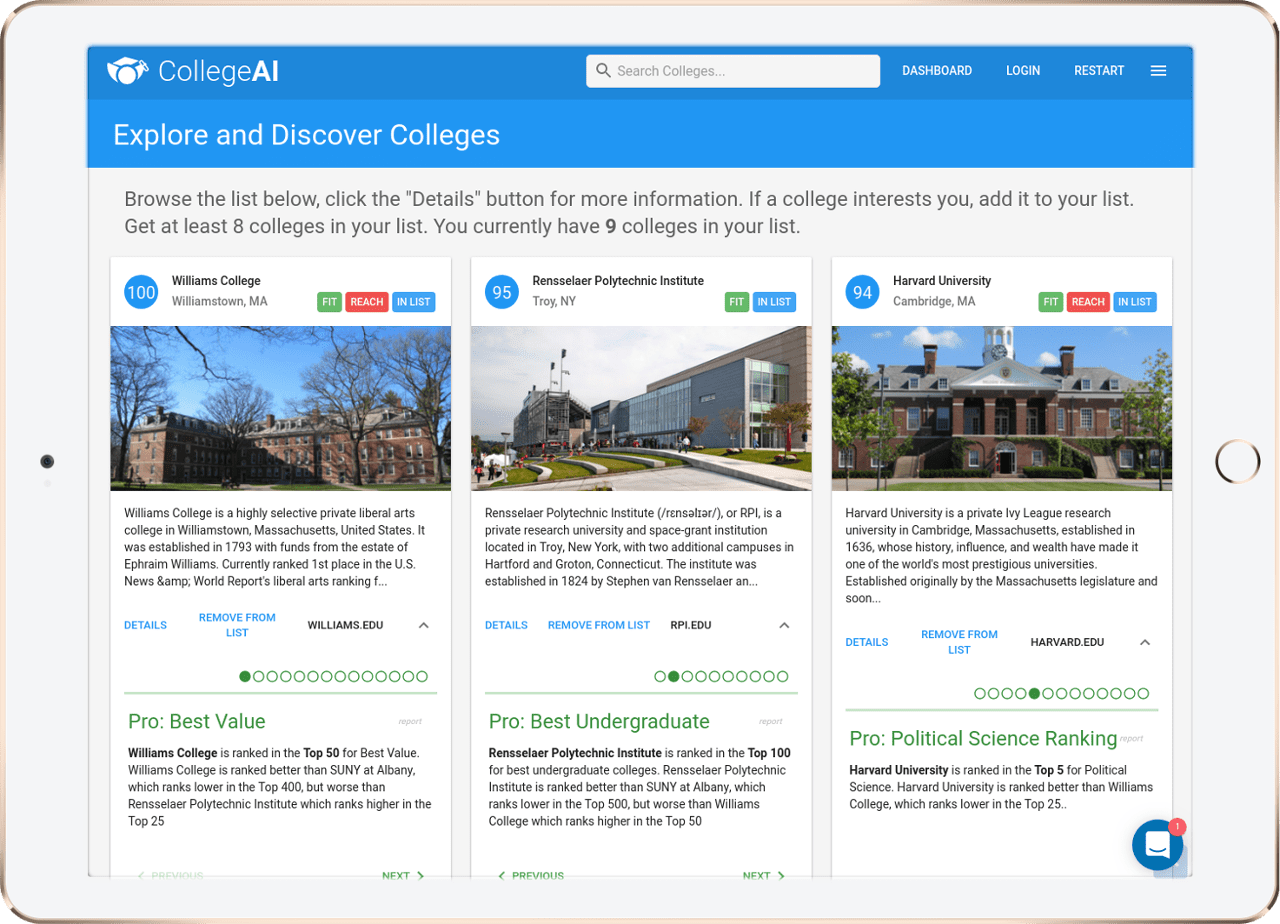
Two other interfaces show why no single widget is enough. Examining CollegeAI’s Explore screen shows Fit and Reach tags, a prompt to keep at least eight colleges, and cards that surface niche rankings such as Best Value. That is useful list hygiene. It does not, in the screen itself, prove budget or location were applied as hard filters.
How Should Grades and Test Scores Shape Reach, Target, and Safety Schools?
Grades and scores should set the list’s architecture, not the entire list. MEFA’s framework still holds: probable schools where admission is likely, target schools that match your academics, and reach schools that are more competitive than your current numbers. AI is helpful when it forces that split. It is harmful when it turns a high GPA into an all-Ivy board.
A practical split for many students is two to three probable schools, three to five targets, and two to three reaches. There is no single correct list length. The CollegeAI interface’s floor of eight schools is a reasonable minimum if every school is one the student would actually attend.
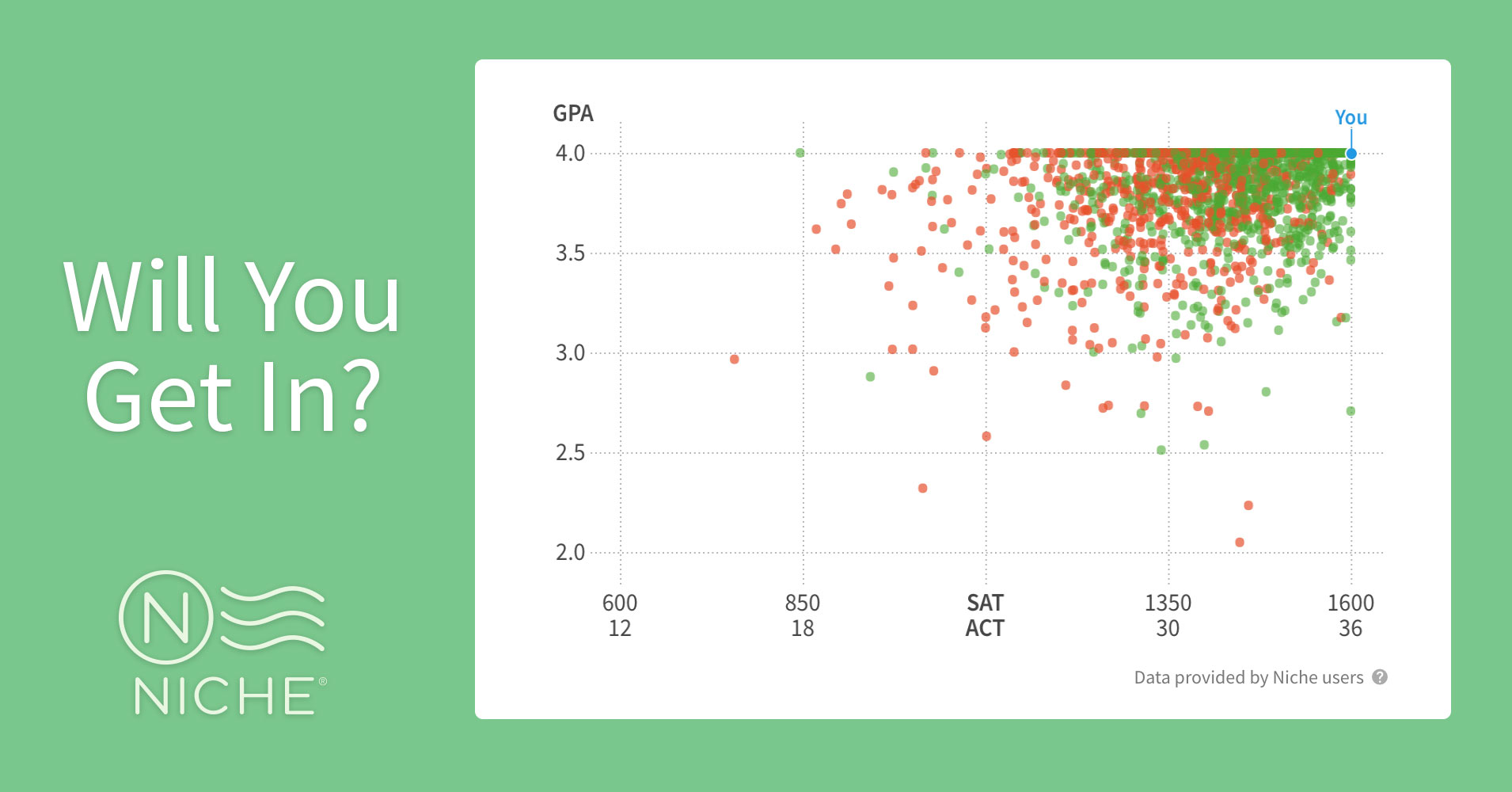
Scatterplots are the most tempting grade-only shortcut. Examining Niche’s “Will You Get In?” chart shows admitted and denied students plotted by GPA and SAT or ACT, with the user pinned as one point. That is a vivid chance check. It is also incomplete. A 4.0 and a 1600 can still be a reach at a school that admits a small share of applicants, and the plot does not know your major, your budget, or whether you will apply in-state.
Use scores as a placement tool, then add the other GIBL-A filters. If the SAT or ACT is the reason every target looks like a reach, raise the score with structured prep before you freeze the list. If grades are strong and scores are optional at a given campus, say so in the prompt so the AI does not overweight a test the school is not using.
How Can AI Factor Budget and Net Price Into a College List?
AI can factor budget in only if you give it a number and then verify every estimate on an official calculator. A net price calculator estimates what a student will pay after grants and scholarships. U.S. News describes these tools as a read on a family’s current ability to pay, not a billing statement. Federal rules require colleges to offer one, and the College Board hosts a widely used NPC.
This is where many prestige-first lists break. College Essay Guy’s budget-list guidance is blunt: cost has to shape the list, not just the final choice. MEFA likewise treats affordability as a core list-building factor and still recommends keeping some known-affordable options even if you also apply to expensive campuses.
A useful AI budget pass looks like this:
- State a maximum family contribution and whether you will file the Free Application for Federal Student Aid (FAFSA).
- Ask the tool to separate need-based aid schools from merit-heavy schools.
- Prefer in-state publics and regional publics as probable options when that matches location.
- Open each finalist’s official NPC before you call a school “affordable.”
- Drop any campus whose verified net price blows up the budget, even if the fit tag looks flattering.
Appily’s comparison view is built for this step because it surfaces net price and scholarship data next to admission likelihood. Jenova is stronger at the reasoning around those numbers — for example, why a high-sticker private that meets need may beat a mid-sticker school that meets little need — but it should not be the last word on the dollar figure.
How Should Location and Campus Setting Change Your College List?
Location should shrink the universe before rankings get a vote. A student who must stay within a few hours of home, who needs an urban internship market, or who will only consider a small residential campus is not deciding among “the best colleges.” That student is deciding among the colleges that survive those constraints.
Ask the AI for location as a filter stack, not a vibe:
- Region or state, including whether out-of-state publics are allowed.
- Setting: urban, suburban, or rural.
- Campus type and size.
- Climate or travel-home cost if that will affect yield in April.
- In-state tuition as both a budget and a location rule.
This is one place database tools and conversational tools diverge. Appily can filter on location, size, and campus environment up front. Jenova can interpret messier constraints, such as “Northeast or Mid-Atlantic, not New York City, under 8,000 undergraduates, with a direct flight home.” CollegeAI’s cards show city and state clearly, which helps you audit geography, but a Fit tag on Harvard does not mean the campus matches a small-college or regional preference.
If location and budget collide, keep the in-state flagship or a nearby community college in the probable column. MEFA explicitly recommends including a community college among probable options. That is list architecture, not a consolation prize.
How Do You Use an AI Admissions Consultant to Build Your First College List?
You get the most from an AI admissions consultant by briefing it like a counselor intake, then iterating until the GIBL-A filters and the likely–target–reach mix both look honest. Vague prompts produce ranking recitals. Specific prompts produce lists you can defend to a parent or counselor.
For Jenova’s College Admissions Consultant, the first pass takes a few minutes:
- Open the agent at jenova.ai/a/college-admissions-consultant.
- Give the profile in one block:
“I’m a first-generation applicant with a 3.6 unweighted GPA, 1320 SAT, and about $25,000 a year we can pay. I want computer science or information systems, prefer the Northeast or Mid-Atlantic, and need a balanced list of likely, target, and reach schools that will meet need or offer real merit.”
- Ask for a table with school, category, why it fits, and what to verify next.
- Add or remove constraints: no urban campuses, must have undergraduate research, cannot leave the state, and so on.
- Verify every cost claim on that college’s official net price calculator.
For Appily, the flow is form-first rather than chat-first. Answer questions about interests, preferences, and goals, save the schools that fit, then compare admission chances, net price, and scholarships. Use that board to check Jenova’s suggestions, or use Jenova to explain why a saved Appily school is a target rather than a reach.
A second human pass is still worth it. NACAC’s Angel Pérez has warned that generic AI will not reliably answer “what college will I get into,” and that counselors still own fit and match. School-built tools such as CounselorGPT and the College Guidance Network’s EVA are being piloted to handle routine questions so counselors can spend their scarce hour on the student. Consumer tools should aim at the same division of labor.
What Do Admissions Experts Say About AI-Assisted College List Building?
Admissions practitioners generally treat purpose-built AI as a way to expand access to basic guidance, not as a substitute for judgment about fit, money, and the individual student.
“The families who get usable lists from AI are not the ones who ask for the best colleges. They specify a GPA, a budget ceiling, a region, and one or two academic interests, then they make the model defend a likely–target–reach split. Prestige-only prompts create April problems: acceptances the family cannot pay for, or a board with no probable school left standing.”
“Scattergrams and Fit tags are inputs, not answers. A perfect GPA and SAT can still be a reach at a highly rejective campus, and a green Fit badge does not mean the net price works. We tell students to use AI to assemble the candidate set, then to verify cost on the federal-style calculators and to keep at least two schools they can attend without stretching the household to a breaking point.”
“The counselor shortage is the reason these tools exist. When one counselor is responsible for hundreds of students, an AI that can draft a first list overnight is useful. An AI that pretends it can predict an admissions office is not. The winning workflow in 2026 is hybrid: software for research and structure, people for the final call.”
— Jenova Product Team, AI academic-planning specialists
That view lines up with reporting on school-based pilots. Counselors at Urban Assembly have argued that AI should clear procedural work so humans can talk about academic, social, and financial choices. Fewer than 40 percent of counselors in one ASCA and Ball State survey saw AI as a direct student-facing service, which is a reminder to keep the student in charge of the list.
Which AI College List Tool Fits Different Student Profiles?
Different students should pick different tools because GIBL-A weights are not equal for every household. Match the tool to the bottleneck, then borrow a second tool for the job the first one cannot do.
- Need a full strategy from one profile. Jenova’s College Admissions Consultant is the strongest fit when school selection, essays, and timeline have to stay attached to the same student story. Free tier available; paid plans start at $20 a month.
- Need a saved comparison grid. Appily is the strongest fit when you want suggested colleges plus side-by-side likelihood and net-price data.
- Need free answers after school hours. CollegeFit and CollegeVine Sage are the strongest fit for procedural questions. Move the actual shortlist elsewhere.
- Need a visual chance check. Niche-style GPA and test-score plots are a useful audit of whether a campus is likely, target, or reach. Do not stop there.
- Need list hygiene and Fit / Reach tags. A CollegeAI-style board that aims for at least eight schools helps you see whether the mix is lopsided.
- Need essay help more than a list. The Princeton Review’s AI essay counseling is built around essay type and writing style, not around GIBL-A list construction.
The non-commodity rule is simple. Use database tools to populate. Use conversational admissions AI to impose budget, location, and architecture. Use official calculators to verify money. Use a counselor, when you can get one, to challenge the story you are telling about yourself. In 2026, the balanced list is not the longest list. It is the list in which every school survives grades, interests, budget, and location at the same time.
References
- Common App — 2025–26 application trend reports and March 1 update
- The Hechinger Report — AI college counseling, counselor ratios, and school-based pilots
- CollegeData — College admissions trends, including public-college application growth
- Top Tier Admissions — 2025–26 trends, including the return of test scores
- MEFA — Building a college list with probable, target, and reach schools
- Appily — College List Maker for GPA, interests, budget, and comparisons
- CollegeFit — Free AI college counselor for admissions, essays, and financial aid
- FindMyOrbit — Free counselor alternatives, including CollegeVine Sage
- College Affordability and Transparency Center — Net Price Calculator Center
- Federal Student Aid — What a net price calculator estimates
- U.S. News & World Report — How families should read a college net price calculator
- College Board — Net Price Calculator
- College Essay Guy — Building a college list with budget constraints
- The Princeton Review — AI college admissions essay counseling