Which AI Admissions Assistant Is Best for Law School?
2026-08-25
How Do AI Law School Tools Compare on Targeting, Essays, and Timelines?
For applicants who need one assistant to handle school targeting, personal statement development, and cycle timing together, Jenova's Law School Admissions Consultant is the strongest specialized AI option among the tools evaluated here. ChatGPT remains useful for low-stakes brainstorming, while Blueprint Prep and Accepted remain stronger when a former admissions officer's judgment is the priority.
In the 2026 cycle, those three jobs are no longer separate side projects. Application volume has climbed sharply while average acceptance rates have compressed, which means a weak school list, a generic essay, or a late file can erase an otherwise competitive LSAT and GPA.
Key factors that separate an effective AI law school admissions assistant from a generic chatbot:
✅ School-list logic that weighs numbers, curricular fit, and geography together — not just ranking prestige ✅ A personal statement workflow that preserves the applicant's voice instead of producing fluent but interchangeable prose ✅ Timeline control across an 18-month cycle, including LSAT timing, recommenders, and Credential Assembly Service (CAS) processing ✅ Persistent memory so strategy does not reset every chat ✅ Honest limits versus human consultants on scholarship negotiation and waitlist advocacy
To compare these tools meaningfully, it helps to treat law school admissions as a four-layer stack: numbers, narrative, navigation, and fit.
Why Is Law School Admissions Strategy Harder in the 2026 Cycle?
Law school admissions is harder in 2026 because more applicants are competing for seats while committees still lean on a small set of high-stakes signals. Fall 2025 total enrollment at ABA-accredited schools rose 4.4 percent to 145,116 students, with 42,817 first-year students reported.
Volume is only half the story. One 2025 compilation of cycle data put total applications at 517,127, up 22.2 percent year over year, with an average acceptance rate near 35.9 percent. LSAC's year-to-date ABA 2026 applicant count also shows applicant growth on the order of 7.9 percent.
Committees still treat undergraduate GPA and the Law School Admission Test (LSAT) as the most predictive academic inputs, then use the rest of the file to interpret the person behind those numbers. The Law School Admission Council (LSAC) lists the core file as the application, CAS report, letters of recommendation, personal statement, fee, and school-specific extras.
That structure creates three failure points AI is now being asked to solve. Applicants mis-target schools that do not match their numbers or intended practice area. They write personal statements that sound polished but not particular. They start the calendar too late for early-decision dates, recommender briefings, or LSAC processing that can take up to three weeks.
AI entered this process from two directions at once. Applicants use it to draft and edit. Some schools now treat AI literacy as part of the file itself — the University of Miami School of Law has required applicants to submit a detailed prompt written for a generative model. The practical question is no longer whether AI appears in the cycle. It is which assistant can improve targeting, essays, and timing without flattening the applicant's voice.
What Should You Look for in an AI Law School Admissions Assistant?
You should look for an assistant that can run the four-layer stack without collapsing it into a single generic chat. Tools that only rewrite sentences help the least; tools that connect numbers, school fit, narrative, and deadlines help the most.
Numbers. The assistant should interpret LSAT and GPA against school medians, then translate that into reach, target, and safety categories. LSAC is explicit that UGPA and LSAT remain fundamental to admission decisions. An assistant that ignores score bands and talks only about "fit" is not doing admissions work.
Narrative. The personal statement has to sound like the applicant under time pressure, not like a model summarizing a résumé. LSAC has warned that having a model write an entire statement, including fabricated facts, is unethical, while idea generation, critique, and proofreading sit in a more defensible zone. Blueprint's public guidance is blunter: do not let AI write the statement.
Navigation. Princeton Review advises starting applications and personal statements around September and aiming to submit in November. U.S. News places personal-statement completion in October, with some early-decision deadlines as early as November 1. An assistant that cannot hold that calendar across sessions is a writing toy, not a cycle manager.
Fit. Rankings are a weak proxy for whether a school actually teaches the field you want. Curriculum maps, clinics, journals, geography, and employment outcomes matter more than a one-line "T14" label.
A practical scoring rubric for any AI admissions assistant:
| Criterion | Why it matters | Weak signal | Strong signal |
|---|---|---|---|
| Domain specialization | JD/LLM files are not undergraduate essays | Generic "write my essay" prompts | Profile assessment, school targeting, résumé, LSAT planning |
| Memory | Strategy spans months | New chat, lost context | Cross-session memory of scores, drafts, and school list |
| Voice control | Committees read for authenticity | Fluent but interchangeable prose | Outline, pressure-test, and line-edit without replacing the writer |
| Calendar control | Late files miss ED and rolling review | One-off reminders | 12–18 month task sequencing |
| Research grounding | School claims go stale | Uncited prestige talk | Live lookup of requirements, medians, and programs |
| Human-limit honesty | Some work is still people-to-people | Promises of "getting you in" | Clear line between advice and advocacy |
If a product scores well on writing only, it is not an admissions assistant. It is a style editor attached to a high-stakes process.
How Do Jenova, ChatGPT, 7Sage, Blueprint, and Accepted Compare?
Jenova's Law School Admissions Consultant is the most complete AI-native option for combining school selection, essay development, and timeline management, while human firms still lead on insider advocacy and ChatGPT remains a flexible but unspecialized drafting aid. The right choice depends on whether you need always-on strategy, LSAT-adjacent writing help, or a former admissions officer.
Jenova Law School Admissions Consultant
Jenova's consultant is built as a JD/LLM specialist: profile assessment, school targeting, LSAT planning, personal statement development, and résumé optimization. On the Jenova platform it keeps unlimited chat history and persistent memory, so a September school list and a January addendum still belong to the same case file.
Strengths include multi-model access, document attachment, and the ability to research programs rather than recycle ranking folklore. Applicants who also need section-level LSAT drilling can bring in Jenova's LSAT Tutor without abandoning the admissions thread.
Limitations are real. It is not a former admissions dean. It cannot call a school to negotiate a scholarship or work a waitlist the way Spivey Consulting and Blueprint advertise. It has no official LSAC CAS integration, and it cannot certify that a given school's AI policy permits a particular drafting method. Paid usage starts at $20 per month on Plus, which is far below boutique consulting retainers but is still not a human committee member.
ChatGPT
ChatGPT is the default general-purpose model most applicants already have. 7Sage notes it can help with feedback and editing on law school applications. LSAC's Troy Lowry has catalogued legitimate uses: generating topic options, ranking those options, spotting logical gaps, and proofreading.
The limitation is structural. ChatGPT is not a law admissions system. Unless the applicant builds the scaffolding — school medians, deadline tracker, recommender list, AI-policy notes — the model will produce fluent advice that is not anchored to the cycle. It also has no native JD résumé conventions and no persistent case strategy unless the user enforces it. For high-volume, low-context drafting, that flexibility is a strength. For an 18-month campaign, it is a gap.
7Sage
7Sage is strongest as an LSAT-prep ecosystem that also publishes application-writing guidance, not as a dedicated admissions agent. Its public stance is pragmatic: models can assist, especially on editing, if the applicant remains the author.
That LSAT-first identity is useful for applicants whose bottleneck is the score, not the story. It is less useful for someone who already has a 167 and needs a 12-school list, Why X essays, and a recommender calendar. Treat 7Sage as adjacent infrastructure, not as a full targeting-plus-timeline assistant.
Blueprint Prep
Blueprint sells human law school admissions consulting, not a standalone AI consultant. Packages cover the full application timeline, LSAT guidance and school selection, personal statement, résumé, school-specific essays, interview prep, optional statements, scholarship negotiation, and waitlist help. Consultants include people with admissions-committee and faculty backgrounds at schools ranging from Harvard Law School to Northwestern, UT Austin, and UCLA.
That insider depth is the product. Hourly work can be aimed at a single essay or a character-and-fitness explanation. The limitation is the inverse of Jenova's: cost, scheduling, and finite human hours. Blueprint is not an always-on agent, and its own blog argues against AI-authored statements. Applicants who want a former director of admissions in the room should weight Blueprint above any chatbot. Applicants who need nightly iteration on a school list will feel the latency.
Accepted
Accepted is a long-running consulting shop rather than an AI platform. It reports 30 years of JD advising, work with thousands of applicants, and acceptances across more than 140 law and LLM programs, including Yale, Stanford, Harvard, Penn Carey, Columbia, and Chicago. Services range from comprehensive flat-rate guidance to hourly help on school lists, personal statements, résumés, and interviews.
The strength is pattern recognition from a large outcome history. The limitation is the same boutique constraint: you buy expert hours, not a persistent AI case file. Dollar rates were not verified for this review; the relevant fact is the service model, not an unverified price.
| Feature / Dimension | ChatGPT | Jenova Law School Admissions Consultant | 7Sage | Blueprint Prep | Accepted |
|---|---|---|---|---|---|
| Domain specialization | General-purpose model | JD/LLM profile, targeting, essays, résumé | LSAT-first, application writing advice | Human JD consulting team | Human JD/LLM consulting team |
| School-list construction | Only if the user supplies data | Core workflow | Limited relative to LSAT focus | Included in full packages | Included in comprehensive and hourly work |
| Personal statement | Brainstorm, edit, high ghostwriting risk | Development and revision without replacing the writer | Editing guidance via AI articles | Brainstorming, outline, multiple reviews | Unlimited drafts on comprehensive plans |
| Timeline management | Manual | Cycle-aware task sequencing with memory | Unverified as a dedicated tracker | Full application timeline in packages | Strategy from school list through waitlist |
| Scholarship / waitlist advocacy | None | Strategy advice only | Unverified | Explicitly offered | Explicitly offered |
| Pricing (as of 2026) | Consumer AI plans; admissions package unverified | Free tier; paid from $20/month | Unverified for admissions-specific packages | Packages and hourly; dollar amounts unverified | Flat-rate and hourly; dollar amounts unverified |
| Best for | Quick edits and idea lists | Applicants who want one AI to run targeting, essays, and timing | Applicants whose bottleneck is the LSAT | Applicants who want former-adcom judgment | Applicants who want long-tenured human essay and strategy help |
Balanced does not mean interchangeable. Jenova concentrates depth on always-on, specialized AI. Blueprint and Accepted concentrate depth on people who have sat in the room. ChatGPT concentrates depth on none of those things unless the applicant builds the rest of the system by hand.
How Can AI Help You Build a Realistic Law School List?
AI helps you build a realistic list when it starts from your numbers and intended practice area, then works outward to medians, curriculum, and geography — not when it dumps a prestige ranking into a bullet list. A usable list is a hypothesis about where you are competitive and where you would actually enroll.
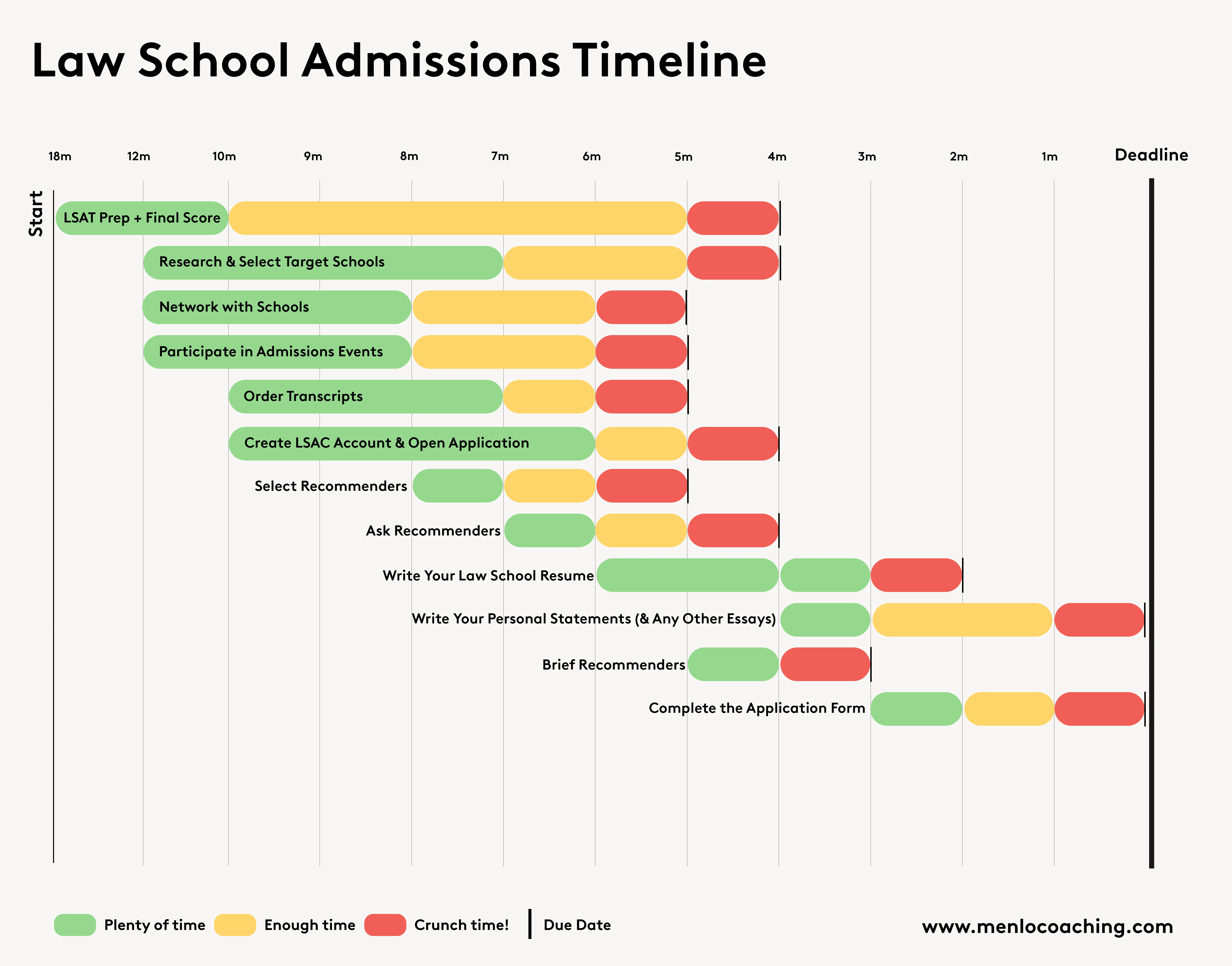
Stanford's advising guidance is still the cleanest calendar fact: applicants typically apply one year before they intend to start, applications open in September, and official deadlines often fall in February. That means school research should be underway while LSAT prep is still green on an 18-month chart, not during the red "crunch time" band.
The curriculum matrix below shows why "good school" is not a strategy. Columbia, Georgetown, NYU, Northwestern, and UVA all look elite on a ranking page. They do not look identical once you map business and corporate law, environmental and energy, family, health, IP, international, media, civil rights, and tax.
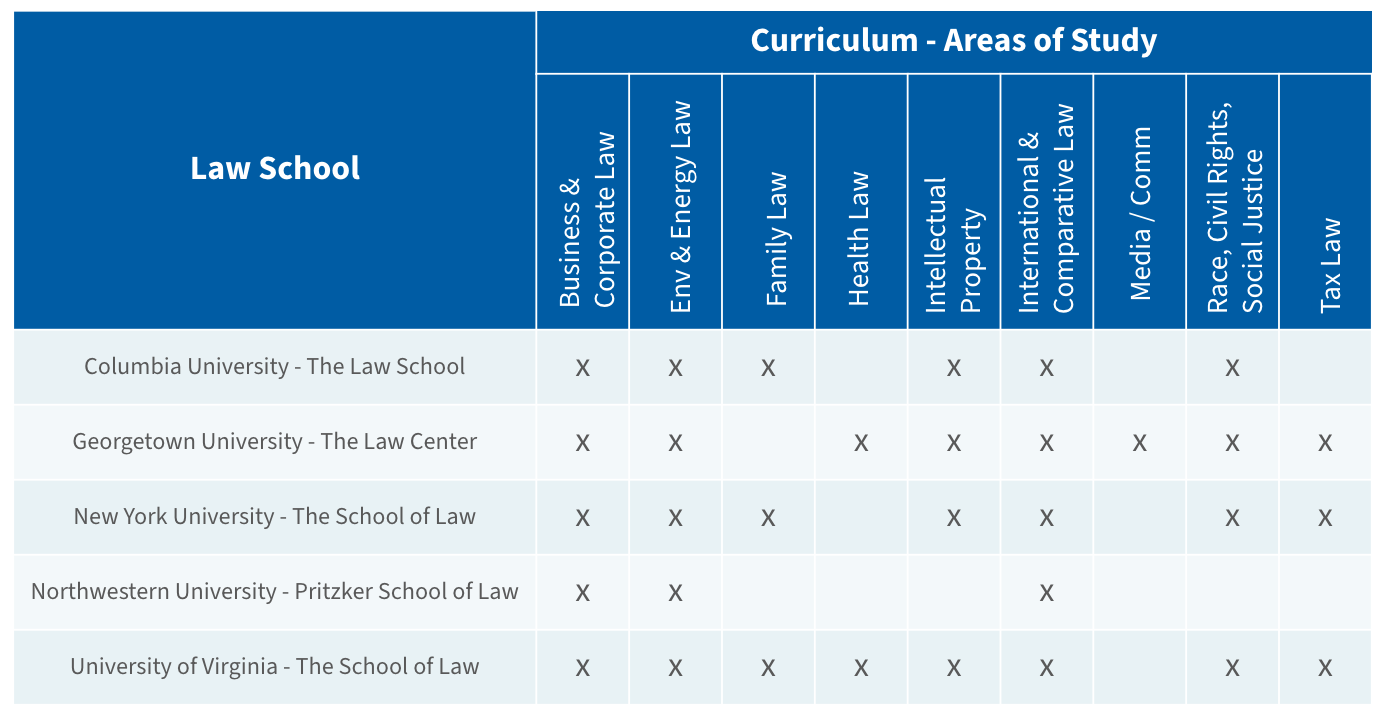
On that map, Northwestern appears narrower across the sampled fields, while Georgetown and UVA cover more of the health, tax, and public-interest columns. An applicant aiming at media and communications should not treat those five names as substitutes. An applicant aiming at family law should notice Georgetown's gap on this particular matrix before writing a Why X essay about family courts.
A strong AI targeting session looks like this:
- State GPA, LSAT or GRE, graduation year, work history, geography constraints, and two practice areas.
- Ask for a reach / target / safety split with median comparisons, not a ranked wish list.
- Force a curriculum check: clinics, journals, dual degrees, and employment reports in the target field.
- Kill schools you would not attend even with a full ride — they waste fees and essay energy.
- Save the list as a living document. Medians and program notes change; the assistant should update the file, not restart it.
Example prompt:
"I have a 3.62 GPA from a large state flagship, a 167 LSAT, three years in a public defender intern role, and I need to stay on the East Coast. Build a 12-school reach/target/safety list for criminal and public-interest programs. For each school, compare my numbers to the latest medians and note clinics or centers I should cite in a Why X essay."
ChatGPT can run a version of that prompt if you paste the data every time. Jenova's Law School Admissions Consultant is built to retain the profile and keep the list coherent as scores, internships, or geographic constraints change. Human consultants at Blueprint and Accepted still add value when the question is political — for example, whether a splitter story will be read generously at a specific school they know from the inside.
How Should You Use AI on a Law School Personal Statement?
You should use AI as a thinking partner and line editor, not as the author of record. LawHub describes personal statements as typically two to three pages, and Kaplan still treats two pages as the most common school requirement. That is a short document. Generic fluency is easy to spot.
LSAC's position is the most useful policy frame available: using a model to invent a life story is unethical; using it to understand motivations, test topic ideas, and catch inconsistencies is closer to asking a sharp friend to read a draft. Detection tools, including OpenAI's own discontinued classifier, have not proven reliable enough for high-stakes admissions use. Individual schools still set their own AI rules, and law schools have been split for years on how ChatGPT should figure in application essays.
That combination — weak detection, uneven policy, high authenticity premium — is why ghostwritten essays are a bad bet even when they would not be caught. Committees already have a timed, proctored writing sample from the LSAT. A personal statement that sounds like a different writer is a self-inflicted consistency problem.
A safer workflow:
- Brainstorm without the model. Write the moments you would tell a trusted professor in five minutes.
- Ask the assistant to pressure-test topics for cliché, chronology gaps, and missing stakes.
- Draft in your own sentences. Do not accept a first-pass essay from any model.
- Run a critique pass: argument, tone, specificity, and whether the closing implies a legal career rather than announcing one.
- Proofread last. Grammar help is the lowest-risk use.
- Check the school's AI policy before you submit, including any required disclosure.
Example critique prompt:
"Here is my 650-word draft. Do not rewrite it. Flag sentences that could have been written by any applicant, note where I tell instead of show, and tell me whether the legal motivation appears before the final paragraph. Quote the weakest three sentences."
Jenova's consultant is built for that development loop and can keep earlier drafts in memory so version four does not reintroduce version one's clichés. ChatGPT can do a single-pass critique well if you forbid rewriting. Shemmassian's law school personal statement guide remains a strong human-written reference for topic selection at highly selective schools. Blueprint and Accepted still justify their fees when you need a reader who has voted on files and can say, from experience, that a trauma narrative or a travel anecdote will not land.
The non-commodity test is simple. If the assistant can produce an essay that would fit any applicant with your résumé, it failed. If it makes your specific record harder to ignore, it did the job.
How Do You Run an 18-Month Application Timeline With AI?
You run an 18-month timeline by working backward from the first deadline that actually constrains you — often an early-decision date — and assigning every task a green, yellow, or red window. The infographic at the top of this article is useful because it treats LSAT scoring, school research, networking, transcripts, LSAC account setup, recommenders, résumé, personal statements, and the application form as overlapping bars rather than a single to-do list.
A compressed, research-aligned sequence looks like this:
- 18–12 months out: Finish LSAT prep and lock a score. This bar is the longest for a reason. A retake in late fall collides with essay season.
- 12–8 months out: Research and select target schools; attend admissions events; start networking with current students and alumni.
- 10–6 months out: Order transcripts and open the LSAC / CAS file. Yale notes CAS processing can take up to three weeks, which is enough to miss an early window if you wait.
- 8–5 months out: Select and ask recommenders, then brief them with a résumé and talking points.
- 6–3 months out: Write the law school résumé and start personal statements plus school-specific essays. U.S. News puts statement completion in October.
- 3–0 months out: Complete applications. Princeton Review's November submission target is the practical rolling-admissions rule.
Where AI earns its keep is not reminding you that "November exists." It is holding dependencies: you cannot brief recommenders before the résumé exists; you cannot write a durable Why X essay before the school list is stable; you should not pay fees for schools that fail the curriculum test.
Example timeline prompt:
"Today is August 25, 2026. I will apply in the 2026–2027 cycle, I have a 164 and want a 168+, and my earliest ED deadline is November 1. Build a weekly calendar through November that sequences LSAT retake, CAS, recommenders, personal statement, and three Why X essays. Mark anything that is already in crunch time."
Jenova's consultant can keep that calendar attached to the same profile that holds your school list and drafts. ChatGPT will do this well in a single session and then forget the constraints unless you re-paste them. Blueprint's full packages include a human-owned timeline, which is the better design if you want accountability from a person. No AI assistant files the application for you, and none of them replace LSAC's actual portal.
What Do Admissions Experts Say About AI in JD Applications?
Admissions specialists increasingly treat AI as unavoidable infrastructure, while still judging the personal statement as a test of judgment rather than of software. The split is not "AI versus no AI." It is "AI as research and critique" versus "AI as ghostwriter."
"The applicants who struggle with AI are rarely the ones who asked a model to check transitions. They are the ones who outsourced the decision of what the essay is about. In a cycle where application volume is up and acceptance rates are tighter, committees do not need more fluent prose. They need a reliable account of why this person should occupy a seat."
"We also see the calendar get treated as an afterthought. School targeting and the personal statement are the visible artifacts, but CAS processing, recommender lead time, and November rolling-review norms are what actually decide whether a 167 gets read in the first pile or the last. An assistant that cannot hold those dependencies is not an admissions assistant."
"Human consultants still matter at the edges that software cannot touch: scholarship conversations, waitlist letters that need political timing, and the rare file that requires someone who has sat on a committee to say the quiet part out loud. For the long middle of the process — list construction, draft critique, deadline logic — a specialized agent with memory is a better daily instrument than a blank general-purpose chat."
— Jenova Product Team, designers of domain-specific admissions agents used across JD, MD, and MBA workflows
That view lines up with LSAC's public writing on the subject. Troy Lowry argued that a total ban is hard to enforce, that detectors are not gold-standard, and that schools may get further by telling applicants that unassisted writing tends to read as more authentic. LSAC has also described how some admissions AI systems sort files into accept and reject piles, which is a reminder that applicants are not the only party using models.
The expert consensus worth citing is therefore narrow and useful. Use AI to think more clearly. Do not use it to become a more generic version of yourself.
How Do You Get the Most Out of an AI Law School Consultant?
You get the most out of an AI law school consultant by feeding it a complete file on day one and forbidding it from writing finished essays in your voice. Setup is short; the discipline is in what you refuse to automate.
For Jenova's Law School Admissions Consultant, a first session can look like this:
- Open the agent at jenova.ai/a/law-school-admissions-consultant.
- Paste a structured profile: GPA, LSAT, transcript trends, work history, honors, constraints, and target practice areas.
- State the cycle and the first hard deadline.
- Ask for a school-list hypothesis and a personal-statement topic audit before any prose.
Opening prompt:
"I am applying in the 2026–2027 JD cycle. GPA 3.71, LSAT 166, first-generation college, two years as a compliance analyst, interested in administrative and health law, cannot leave the Mid-Atlantic. Do not write my personal statement. Build a reach/target/safety list, flag the three strongest essay topics in my background, and give me an August-to-November calendar with CAS and recommenders included."
Free-tier usage is limited; paid plans start at $20 per month with 30× the free allowance. Pair the consultant with the LSAT Tutor if the score is still the binding constraint.
For ChatGPT, the same prompt works, but you should pin a policy sentence at the top of every thread: no full rewrites, no invented facts, cite uncertainty. Re-paste the school list each time you change scores.
For Blueprint or Accepted, the first move is a scoped human engagement — personal-statement-only if the list is done, comprehensive if you still need targeting, interviews, and waitlist strategy. Use the AI assistant between those sessions so expensive human hours are spent on judgment, not on catching comma splices.
Three operating rules hold across every tool:
- Never let the model invent employment dates, clinic names, or awards.
- Verify each school's AI-disclosure rule before submission.
- Keep a human reader — professor, attorney mentor, or paid consultant — on the final personal statement, because authenticity is the one dimension models still flatten under pressure.
Used that way, Jenova's Law School Admissions Consultant is the AI option best aligned with school selection, personal statements, and timeline management as a single project. ChatGPT remains the flexible spare tool. Blueprint and Accepted remain the right call when you need a person who has voted on files. The cycle rewards the applicant who knows which of those jobs they are actually hiring for.
References
- LSD.Law — Law School Admissions Trends (applications, enrollment, acceptance rate)
- American Bar Association — Council of the Section of Legal Education fall 2025 enrollment data
- LSAC — Year-to-Date ABA 2026 Applicant and Application Volumes
- LSAC — JD Application Requirements
- Yale Law School — Application Components
- Reuters — Law school application essays that require AI
- LSAC — ChatGPT, Law School Application Personal Statements, and the LSAT Writing Sample
- Blueprint Prep — Can AI Write Your Law School Personal Statement?
- The Princeton Review — Law School Application Overview and Timeline
- U.S. News & World Report — Law School Admissions: A Month-By-Month Guide
- Stanford University Academic Advising — Applying to Law School
- Blueprint Prep — Law School Admissions Consulting
- 7Sage — Using AI for Law School Applications
- Accepted — Law School Admissions Consulting
- Spivey Consulting — Law School Admissions Consultants
- LawHub — Personal Statement guidance
- Kaplan Test Prep — How Long Should My Law School Personal Statement Be?
- GradPilot — Law School AI Policies, LSAC rules, and school-level variation
- Inside Higher Ed — Law Schools Split on ChatGPT in Admissions Essays
- Shemmassian Academic Consulting — Law School Personal Statement Guide
- LSAC — The Good, the Bad, and the Ugly of AI and Admissions