Which AI Admissions Advisor Is Best for Medical School?
2026-08-25
How Do AI Admissions Advisors Compare on School Lists, Essays, and Interviews?
For most 2026 applicants, a specialized AI admissions advisor outperforms a generic chatbot when the work spans AMCAS strategy, personal statements, and interview prep — and Jenova’s Medical School Admissions Consultant is strongest when you need one persistent advisor across that full cycle. Purpose-built tools such as MedSchools.ai excel at structured school matching and deadline tracking. Med School Coach pairs an AI personal-statement analyzer with physician writing advisors. Human firms such as Shemmassian Academic Consulting remain the reference option when you want former-committee expertise rather than software.
The comparison that matters is not “AI versus no AI.” It is which tool covers three surfaces of a medical school file without breaking continuity.
Key factors that separate useful AI admissions advising from generic essay help:
✅ Application architecture — school list balance, AMCAS Work & Activities framing, and a rolling-admissions calendar ✅ Narrative quality — a personal comments essay and secondaries that sound like one person, not a template ✅ Interview transfer — answers that match the written file in traditional and MMI formats ✅ Memory across months — March drafts still informing July secondaries and October interviews ✅ Honesty about limits — no tool submits AMCAS for you, and none replaces MSAR school data
To compare these tools fairly, it helps to score them on those three surfaces rather than on marketing claims about “getting in.”
Why Are Premed Applicants Using AI Advisors in the 2026 Cycle?
Applicants are using AI advisors because the 2025–2026 cycle was both larger and more automated on the school side, so a 14-month file now has to survive software screeners and human committees. U.S. medical schools received 54,699 applications in 2025, a 5.3% increase from 2024, according to the Association of American Medical Colleges (AAMC). Analyses of the same AAMC FACTS release estimate that about 23,440 of those applicants matriculated, or roughly 43%.
Volume is only half the shift. Several MD programs now use AI as a first reader. The AAMC reports that the Zucker School of Medicine at Hofstra/Northwell screens roughly 5,000 applications with an AI system before humans review a smaller pool, and NYU Grossman School of Medicine has piloted similar screening. That means clichéd, generic, or internally inconsistent writing is easier to flag — whether the next reader is a model or a tired faculty member.
The AAMC’s own application timeline still assumes years of clinical work, letters, MCAT timing, and a primary application through AMCAS. AI does not shorten prerequisites. It compresses the parts students historically did poorly under time pressure: school research, activity descriptions, essay iteration, and interview rehearsal.
The practical implication for 2026 is simple. An advisor that forgets your file between chats is a writing toy. An advisor that keeps GPA, MCAT, activities, and school list in one thread can actually plan a cycle.
What Should You Look for in an AI Medical School Admissions Advisor?
You should look for coverage of the full file, not a single grammar pass on the personal comments essay. A useful way to evaluate tools is a Three-Surface Readiness model: architecture (where and when you apply), narrative (how you explain the path), and transfer (whether interviews sound like the same applicant).
Architecture includes a balanced list, state-residency logic, mission fit, and a calendar that respects rolling admissions. The AAMC timeline treats school research, MCAT scheduling, and letters as multi-year work. Advisors that skip this layer leave students polishing essays for the wrong programs.
Narrative includes the AMCAS personal comments essay, Work & Activities, and secondaries. The AAMC’s guidance on the personal comments essay emphasizes focused, specific writing rather than a résumé in paragraph form. The Princeton Review similarly warns applicants to avoid clichés and to show rather than declare motivation.
Transfer is the surface most chatbots miss. Interviewers notice when “why medicine” in October contradicts March’s essay. Shemmassian’s interview guidance stresses consistency with the written application, especially for “Why this school?” and “Tell me about yourself.”
When you score tools, weigh these six dimensions:
- AMCAS fluency — character limits, activity “most meaningful” entries, secondary volume
- School-list method — stats plus mission fit, not prestige ranking alone
- Authenticity controls — flags for generic AI cadence, not just grammar
- Interview formats — traditional, closed-file, virtual, and MMI stations
- Persistence — memory across the cycle, not a blank chat each week
- Cost versus human backup — whether you still need a physician editor for final review
Jenova is strongest on persistence and end-to-end coaching. It is weaker if you want a former admissions-committee physician to personally mark up every draft. That limitation is real, and it should shape who uses which tool.
How Does Jenova Compare to MedSchools.ai, Med School Coach, and Human Consultants?
Jenova’s Medical School Admissions Consultant is the better default for applicants who want one advisor for planning, writing, and interview rehearsal, while MedSchools.ai is stronger as a structured tracker and Med School Coach is stronger when you want physician editors on call. Human consultancies still lead when budget can buy committee-side experience rather than software.
The table below is a reference snapshot as of 2026, not a ranking of “who gets you in.”
| Feature / Dimension | Generic chatbot (e.g., ChatGPT) | MedSchools.ai | Jenova Medical School Admissions Consultant | Med School Coach | Shemmassian Academic Consulting |
|---|---|---|---|---|---|
| Cycle planning & AMCAS strategy | Generic checklists; no durable applicant file | Dashboard for schools, deadlines, and status | Persistent, profile-aware planning across chats | Timeline resources plus consultant packages | Deep written guides; advisor-led strategy |
| Personal statement feedback | Fast drafts; weak on AMCAS norms and voice | Dedicated personal statement coach | Iterative narrative coaching with memory | ChatGPT-powered analyzer plus physician/writing advisors | Expert human editing |
| Interview / MMI prep | Generic questions; forgets your activities | School-specific interview add-on | Application-aware mocks, ethics, and MMI drills | Consultant-led interview prep | 120+ interview questions and MMI guides |
| School list building | Hallucination risk on stats and missions | Matching across 173+ U.S. MD schools | Strategy using your stats plus live research | Consultant-built lists | Guide-based lists with optional advising |
| Pricing (as of 2026) | Consumer chatbot plans (varies) | Free tier; $49.95/mo or $399/year; interview add-on $29.95/mo | Free limited usage; Plus $20/mo (30× usage) | AI analyzer widely accessible; full consulting is premium (public package pricing Unverified) | Premium custom consulting (public package pricing Unverified) |
| Best for | Cheap first drafts | Applicants who want a med-school CRM | Applicants who need one advisor from list to interview | Applicants who want physicians in the loop | Applicants buying human expertise |
Jenova Medical School Admissions Consultant
Testing the agent as a cycle partner shows the advantage is continuity. You can load GPA, MCAT, activities, state of residence, and target schools once, then keep using the same thread for secondaries and mocks. The platform’s multi-model access and document upload help when you need to ground advice in your CV, transcripts, or a school’s mission page.
It also sits next to Jenova’s MCAT Tutor, which matters if you are still testing while building the file. The honest limits are equally specific: it does not sit on an admissions committee, does not write letters of evaluation, and does not replace MSAR for official median GPA/MCAT and deadline data. Interview practice is conversational, not a live actor circuit.
Jenova’s Medical School Admissions Consultant is available at jenova.ai/a/medical-school-admissions-consultant. The free tier includes core features with limited usage; paid plans start at $20/month.
MedSchools.ai
MedSchools.ai is built as a medical-school product rather than a general agent. Its site advertises personal statement coaching, 700-character activity help, smart school matching, an application dashboard, and school-specific interview practice. That structure is a genuine strength for applicants who lose secondaries in spreadsheets.
Limits follow from the same design. Interview practice is a paid add-on. The platform is narrower than a general research-and-writing agent if you also need MCAT study, literature search, or long document analysis. User-satisfaction figures on the marketing page should be treated as self-reported, not as AAMC outcomes data.
Med School Coach
Med School Coach occupies a hybrid lane: an AI personal statement analyzer plus human physician and writing advisors. That is attractive if your bottleneck is a single essay and you want a clinician’s read before submission.
The limitation is scope. An analyzer that critiques one statement is not the same as a year-long admissions strategist. Full consulting is a different product and a different price tier from the AI widget.
Shemmassian Academic Consulting and other human firms
Shemmassian remains one of the densest public libraries for interviews and MMIs, including station strategy and large question banks. Blueprint Prep, Jack Westin, MedEdits, and similar firms sell white-glove human advising. MedEdits has also argued that AI in admissions is as likely to preserve existing patterns as to transform them.
Human advising is stronger for political judgment — how a felony disclosure, an upward grade trend, or a nontraditional career will land in a specific committee. It is weaker on cost, availability, and 11 p.m. secondary turnaround. Many applicants use AI for volume and a human editor for the final personal statement.
How Can AI Help You Write a Personal Statement That Survives Committee Review?
AI helps most when it interrogates your stories, tightens structure, and hunts for generic cadence — not when it writes the essay for you. Schools already use software in screening, and committees still read for motive, maturity, and fit. Ghostwritten prose that could belong to any premed is a liability on both fronts.
The AAMC’s personal comments guidance asks for a focused account of why you want medicine, not a second activities list. Princeton Review’s essay advice lands in the same place: find a specific angle, cut clichés, and revise after letting the draft sit.
A working method with Jenova looks like this:
- Dump raw material first — clinical hours, a failure, a patient encounter, the moment you almost quit.
- Ask for a theme diagnosis, not a draft.
- Write the first version yourself in your own syntax.
- Request a committee-style critique: motivation, insight, redundancy with Work & Activities, and AI-sounding phrases.
- Freeze a “voice sample” paragraph and require later drafts to match it.
A useful first prompt:
“Here is my GPA, MCAT, activity list, and a messy personal statement draft. Do not rewrite it. Identify the actual theme, flag sentences that could appear in any premed essay, and tell me which two stories should carry the piece. Then give me a paragraph-by-paragraph revision plan that keeps my phrasing.”
For Med School Coach’s analyzer, the workflow is narrower: paste a draft, take the AI notes, then decide whether a physician advisor pass is worth the consulting fee. For MedSchools.ai, the value is repeating that loop against a saved profile so later secondaries do not invent a new personality.
The non-commodity test is simple. If a screener removed your name and school list, would the essay still be recognizably yours? If not, the AI did too much of the writing.
How Should You Prepare for Traditional and MMI Interviews With AI?
You should prepare by rehearsing out loud against your application and the school’s format, then correcting for ethics, empathy, and consistency — not by memorizing canned answers. Traditional interviews probe fit and narrative. MMIs probe process: how you think under a clock.
Shemmassian describes MMI circuits as roughly six to ten stations, often with two minutes to prepare and about eight minutes to perform. Stations may include ethical dilemmas, policy questions, actor encounters, or teamwork tasks. The scoring target is not a perfect policy lecture. It is autonomy, beneficence, non-maleficence, politeness, and the habit of asking clarifying questions before taking a position.

Jenova is useful when you paste your personal statement and activity descriptions, then run school-specific mocks:
“Closed-file traditional interview for a research-heavy MD program. Ask ‘Tell me about yourself,’ ‘Why medicine,’ and ‘Why this school,’ then grill me where my answers drift from my AMCAS essay. After each answer, score content, delivery, and consistency.”
For MMI:
“Give me a two-minute prompt, then an eight-minute ethics station involving a patient who refuses a recommended treatment. Interrupt me if I skip clarifying questions. Debrief using autonomy, beneficence, and non-maleficence — not a scripted speech.”
MedSchools.ai’s advantage is school-tagged practice, billed separately as of 2026. Shemmassian’s advantage is the public question bank you can drill even without software. Jenova’s Public Speaking Coach is a reasonable add-on for pacing, filler words, and virtual-camera delivery, but it will not know AMCAS content unless you bring that file into the conversation.
Limits apply to every AI mock. No chatbot reproduces a standardized actor, a noisy hallway, or an interviewer who has already read 30 files that day. Use AI for reps and structure; use a friend, advisor, or consultant for at least one live run before the first real interview.
How Do You Build a Medical School Application Timeline With AI?
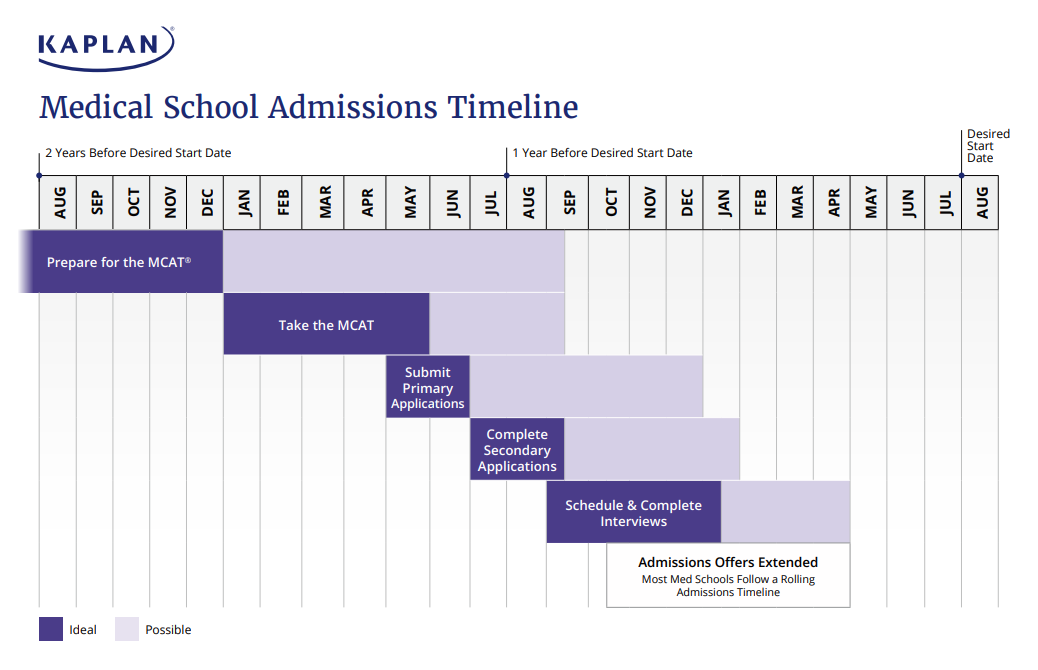
You build the timeline backward from matriculation, locking MCAT, letters, and the personal statement before AMCAS opens — then you use AI as a project manager, not as a last-week ghostwriter. Most MD schools still follow rolling admissions, so a polished August primary is strategically late.
Med School Coach’s 2025–26 timeline advises finishing the personal statement and Work & Activities around mid-May. Jack Westin notes that students who start the personal statement when AMCAS opens often submit in August, after many interview slots are already in play. The AAMC year-by-year guide is still the canonical checklist for clinical work, letters, and fee assistance.
A practical AI-assisted calendar:
- Two years out — Map prerequisite gaps, clinical hours, and MCAT date. Use an MCAT tutor agent if content is still the bottleneck.
- Late winter — Draft personal comments and the 15 activities; identify 3 most meaningful experiences.
- Spring — Confirm letter writers, build a school list from MSAR medians and mission language, and complete AMCAS.
- May–June — Submit the primary early; pre-write secondaries for high-probability schools.
- June–August — Return secondaries in days, not weeks.
- September–February — Interview weekly; log each school’s questions so later mocks get harder, not repetitive.
A planning prompt that stays useful all cycle:
“I want to matriculate in fall 2027. MCAT date, GPA, state of residence, and activity list are below. Build a week-by-week plan through secondaries. Flag anything that conflicts with rolling admissions. Do not invent school medians — tell me what I must verify in MSAR.”
Generic chatbots can generate a pretty Gantt chart and still invent deadlines. Specialized advisors are safer when they admit uncertainty and send you back to AMCAS school deadline tools and MSAR.
What Do Admissions Product Experts Say About Using AI on a Medical School File?
Admissions specialists who work with AI tools tend to recommend them as a third reader and cycle manager, not as an author of record — especially now that some schools screen with models of their own.
"The failure mode we see is not that students use AI. It is that they use it as a ghostwriter in March and a stranger in October. Committees are reading for a single human being. If your secondary voice, your activity descriptions, and your MMI ethics answers were clearly produced by three different systems, the file feels assembled rather than lived. Persistent memory is the unglamorous feature that actually matters across a 14-month AMCAS cycle."
"There is a second shift applicants underweight: some MD programs already use AI as a first screener so faculty can spend time on a smaller pool. That does not mean you should optimize for keywords. It means generic prose is easier to discard. Specific clinical texture, a coherent motivation, and internally consistent dates and roles are harder for both software and humans to dismiss."
"We would not trade a strong letter of evaluation or real clinical responsibility for a better chatbot. We would use AI to stop losing weeks on school-list chaos, 700-character rewrites, and unrehearsed 'Why this school?' answers. Those are process problems, and process problems are what software is good at."
— Jenova Product Team, specialists in AI admissions tooling and long-running applicant workflows
That view lines up with reporting that AI screeners replicate prior human decisions more than they invent a new definition of merit. Efficiency on the school side does not remove human review. It raises the cost of a sloppy, interchangeable application.
Which AI Advisor Fits Different Medical School Applicant Profiles?
The right AI advisor depends on your bottleneck: tracking, writing, physician feedback, or a full-cycle thinking partner. No single product is best for every file.
First-time applicants with a complete MCAT and a messy calendar usually need architecture first. MedSchools.ai’s dashboard is built for that. Jenova is a close alternative if you also want essay and interview work in the same thread.
Reapplicants need diagnosis, not motivation posters. An advisor that can compare last year’s school list, essay theme, and interview notes against this year’s strategy is more valuable than a blank chatbot. Jenova’s cross-session memory is the practical advantage here, provided you upload the old application.
Nontraditional and career-changer applicants often have strong stories and weak AMCAS translation. They benefit from iterative narrative coaching and from a human reader who has seen unusual paths. A Jenova draft cycle plus a Med School Coach or independent editor on the final personal statement is a defensible split.
Interview-heavy weeks call for format-specific reps. Use Jenova or MedSchools.ai for volume, Shemmassian’s MMI material for station types, and one live mock for nerves.
Budget-constrained applicants can do real work on free tiers: Jenova’s limited usage, MedSchools.ai’s free access, and AAMC’s public guides. Spend money first on MCAT official materials, applications, and travel — not on unlimited AI rewriting.
High-budget applicants targeting the most competitive research schools may still want a human consultancy for positioning, while using AI to pre-write secondaries and grind interview reps. AI should not be the only sophisticated reader of a file that will also be read by sophisticated software.
Across profiles, verify numbers in primary sources. Applicant-volume growth in 2025 does not tell you your odds at a specific school. Medians, in-state bias, and interview rates live in MSAR and school reports, not in a model’s memory.
References
- AAMC — U.S. medical schools enroll record number of students in 2025 (54,699 applicants, 5.3% increase)
- AAMC FACTS — Applicants and Matriculants Data
- Inspira Advantage — 2025–2026 cycle matriculation figures drawn from AAMC data
- AcceptMed — Applicant patterns and trends in the 2025–2026 cycle
- AAMC — AI will now read your medical school application
- AAMC — Timeline for application and admission to medical school
- AAMC — Apply to medical school with the AMCAS program
- AAMC — 6 tips for writing your AMCAS personal comments essay
- AAMC Medical School Admission Requirements (MSAR)
- MedSchools.ai — AI admissions advisor features and pricing
- Med School Coach — AI-powered personal statement analyzer
- Med School Coach — 2025/26 AMCAS application timeline
- Shemmassian Academic Consulting — How to ace medical school interviews
- Shemmassian Academic Consulting — MMI interview guide
- The Princeton Review — Tips for the medical school personal statement
- Jack Westin — Medical school application timeline for 2026–2027
- MedEdits — AI in medical school admissions