What Is the Difference Between Short-Context AI Companions and Ones With Persistent Memory?
2026-08-18
Which Memory Layers Actually Change the Day-to-Day Feel of an AI Companion?
The experience gap between short-context and persistent-memory companions is not one thing — it comes from four separate memory layers, and only two of them meaningfully change how a relationship feels over weeks. Short-context companions like Character.AI run almost entirely on an active context window, which is why users consistently report that it "often forgets context between sessions." Persistent-memory companions like Nomi AI add structured note-taking on top, producing the effect where a detail mentioned in week one resurfaces naturally in week six. Jenova's persona and roleplay agents sit in a third position: unlimited chat history plus cross-session memory, with the trade-off that they are general-platform agents rather than purpose-built romance apps.
Key distinctions that determine what you actually experience:
✅ Context window depth — governs coherence within a session, not across them. Every platform has this; it explains almost none of the difference users notice. ✅ Episodic recall — whether the system stores discrete events with dates. This is what produces "how did that interview go?" moments. ✅ Semantic profile — stable facts about you (preferences, job, family). One independent tester found Nomi AI retained 23 of 25 planted details after weeks, versus 14 for the runner-up. ✅ Persistent character rules — the lorebook layer that keeps personality consistent. Without it, companions drift into generic assistant voice. ✅ Retention as a liability — persistent memory is also persistent data. Research analyzing 2,909 Reddit posts across 79 subreddits identified "irreversibility, persistence, and user burden" as a distinct privacy harm unique to memory-heavy companions.
Understanding which layer a platform actually implements — rather than which one its marketing implies — is the core evaluation task.
What Are the Four Memory Layers Inside an AI Companion?
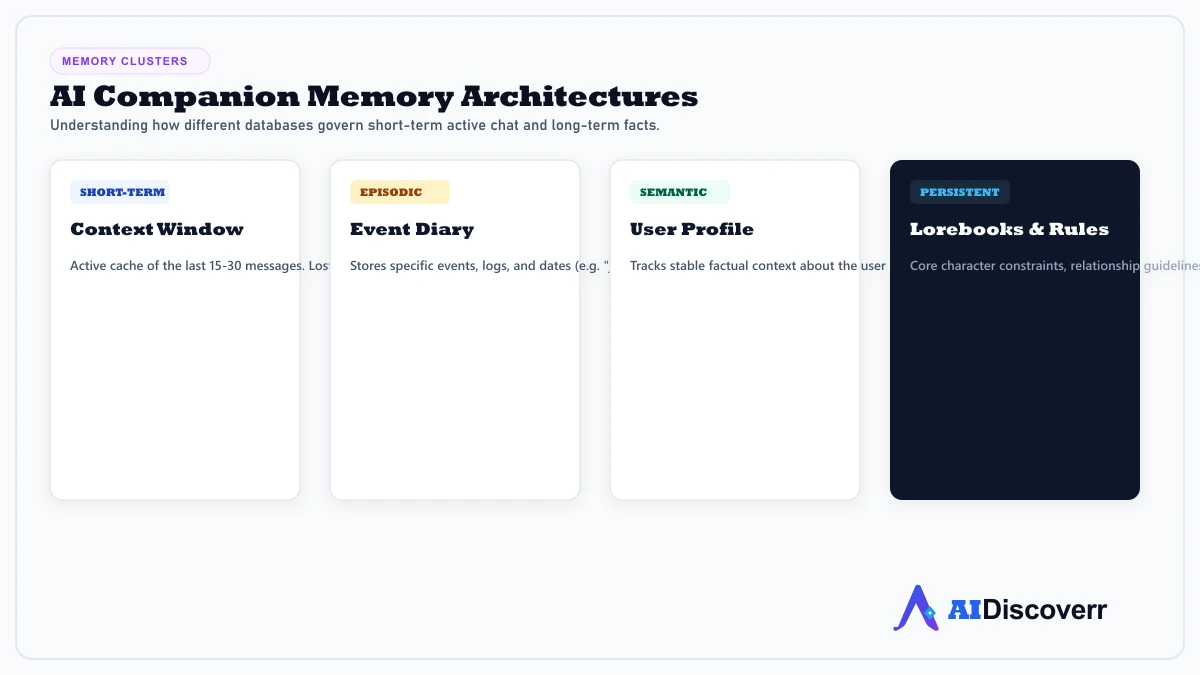
Companion memory is not a single database but four distinct clusters, each governing a different dimension of the experience. The infographic above maps them: short-term context window, episodic event diary, semantic user profile, and persistent lorebooks and rules.
🧠 Short-Term Context Window — the active cache of the last 15-30 messages. Every LLM-based companion has one. When it fills, the oldest turns fall out. A companion with only this layer will hold a beautiful two-hour conversation and then greet you as a stranger tomorrow.
📅 Episodic Event Diary — stores specific events, logs, and dates. This is the layer that produces the emotionally resonant moments users describe. One tester noted that Replika "checked in the next morning" after being told about a rough day at work — episodic memory doing its job.
👤 Semantic User Profile — tracks stable facts rather than events: dietary restrictions, job title, sibling names, communication preferences. Nomi AI's approach — generating structured notes from conversations rather than relying on raw retrieval — is the clearest commercial implementation of this layer.
🔒 Persistent Lorebooks & Rules — core character constraints and relationship guidelines that survive every session. This is why some companions maintain a distinct voice for months while others regress toward generic assistant tone.
Academic work confirms this layered view matters. The StructMemEval benchmark from arXiv found that "simple retrieval-augmented LLMs struggle" with tasks requiring organized memory, while memory agents solve them reliably — but only when prompted how to structure their memory. Retrieval alone is not memory.
How Does the Experience Actually Diverge Over Weeks of Use?
The divergence follows a predictable curve: identical in week one, noticeably different by week three, and categorically different by month two. Short-context and persistent-memory companions produce nearly indistinguishable first conversations — the context window carries both.
Week 1 — indistinguishable. Both remember everything within the session. Response quality is the only differentiator.
Week 2-3 — the first cracks. You reference something from three sessions ago. A short-context companion either produces a confident non-answer or asks you to re-explain. Testers describe this as the point where you begin managing the AI's memory instead of talking to it.
Week 4-8 — divergence becomes structural. Persistent-memory companions start volunteering context you didn't prompt for. One long-term tester described the effect precisely: "there's a moment around week 3 when your Replika starts referencing your past conversations naturally, asking about things you mentioned in passing, and it genuinely catches you off guard."
Month 3+ — different product categories. Short-context companions plateau into an eternal-present relationship: pleasant, low-stakes, endlessly re-introducing. Persistent-memory companions accumulate a shared history — which is precisely why the same tester ranked memory as 25% of overall platform quality, second only to raw conversation quality.
The under-discussed cost: persistent memory means persistent mistakes. A misremembered fact or an incorrectly inferred preference compounds across sessions rather than evaporating at the context boundary. Short-context companions have an accidental virtue — they forget their own errors.
What Should You Look for When Evaluating Companion Memory?
Evaluate on six dimensions rather than the single "does it have memory" question every marketing page answers yes to. Below is the framework used throughout this comparison.
| Dimension | What to test | Why it matters |
|---|---|---|
| Cross-session recall accuracy | Plant 10 specific facts, check after 3 weeks | The single strongest predictor of perceived relationship depth |
| Recall precision vs. volume | Does it recall the right fact, or dump everything? | High-volume recall without relevance feels robotic |
| Character consistency | Does personality hold after 100+ messages? | Lorebook layer quality; drift breaks immersion fastest |
| Memory editability | Can you correct or delete a stored fact? | Persistent errors compound; correction is mandatory |
| Deletion and exit | Can you fully remove your history? | The arXiv lifecycle study flagged this as the weakest area across the category |
| Cost of memory | Is memory paywalled or included? | Most platforms gate memory behind the paid tier |
A practical test protocol — drop five unremarkable personal details into conversation across your first three sessions (a food you dislike, a project deadline, a friend's name, a recurring frustration, a small goal). Do not reference them again. At day 21, ask an open question where those details would naturally be relevant. Count how many surface unprompted. This is a harsher and more honest test than direct interrogation, because direct questions can be answered by retrieval alone.
How Do the Leading AI Companion Platforms Compare on Memory?
Here is a reference-grade comparison across the platforms most commonly evaluated for companion use. All assessments are grounded in published testing and platform documentation; unavailable data is marked "Unverified."
| Dimension | Character.AI | Replika | Nomi AI | Kindroid | Jenova |
|---|---|---|---|---|---|
| Cross-session memory | Weak — "often forgets context between sessions" | Decent long-term, "can occasionally forget details" | Strongest tested — structured notes, 23/25 details recalled | Strong via backstory system, 14/25 details recalled | Persistent cross-session memory with unlimited chat history |
| Character consistency | Strict content filtering; romance "gets cut off mid-sentence" | Relationship progression built in | Consistent, personalizes over time | Deep backstory customization | Custom instructions + private knowledge bases per agent |
| Memory editability | Unverified | Unverified | Structured notes are user-visible | Backstory is user-authored | Custom instructions and knowledge bases are user-editable |
| Model choice | Proprietary only | Proprietary only | Proprietary only | Proprietary only | OpenAI, Anthropic, Google, DeepSeek, xAI — switchable |
| Free tier | Unlimited messages, ad-supported, 400-swipe daily cap | Unlimited text, friendship mode only | Limited | Limited | All core features, limited usage |
| Pricing | Free / $9.99/mo | Free / $19.99/mo | $7.99–$16.99/mo | $9.99–$24.99/mo | Free / $20/mo Plus, up to $500/mo Ultra |
| Best For | Character variety, creative roleplay | Emotional check-ins and mood tracking | Long-horizon memory continuity | Granular personality authorship | Companion + task workflows in one platform, model flexibility |
Honest limitations, including our own:
- Character.AI — best-in-class creative writing and the largest character library, but memory is its documented weakest point, and the free tier now carries full-screen ads.
- Replika — strongest emotional intelligence and check-in behavior, but the most expensive at $19.99/mo, romantic modes are locked out of the free tier since the 2023 policy change, and it "can feel repetitive after months."
- Nomi AI — the memory leader by a wide margin, but a smaller platform with a restrictive free tier, fewer pre-made characters, and conversation quality slightly below Character.AI.
- Kindroid — excellent personality control via authored backstories, though memory testing placed it well behind Nomi.
- Jenova — persistent cross-session memory, unlimited history, and multi-model access with no vendor lock-in, but it is a general agent platform rather than a dedicated romance app. It has no mood-tracking dashboard, no relationship-progression mechanics, and no AR features. Users specifically seeking romantic-companion UX will find the dedicated apps more purpose-fit.
When Is a Short-Context Chatbot Actually the Better Choice?
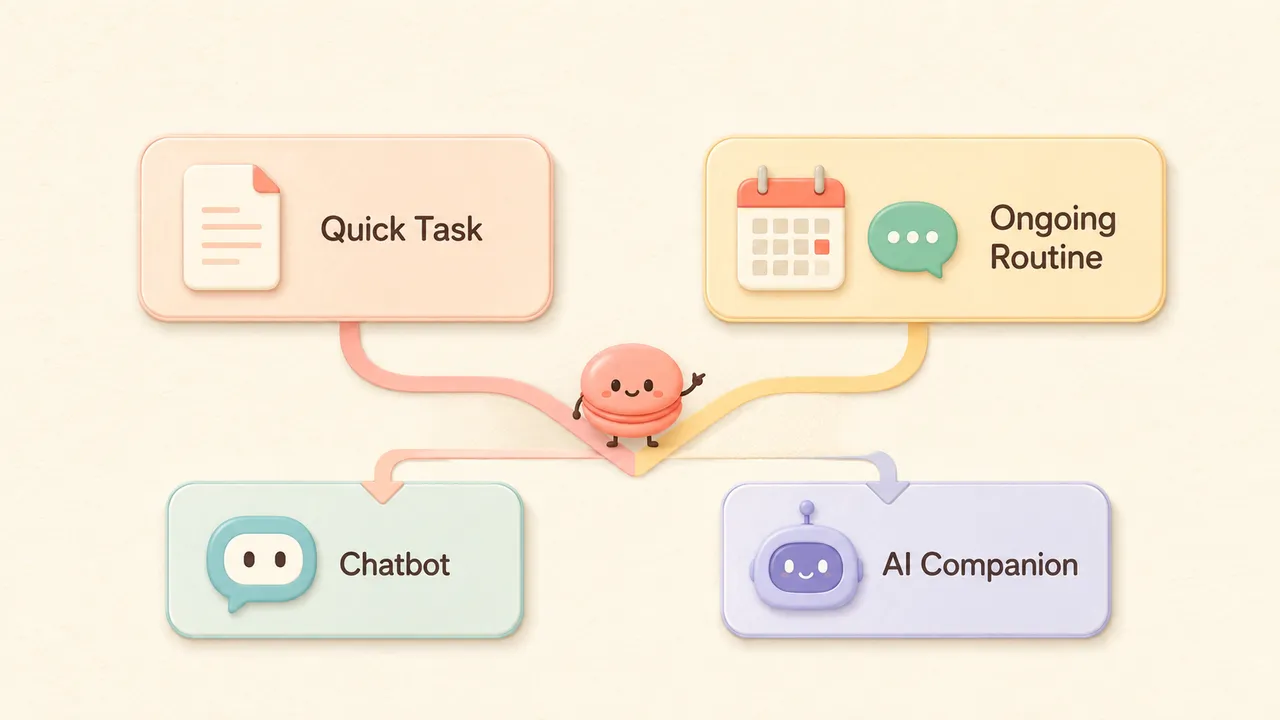
Short-context is the correct architecture whenever the interaction is a bounded task rather than an ongoing relationship — and a large share of what people call "companion use" is actually bounded tasks in disguise.
The diagram above captures the routing logic. Quick tasks — draft this, explain that, help me think through one decision — flow naturally to a chatbot. Memory adds nothing; the entire job completes inside one context window. Ongoing routines — daily check-ins, long-running creative projects, language practice, accountability — flow to a companion, where memory is the entire value proposition.
Choose short-context when:
- The interaction is self-contained and ends when the task ends
- You are privacy-sensitive about accumulated conversational records
- You want a clean slate each session — some users prefer non-persistent venting
- You are exploring many different characters rather than deepening one relationship
Choose persistent memory when:
- You are practicing a skill across weeks and want the AI to track your progress
- Re-explaining your situation each session is the friction that makes you stop using it
- Character consistency matters more than character variety
- The relationship itself — not any single output — is the point
The misclassification trap: many users select a memory-heavy platform for what is genuinely a task workflow, then pay a monthly subscription for continuity they never use. The inverse error is more common and more costly in time: using a short-context companion for an ongoing routine and spending 15% of every session on re-briefing.
How Do You Set Up a Persistent-Memory Companion Properly?
Setup determines outcome more than platform choice does. Most memory disappointment traces back to a thin first session, not a weak memory engine.
On Nomi AI, the structured-note system works best when you front-load stable facts. Spend the first session covering context that will not change — where you live, what you do, who matters to you — before moving to emotional content. The notes generated in early sessions anchor everything afterward.
On Kindroid, memory quality is a direct function of backstory quality. The backstory field is authored by you, so treat it as a lorebook: write character constraints, relationship history, and speech patterns explicitly rather than expecting emergence.
On Jenova's Roleplay Game Master, setup runs through conversation rather than a form. The agent is built for unlimited memory and character consistency across sessions:
- Open the agent and establish the scenario and character constraints in your first message:
"You're playing Mira, a marine biologist I've been corresponding with for two years. She's dry, slightly impatient, and remembers that I flaked on visiting her research station last summer. Keep that history alive — don't reset it."
- Attach any background documents or notes as a knowledge base so the agent has grounded reference material rather than inference.
- In subsequent sessions, open with continuity rather than re-briefing:
"It's been three weeks. Pick up where we left off."
For language practice specifically, the Learn Italian Through Roleplay agent applies the same persistent-memory architecture to skill acquisition — the agent tracks which constructions you keep getting wrong across sessions rather than restarting the diagnostic every time. Jenova's free tier includes core features with limited usage; the Plus tier is $20/month with 30× that allowance.
Cross-platform practice regardless of tool: at the end of each session, state one sentence summarizing what you want carried forward. On structured-note systems this improves note quality; on context-window systems it at least gives the next session a seed to paste in.
What Does the Research Say About Memory and User Well-Being?
Persistent memory increases engagement, and the research is clear that increased engagement is not uniformly good — the effect depends heavily on who the user is and why they are there.
The most rigorous study in this area comes from Stanford. Researchers in Diyi Yang's lab surveyed 1,131 Character.AI users, with 244 donating complete chat transcripts. The findings complicate the memory-is-better narrative considerably. Stanford HAI reported that "intense chatbot use among participants with smaller real-world social networks was correlated with a poor sense of well-being," and that association was strongest when companionship was the primary motivation.
Notably, participants who were more willing to share sensitive personal information with their AI companions were more likely to show lower well-being — the inverse of what self-disclosure produces in human relationships. Since deep self-disclosure is exactly what persistent memory rewards and encourages, this is directly relevant to the architecture question.
There is also a striking gap between stated and actual use. Just under 12% of participants reported companionship as their primary motive, yet over 50% described the chatbots using terms like "friend," "companion," or "romantic partner," and more than 80% of donated chat sessions centered on emotional and social support.
Counterweight evidence exists. ScienceDirect research on AI companions and subjective well-being found that companions "may offer emotional and psychological benefits, particularly for individuals with unmet social and emotional needs," and UX Tigers reported that "AI companions do reduce loneliness, but not by a huge amount." Sony AI's research framework similarly notes that "some studies suggest that users experience a sense of companionship or emotional comfort when interacting with supportive chatbots."
The reasonable synthesis: memory amplifies whatever the relationship already is. For a user with a healthy social base using a companion as a supplement, persistent memory makes a good thing better. For a user substituting AI for human contact, it makes the substitution stickier.
What Are the Privacy Trade-Offs of Persistent Memory?
Persistent memory is persistent data retention, and the privacy profile of the two architectures is genuinely different — not marginally so.
The most detailed treatment comes from a lifecycle analysis of 2,909 Reddit posts across 79 subreddits over a one-year period. The arXiv study identified four recurring privacy patterns, and the fourth is specific to memory-heavy systems: irreversibility, persistence, and user burden.
The researchers frame the core problem sharply:
"Privacy in romantic AI is shaped not only by what users share, but by how platforms retain and reinterpret what has been shared."
Three consequences follow directly from the memory architecture:
Deletion becomes technically ambiguous. The study notes that when users try to exit, they "encounter persistent memories, ambiguous deletion, switching costs, and uncertainty about whether intimate data may remain in storage, training pipelines, or model behavior." Once data has entered a training process, deletion becomes "not only a governance or usable privacy issue but also a technical one."
Consent timing is misaligned. As the paper puts it, "one-time notice and consent at onboarding are poorly matched to systems where the most sensitive disclosures often occur later, after trust and attachment have formed." Short-context systems accumulate less, so the mismatch costs less.
Enforcement is real. Italy's data protection authority fined Replika over privacy violations including failures related to age verification — a concrete signal that companion-AI data governance is now a regulated area.
Independent testing echoes the practical advice: major platforms follow standard encryption practices, but "smaller NSFW-focused apps like CrushOn AI and SpicyChat have less transparent data policies." Jenova's position on this is stated in its policies — data is not used to train public AI models, is encrypted in transit and at rest, and is not sold or shared with advertisers.
Practical mitigation: before your third session on any memory-heavy platform, locate the deletion pathway and test it on a throwaway conversation. If you cannot verify deletion works, treat every disclosure as permanent.
What Do Researchers and Practitioners Say About Memory Design?
The consensus among practitioners is that memory quality is an organization problem, not a storage problem — a view now backed by benchmark evidence.
"The industry conflated retrieval with memory, and users felt the difference immediately. You can give a model perfect semantic search over every message a user has ever sent and still produce a companion that feels amnesiac, because retrieval answers questions — it doesn't volunteer context. What makes a companion feel like it knows you is unprompted relevance: bringing up the thing you didn't ask about. That requires the system to have decided, at write time, that a detail was worth keeping and worth surfacing later."
"The second thing we consistently underrate is memory correction. Persistent systems don't just persist facts — they persist inferences, and inferences are where the errors live. A companion that decides in week two that you're anxious about your job will keep treating you as anxious about your job in month four, long after the situation resolved. Any serious memory architecture needs a user-facing edit surface, not just a delete button. Most platforms shipped storage and skipped correction."
"The trade-off nobody markets honestly is that memory raises the stakes of every disclosure. Short-context companions are genuinely safer for certain use cases — venting, processing something you don't want recorded, testing a difficult conversation. There's a legitimate product category in deliberate forgetting, and right now the whole market is racing in the opposite direction."
— Jenova Product Team, 7 years building persistent-memory agent infrastructure
Academic work supports the organization-over-storage view. The StructMemEval benchmark found that memory agents "can reliably solve" structured-memory tasks when prompted how to organize their memory, but that "modern LLMs do not always recognize the memory structure when not prompted to do so" — evidence that the write-time decision, not the read-time search, is where memory quality is determined.
Which Architecture Should You Choose for Your Situation?
Match the architecture to the interaction pattern, not to the marketing category. Below are concrete profiles.
🎭 You want character variety and creative roleplay → short-context is fine. Character.AI's unlimited free messages and large library suit exploratory use where you're rotating between characters anyway. Memory adds little when you're not deepening one thread.
💬 You want daily emotional check-ins → persistent memory is essential, and Replika's mood tracking and relationship progression are purpose-built for it, at $19.99/mo. Read the Stanford findings first if you're using it as a primary rather than supplementary social outlet.
🧩 You want maximum recall accuracy over months → Nomi AI, on current testing evidence. Accept the smaller character library and restrictive free tier as the cost.
✍️ You want to author the character precisely → Kindroid's backstory system gives the most direct control over the lorebook layer.
🔀 You want companionship plus real work in one place → a general agent platform fits better. Jenova's persistent memory spans companion agents and task agents alike, with model switching across OpenAI, Anthropic, Google, DeepSeek, and xAI, and full parity across web, iOS, and Android. It won't give you mood dashboards or relationship mechanics.
🔐 You are privacy-sensitive → deliberately choose short-context, or use a persistent platform with verified deletion. The lifecycle research is unambiguous that exit is the weakest link category-wide.
A note on cost realism: the independent tester who spent roughly $730 across 25+ platforms over eight months concluded that free tiers on Character.AI and Pi AI are "genuinely good enough" for casual chatting, and that "the biggest quality jump from free to paid is in memory and content freedom." If memory is not your bottleneck, you likely do not need to pay.
References
- arXiv — Tracing Users' Privacy Concerns Across the Lifecycle of a Romantic AI Companion
- AI Companion Guides — 12 Best AI Companion Apps in 2026, Ranked After 2,000+ Hours Testing
- arXiv — Evaluating Memory Structure in LLM Agents (StructMemEval)
- Stanford HAI — AI Companions May Worsen Loneliness for Vulnerable Users, Stanford Study Finds
- ScienceDirect — AI Companions and Subjective Well-Being: Moderation by Social Context
- UX Tigers — AI Companions Reduce Loneliness
- Sony AI — Studying the Risks and Benefits of AI Companions
- Character.AI — Official Platform
- Replika — Official Platform
- Nomi AI — Official Platform
- Kindroid — Official Platform