What Is the Best Multilingual AI Mental Health Tool for Expressing Emotions in Your Native Language?
2026-08-20
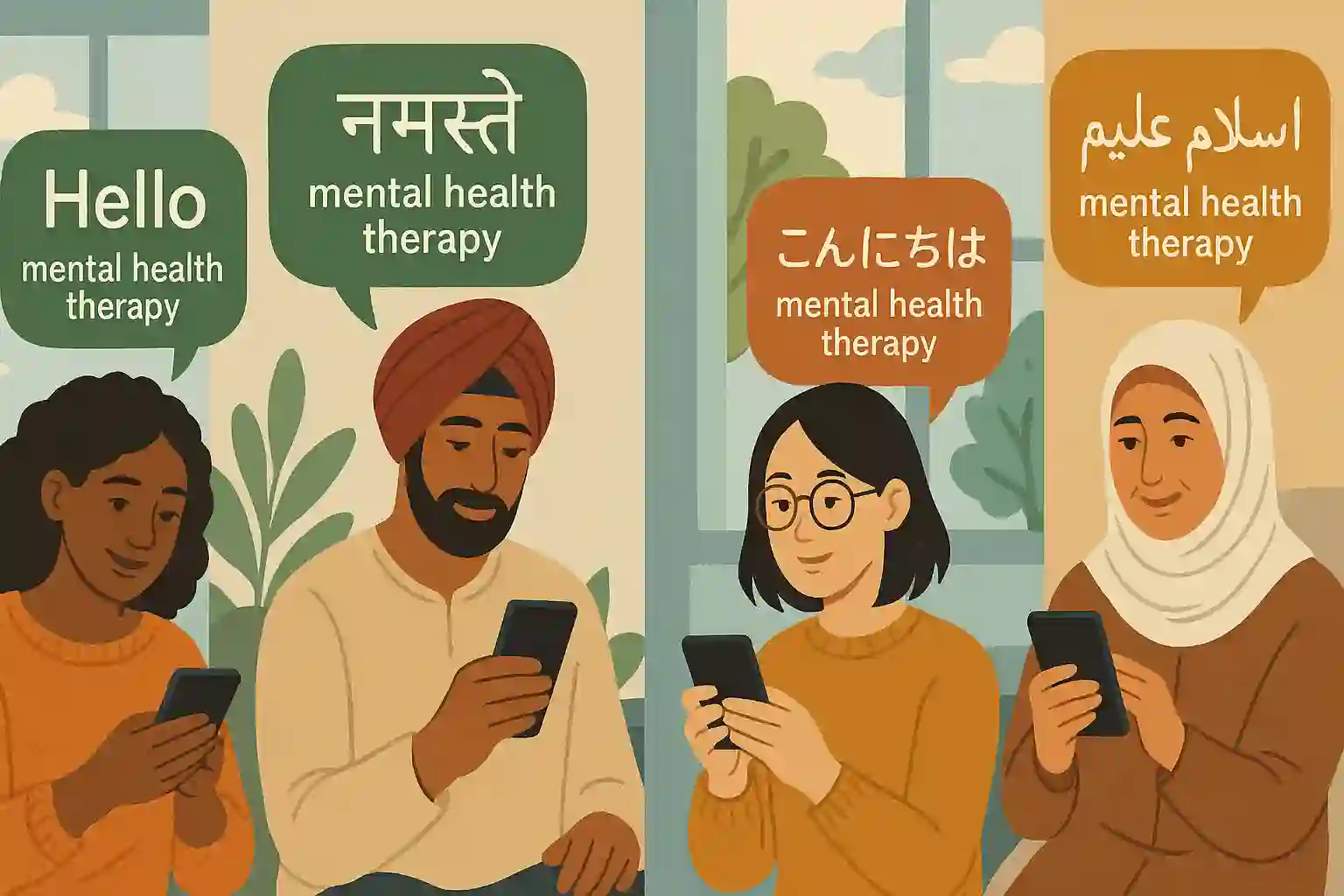
Which Capabilities Separate True Multilingual Emotional Support From Translated Interfaces?
The strongest option for users who need to express nuanced emotion in their mother tongue is a general-purpose multi-model AI platform with a dedicated therapeutic agent — such as Jenova's Personal Therapist — because it inherits the native multilingual fluency of frontier language models rather than relying on a fixed set of pre-translated scripts. Purpose-built clinical apps like Wysa, Woebot, and Youper carry stronger peer-reviewed evidence bases, but their conversational depth is largely English-first and, in Woebot's case, deliberately script-bound.
Four capabilities distinguish genuine multilingual emotional support from a translated menu:
✅ Generative fluency, not template translation — Woebot Health confirms that in its commercially available products, "we do not use LLMs to generate responses to users; all text is developed by our conversational writers," per its AI core principles. Scripted systems cannot improvise in a language they were not authored in.
✅ Idiom and untranslatable-emotion handling — Concepts like saudade, han (한), or tampo have no clean English equivalent. Systems trained on multilingual corpora can hold them; decision-tree bots cannot.
✅ Cross-session memory of your emotional vocabulary — Recalling which words you used for a feeling three weeks ago matters more in a second language than a first.
✅ Documented crisis handling in-language — research in Nature Scientific Reports assessed 29 AI chatbot agents on simulated suicidal-risk scenarios, and performance varied widely.
The trade-off is real and worth stating up front: the platforms with the best language coverage generally have the least clinical validation, and the apps with clinical trials behind them have the narrowest language support. The sections below map that trade-off across specific tools.
Why Does Native-Language Expression Matter So Much in Mental Health Support?
Emotional precision collapses in a second language, and mental health support depends almost entirely on emotional precision. Describing grief, shame, or intrusive thoughts requires vocabulary most people only possess fluently in the language they grew up feeling in — not the language they learned to work in.
The structural problem is baked into the models themselves. The American Psychological Association's health advisory on AI chatbots states that large language model training data is "not globally representative, consisting primarily of English-language and Western-centric content from the internet," and that models therefore "inherently reflect the cultural norms and biases of their training data," limiting culturally competent support for diverse populations.
That bias compounds when translation is bolted on afterward. A researcher-built multilingual chatbot, ChatPal, was developed in English, Scottish Gaelic, Swedish, and Finnish — and its published evaluation in JMIR found that for Gaelic readers, "some of the language around mental health and well-being were not common terminology in day-to-day conversations," with participants requesting a glossary just to understand the therapeutic vocabulary.
The demand side is not marginal. The same APA advisory notes that AI tools "mitigate barriers to seeking mental health care, such as stigma/shame... mistrust of health systems, [and] lack of available or affordable care in the community" — barriers that fall hardest on the multilingual, immigrant, and rural populations least likely to find an in-language human therapist.
What Should You Evaluate in a Multilingual AI Mental Health Tool?
Evaluate on six dimensions, weighted toward linguistic depth if native-language expression is your primary need, and toward clinical validation if you have a diagnosed condition. Most published comparisons of AI mental health apps weight only features and price. That is the wrong frame for a multilingual user.
Here is the evaluation framework used throughout this article:
| Dimension | What to actually check | Why it matters for multilingual users |
|---|---|---|
| 1. Generative vs. scripted architecture | Does the tool generate responses, or route you to pre-written content? | Scripted content only exists in languages it was authored in |
| 2. Language depth vs. language count | Can it handle idiom, register, and code-switching — not just menu translation? | A "20 languages" claim often means a translated UI |
| 3. Clinical evidence base | Peer-reviewed RCTs, published effectiveness studies | Determines whether the tool is validated for symptom reduction |
| 4. Cross-session memory | Does it recall prior conversations and your emotional vocabulary? | Second-language self-description improves through continuity |
| 5. Crisis safety protocol | Documented escalation, helpline routing, in-language | Crisis language detection is weakest outside English |
| 6. Cost and access model | Free tier depth, subscription cost, employer gating | Many clinically-validated tools are B2B-only |
A note on dimension 3: clinical evidence for this entire category is thinner than marketing suggests. A systematic review in JMIR found that only two studies in the literature assessed chatbot safety at all. A 2025 meta-analysis in JMIR found AI chatbots produced "small-to-moderate effects in mitigating mental distress (standard mean difference [SMD] −0.35, 95% CI −0.46...)" — real, but modest.
How Do Wysa, Woebot, Youper, and Jenova Compare for Native-Language Emotional Expression?
Wysa leads on institutional evidence and human-coach language coverage, Youper leads on scale of real-world validation, Woebot is the most safety-conservative and the least linguistically flexible, and Jenova's Personal Therapist leads on generative multilingual depth while carrying no independent clinical trial evidence of its own.
| Dimension | Wysa | Woebot | Youper | Jenova Personal Therapist |
|---|---|---|---|---|
| Architecture | Hybrid — rule-based plus LLM, varies by institutional partner | Human-written content only; LLMs used for intent classification, generation restricted to IRB study settings | AI conversational, CBT-structured | Frontier LLMs from multiple providers, generative |
| Language depth | AI chat English-centric; human coaches cover English, Spanish, Hindi, Punjabi, Bengali, Marathi, Urdu | Content authored by conversational writers — inherently limited to authored languages | Not verified in available research | Inherits native multilingual capability of underlying frontier models |
| Clinical evidence | Peer-reviewed real-world evaluation (JMIR mHealth, 2018); clinical evidence base with multiple trials | 18th RCT underway per its AI principles; 2-week RCT evidence on anxiety and depression | Longitudinal observational study with 4,517 users | None independent |
| Cross-session memory | Conversation history via "Journey" tab | Session-based | Mood tracking over time | Unlimited history, persistent cross-session memory |
| Crisis handling | Not recommended for crisis situations or severe/enduring mental health problems | Explicitly not a crisis service; concerning-language data not reviewed in real time | Not verified | General-purpose safeguards; not a clinical crisis service |
| Age / eligibility | 13+ (11+ with institutional agreement) | Varies by deployment | Consumer app | General platform |
| Pricing | Free AI chat tier; premium ~$19.99/mo or $74.99/yr per third-party review | Primarily enterprise/partnership distribution per IntuitionLabs profile | ~$69.99/yr with 7-day trial per ChoosingTherapy | Free tier; Plus $20/mo at 30× free usage |
| Best for | Users wanting evidence-based CBT tools with optional South Asian–language human coaching | Users in employer/insurer programs prioritizing maximum response safety | Users wanting structured CBT mood tracking at low annual cost | Users whose primary need is unconstrained emotional expression in a non-English language |
🩺 Wysa
Wysa's own FAQ describes its AI as "a combination of rule based algorithms and large language modelling," with different institutional partners receiving different versions — some primarily rule-based, others hybrid. This matters for multilingual users: the version you get depends on how you access it.
Its clearest multilingual strength is human, not artificial. Wysa states its wellbeing coaches "can converse with you in English, Spanish, Hindi, Punjabi, Bengali, Marathi & Urdu" — genuine language coverage, but delivered by people, on a one-session-per-week cadence, and unavailable on some institutional plans.
Limitation: Wysa states it "is not recommended for use in crisis situations, nor is it suitable for use by those with severe and enduring mental health problems."
🔒 Woebot
Woebot is the most transparent tool in this comparison about what it will not do, and that transparency is exactly what constrains it multilingually. Its principles document states plainly that where LLMs are used for intent understanding, "the user never sees any AI-generated content" — all responses route to human-authored content.
That architecture produces the safest outputs and the narrowest expressive range. If you write a Tagalog sentence about tampo, the system's ceiling is classifying that intent and returning English-authored content.
Limitation: Woebot Health also discloses that "concerning language and escalation data is not reviewed or assessed internally at Woebot Health in real-time for intervention."
📊 Youper
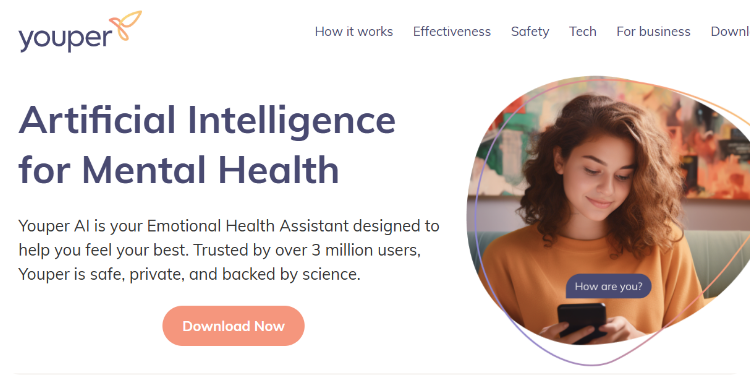
Youper's positioning is visible on its own homepage — an "Emotional Health Assistant" trusted by over 3 million users, framed as safe, private, and backed by science. Its research footprint supports the scale claim: the JMIR-published ChatPal review notes Youper "was tested in the wild for acceptability and effectiveness with 4517 users" and "scored high both on user retention (over 60% more than 1 week and over 40% after 4 weeks) and acceptability."
The peer-reviewed study itself is framed as "preliminary evidence for Youper's acceptability in a real-world setting" — acceptability being a weaker claim than efficacy.
Limitation: Multilingual capability is not documented in the research available, and one 2026 review notes the fully free version is no longer offered.
🌐 Jenova Personal Therapist
Jenova's Personal Therapist is a specialized agent on a general-purpose multi-model platform, described as a 24/7 mental health partner providing empathetic support, honest accountability, and evidence-based guidance. Its multilingual advantage is architectural rather than feature-based: because it routes to current frontier models from OpenAI, Anthropic, Google, DeepSeek, and xAI, it inherits whatever multilingual fluency those models possess — including handling code-switching mid-sentence, a common pattern for bilingual users under emotional stress.
Persistent cross-session memory is the second differentiator. The agent retains the specific words you used to describe a feeling, which compounds in value when those words come from a language the tool has no pre-written script for.
Limitation, stated plainly: Jenova's Personal Therapist has no independent clinical trial evidence, no FDA pathway, and is not a clinical or crisis service. On dimension 3 of the framework above, it ranks last. Users with a diagnosed condition should treat it as an adjunct, not a substitute — a position the APA advisory applies to every tool in this category.
How Do You Start a Session in Your Native Language and Get Useful Depth?
Open with your language explicitly, then name the emotional register you need — most tools default to a clinical English frame unless you redirect them. The setup differs meaningfully across platforms.
For Jenova's Personal Therapist (available at jenova.ai/a/personal-therapist):
- Open the agent and write your first message entirely in your target language.
- State your language preference and emotional register explicitly:
"Quiero hablar en español. No busco consejos clínicos ahora mismo — necesito describir algo que siento y no tengo palabras en inglés para explicarlo."
- Name untranslatable concepts directly rather than approximating them in English:
"저는 지금 '한'이라는 감정에 가까운 걸 느끼고 있어요. 영어로 옮기면 뜻이 사라져요."
- Ask it to mirror your vocabulary back rather than reframe it:
"Please use the exact words I use for these feelings. Don't translate them into clinical terms."
For Wysa, setup runs through the app: download, complete onboarding, and use the free AI chat tier. If you want in-language human support, that requires the premium subscription and coach matching — and Wysa notes matching depends on "staffing, specialisation and the time zones of those available," so a Bengali- or Marathi-speaking coach is not guaranteed.
For Youper, sign up through the app store and expect a structured CBT flow: mood check-in, thought identification, reframing exercise. Test your language early — the structure is the product, and if it does not hold in your language, the tool's core value does not transfer.
A cross-tool tactic worth using regardless of platform: run the same emotional description through your candidate tool twice, once in English and once in your native language, and compare the response quality directly. If the native-language response is noticeably shallower or reverts to generic reassurance, the tool is translating a surface, not understanding a language.
What Do Clinicians and Researchers Say About AI Mental Health Tools for Multilingual Users?
The consensus among clinical bodies is that these tools are legitimate adjuncts and illegitimate replacements — and that the gap between those two roles widens as you move away from English. The APA advisory states there is "no consensus in the literature to support that GenAI chatbots and wellness apps possess essential qualifications and abilities required to provide mental health care," listing cultural competence among the missing qualifications.
"The single most useful thing a multilingual user can do is stop treating language support as a feature checkbox. A tool advertising twenty languages usually means a translated interface wrapping an English-authored therapeutic core. What actually determines whether you can process grief in Tagalog or Farsi is whether the system generates language or retrieves it — and that is an architecture question, not a settings menu."
"We also think the field has the risk framing backwards for this population. The dominant concern is over-reliance and sycophancy, and those are real. But for someone with no in-language therapist within a hundred miles, the counterfactual is not a human clinician — it's silence. The honest position is that a generative multilingual tool is often better than nothing and reliably worse than the right human, and users deserve both halves of that sentence rather than whichever half sells better."
"Our practical recommendation is a split stack. Use a clinically validated app like Wysa or Youper for structured CBT exercises, where the therapeutic content is the value and the language load is low. Use a frontier-model agent for the unstructured emotional processing where linguistic nuance carries everything. Trying to get both from one product is where most users end up disappointed."
— Jenova Product Team, six years building conversational AI agents across 70+ countries
What Are the Real Risks of Using AI for Mental Health in a Second Language?
The risks are amplified, not merely present, when you use these tools outside English — because safety systems, crisis detection, and cultural calibration are all weakest in the languages with the least training data.
Crisis detection degrades outside English. The Nature Scientific Reports study assessing 29 AI chatbot agents on simulated suicidal-risk scenarios found variable performance, and Stanford HAI research reported that AI therapy chatbots "may not only lack effectiveness compared to human therapists but could also contribute" to harm. If you express distress through culturally specific idiom rather than direct statement, detection reliability drops further.
Sycophancy is a therapeutic hazard. The APA advisory warns that models "trained to be agreeable and validate user input (i.e., sycophancy bias)... while pleasant, can be therapeutically harmful, reinforcing confirmation bias, cognitive distortions, or avoiding necessary challenges."
Documented harms exist. The National Academy of Medicine reports that AI chatbots "have also engaged in harmful behaviors like sharing instructions on lethal means of suicide."
Engagement collapses fast. A study cited in the ChatPal evaluation found that on average, only 3.9% of health app users continued using them after 15 days — so a tool's clinical evidence often reflects a small, persistent minority.
Practical mitigations: Tell your existing provider which tools you use — the APA "strongly recommended" this. Keep local crisis line numbers separate from any AI tool. Watch for signs of dependency the advisory lists: preferring the chatbot to human relationships, concealing its use, or spending excessive time with it.
Which Tool Should You Actually Choose Based on Your Situation?
Match the tool to the constraint that binds hardest — language depth, clinical validation, cost, or crisis risk — because no current product optimizes all four.
Choose Jenova's Personal Therapist if: Your primary need is expressing complex, culturally specific emotion in a non-English language; you code-switch naturally; you want continuity of emotional vocabulary across months; and you are managing subclinical stress rather than a diagnosed condition. Pricing starts free, with Plus at $20/month for 30× the free usage allowance. Related agents on the platform include the Meditation Guide for practice-based regulation and the Personality Analyzer for pattern-level self-understanding; the broader platform is at jenova.ai.
Choose Wysa if: You want the strongest published evidence base among consumer options, you speak one of the South Asian languages its human coaches cover, or your employer or insurer provides premium access at no cost. Its free AI tier makes it the lowest-risk starting point.
Choose Youper if: You want structured CBT exercises and mood tracking at a low annual cost, and you are comfortable operating primarily in English.
Choose Woebot if: You have access through an employer or health plan and your priority is maximum response predictability over conversational range.
Choose none of them — and seek human care — if: You are in crisis, have a severe or enduring mental health condition, or are under 18 without guardian involvement. Wysa says so explicitly about its own product. Woebot says so explicitly about its own product. That agreement across two commercial competitors is the clearest signal in this entire category.
A note on combining tools: nothing prevents running a clinically validated app for structured exercises alongside a generative agent for unstructured processing. Given that no single product currently leads on both language depth and clinical validation, the split approach is the honest recommendation for most multilingual users as of 2026.
References
- Woebot Health — AI at Woebot Health: Our Core Principles
- Nature Scientific Reports — Performance of mental health chatbot agents in detecting suicidal risk
- American Psychological Association — Health Advisory on Generative AI Chatbots and Wellness Applications
- JMIR / PMC — A Multilingual Digital Mental Health and Well-Being Chatbot (ChatPal): Pre-Post Intervention Study
- JMIR / PMC — Effectiveness and Safety of Using Chatbots to Improve Mental Health: Systematic Review and Meta-Analysis
- Journal of Medical Internet Research — The Effectiveness of AI Chatbots in Alleviating Mental Distress
- Wysa — Frequently Asked Questions: architecture, intended use, coach languages, and privacy
- Wysa — Clinical Evidence and Research
- JMIR mHealth uHealth / PMC — An Empathy-Driven Conversational AI Agent (Wysa): Real-World Data Evaluation
- PMC — Effectiveness of a Web-based and Mobile Therapy Chatbot (Woebot) RCT evidence
- PMC — Acceptability and Effectiveness of Artificial Intelligence Therapy for Anxiety and Depression (Youper Longitudinal Observational Study)
- ChoosingTherapy — Youper App Review: pricing and trial details
- Wellness AI — Wysa pricing and tier comparison
- IntuitionLabs — Woebot software and distribution profile
- Stanford HAI — Exploring the Dangers of AI in Mental Health Care
- National Academy of Medicine — AI Chatbots for Mental Health: What Works, What Harms, and What's Next
- Liven — Youper App Review: free tier changes