What Is the Best AI Mahjong Tutor for Learning All Variants?
2026-08-27
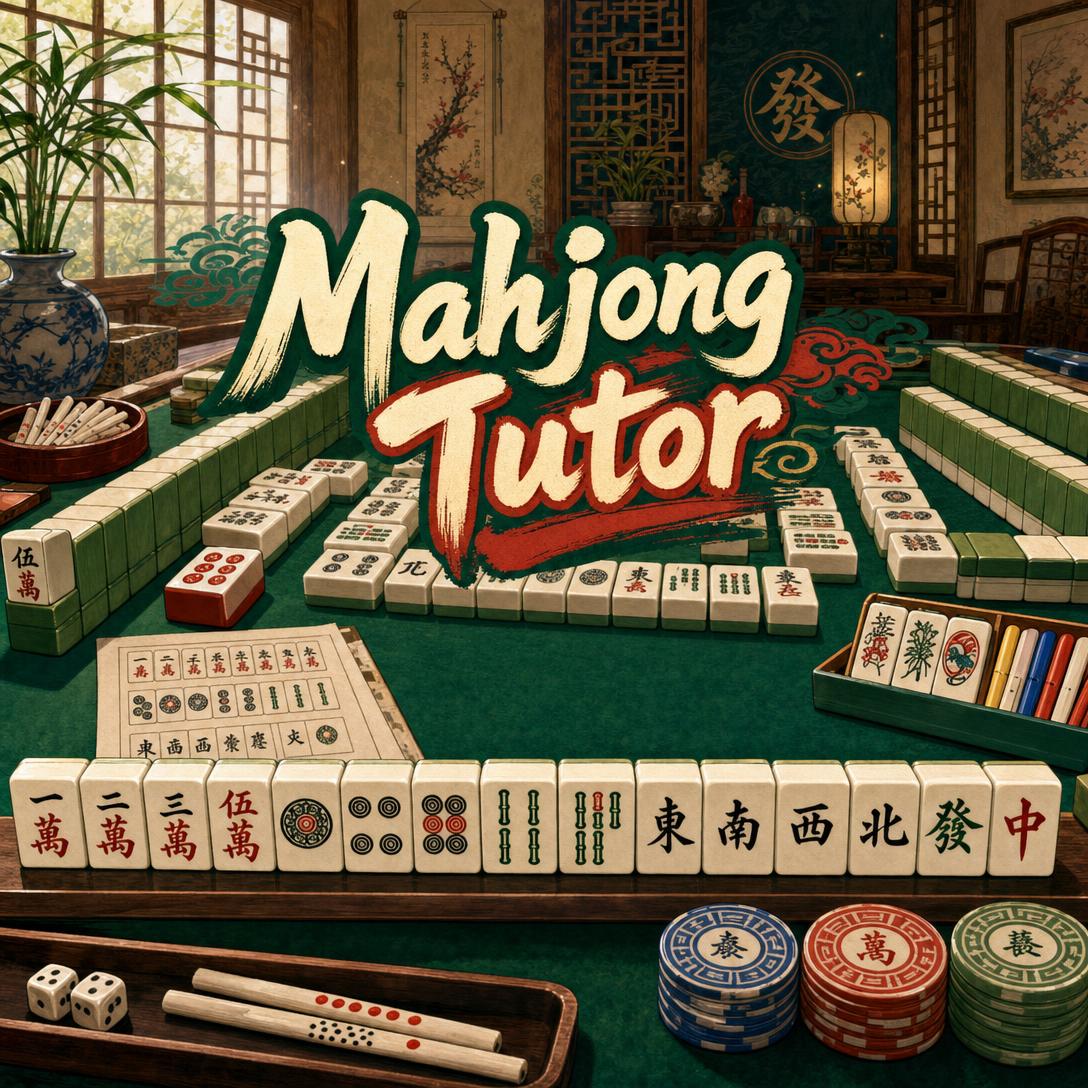
How Do AI Mahjong Coaches Compare on Variant Coverage, Tile Efficiency, and Adaptive Drills?
The strongest option for multi-variant strategy coaching in 2026 is Mahjong Tutor, because it teaches Riichi, American Mah Jongg, Chinese Official (MCR), Hong Kong, Sichuan Bloody, Classical Chinese, and sanma through hand analysis and drills rather than through a single play client. Mahjong Soul and Tenhou remain better for live Riichi tables. Mahjong 4 Friends and American Mahjong Practice are stronger when you mainly need a virtual table or NMJL card reps.
What separates a useful AI mahjong tutor from a generic chatbot or a play app:
✅ Variant precision — advice that is correct in Riichi can be illegal in American Mah Jongg, and an 8-point MCR minimum does not apply to a 3-faan Hong Kong table.
✅ Tile efficiency — coaching in blocks, waits, and acceptance counts, not just “this tile looks useful.”
✅ Defense literacy — safe-tile logic, discard reading, and fold decisions, not only offensive pattern chasing.
✅ Adaptive drills — discard problems, wait identification, scoring walkthroughs, and Charleston or ding que practice at the student’s actual level.
✅ Honest transfer — skills that survive at a physical table, not habits locked to one app’s hints.
To compare these tools fairly, it helps to judge them on teaching method and variant breadth, not on graphics or ranked-match volume alone.
Why Has Demand for Structured Mahjong Instruction Surged in 2026?
Structured mahjong instruction is in demand because the player base is growing faster than the supply of teachers who can explain more than one ruleset. The mahjong game market was valued at about $1.94 billion in 2025**](https://www.wiseguyreports.com/reports/mahjong-game-market), and the [**physical mahjong set market reached about $1.12 billion the same year. That commercial growth matches a social revival: Yelp searches for mahjong clubs rose more than 4,400% year over year, according to reporting on the club boom among younger players.
The learning problem is not a shortage of apps. It is fragmentation. American players buy a new National Mah Jongg League (NMJL) card each year — the League marked 89 years in 2026 — and must relearn legal hands, Charleston passing, and joker restrictions. Riichi players land on Mahjong Soul or Tenhou and meet yaku, furiten, dora, and han/fu scoring with little conceptual scaffolding. Hong Kong tables often enforce a 3-faan minimum. Chinese Official / competition play commonly requires an 8-fan floor before a hand even counts.
New players therefore bounce between solitaire matching games, variant-specific clients, and house-rule nights. Reviewers of learning apps repeatedly warn that many products labeled “Mahjong” are actually Mahjong Solitaire, a pairing puzzle rather than four-player mahjong. That mismatch wastes the first week of study. An AI tutor that asks which variant you play, then teaches that ruleset’s scoring and defense, is responding to a real 2026 bottleneck: too many tables, not enough portable instruction.
What Should You Look for in an AI Mahjong Tutor?
You should evaluate an AI mahjong tutor with a HANDS framework: Hand analysis, Adaptive diagnosis, Notation and variant precision, Defensive literacy, and Scoring fluency. Play quality and animation polish matter for table time, but they are poor proxies for whether you will still know why a discard was wrong next week.
Hand analysis means the tool can take a real rack — or a replay description — and talk in blocks, waits, and alternative directions. “Discard the 7 bamboo” is a hint. “This closed wait is narrower than the two-sided wait, and you are still two tiles from ready” is instruction.
Adaptive diagnosis means the tutor infers level from language, not from a placement quiz. Someone asking what the tiles are is a beginner. Someone arguing about push/fold on the last hand is not.
Notation and variant precision means the tutor can read 1m–9m / 1p–9p / 1s–9s, MPSZ, craks/dots/bams, Unicode tiles, and American card shorthand, then refuse to mix rulesets. Calling a chow from any seat is not the same game as American Mah Jongg, where chows by call are not how the card works.
Defensive literacy is the gap most apps skip. Riichi defense includes genbutsu (tiles already discarded by a player), suji (1-4-7 / 2-5-8 / 3-6-9 wait inference), kabe (all four copies visible), and betaori (full fold). American defense is card elimination from exposures. Sichuan defense starts with ding que, the abandoned suit.
Scoring fluency should be taught after turn flow, not before. Riichi han/fu, Hong Kong faan doubling, MCR’s tiered fan catalogue, and NMJL card values are different mathematical languages. A tutor that dumps a scoring table on day one usually loses the student.
Also weigh table transfer. If an app only works because it highlights the “right” tile, you may play well on that screen and freeze at a friend’s house. Prefer tools that ask for your read first, then explain the principle.
Which Tools Compete as Mahjong Learning Platforms?
Mahjong Soul and Tenhou dominate live Riichi practice, Mahjong 4 Friends and American card apps dominate NMJL table time, and Jenova’s Mahjong Tutor competes as a cross-variant coach rather than as a fourth-player substitute. That split — play client versus instructor — is the comparison that actually predicts results.
| Feature / Dimension | Mahjong Soul | Tenhou | Mahjong Tutor (Jenova) | Mahjong 4 Friends | American Mahjong Practice |
|---|---|---|---|---|---|
| Variant coverage | Japanese Riichi | Japanese Riichi | Riichi, American, MCR, Hong Kong, Sichuan, sanma, Classical | American, Chinese, Hong Kong, British, Panama | American Mah Jongg only |
| Teaching method | Built-in tutorial, then ranked/unranked play | Ranked tables; learning by punishment | Variant-first Socratic coaching, drills, scoring walkthroughs | Rule prompts and suggested hands during play | Suggested hands, filters, undo/replay vs bots |
| Efficiency & defense | Absorbed through games and replays | High-level opponents; replay review culture | Block theory, ukeire, suji/kabe, push/fold, card switching | Limited; play-focused | Card drilling; optional defense-mode bots |
| Live four-player table | Yes (ranked, events, private) | Yes (most competitive Riichi ladder) | No — analysis and drills, not a client | Yes (friends, public, bots, mixed) | Solo vs bots; not a group replacement |
| Pricing (as of 2026) | Free to play; cosmetics | Free | Free tier with limited usage; Plus $20/month for 30× usage | Free with ads; optional ad-free/premium | Prior-year card free; 2026 card $14.99 or $2.99/month |
| Best for | Polished Riichi reps and events | Serious Riichi competition and log review | Multi-variant strategy, scoring, and weak-pattern coaching | Flexible online/offline tables across several styles | Private NMJL card practice |
Mahjong Soul
Mahjong Soul is the polished English Riichi client most beginners are sent to. Independent app testing describes built-in tutorials, ranked matchmaking, private games, computer practice, and a 3D interface across iOS, Android, and web, with roughly 11,000 App Store ratings at 4.9 stars and 500,000+ Google Play downloads. English-language Riichi coaches still call it the best casual online option, with shareable logs and events.
Its limitation is pedagogical. The tutorial teaches how to click through a Riichi hand. It does not systematically build shanten counting, wait reading, or endgame placement. The anime presentation and cosmetic shop also filter out players who wanted a kitchen-table aesthetic.
Tenhou
Tenhou is the harsher Riichi ladder. Coaches describe tenhou.net as the most competitive online Riichi hub, with ranking that separates beginners from experts and full replay files for review. An English interface exists, including HD and browser patches, though yaku names often stay in Japanese.
Tenhou’s strength is opponent quality. Its limitation is teaching. There is no Socratic tutor sitting beside the discard. Weak players leak points quickly, which is motivating for some and demoralizing for others. Use it after you can finish a hand without asking what riichi means.
Mahjong 4 Friends
Mahjong 4 Friends is the broadest play app in recent head-to-head testing. It supports American Mah Jongg with the current NMJL card for free, plus Chinese, Hong Kong, British, and Panama rules, with friends, public tables, bots, or mixed seats. Reviewers cited about 21,000 iOS ratings at 4.9 stars and unlimited free games with ads.
That makes it excellent table simulation. It is weaker as a strategy school. Suggested hands and prompts help beginners move, but testers of guided apps in the same roundup noted that telling you what to pass is not the same as teaching why the pass preserves two card lines.
American Mahjong Practice, MAHJ, and I Love Mahj
American specialists serve NMJL players who need card fluency more than Riichi yaku. American Mahjong Practice is built for solo bot games, suggested hands, section filters, undo, and stats; the 2026 card is $14.99 once or $2.99 per month. Testers liked the drilling and disliked a split interface and the current-card paywall.
MAHJ, released April 2026, is closer to a course: 18 interactive American lessons, Charleston help, and a hand analyzer, with a $4.99 unlock after free intro lessons. Testers found the lessons clear but too eager to announce the next move instead of explaining the reason. I Love Mahj remains a widely listed American online table. None of these teach MCR’s 81 scoring elements or Riichi furiten.
Jenova Mahjong Tutor
Jenova’s Mahjong Tutor is the opposite product: instructor first, table second. It confirms variant before teaching, then coaches tile efficiency, defense, scoring, and drills in that dialect. It will walk a Riichi han/fu hand, an MCR element stack, a Hong Kong faan doubling, or an NMJL Charleston decision without pretending those are one game.
Honest limits matter. It is not a four-player client, so it cannot replace Mahjong Soul events or a Mahjong 4 Friends table. It will not reproduce the copyrighted NMJL Standard Hands card; students still buy the official 2026 card. Hand analysis is only as good as the rack you describe. Free usage is capped; heavier drill days fit Plus at $20/month or higher tiers.
How Does Variant-First Coaching Change What You Learn?
Variant-first coaching prevents the most expensive beginner error in mahjong: applying the right idea to the wrong ruleset. A tutor that asks “Riichi, American, Hong Kong, MCR, Sichuan, or sanma?” before explaining calling rules is doing more for accuracy than a generic “how to play mahjong” page.
Riichi is a closed-hand value game until you call. Yaku gate the win. Furiten can make a winning tile undeadly. Dora, aka dora, kan dora, and ura dora swing scores. Defense has named tools — suji, kabe, genbutsu — because dealing into a riichi is how ranks collapse. Ranked concepts such as uma, oka, and oorasu (the last hand) change whether a cheap win is correct.
American Mah Jongg is a card game that happens to use mahjong tiles. Legal hands live on the annual NMJL card. The Charleston (pass left, across, right, then courtesy) is a distinct skill. Jokers substitute under restrictions; exposures and calling conventions differ; chows are not the Chinese calling pattern. Card switching — abandoning a dying line for a cousin hand — is the strategic analog of Riichi’s pivot.
Chinese Official (MCR) scores across dozens of fan elements with an 8-point minimum in competition-style play. The five scoring principles (non-repeat, non-separation, non-identical, freedom to choose, exclusion) decide which fans stack. Hong Kong / Cantonese play is faan-based; many tables require 3 faan, then pay on a doubling schedule with house caps. Sichuan Bloody removes honors, forces ding que (one suit abandoned), and allows multiple winners in one deal. Sanma removes a stretch of characters, speeds the table, and changes defensive math.
False friends are where unguided YouTube study fails. “Pung/kong” vocabulary travels. Eligibility, payment, and whether a chicken hand is allowed do not. Yellow Mountain Imports notes that groups must agree scoring before play because regional rules diverge immediately. An AI tutor that flags “this advice is Riichi-only” is teaching the meta-skill of not poisoning your home game.
To start variant-first work in Jenova’s Mahjong Tutor, state the table you actually sit at:
“Hong Kong mahjong, usually 3 faan minimum. I understand chows and pungs but I cannot tell if a hand is worth declaring. Walk me through faan with examples, then quiz me.”
On Mahjong Soul, the equivalent start is the in-client tutorial, then slow rooms — useful for muscle memory, weaker for explaining why a dama tenpai should stay silent.
How Do Tile Efficiency, Defense, and Scoring Lessons Differ Across Tools?
Tile efficiency, defense, and scoring are the three skills that separate people who can finish a hand from people who win on purpose, and most apps train only the first half of the first skill. Efficiency means building four sets and a pair (or the local equivalent) while keeping as many live tiles as possible. Defense means not donating. Scoring means knowing whether the extra turn is worth the extra risk.
In Riichi terms, strong coaching talks in blocks and taatsu (adjacent/ready shapes), not isolated tiles. A two-sided wait (ryanmen) usually beats a closed wait (kanchan) or edge wait (penchan) because it accepts more tiles. Shanten counts how far you are from ready; ukeire counts remaining tiles that improve the hand. Specialized tools such as Euophrys’ Mahjong Efficiency Trainer drill the widest discard, with the caveat that they optimize acceptance, not expected value. NPMahjong’s tool list still treats that trainer, wait quizzes, and Tenhou logs as the English Riichi practice stack.
A conversational tutor should add the layer those trainers omit: value versus speed, meld timing, and when to throw the efficient tile because an opponent is in riichi. Push/fold is not a slogan. It is “this wait is 8 tiles wide and cheap” versus “this wait is 2 tiles wide, they discarded nothing in that suit, fold.”
Defense teaching should be variant-native:
- Riichi: genbutsu first, then suji and kabe, then betaori when the deal is lost.
- American: track exposures against card families; jokers and quints change what can still be alive.
- Sichuan: ding que reading — the abandoned suit is information, not flavor.
- All variants: discard order and suit abandonment still leak hand direction.
Scoring lessons should be stepwise. Beginners need “this win is cheap because it is a low-faan mixed hand.” Intermediate Riichi players need fu pitfalls: closed-ron +10, wait-type fu, open versus closed meld fu. MCR students need element identification under the 8-point gate. American students need the card in hand — not a pirated replica — and practice naming categories.
Mahjong Soul and Tenhou expose you to these decisions at full speed. American practice apps suggest matching card lines and can add bots that are allowed to win so you practice defense. Jenova’s tutor is stronger when you paste a messy mid-hand and want a principle, then a drill that attacks the habit (for example, calling too early and stranding a concealed-value path).
Players who already study incomplete-information games often pair this work with Poker Coach, because fold equity, range reading, and “this pot is not worth the risk” transfer surprisingly well. For spaced review of scoring tables and wait quizzes, Study Buddy can hold the memorization load while the mahjong tutor keeps the table logic.
How Do You Structure Practice With an AI Mahjong Tutor?
You get the most from an AI mahjong tutor by locking a variant, naming a single weakness, and alternating analysis with unanswered drills — not by asking for a complete rules dump every session. Treat the tutor like a coach with a notebook, and treat a play app like the gym.
A practical weekly split for 2026 learners:
- Rules until you can finish a hand without stopping play. Tiles, melds, turn order, winning conditions. Delay full scoring.
- Ten focused hands of analysis. Describe seat wind, round, visible discards, and your rack.
- Drills with answers hidden. Discard choice, wait identification, or “is this 3 faan?”
- Live table time. Mahjong Soul / Tenhou for Riichi; Mahjong 4 Friends or I Love Mahj for American; a real table whenever possible.
- One post-mortem. Recurring mistakes only — not every ugly discard.
For Jenova’s Mahjong Tutor, setup is a short brief:
- Open the agent at jenova.ai/a/mahjong-tutor.
- State variant, platform, and goal in one message:
“Riichi on Mahjong Soul, around Silver. I deal into riichi constantly. Teach suji and when to betaori. Quiz me before you explain.”
- Share hands in whatever notation you already use (
123m456p789s11z, “3 crak 4 crak 5 crak,” or Unicode tiles). Ask the tutor to mirror it. - After three or four exchanges, confirm the level read. If it is wrong, correct it; the rest of the curriculum should move.
- Switch to drill mode and refuse the answer until you pick a tile.
Example drill prompt:
“Give me a Riichi discard problem: East-1, I’m 1-shanten, south just declared riichi. Wait for my discard before analyzing. Then tell me the principle, not just the tile.”
For American card work, buy the official NMJL card, then use the tutor to interpret your card — Charleston first-pass choices, when to break a pair, how exposures narrow opponents — while American Mahjong Practice or Mahjong 4 Friends supplies reps. Community teachers emphasize section-limited repetition for card reading; the AI should not replace that, it should explain the misses.
For Mahjong Soul or Tenhou, export the habit: play a hanchan, then paste the ugly hand. Ranked play without review mostly grooms the same leak. Offline CPU practice still matters; long-time Riichi coaches credit hours against computer opponents as the foundation before facing Tenhou fields.
Skip features the tutor cannot honestly offer. It cannot schedule daily reminders, watch a tournament registration page, or sit as the fourth at your Wednesday table. If you need a fourth, use a client. If you need a reason, use the tutor.
What Do Mahjong Instructors Say About AI Tutoring Versus App Practice?
Mahjong instructors tend to treat apps as tables and AI tutors as coaches: you need both, and confusing them is why people plateau with a full yaku list and empty defense. Play clients create repetition. Tutors create transferable judgment — if they ask for your read before feeding a hint.
“The 2026 problem is not finding a place to click tiles. Between Mahjong Soul, Tenhou, Mahjong 4 Friends, and the NMJL card apps, tables are abundant. The failure mode we see is variant collision plus hint dependence. A student learns Riichi calling on a phone, then sits in an American game and tries to chow. Or an American app highlights the Charleston pass, the student complies, and they still cannot explain which two card families they were preserving. That is fluency on rails, not fluency.”
“We would rather a tutor remember that you call too early, undervalue two-sided waits, and panic-discard honors without reading the pond — then build drills that hurt those habits — than a client that wins the hand for you. Ranked Riichi is still the best exam. It is a poor first teacher. NMJL card apps are still the best way to see this year’s lines at speed. They are a poor way to learn why you should have switched at pass two.”
“If you only have three hours a week, spend one on unanswered problems, one on a real or online table, and one on post-mortem. Tools that blur those hours into ‘the app said discard this’ produce confident beginners who collapse when the hints disappear.”
— Jenova Product Team, adaptive game-strategy coaching (AI agent design)
That view matches independent testing of beginner American apps: guided products can feel like they tell you what to do next rather than why. It also matches the Riichi world’s split of Mahjong Soul for accessible play, Tenhou for strength, and separate trainers for efficiency and waits. AI tutoring is the missing connective tissue, not a replacement ladder.
Who Should Use an AI Tutor Instead of Ranked Play or Card-Drill Apps?
Use an AI mahjong tutor when your bottleneck is judgment across rules, scoring, or defense; use ranked play or card-drill apps when your bottleneck is speed against opponents. Most improving players should sequence them, not pick a camp.
Choose an AI tutor first if you:
- Are switching variants (American → Riichi, kitchen-table Hong Kong → MCR).
- Can recite rules but cannot explain a discard.
- Bleed points to riichi declarations, hot exposures, or late Charleston panic.
- Need han/fu, faan, or MCR element walkthroughs that pause when you get lost.
- Want drills that target your repeating error, not a random daily puzzle.
Choose Mahjong Soul or Tenhou first if you:
- Already finish Riichi hands and need human-speed defense.
- Want placement fights, events, and replay culture.
- Are preparing for a Riichi club that uses EMA-like or Japanese-standard timing.
Choose Mahjong 4 Friends, I Love Mahj, or American Mahjong Practice first if you:
- Have game night on the calendar and need current-card mileage.
- Are learning the Charleston by feel.
- Need bots at 11 p.m. when a fourth human is not available.
Jenova’s Mahjong Tutor is among the more complete choices for the first group because variant coverage and Socratic drills are the product, not an afterthought. It is the wrong tool if you refuse to describe hands and only want to tap a tile. It is also the wrong tool if you need the social table — voice chat, public rooms, and mixed bot/human seats are what Mahjong 4 Friends and Real Mah Jongg sell, the latter at about $6.99/month on iOS after a two-week trial.
A reasonable 2026 stack for a serious beginner-intermediate is narrow: one tutor for why, one client for reps, one official reference (NMJL card or a Riichi yaku sheet). Adding a fifth overlapping American app usually costs money without adding a new skill. If Chinese terminology is itself the blocker — pung versus peng, fan versus faan, ding que — language roleplay can sit beside strategy work, but the mahjong tutor should still own the rules.
The practical test is simple. After a week, can you discard without on-screen suggestions and justify the tile in one sentence that is legal for your variant? If yes, add harder tables. If no, more ranked games will only rehearse the leak.
References
- WiseGuy Reports — Mahjong game market size 2025 and forecast to 2035
- Growth Market Reports — Global mahjong set market 2025
- Yahoo Lifestyle — Yelp data on mahjong club search growth
- Washington City Paper — Mah Jongg industry value and revival coverage
- National Mah Jongg League — Official 2026 card and League home
- Mahjong 4 Friends — Head-to-head review of learning and practice apps
- NPMahjong — English Riichi tools, Tenhou, and Mahjong Soul guidance
- Wikipedia — Hong Kong mahjong scoring and faan minimums
- TileBuddy — Hong Kong mahjong rules and 3-faan requirement
- Yellow Mountain Imports — Chinese mahjong rules, scoring fans, and 8-fan competition note
- Apple App Store — American Mahjong Practice
- I Love Mahj — Listed online American Mah Jongg practice options
- Euophrys — Riichi tile efficiency trainer
- Lara’s Mahjong Edit — 2026 NMJL card beginner hand guidance
- Bam Good Time — 2026 American Mahjong app comparison