What Is the Best AI Texting Coach for Replies That Sound Like You?
2026-08-28
How Do AI Texting Coaches Compare on Voice Matching, Screenshot Reads, and Relationship Range?
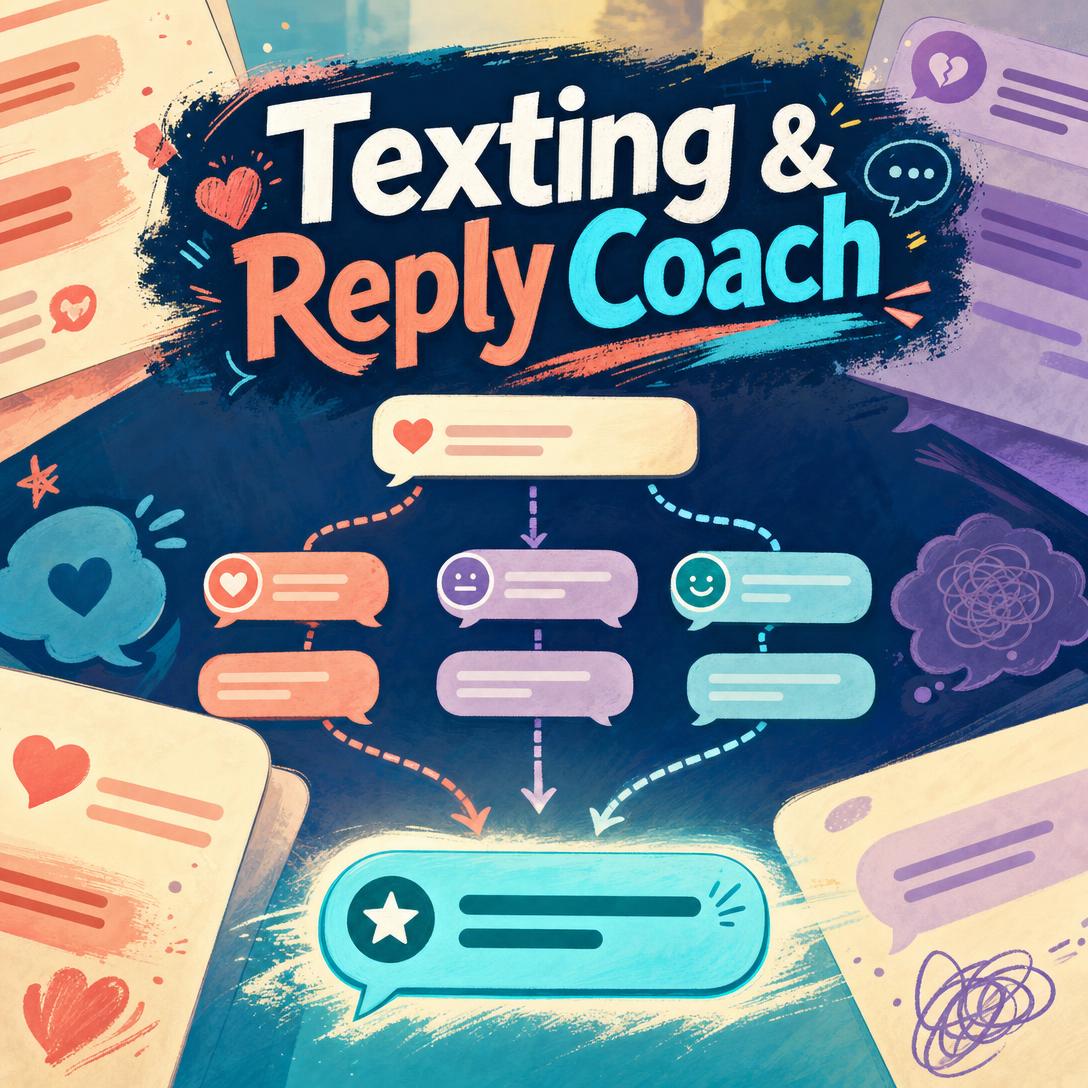
The strongest AI texting coach for replies that sound like you in 2026 is one that reads the whole thread, matches your existing texting voice, and works beyond dating apps. Jenova's Texting & Reply Coach is built for that job: screenshot analysis, send-ready options in your register, and coverage across romantic, professional, family, and friend threads. YourMove AI, Rizz, and Winggg are stronger when the goal is dating-app volume — openers, bios, and fast flirt replies rather than full-relationship coaching.
Key factors that separate a usable reply coach from a generic chatbot:
✅ Voice fidelity — suggested texts match your capitalization, emoji habits, slang, and message length, not a polished assistant tone
✅ Thread reading — the model uses the full screenshot, not just the last line, including pacing, subtext, and who is pursuing
✅ Relationship range — dating, work, family, friends, group chats, and conflict, not only Tinder or Hinge banter
✅ Strategic restraint — it can recommend silence, a boundary, or a follow-up wait instead of always producing a clever line
✅ Continuity — it remembers how you text and how each recurring person tends to show up in your threads
To compare these products fairly, it helps to score them on whether a draft is something you would actually send — not on how many pickup lines they can generate per minute.
Why Are So Many People Using AI to Draft Text Replies in 2026?
People are using AI to draft texts because messaging now carries outsized social weight, and many users would rather pause than send the wrong tone. A 2025 Match.com and Kinsey Institute study reported by CBS News found that 1 in 4 U.S. singles — and nearly half of Gen Z — use AI to improve their dating game, a 333% increase from the prior year.
That demand is no longer limited to third-party “rizz” apps. The Conversation reported in 2026 that Bumble planned to move away from the swipe and toward an AI dating assistant. The Guardian earlier documented Match Group preparing AI features to tailor profiles and search for dates, with critics warning that genuine connection could thin out.
Texting research helps explain the anxiety underneath the trend. A daily-diary study in Computers in Human Behavior Reports found texting was positively associated with feeling understood — but mainly when face-to-face contact was already low. Partners also form specific expectations around mobile messaging timing and content, which is why a delayed reply or a period on “ok.” can feel like a verdict.
The practical result in 2026 is a split market. Dating assistants optimize for matches and banter. Conversation coaches optimize for reading a real dynamic and handing you a line you can paste without sounding like someone else.
What Should You Look for in an AI Texting and Reply Coach?
You should evaluate an AI texting coach on whether its drafts are sendable in your voice, not on how witty the marketing copy sounds. The useful test is what we call the Send-Ready Six: voice fidelity, dynamic literacy, relationship range, context capture, strategic restraint, and continuity.
Voice fidelity. If you text in all lowercase, split thoughts across three bubbles, and never use exclamation points, a grammatically perfect paragraph is a failed output. Formatting carries meaning — periods, ellipses, “haha” versus “lol,” emoji reactions, and rapid-fire splits all change how a message lands.
Dynamic literacy. A coach should distinguish interest from breadcrumbing, a busy delay from a slow fade, and overthinking from a genuinely dismissive pattern. Generic chatbots summarize the last message. A specialist reads who is investing, who is withdrawing, and where the thread actually turned.
Relationship range. Dating-app openers are only one genre. The same person may need a firm-but-kind boundary with a parent, a calibrated note to a manager, and a repair text after a fight with a partner.
Context capture. Screenshot workflows beat “paste the last line” workflows because the narrative arc lives in the earlier bubbles. Partial screenshots should still get a best-effort read, with a flag when missing context could change the advice.
Strategic restraint. Sometimes the correct output is no text. Chasing after a clear cooldown, over-explaining a boundary, or rewarding emotional bait can make a “great reply” the wrong move.
Continuity. Style rules and recurring people should persist across sessions. Re-explaining “I never double text” every time is a product failure, not a user failure.
Privacy belongs on the same checklist. Uploading private threads is intimate. Jenova states that user data is not used to train public AI models and is encrypted in transit and at rest. Other apps’ data practices should be read in their own policies before you share a conversation with a partner, coworker, or family member.
How Do Jenova, YourMove AI, Rizz, Winggg, and Keys AI Compare?
They compare as two product types: dating-volume assistants versus conversation analysts, with Keys AI sitting closer to a general keyboard overlay. YourMove, Rizz, and Winggg concentrate on dating-app openers and flirt replies. Jenova’s Texting & Reply Coach concentrates on decoding a thread and drafting replies that match the user’s voice across relationship types. Keys AI is described as a general keyboard texting coach rather than a dating-only wingman.
| Feature / Dimension | YourMove AI | Jenova Texting & Reply Coach | Rizz | Winggg | Keys AI |
|---|---|---|---|---|---|
| Voice / style matching | Tone help for dating replies; less emphasis on long-term personal register | Learns from your sent bubbles, stated rules, and edits | Improves with use as you accept or reject suggestions | User picks a tone (Friendly, Charming, Funny, Playful, Flirty, Witty) | In-keyboard coaching; depth unverified |
| Screenshot / thread analysis | Profile screenshots and incoming messages for openers and replies | Full-thread screenshot reads, including subtext and inflection points | Conversation screenshots from dating apps or social | Incoming message in, reply out; profile analysis for openers | Keyboard overlay; screenshot depth unverified |
| Relationship range | Dating-app focused | Romantic, situationship, ex, friends, family, professional, group chats, conflict | Primarily dating and flirting | Dating apps plus iMessage and IRL openers | General texting, not dating-only |
| Extra dating features | Bio writer, profile feedback, opener generator | Reply strategy and meaning-reads; no dedicated bio studio | Openers for dating bios and chat replies | IRL intros, ask-outs, polite breakups, profile rewrites | Unverified |
| Pricing (as of 2026) | App Store lists Premium at $9.99, weekly at $4.99, annual at $49.99 | Free with limited usage; Plus starts at $20/month (30× usage) | Roundups list about $4.99/week | 5 free uses; $2.99/week, $9.99/month, $44.99 for 6 months | Premium reported from $4.99 to $59.99 by plan length |
| Best for | High-volume dating-app messaging and bios | Send-ready replies in your voice across real relationships | Fast dating replies for a young, dating-app audience | Dating openers plus in-person line help | People who want suggestions inside the keyboard |
YourMove AI
YourMove is strongest as a dating-app efficiency layer. The company says users can screenshot a profile or enter a topic and get three personalized openers in five seconds, then paste a received message to keep banter going. It also offers a profile writer and claims a good bio can 4x matches. It reports 300,000+ customers.
The limitation is scope. YourMove is built to reduce time spent swiping and texting dates, not to coach a tense family thread or a manager follow-up. Apple’s listing prices Premium, weekly, and annual plans separately, so cost depends on which storefront and term you use.
Rizz
Rizz is strongest as a high-reach dating screenshot assistant. CBS News reported that founder Roman Khaves described a user base of roughly 10 million, about 65% men and 35% women, largely ages 18–25. Users upload conversation screenshots; the app suggests a reply and, according to Khaves, learns which suggestions you prefer over time.
The limitation is quality consistency and use-case narrowness. A 2026 roundup on GetMatches.ai listed Rizz around $4.99/week and noted reviewers describing output as generic and repetitive. Rizz is a dating wingman, not a cross-relationship communication coach.
Winggg
Winggg is strongest when you want labeled tones and help that extends from the app to in-person lines. It works with Tinder, Hinge, Bumble, OkCupid, and regular iMessages, and paid plans add IRL ask-outs and polite breakup language. Pricing on its site is unusually low at the weekly tier: 5 uses free, then $2.99/week**, **$9.99/month, or $44.99 for six months.
The limitation is analytical depth. Choosing “Playful” or “Witty” is not the same as diagnosing a slow fade, a guilt trip, or a group-chat pile-on. Winggg is a conversation generator with dating and IRL scripts, not a dynamic reader.
Keys AI
Keys AI is strongest as an always-on keyboard rather than a session-based coach. WingAI’s comparison frames it as a general texting coach, which matters if you want suggestions outside dating apps. VIDA Select’s review reported premium subscriptions ranging from $4.99 to $59.99 depending on length.
The limitation is verified substance. Public pages describe the category more clearly than they document thread-level analysis, red-flag detection, or long-term voice memory. If you need a read on what the conversation is doing, a screenshot analyst is a better fit than a keyboard that offers lines in place.
Jenova Texting & Reply Coach
Jenova is strongest when you already have a thread and need a reply that could pass as yours. You upload a conversation screenshot. It reads who said what, where the temperature changed, and what the last message is actually doing — interest, testing, logistics, withdrawal, or bait — then returns copy-pasteable options labeled by approach, such as keep it casual, show interest, or firm but kind.
It is not the right primary product if you want a dating bio factory, an always-on iMessage keyboard, or in-bar opener scripts. It also cannot watch your inbox, ping you when someone replies, or schedule a follow-up text. Those gaps are real. The trade-off is judgment: a screenshot workflow inserts a beat between impulse and send, which is often the point.
How Does Voice Matching Affect Whether a Suggested Reply Actually Gets Sent?
Voice matching determines whether a suggested reply leaves the clipboard, because people reject lines that are strategically fine but stylistically alien. A draft that does not sound like the user fails even when the tactic is sound.
Examining real threads shows how much meaning sits in mechanics rather than vocabulary. “ok” is not “ok.” is not “Ok.” Laughter registers differ: “haha,” “lol,” “😂,” and “💀” are not interchangeable. Message splitting — three short bubbles versus one considered paragraph — signals different energy. Emoji reactions can function as conversation enders rather than replies.
Effective coaches pull style from the user’s own sent messages in the screenshot, then from explicit rules (“no exclamation points,” “never double text”), then from repeated edits. If you always delete the joke, the next draft should stop leading with a joke.
Dating assistants that offer a tone picker (funny, flirty, witty) solve a different problem. They help you perform a mode. They do not automatically reproduce your lowercase, your slang, or your habit of answering a question with a question. That is why generic-chatbot users often rewrite every suggestion before sending — the labor the coach was supposed to remove.
What Patterns Can an AI Coach Detect in a Text Thread That Generic Chatbots Miss?
A specialist coach can name the pattern in the thread — slow fade, breadcrumbing, testing, soft ghosting — instead of only paraphrasing the last bubble. Generic chatbots are decent at “they seem interested.” They are weaker at explaining how interest is leaking out of the pacing.
Patterns worth scoring on any serious tool:
- Slow fade — longer gaps, shorter replies, fewer questions; often avoidance of a direct no
- Breadcrumbing — sporadic pokes that maintain access without plans
- Orbiting — stories and likes without texts
- Soft ghosting — taps and reactions without advancing the conversation
- Testing — ambiguous or provocative lines meant to measure your investment
- Anxiety spiral — the user treating a 30-minute gap or a period as proof of rejection when the rest of the pattern is warm
Signal detection should cover more than romance. Effort asymmetry, question-asking ratio, who initiates, who controls pace, passive aggression, bids for attention dressed up as logistics, and both red and green flags all change the correct next line.
Group chats add another layer generic models flatten. Every message has an audience. Side conversations sometimes belong in DMs. Re-entering a fast thread without derailing it is a skill. A dating-only assistant rarely models that.
The overthinking filter is part of the same literacy. A good coach will say “they’re busy; the period is not a verdict” when the pattern is benign, and “this is dismissive” when the pattern is not. That judgment is the product. Pickup lines are the commodity.
How Do You Get Send-Ready Replies From an AI Texting Coach?
You get better replies by feeding the full thread, stating the goal in one line, and correcting voice the first time it is off. Most tools fail when users paste only the last message and ask for “something flirty.”
For Jenova’s Texting & Reply Coach, a typical pass looks like this:
- Open the agent and upload the conversation screenshot — the mobile apps make this easier than desktop screenshots.
- Add the goal only if it is not obvious from the thread:
"I want to set a boundary about last-minute plans without starting a fight."
- Read the dynamic summary, then pick among the labeled options rather than mixing all of them into one overcooked paragraph.
- If a draft is almost right, say how you would actually text:
"I never use exclamation points and I don't send paragraphs. Make it one lowercase line."
When the screenshot is clear, useful coaching starts with analysis and replies rather than a long intake quiz. One clarifying question is enough if the relationship type or the goal is genuinely missing.
For YourMove, the parallel flow is dating-specific: screenshot a profile or enter a topic, take three openers, then paste the other person’s message when you need a response. For Winggg, choose a tone and spend the five free uses on the threads that are actually stalled, not on messages you already know how to send.
Adjacent Jenova agents fit specific leftover jobs. Crush Decoder is for “what does this behavior mean” when you need a read more than a draft. Dating App Advisor is for profile and opener strategy on the apps themselves. Relationship Advisor is for the larger pattern after the text is sent. Date Planner is relevant once a thread turns into an actual plan.
If you write your own reply and want a pre-send check, ask for a draft review rather than a rewrite by default. A decent coach should say when your version already works.
What Do Communication Experts Say About Using AI to Write Texts?
Experts generally treat AI texting help as a legitimate supplement for initiation and tone-checking, and as a problem when it replaces the user’s actual voice or becomes the relationship. Kasley Killam, a social health and human connection expert quoted by CBS News, put the risk cleanly: AI is useful unless it becomes a substitute for human connection rather than a supplement.
"The failure mode we see most often is not bad strategy. It is a reply the user would never send. If someone texts in all lowercase with no punctuation, a tidy paragraph with two exclamation points will sit in the clipboard. Voice matching is the difference between a coach and a ghostwriter."
"Dating-volume tools optimized the wrong bottleneck for a lot of users. The bottleneck is not inventing a clever opener. It is reading power, pacing, and subtext in a thread that already exists — including the threads that are not romantic."
"We also see better outcomes when the product is allowed to recommend silence. If every screenshot produces three witty options, the model is incentivized to keep the user performing. Real texting includes boundaries, cooldown, and the decision not to reward bait."
— Jenova Product Team, AI agent design for communication workflows
Authenticity concerns are not theoretical. CBS interviewed a Rizz user who found the tool helpful for starting conversations but noted that some dates grew skeptical after learning about the behind-the-scenes coaching. That is the design tension for every product in this category: help people say what they mean, without renting them a personality.
When Is the Best Move Not to Reply at All?
The best move is not to reply when answering would reward manipulation, reopen a closed boundary, or turn your anxiety into extra labor for someone who is already withdrawing. Strategic non-response is an action, not a freeze.
Situations where a coach should be willing to output nothing:
- After guilt-tripping, bait, or a message designed to provoke a chase
- After you already stated a clear boundary that does not need a closing argument
- When your impulse is to over-explain, apologize for existing, or stack follow-ups
- When the other person needs to sit with what they said
- When continuing would undercut your position in a slow fade you have already named
This is where dating-volume products systematically underperform. Their success metric is a sent message, a kept conversation, another reply. A thread with an ex, a breadcrumbing situationship, or a difficult relative often needs the opposite.
Timing advice should be context-dependent rather than folkloric. “Wait three days” is not analysis. “They reply in bursts after work, and two hours is inside their normal pattern” is analysis. So is “the questions stopped, the messages halved, and a bump would only reset a fade they are already running.”
Used that way, an AI texting coach is less a rizz generator and more a pacing instrument. The send-ready reply is the common output. The useful one, some days, is permission to put the phone down.
References
- CBS News — Match/Kinsey figures on AI dating use, Rizz user base, and Kasley Killam on supplement vs. substitute
- YourMove AI — official product features, opener workflow, bio claim, and customer count
- The Conversation — Bumble’s planned shift from swiping to an AI dating assistant
- The Guardian — Match Group AI features for profiles and date search
- ScienceDirect — daily-diary study on texting, face-to-face contact, and feeling understood
- Journal of Social Media in Society — partner expectations around direct mobile messaging
- RIZZ — official AI dating assistant positioning
- Winggg — dating/iMessage coverage, tone modes, IRL features, and published pricing
- Apple App Store — YourMove AI Keyboard plan prices
- WingAI — Keys AI described as a general keyboard texting coach
- VIDA Select — Keys AI premium pricing range
- GetMatches.ai — 2026 texting-assistant roundup with Rizz pricing and review notes