What Is the Best AI Physics Tutor for Students in 2026?
2026-08-28
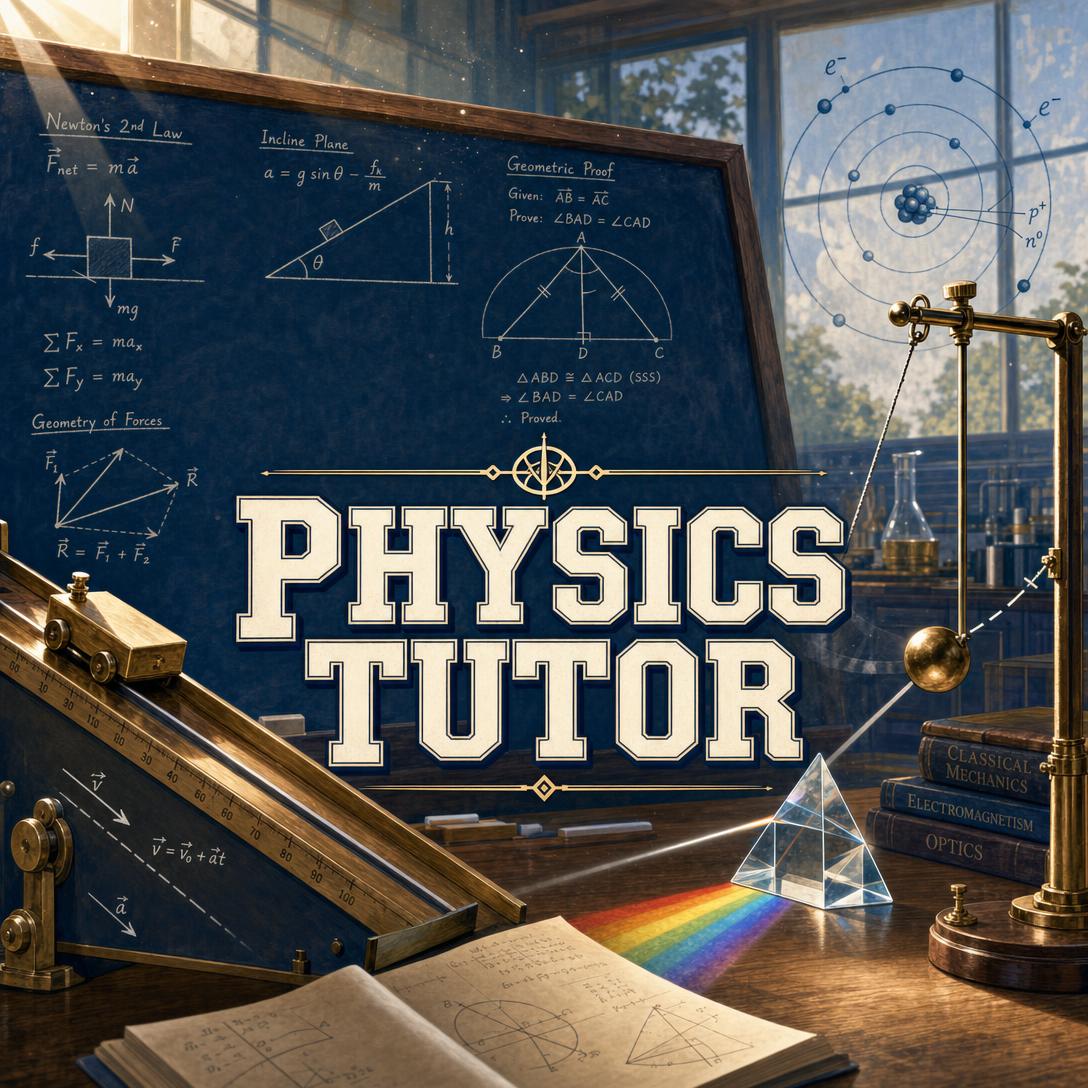
How Do AI Physics Tutors Compare on Intuition-Building Versus Answer Delivery?
The AI physics tutors worth using in 2026 are the ones that force you to reason from principles before they hand over a number. Jenova Physics Tutor is strongest when you need adaptive, Socratic 1:1 coaching from middle school through university; Khan Academy is strongest as a free, structured course library; Brilliant is strongest for short interactive concept drills; and Wolfram Alpha is strongest as a computational engine rather than a teacher.
That split — intuition-building versus answer delivery — is the evaluation axis that matters most. Homework-solver chatbots can produce a velocity or a voltage. They rarely catch the misconception that produced the wrong setup.
Key factors that separate effective AI physics tutoring from generic solvers:
✅ Physical picture first — what happens and why — before any equation is written ✅ Free-body diagrams, ray diagrams, and circuit diagrams treated as non-negotiable setup, not decoration ✅ Symbolic solving before number-plugging, with unit and limiting-case checks ✅ Named diagnosis of high-frequency misconceptions (force-to-keep-moving, current-used-up, heat-versus-temperature) ✅ Exam-format fluency for AP, IB, A-Level, Olympiad, GRE Physics, and MCAT-style passages
To compare these tools fairly, it helps to judge them on a Principle-First Rubric: guided discovery, domain depth, exam alignment, representational fluency, memory across sessions, and cost — not on who prints an answer fastest.
Why Has Demand for AI Physics Help Grown in 2026?
Students are looking for AI physics help in 2026 because exam formats now punish plug-and-chug more aggressively, while answer-only chatbots have become easy to find. The College Board's AP Physics 1 exam is a hybrid digital test: 42 multiple-choice questions in 85 minutes and 4 free-response questions in 95 minutes, split evenly at 50% of the score each.
Those four free-response items are not interchangeable calculation dumps. They cover mathematical routines, translation between representations, experimental design and analysis, and qualitative/quantitative translation. An AI that only outputs $F = ma$ leaves the experimental-design and representation-translation tasks untouched.
Roundups of free AI tools for physics in 2026–2027 show how crowded the category has become. That crowding makes the teaching model more important than the chatbot label. Apps such as Physics Master AI advertise always-on homework chat. That is useful at 1 a.m. It is a weak substitute for building the instinct to ask “what is conserved?” before writing equations.
Physics tutoring businesses still lean on simulations such as PhET, alongside lab platforms like Labster, because interactive labs train a different skill than conversation does. The practical 2026 stack is usually mixed: a tutor for reasoning, a course library for coverage, a computer-algebra tool for messy integrals, and a simulation for the experiment you cannot run at a desk.
What Should You Look for in an AI Physics Tutor?
You should look for an AI physics tutor that diagnoses how you are thinking, not one that only scores whether the final number matches the key. The Principle-First Rubric below is the framework used in this comparison.
📊 The Principle-First Rubric
| Dimension | What “good” looks like | What “thin” looks like |
|---|---|---|
| Guided discovery | Socratic nudges, then direct teaching if you stall | Immediate final answer with a pasted formula |
| Domain depth | Mechanics through E&M, thermo, optics, modern physics | One course band (for example, intro mechanics only) |
| Exam alignment | FRQ habits, command terms, required practicals | Generic end-of-chapter numericals |
| Representational fluency | Diagrams, graphs, analogies, limiting cases, LaTeX | Text-only explanations |
| Persistence | Remembers your level, math comfort, and error patterns | Every session starts from zero |
| Cost / access | Clear free tier or fully free library | Paywall before you can test teaching quality |
Guided discovery is the difference between being walked to Gauss’s law and being handed the flux formula. If you are stuck after two or three nudges, a good tutor should switch to direct instruction and then check understanding — not keep interrogating you.
Symbolic-first solving is the single most reliable physics habit an AI can enforce. Solve in variables, substitute numbers last, then ask whether the units work and whether the magnitude is reasonable. Tutors that jump to calculator-ready arithmetic hide algebraic structure and make sign errors harder to catch.
Misconception naming matters more in physics than in many other subjects. “Force is needed to keep an object moving,” “action-reaction forces cancel,” and “current is used up in a circuit” are stable, research-familiar errors. A tutor that never names them will keep grading symptoms.
Exam awareness should be specific. AP Physics 1 emphasizes paragraph justification and experimental design. AP Physics C is calculus-based. IB Physics has command terms and an internal assessment. Olympiad work rewards multi-concept integration and estimation. A generic STEM bot that does not know those differences will overfit to homework numericals.
Honest limitation of conversation-only tutors: none of the AI tutors below replaces a supervised lab or a PhET-style simulation sandbox. If your goal is to see standing waves or charge flow, pair the tutor with a simulation rather than asking chat to impersonate one.
How Do Khan Academy, Brilliant, Wolfram Alpha, and Jenova Compare for Physics?
Khan Academy, Brilliant, Wolfram Alpha, and Jenova Physics Tutor occupy different jobs in a physics workflow: structured free curriculum, interactive concept practice, computation, and adaptive 1:1 tutoring. Treating them as interchangeable “AI physics tutors” hides those job differences.
| Feature / Dimension | Khan Academy | Jenova Physics Tutor | Brilliant | Wolfram Alpha |
|---|---|---|---|---|
| Teaching model | Video lessons, articles, mastery practice | Adaptive Socratic dialogue with direct-instruction fallback | Interactive visual exercises | Computational Q&A and knowledgebase lookup |
| Domain span | Middle school through AP Physics courses, including AP Physics 1, 2, and AP Physics C: Mechanics | Foundations through advanced topics (mechanics, E&M, thermo, optics, QM, nuclear, astrophysics) | Conceptual courses such as Physics of the Everyday | Broad science computation; not a sequenced curriculum |
| Exam prep | Course-aligned AP physics practice | AP, IB, A-Level, Olympiad, GRE Physics, MCAT-style, university entrance awareness | Concept fluency more than FRQ scoring | Fast calculation support; little pedagogy |
| Diagrams | Video demonstrations | Generated free-body, circuit, ray, field, and energy diagrams | Interactive on-screen visuals | Computed plots and symbolic output |
| Memory | Course progress tracking | Persistent cross-session memory of level, misconceptions, and strategies | Course/lesson progress | Query-by-query computation |
| Pricing (as of 2026) | Free for learners, teachers, and parents | Free tier with limited usage; paid plans from $20/month | About $27.99/month or $161.88/year, with a trial | Free web access; Pro pricing unverified here |
| Best for | Self-paced, zero-cost course coverage | Students who need a thinking partner on live problems | Daily interactive intuition drills | Checking integrals, units, and closed-form results |
Khan Academy
Khan Academy remains the default free physics syllabus on the open web. Its physics archive points learners to mastery-enabled Middle School Physics, High School Physics, AP Physics 1, AP Physics 2, and AP Physics C: Mechanics, and learning is always free.
Strengths are coverage, classroom fit, and cost. Limitations are conversational: it will not sit with your botched Atwood machine, name your sign-convention drift, or regenerate a free-body diagram from a photo of a worksheet. It is a curriculum. It is not a tutor who remembers that you skip diagrams on “easy” problems.
Brilliant
Brilliant’s pitch is visual, interactive practice rather than lecture. Physics of the Everyday runs 33 lessons and 132 exercises, using toilets, bridges, weather, and sports as the physical setting. That is excellent for intuition at an introductory level.
It is a weaker match for calculus-based AP Physics C free-response work or olympiad multi-part problems. Full access is paid: as of 2026, reviewers list about $27.99 per month or $161.88 per year after a short trial. Students in
often debate whether that premium is worth it versus textbooks and free video.Wolfram Alpha
Wolfram Alpha is computational intelligence, not Socratic teaching. It computes answers from a curated knowledgebase and algorithmic engine across mathematics and science. For a definite integral, a unit conversion, or a quick kinematics check, it is often faster than a tutor.
The limitation is pedagogical. It will not insist on a free-body diagram, will not catch the “centrifugal force pushes outward” mix-up in an inertial frame, and will not grade a paragraph justification the way an AP Physics 1 reader would. Use it after you have a model, not instead of building one.
Jenova Physics Tutor
Jenova Physics Tutor is built as a level-adaptive coach: it infers whether you are in algebra-based high school, calculus-based AP Physics C, or undergraduate E&M, then matches rigor and vocabulary. Default mode is guided discovery. If you are stuck, time-pressured, or explicitly want the answer, it shifts rather than trapping you in endless questions.
Its depth advantage is first-hand and specific. It treats free-body diagrams as mandatory in mechanics, pushes conservation-law checks before equation setup, and uses dimensional analysis and limiting cases (, , ) as error traps. It can generate diagrams and practice sets, and it keeps topic mastery and misconception notes across sessions on the Jenova platform.
Honest limitations: it is not a live lab. It has no official College Board item bank. The free tier is usage-capped. It cannot schedule “send me a problem every morning.” For interactive experiments, PhET still wins. For raw symbolic grind, Wolfram Alpha still wins.
Other options worth knowing
Varsity Tutors’ High School Physics app packages practice tests and quizzes for high-school physics. That helps retrieval practice. It is not a misconception-aware dialogue tutor.
PhysicsGraph positions itself as mastery learning for the physical sciences in comparisons against Brilliant. Independent, current pricing and pedagogy details were too thin here to treat it as a fully scored contender.
How Does Socratic Tutoring Change Physics Problem-Solving?
Socratic tutoring changes physics problem-solving by delaying the equation until the physical situation is stable — which is exactly where most wrong answers are born. In practice, that means the first moves are a sketch, a force inventory, and a conservation check, not a hunt for “the formula for this chapter.”
A typical mechanics pass under a principle-first tutor looks like this:
- Draw the situation and a free-body diagram before any algebra.
- Ask whether energy, momentum, angular momentum, or charge is conserved.
- Choose Newton’s laws, energy methods, or kinematics because the diagram demands it — not because the homework section title does.
- Solve symbolically, then substitute numbers.
- Check units, magnitude, and limiting cases.
That sequence is slower than pasting a problem into an answer engine. It is also how you survive AP Physics 1’s translation-between-representations and qualitative/quantitative FRQs. Those items ask you to move among words, graphs, diagrams, and equations. A solver that only emits a number never rehearses that translation.
Jenova Physics Tutor’s default is guided discovery with a release valve: after a couple of unsuccessful nudges, it teaches directly, then checks comprehension. That matters. Pure Socratic bots can stall anxious students. Pure answer bots never build the “what happens if friction goes to zero?” reflex.
Khan Academy rehearses some of the same ideas through videos and mastery questions, but the path is linear. Brilliant’s interactive items are closer to guided discovery for conceptual hooks — forces, energy, estimation, torque, weather — yet they are lesson-scoped, not open-problem coaching.
If you already know you want the numerical answer, say so. A good tutor should honor that, then immediately test whether you can reconstruct the principle. “Never do the homework without teaching” is a constraint, not a slogan: even a direct answer should be followed by a check that you could set the problem up tomorrow.
Which AI Physics Tutors Are Strongest for AP, IB, and Olympiad Prep?
Jenova Physics Tutor is the strongest conversational option in this set for mixed exam prep, while Khan Academy is the strongest free course option for AP-aligned content, and neither Brilliant nor Wolfram Alpha is primarily an exam coach. The right pick depends on whether you need FRQ habits, a syllabus map, or calculation horsepower.
AP Physics
As of the 2026 administration, AP Physics 1 is a hybrid digital exam in the Bluebook app: multiple-choice on screen, handwritten free-response in a paper booklet. Calculators are permitted, and a reference sheet is provided.
That format change is easy to underestimate. Students who only practice typed chat answers still have to handwrite experimental-design and paragraph-justification FRQs under time pressure. An AI tutor should therefore:
- Mimic discrete MCQs and multi-question data sets
- Force written justifications, not just circled choices
- Practice experimental variables, uncertainty, and “what the graph actually shows”
- Separate algebra-based AP Physics 1/2 from calculus-based AP Physics C
Khan Academy’s labeled AP Physics 1, 2, and C: Mechanics courses are the easiest free on-ramp. Jenova Physics Tutor is more useful once you are inside a live FRQ and need someone to stop you from treating Newton’s third-law pair as if the forces cancelled on the same object. Wolfram Alpha can check the integral in an AP Physics C: E&M Gauss’s-law problem; it will not score the prose.
Students sitting multiple APs often pair this work with Jenova’s AP Exam Tutor for rubric and pacing habits that cut across subjects.
IB, A-Level, Olympiad, GRE, and MCAT
IB Physics adds command terms, data-booklet fluency, and an internal assessment. A-Level specifications (AQA, OCR, Edexcel, CIE) differ on required practicals and synoptic papers. Olympiad tracks (F=ma, USAPhO, IPhO) reward estimation and multi-concept stacking. GRE Physics rewards speed and dimensional-analysis shortcuts. MCAT physical-sciences items are passage-based and estimation-heavy.
No tool in this comparison is an official stand-in for those boards. Jenova Physics Tutor is designed to adapt strategy when you name the exam and timeline. Khan Academy does not try to be IPhO prep. Brilliant’s everyday-physics course is explicit that a nodding familiarity with heat, energy, and force is enough to start — the wrong difficulty band for olympiad mechanics.
Pre-med students who need physics inside a broader MCAT plan may also use Jenova’s MCAT Tutor for passage reasoning, while keeping a dedicated physics tutor for first-principles mechanics and E&M.
How Do You Work Through a Physics Problem With an AI Tutor?
You get the most from an AI physics tutor by stating your level, showing your setup, and asking for the next reasoning step — not by pasting a problem and requesting the final box. Setup takes under two minutes; the quality of the next hour depends on that setup.
For Jenova Physics Tutor:
- Open the agent at jenova.ai/a/physics-tutor.
- State level, math comfort, and exam context in one message:
"I'm in AP Physics C: Mechanics, comfortable with single-variable calculus, and I keep missing torque sign conventions. Exam is in May. Here's the problem…"
- If you have a worksheet photo or a lab graph, upload it and ask for a diagram check before any algebra.
- When you stall, request a nudge rather than the solution:
"Don't give the answer. Tell me whether energy or Newton's second law is the cleaner starting point, and why."
- After a solution, demand the two physicist checks: units and a limiting case.
A productive follow-up looks like this:
"I got 3.2 m/s² to the left. If the hanging mass goes to zero, should acceleration go to zero? If not, I set the system wrong."
That is limiting-case analysis used as a debugger. It catches more errors than re-doing the arithmetic.
For Khan Academy, the parallel path is different: pick the matching AP or high-school unit, complete the mastery sequence, and only then bring leftover confusions to a conversational tutor. For Brilliant, work a short interactive lesson on the concept (torque, momentum, estimation), then attempt a textbook problem with a tutor so the interaction is not the only representation you have seen.
If the bottleneck is algebra or calculus rather than physics, switch to Jenova’s Math Tutor for the derivation, then return to the physics setup. Chemistry overlap — calorimetry, gas laws, electrochemistry — is common in AP Physics 2 and MCAT work; Chemistry Tutor is the natural sibling when the confusion is chemical rather than mechanical.
Platform note, as reference data: Jenova Physics Tutor runs with persistent chat history and cross-session memory. The free plan includes core features with limited usage; Plus is $20/month at 30× free usage, with higher tiers at $50, $100, $200, $500, and $1,000 per month. Usage resets monthly. It cannot send recurring daily problem sets or run background reminders — you have to open the thread.
What Do Physics Educators Say About AI Tutoring?
Physics educators tend to support AI tutors that expose reasoning and to distrust tools that hide it — because physics grades the model, not the arithmetic. The highest-value AI behavior is forcing a diagram, naming the principle, and checking whether the answer still makes sense when a parameter is driven to an extreme.
"The failure mode we see over and over is not 'the student cannot multiply.' It is that they grab an energy equation for a problem that is really a Newton’s-second-law problem, or they cancel third-law pairs that do not act on the same object. If an AI never makes them draw the free-body diagram, it is practicing the wrong sport."
"Exam boards are moving in the same direction. AP Physics 1’s free-response mix — mathematical routines, translation between representations, experimental design, qualitative/quantitative translation — is almost a rubric for anti-plug-and-chug teaching. An AI that only emits a numeric answer is misaligned with how the course is now scored."
"Persistent memory is the unglamorous advantage. A tutor that remembers you skip diagrams on easy problems, mix mass and weight, or default to energy methods can spend the next session on that pattern. A stateless chatbot will happily re-explain projectile motion from scratch and miss the actual bug."
"The complementary stack is still real: Khan Academy or a textbook for coverage, PhET for the experiment, Wolfram Alpha for a gnarly integral, and a Socratic agent for the live problem. Replacing all of that with one homework chat is how students stay fluent at getting answers and fragile at physics."
— Jenova Product Team, designers of adaptive STEM tutoring agents
That view matches the 2026 exam reality already cited: hybrid digital AP Physics 1, handwritten FRQs, and representation-heavy scoring. It also matches why fully free video libraries still matter. AI dialogue does not magically replace a well-sequenced syllabus.
When Should You Combine an AI Physics Tutor With Simulations and Textbooks?
You should combine an AI physics tutor with simulations and textbooks whenever the task is experimental, spatial, or long-form — because conversation is a poor laboratory and a poor substitute for a worked reference corpus. The combination is the strategy, not a compromise.
Use a conversational tutor (Jenova Physics Tutor) when you are stuck mid-problem, carrying a misconception across topics, or preparing written justifications. Use a structured library (Khan Academy) when you need to see the whole unit in order, including AP-tagged practice. Use interactive visuals (Brilliant, PhET) when the concept is kinematic or field-based and you need to drag a parameter and watch the system respond. Use a computer-algebra engine (Wolfram Alpha) when the physics is set and the remaining pain is algebraic.
A concrete weekly pattern for an AP Physics 1 student in 2026:
- Cover the unit on Khan Academy’s free physics sequence.
- Run one PhET lab on the same idea (circuits, waves, projectiles).
- Bring two missed problems to Jenova Physics Tutor and insist on diagrams plus a paragraph justification.
- Check any ugly algebra in Wolfram Alpha after you have a symbolic result.
- Handwrite one experimental-design FRQ on paper, because the exam still collects handwritten free-response.
University and olympiad students should add estimation drills and multi-concept problems. Introductory students who find formal courses dry can start on Brilliant’s everyday-physics lessons, then graduate to exam-style work once the vocabulary of force, energy, and momentum is no longer the bottleneck.
Jenova Physics Tutor’s limitation in this stack is clear: it can generate educational diagrams, but it is not a real-time sandbox. Khan Academy’s limitation is the inverse: superb scaffolding, weak personalization. Brilliant’s limitation is depth and exam specificity at a paid price point. Wolfram Alpha’s limitation is teaching. Choose the mix on purpose.
References
- College Board AP Central — AP Physics 1 exam format, hybrid digital design, and FRQ types
- Khan Academy — Physics course archive (middle school, high school, AP Physics)
- Khan Academy — Pricing: free for independent learners, teachers, and parents
- Khan Academy Support — Confirmation that learning on the platform is free
- Brilliant — Course catalog for visual, interactive STEM practice
- Brilliant — Physics of the Everyday (33 lessons, 132 exercises)
- Nibble — Brilliant pricing review for 2026 ($27.99/month or $161.88/year)
- Wolfram Alpha — Computational knowledge engine for mathematics and science
- UWorld College Prep — AP Physics 1 2026 hybrid digital exam format
- EduGenius — Best free AI tools for physics in 2026–2027
- Tutorbase — Physics tutoring tools including PhET, BitPaper, and Labster
- Google Play — Physics Master AI homework tutor app listing
- Varsity Tutors — High School Physics mobile practice app
- PhysicsGraph — Comparison page positioning mastery learning against Brilliant