What Is the Best AI Crush Decoder for Mixed Signals?
2026-08-28
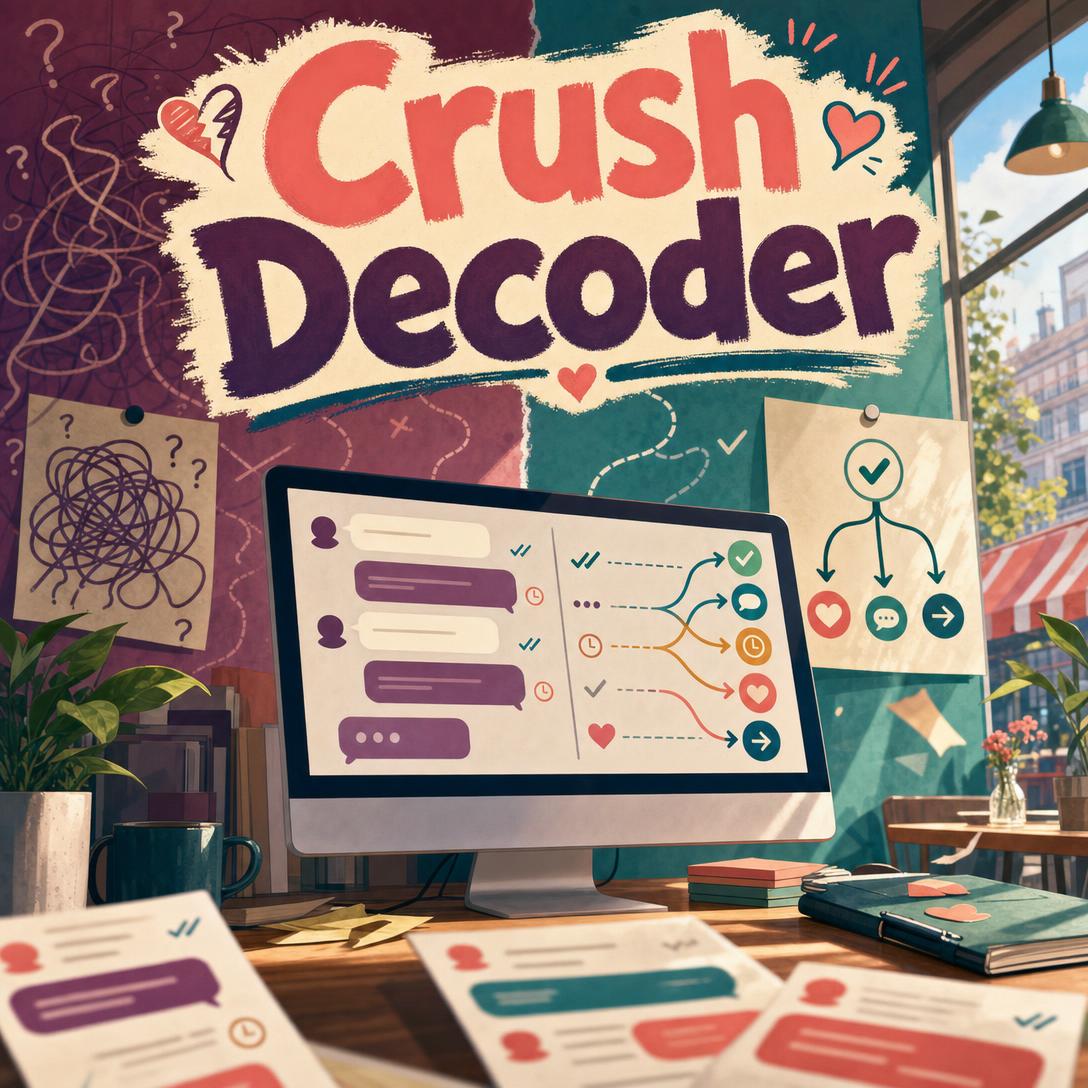
Do AI Crush Decoders Analyze Patterns Over Time or Just Rewrite Your Next Text?
The useful split in 2026 is diagnostic versus generative. Jenova's Crush Decoder is built to interpret texts, behavior, and absence as a pattern and say when the evidence points to interest, conflict, breadcrumbing, or disinterest. Wingman, Rizz, and YourMove AI are stronger when the job is producing openers, replies, or a sharper dating-app profile.
Key factors that separate a crush decoder from a pickup-line generator:
✅ Pattern persistence — initiation, effort, and escalation over weeks, not one delayed reply ✅ Honesty under hope — a clear disinterest call when the trajectory is down, not three flattering maybes ✅ Context calibration — workplace warmth, friend-group baseline, and app banter do not mean the same thing ✅ Bias correction — anxious readers overweight crumbs; avoidant readers dismiss real effort ✅ Test design — a low-risk move that creates new evidence beats a cleverer text that delays the truth
To compare these tools fairly, it helps to judge them on whether they collapse ambiguity or simply help you send the next message.
Why Are People Using AI to Decode Crush Texts and Mixed Signals in 2026?
People are using AI crush readers because modern dating produces more ambiguous digital evidence than most friend groups can interpret well. A 2025 SSRS poll found that 39% of U.S. adults have used an online dating site or app, including 65% of adults aged 18–29. Pew Research Center has reported that about half of adults under 30 (53%) have used a dating site or app. That volume of matching, ghosting, and slow-fade messaging is exactly the environment where people screenshot a thread and ask, “What does this mean?”
The pain is not a shortage of advice. It is a shortage of sorting. One slow reply, one story view, and one “we should hang out soon” get treated as a novel. Attraction research has long treated proximity and reciprocity as core drivers of liking, which is why initiation balance and follow-through matter more than emoji choice. A decoder that tracks who starts contact, who proposes plans, and who escalates is doing a different job than an app that writes a flirty opener in five seconds.
There is also a category split forming in 2026. Dating-app assistants optimize for matches and banter. Relationship coaches optimize for couples already together. Crush decoding sits in the messy middle: a coworker, a friend of a friend, an unmatched in-person interest, or a match who will not leave the chat. That is why “what should I say?” and “do they actually like me?” keep getting collapsed into one product pitch — and why they should not.
What Should You Look for in an AI Crush Decoder?
You should look for pattern tracking, calibrated honesty, context handling, and a next move you can actually run — not unlimited rizz. This article uses a Clarity-Over-Comfort framework: six dimensions that predict whether an AI will help you decide, or help you keep hoping.
1. Pattern persistence. A single data point is almost never a read. Initiation share, message effort, plan-making, and whether effort is rising or falling are the units that matter.
2. Honesty under hope. If the tool cannot say “this looks like breadcrumbing” or “this is polite disinterest,” it is a comfort object. Comfort objects waste months.
3. Context calibration. Office friendliness, group-chat warmth, cultural directness, and dating-app pacing all change the meaning of the same behavior. A decoder that ignores setting will over-read baseline kindness.
4. Bias correction. Anxious readers treat silence as a verdict. Avoidant readers treat a concrete invite as “just being nice.” The reader’s filter is part of the evidence.
5. Test design. When signals are genuinely unclear, the high-value output is an experiment with a predetermined readout: stop initiating, suggest a specific plan, share something mildly vulnerable, and decide in advance what each response means.
6. Cost-to-clarity. Weekly dating-assistant subscriptions can exceed the price of a deeper monthly AI workspace. Pay for the job you need. If you only need a line, a generator is enough. If you need a trajectory read, a generator is the wrong instrument.
Reply drafting still matters, but it is a downstream feature. Matching energy, asking a real question, and proposing a specific time are useful after you know the pattern. They are not a substitute for knowing it. If you already have a date on the calendar, a specialist like Jenova's Date Planner is a better fit than another round of screenshot decoding.
How Do Crush Decoder, Wingman, Rizz, and YourMove AI Compare?
Crush Decoder is the strongest option in this set for honest pattern reads across friends, coworkers, and mixed-signal threads, while Wingman, Rizz, and YourMove AI are more capable as dating-app production tools. None of them replaces in-person judgment, and each has a clear miss.
| Feature / Dimension | Crush Decoder | Wingman | Rizz | YourMove AI |
|---|---|---|---|---|
| Core job | Decode texts, behavior, and absence; name the pattern; suggest a next move | Dating-coach suite: interests tracker, screenshots, photos, bios | Generate openers, bios, and replies | Dating-app texting assistant: openers, replies, bio, profile feedback |
| Pattern / history tracking | Tracks the crush situation across chats, including trajectory and tests | Profiles for each interest, conversation history, and updating insights | Conversation screenshot in, line out; weaker as a long-arc diagnostic | Session help around a profile or message; not a crush case file |
| Honesty / disinterest calls | Built to give a direct read, including breadcrumbing and slow fades | Practical coaching tone; broader “what to do next” than a disinterest verdict | Optimized to keep banter going | Optimized to keep you sending and matching |
| Context types | Workplace, friend group, apps, school, long-distance, exes, cross-cultural | Strongest around app dating and people you are already talking to | App messaging and pickup-style replies | App profiles, openers, and in-thread replies |
| Reply drafting | Energy-matched phrasing and “when not to text” | Screenshot lines meant to sound like you | High volume of openers and responses | Three personalized openers from a profile screenshot, plus reply suggestions |
| Profile / photo tools | Not a profile product | Photo rating, bio rewrite, full profile audit | Bio/opener generation | Bio writer and profile feedback; YourMove claims a strong bio can 4× matches |
| Platforms | Web, iOS, and Android via Jenova | iPhone only (iOS 15.1+) | App / web listings vary | iOS, Android, and web |
| Pricing (as of 2026) | Free tier with limited usage; Plus $20/month for 30× usage | App Store premium access listed at $7.99, $23.99, and $41.49 | Business Insider reported about $20/month**](https://www.businessinsider.com/rizz-dating-app-ai-analyzes-text-screenshot-conversations-advice-2024-6); [**SwipeStats listed Pro at $9.99/month and Elite at $19.99/month | TruShot reported about $79/year or $1.50–$3.75/week |
| Best for | “Do they like me?” pattern reads and mixed-signal sorting | iPhone users who want a dating cockpit (photos + texts + tracker) | Fast openers and reply options | Volume dating-app messaging and bio help |
Crush Decoder
Crush Decoder treats actions, consistency, and cost as the real signals. It looks at who initiates, whether messages ask questions or dead-end, whether plans are specific, and what the other person never does — never suggesting plans, never introducing you to their world, never escalating. It is also explicit about noise: one slow reply, emoji variation, and story views are usually not data.
The limitation is the other side of that focus. It will not rate your photos, rewrite your Tinder bio, or sit as a keyboard over Hinge. It cannot watch someone’s Instagram or remind you to text tomorrow. Reads are probabilistic, and they only work if you report the context honestly — including how this person treats everyone else, not only how they treat you.
Wingman
Wingman is an iPhone dating coach that keeps a file on each person you are talking to. The App Store listing describes screenshot advice, photo rating, bio rewrites, quizzes, and tracking of attachment style, communication patterns, red flags, and conversation history. That memory is a real strength compared with one-shot rizz apps that generate a line and forget you.
The limitation is scope and platform. It is iPhone-only, and the product is built as a dating cockpit — profile, photos, openers — more than as a specialist in workplace crushes, friend-group baselines, or “this is breadcrumbing, stop chasing.” If your problem is a confusing coworker rather than a weak Hinge grid, much of the suite is unused.
Rizz
Rizz positions itself as an AI dating assistant for engaging openers, bios, and tailored responses. A 2024 Business Insider test described screenshot analysis of conversations for about $20 a month. That is useful when you already decided to keep the chat alive and need phrasing.
The limitation is the incentive. A tool paid to produce the next line is rarely the tool that tells you the thread is entertainment, not pursuit. Pricing also varies by listing and plan, which makes cost-to-clarity harder to pin down than a simple monthly workspace fee.
YourMove AI
YourMove AI is a dating-app texting assistant: screenshot a profile for openers, paste a received message for replies, and use a bio writer plus profile feedback. The company says more than 300,000 customers use it to spend less time swiping. As of 2026, independent write-ups describe weekly plans around $1.50–$3.75 and an annual option around $79.
The limitation is honest and self-stated: it helps you get to the date faster, and it does not help you on the date. It also does not specialize in decoding a months-long friend crush, a slow fade, or a mixed-signal coworker. If your crush is not on an app, most of the workflow is the wrong shape.
Relationship-coach apps are a fifth lane, not a crush decoder. Mei says its AI has guided more than 800,000 people through dating and relationship situations, which is relevant once you are in a defined relationship and need conversation help — not when you still cannot tell whether you should ask them out.
How Does Pattern-Based Signal Reading Differ From Single-Text Analysis?
Pattern-based reading treats trajectory as the unit of analysis, while single-text analysis treats one message as a story. The first can change your decision. The second usually changes your wording.
In practice, the high-signal cluster is small:
- Initiation — who starts contact, and whether that share is shifting
- Effort — questions, callbacks, humor, and vulnerability versus “haha yeah”
- Plan quality — a specific time and place versus “we should do something soon”
- Escalation — voice or video, one-on-one time, introduced friends, future references
- Absence — never initiating, never proposing, never integrating you, never moving the level up
- Cost — what they do when it costs time, convenience, or social risk
The low-signal cluster is large, which is why people overthink. A 40-minute delay is not a pattern. Watching a story is passive consumption. Generic warmth is meaningless until you know whether this person is warm with everyone. Reciprocity shows up in attraction research, including a speed-dating study that found some support for the reciprocity principle but none for similarity, with physical attractiveness the strongest initial predictor. For an existing crush, that finding is a caution: first-impression beauty research does not license you to over-read a single text, and reciprocity is a trend toward balanced effort — not a guarantee that they like you back.
A practical check Crush Decoder uses in spirit: would you notice this behavior if you were not already interested? If the answer is no, you are not looking at a signal. You are looking at hope.
How Should Mixed Signals Be Sorted Before You Text Back?
Most mixed signals resolve into one of four categories, and the category changes the advice more than any clever reply. Sorting first is the non-commodity step most rizz apps skip.
1. Not actually mixed. One signal is real; the other is social lubrication or anxious interpretation. “They’re always too busy, but they said we should hang out soon” is usually busyness plus politeness. The vague offer is not a plan.
2. Genuinely conflicted. Interest is present, but timing, a recent breakup, a friendship-risk fear, or competing feelings create pullbacks. The tell is high engagement followed by anxious retreat, not flat indifference.
3. Breadcrumbing. Low-effort pings arrive when you pull away, then stall at the same shallow level. The consistency of the inconsistency is the tell. Generating a better opener here extends the loop.
4. Context-dependent. Workplace friendliness, cultural warmth, and extrovert baseline can look like flirting if you ignore the setting. Differentiated treatment — how they act with you versus with everyone — is the comparison that matters.
When the category is still unclear, low-risk tests beat more decoding:
- Stop initiating for a few days — do they notice and reach out?
- Suggest a specific one-on-one plan — enthusiastic yes, counter-offer, or dodge?
- Share something mildly vulnerable — do they match or deflect?
- Reference a future event — do they pick it up as “we,” or let it die?
Frame each as an experiment: if they do X, that means Y; if they do not, that also means something. Do not run a test you will refuse to believe.
How Do You Get an Honest Read From an AI Crush Decoder?
You get an honest read by feeding the pattern, the setting, and your own bias — then asking for a verdict with a next move, not a pile of maybes. Most tools can answer “what do I send?” Fewer will answer “should I send anything?”
For Crush Decoder, a useful first pass takes about two minutes:
- Open the agent at jenova.ai/a/crush-decoder.
- Give relationship context, timeline, and how they treat other people, not only you.
- Paste the thread or describe the last several interactions in order.
- Ask for a read, a confidence level, and one test — not five interpretations.
"We're in the same friend group. Six weeks of frequent hangouts, she laughs at my jokes and remembers small details, but she never texts first and she canceled the one one-on-one plan without rescheduling. I overthink response times. What's the pattern, and what's the lowest-risk next move?"
A strong output names the category, cites the evidence you provided, and tells you whether to match energy, run a test, or stop. If you actually need a send-ready message after that read, Jenova's Texting & Reply Coach is the adjacent workflow: same conversation dynamics, more emphasis on a reply in your voice. If the crush is an app match rather than someone in your life, Jenova's Dating App Advisor is the better profile-and-pacing specialist.
For Wingman, the parallel setup is: add the person as a romantic interest, share screenshots, and ask what to do next on iPhone. For YourMove AI, screenshot a profile or paste the received line and generate openers or replies. Those flows are faster when the decision is already “keep talking.” They are weaker when the decision is “this might be a fade.”
Jenova pricing, for reference: the free tier includes core features with limited usage; Plus is $20/month for 30× usage, with higher tiers above that. Usage resets monthly. That is a different cost shape from weekly dating-assistant subscriptions, which can look cheap per week and expensive per year.
What Do Dating Psychology Practitioners Say About AI Signal Reading?
Practitioners who work on attraction and communication tend to trust patterns, reciprocity, and setting more than isolated wording — and they treat AI as a bias check, not an oracle. Signal reading is probabilistic. Anyone selling certainty is selling theater.
"The product failure we see is not bad grammar in openers. It is tools that keep users sending into a downward effort slope because the metric is ‘a message went out.’ If initiation share, plan specificity, and escalation are all falling, a funnier text is not progress. It is delay with better punctuation."
"Attachment distortion is the hidden variable. Anxious readers turn a delayed reply into a narrative. Avoidant readers explain away a concrete Saturday invite. A decoder that only models the crush, and not the reader, will rubber-stamp the user’s existing story. That is why ‘would you notice this if you weren’t already interested?’ is more useful than another paraphrase of ‘haha yeah.’"
"Low-risk tests outperform clever lines because they create new evidence. Stop initiating, propose one specific plan, or match vulnerability — then honor the readout. Directness is still underrated. Most regret in this category is not saying something after the pattern was already clear."
— Jenova Product Team, AI agent design for interpersonal decision-making
That view lines up with the research caution above: reciprocity is real enough to respect as a trend, and not strong enough to treat a single warm message as proof. Use AI to zoom out. Do not use it to prosecute a sentence.
When Should You Stop Decoding and Make a Direct Move?
You should stop decoding when the pattern is stable enough that another screenshot will not change the decision. More analysis after that point is usually anxiety management.
Make a direct move when: initiation is roughly mutual, effort is rising, one-on-one time is happening, and you are already behaving like more than friends. Match the risk to the clarity. A specific plan (“that ramen place you mentioned — Saturday?”) is the clean test. “We should hang out sometime” is not a move; it is another mixed signal you just contributed.
Hold and mirror when: the last escalation got a lukewarm response. Matching energy is information. Doubling your effort after a downgrade is how asymmetry hardens.
Stop chasing when: responses are short as a pattern, plans stay vague, cancellations come without a reschedule, other romantic interests are mentioned, or they reappear only when you withdraw. A slow fade is a downward slope, not a busy week they named and recovered from. Late-night “I miss you” from an ex is comfort-seeking until daylight follow-through appears.
Define-the-relationship conversations belong after consistent positive signals, in a private low-pressure setting, with you stating what you want rather than asking them to name the unnamed. Asking is a win because ambiguity is more expensive than most answers. Crush Decoder will not guarantee the outcome, will not help you manufacture jealousy, and should not be used to continue contact after a clear no. If the loop looks like fixation rather than a crush, that is a professional-support problem, not a prompting problem.
The practical close is simple. If you need a line for an app, Rizz or YourMove AI will get you one faster. If you need an iPhone dating file with photo critique, Wingman is built for that. If you need someone to read the pattern and tell you whether the next move is a plan, a test, or an exit, Crush Decoder is the tool in this group designed for that job.
References
- SSRS — 2025 U.S. online dating usage, including 39% lifetime use and 65% among adults 18–29
- Pew Research Center — Key findings about online dating in the U.S., including 53% of adults under 30
- EBSCO Research Starters — Attraction theories, including proximity and reciprocity
- Apple App Store — Wingman: AI Dating Coach features, iPhone requirement, and in-app premium pricing
- YourMove AI — Official product positioning, opener/reply/bio features, 300,000+ customer claim, and bio match claim
- TruShot — YourMove AI review (2026) with reported weekly and annual pricing
- RIZZ — Official AI dating assistant positioning for openers, bios, and responses
- Business Insider — 2024 hands-on of Rizz screenshot text analysis and reported monthly price
- SwipeStats — Rizz app review with Pro and Elite monthly plan figures
- Mei — AI relationship coach positioning and claimed guidance volume
- PubMed — Luo et al. speed-dating study on similarity, reciprocity, security, and physical attractiveness